● Margin Squeeze, Soaring Costs, Shrinking Profits
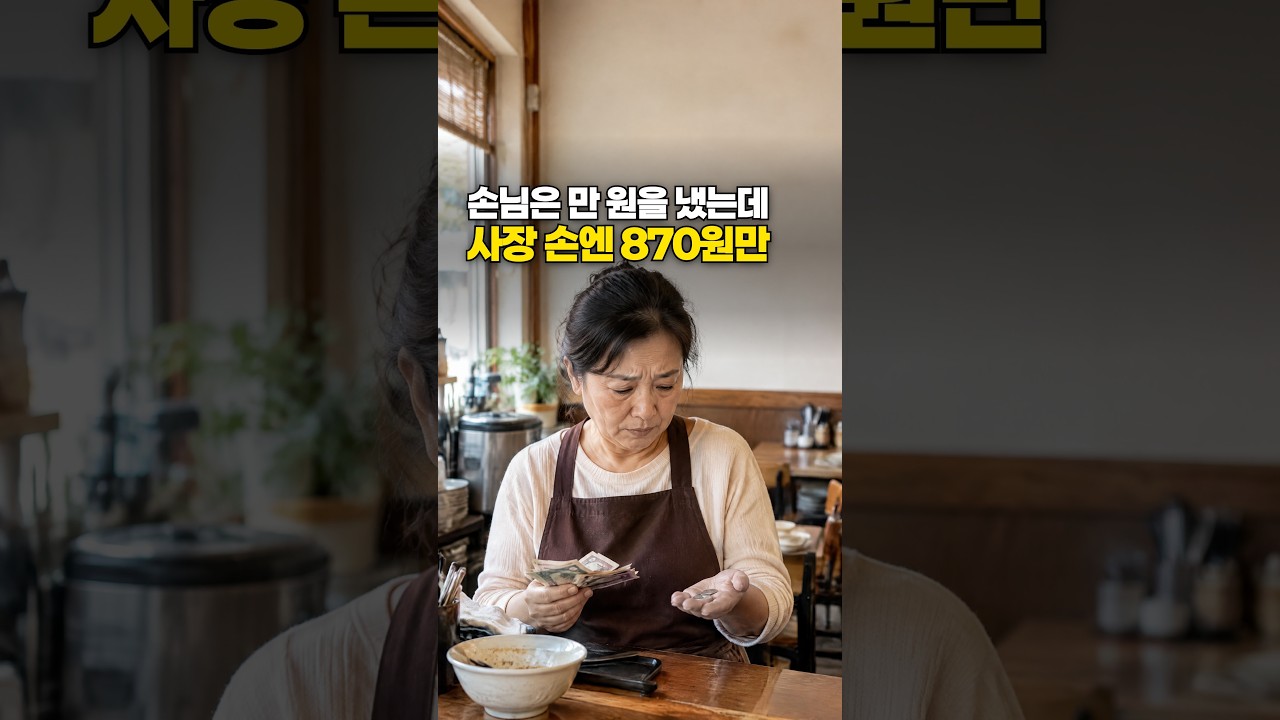
For a KRW 10,000 meal, the owner retains only KRW 870
The key issue is not simply that dining out has become more expensive.
Restaurant sales increased by 41.4% from 2020 to 2024, while operating expenses rose by 46.7% over the same period.
Although higher menu prices lifted revenue on the surface, rising input costs, labor expenses, and rent increased faster, reducing profitability for small business owners.
As a result, operating profit from a KRW 10,000 meal declined from KRW 1,210 in 2020 to KRW 870 in 2024.
This is a representative case of higher dining prices, inflation, weaker consumer demand, and deteriorating profitability in small business operations occurring simultaneously.
1. Key takeaway: menu prices rose, but owner profits fell
Dining-out prices have risen sharply over the past several years.
For consumers, items such as kimbap, soup, cold noodles, set meals, fried chicken, and coffee have become increasingly expensive.
However, higher meal prices do not necessarily translate into higher profits for restaurant owners.
From 2020 to 2024, restaurant sales increased by 41.4%.
Over the same period, operating expenses increased by 46.7%.
In other words, costs rose faster than sales.
This gap explains why many owners say that higher sales still leave little profit.
2. The numbers are clearer: operating margin fell from 12.1% to 8.7%
Restaurant operating margin was 12.1% in 2020.
In practical terms, KRW 10,000 in sales generated about KRW 1,210 in operating profit.
By 2024, operating margin had declined to 8.7%.
Based on the same KRW 10,000 in sales, profit fell to KRW 870.
That implies a reduction of KRW 340 per meal over four years.
In percentage terms, operating margin declined by 3.4 percentage points.
This is not only a statistical change; it means thinner survival margins for small business operators.
3. How is a KRW 10,000 meal allocated?
Assume a customer orders a KRW 10,000 menu item.
In 2020, about KRW 1,210 remained as operating profit.
The remaining KRW 8,790 went to ingredients, wages, rent, electricity, gas, delivery fees, card fees, and other operating costs.
By 2024, the situation had become tighter.
Operating profit from KRW 10,000 in sales was KRW 870.
The remaining KRW 9,130 was absorbed by operating costs.
For customers, meals have become more expensive.
For owners, even after raising prices, retained profit has declined.
| Category | 2020 | 2024 | Change |
|---|---|---|---|
| Restaurant sales | Base | +41.4% | Revenue growth |
| Operating expenses | Base | +46.7% | Costs rose faster |
| Operating margin | 12.1% | 8.7% | -3.4 percentage points |
| Operating profit per KRW 10,000 | KRW 1,210 | KRW 870 | KRW 340 decline |
4. The primary driver is ingredient inflation
The first cost item to examine is food ingredients.
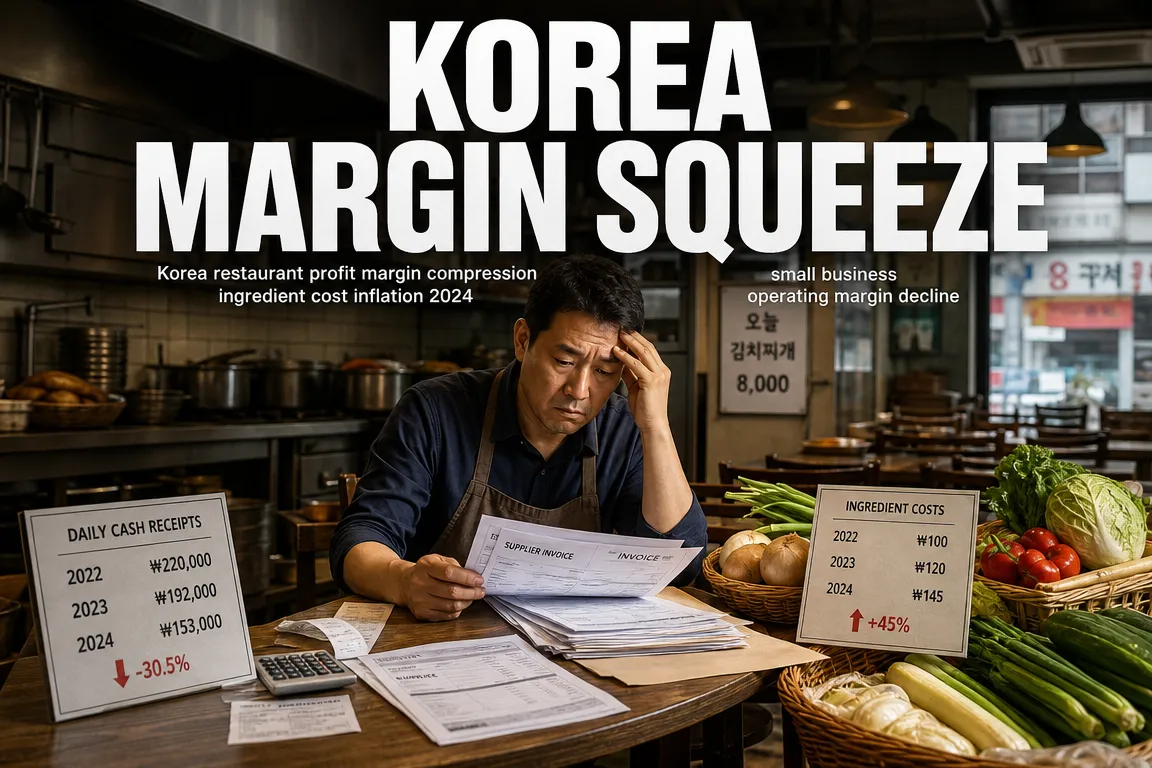
In 2020, ingredients accounted for 36.3% of restaurant sales.
By 2024, that share had risen to 40.7%.
Based on a KRW 10,000 menu item, ingredient cost increased from about KRW 3,630 to KRW 4,070.
That means ingredient expense rose by roughly KRW 440 per meal.
This reflects higher prices across rice, flour, meat, vegetables, cooking oil, eggs, milk, coffee beans, and sauces.
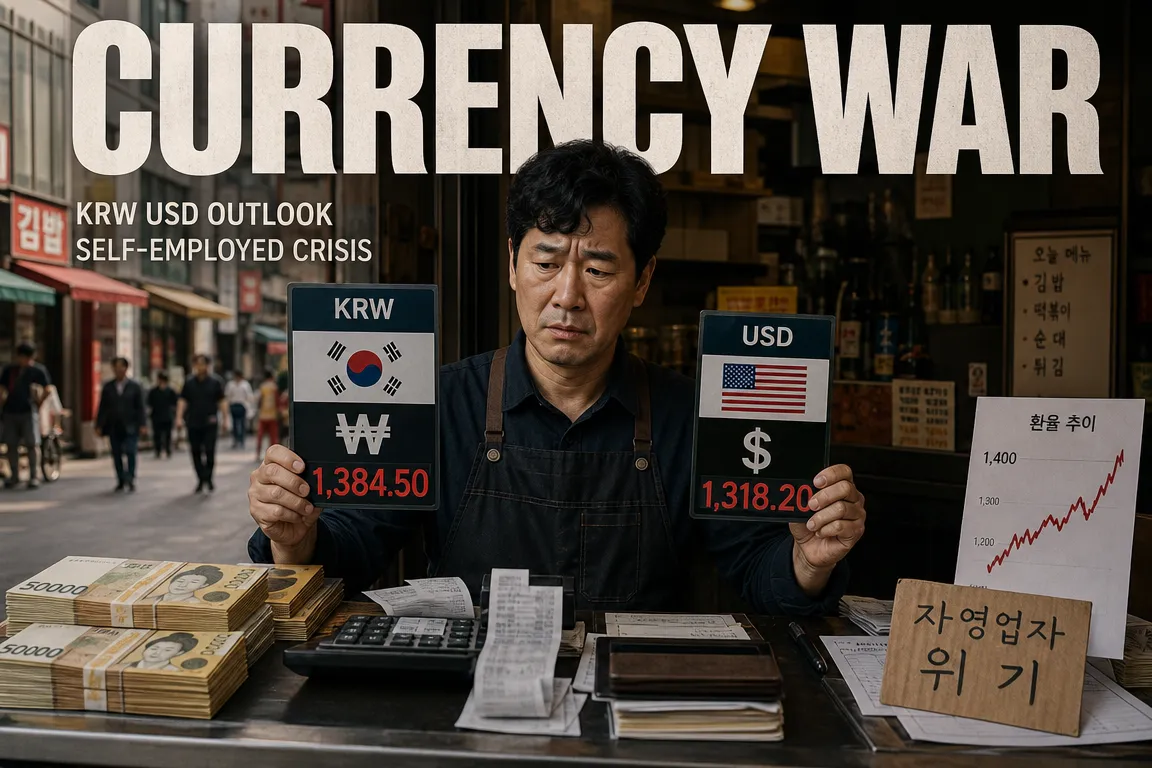
Exchange-rate movements also raise the cost of imported inputs.
Farm commodity prices, global grain prices, energy costs, and logistics costs all affect restaurant margins, leaving owners with limited control.
5. Why price increases do not fully solve the problem
A common question is whether restaurants can simply raise prices further.
In practice, that is difficult.
First, consumer resistance limits pricing power.
When menu prices exceed certain levels, customer traffic tends to decline.
During periods of weaker consumer spending, more customers reduce dining-out frequency or switch to lower-priced alternatives.
Second, competition constrains pricing.
If one restaurant raises prices too quickly relative to nearby competitors, customers may shift elsewhere.
Third, fixed costs such as delivery-platform fees and card fees reduce flexibility.
Even when sales increase, fees, packaging costs, labor, and utilities may rise as well, limiting profit expansion.
Price increases are necessary, but they cannot offset cost pressure on their own.
6. Sales growth and profit growth are not the same
The most important point is that sales and profit are fundamentally different.
At first glance, 41.4% sales growth suggests stronger business performance.
However, if operating expenses rise by 46.7%, the picture changes.
When costs increase faster than sales, operating margin declines.
The same logic applies to corporate earnings analysis.
High revenue growth does not guarantee stronger profitability if cost ratios rise and expense control weakens.
In the restaurant sector, this effect is more visible because ingredient costs rise daily, labor costs recur monthly, and rent must be paid even when business conditions weaken.
7. Declining small-business profitability is a structural issue, not only an individual one
Lower profits should not be interpreted simply as poor management by owners.
The current deterioration in restaurant profitability is the result of inflation combined with structural cost increases.
When ingredient costs rise, menu prices need to follow.
But higher menu prices reduce demand as consumers become more price-sensitive.
As demand weakens, restaurants may rely more on discounts, delivery, set menus, and promotions to maintain sales.
That can increase working hours while reducing actual retained income.
In other words, higher dining prices do not create a direct conflict between consumers and owners.
Consumers face higher costs, while owners face lower margins.
8. The most important point often missed in coverage
The key issue is not price inflation, but margin compression.
Most coverage focuses on how much dining prices have increased.
More important is the fact that profits declined even as prices rose.
This indicates weaker overall resilience in the restaurant sector.
Another important point is that KRW 870 in operating profit is not necessarily the owner’s final take-home income.
Operating profit excludes interest expense, taxes, equipment replacement, renovation costs, closure risk, and the owner’s own labor input.
Under a high-rate environment, debt-financed operators face additional pressure.
Sales may rise while cash flow weakens.
That is one of the most overlooked aspects of the current restaurant downturn.
9. What will matter more for restaurants going forward
Restaurants are likely to face a more difficult operating environment in which taste alone is no longer sufficient.
Cost control, menu simplification, inventory management, labor allocation, and lower reliance on delivery may become core competitive factors.
AI and data-driven tools are also likely to become more important in restaurant operations.
For example, sales data can be used to distinguish high-volume items from high-margin items.
Demand can be forecast by day and time to reduce waste.
Kiosks, reservation systems, automated ordering, and store management software may help lower labor and operating costs.
Restaurants are not exempt from the broader digital transformation trend.
In the future, the ability to manage data and control costs may become as important as product quality.
10. What consumers should focus on
For consumers, higher dining prices are a real burden.
However, it is not accurate to assume that restaurants are simply earning excessive profits based on menu prices alone.
The figure of KRW 870 in operating profit per KRW 10,000 meal reflects the current economics of the sector.
Consumers face higher costs and reduce dining-out frequency, while owners raise prices and still see profits shrink.
If this structure continues, low-price restaurants may struggle to maintain quality, and small restaurants may face stronger closure pressure.
By contrast, large franchises and systemized operators may benefit from stronger purchasing power and greater operating efficiency.
This trend could contribute to further polarization in the restaurant industry.
11. Investment and macroeconomic implications
The decline in restaurant profitability is not only a small-business issue; it is linked to broader macroeconomic trends.
If inflation remains elevated, consumers may tighten spending while small business owners continue to face cost pressure.
If consumer demand weakens further, the impact may extend across restaurants, retail, delivery services, and food suppliers.
Conversely, if raw material prices stabilize and interest rates ease, small-business profitability may recover partially.
From an investment perspective, companies that control costs and protect margins may matter more than those that only show revenue growth.
When evaluating restaurant franchises, food distributors, delivery platforms, automation solutions, and AI store-management companies, operating margin should be reviewed alongside sales growth.
This case illustrates how inflation, consumption, small business economics, and technology shifts intersect in the Korean economy.
< Summary >
From 2020 to 2024, restaurant sales increased by 41.4%.
Over the same period, operating expenses rose by 46.7%, outpacing sales growth.
As a result, operating margin declined from 12.1% to 8.7%.
Operating profit per KRW 10,000 meal fell from KRW 1,210 to KRW 870.
The main driver was ingredient inflation, with ingredient cost share rising from 36.3% to 40.7%.
The key issue is not higher prices, but margin compression.
Going forward, cost control, operational efficiency, and AI-based demand forecasting and inventory management are likely to become increasingly important for restaurant survival.
[Related Articles…]
- Inflation, Household Costs, and Consumer Spending Trends
- How Automation Is Reshaping Small Business Operations
*Source: [ 월텍남 – 월스트리트 테크남 ]
– 만 원짜리 한 그릇에서 사장이 갖는 870원