● AI Inflection Point
Siri, Gemini, Claude, and ChatGPT: Who Will Be the First Gateway to the AI Era?
The truly important issue in this shift is not “which AI model is smarter.”
The core point is where the money will flow next, why companies are buying their own AI servers, and why Nvidia, Broadcom, Dell, and Microsoft are being watched again.
In particular, we need to connect private AI, on-device AI, AI agents, data security, GPU investment, model routing, and AI payment infrastructure all at once.
On the surface, it looks like competition between Siri and ChatGPT, but in reality this is a story about the enterprise AI infrastructure market and the AI semiconductor market changing shape.
1. The core of Apple’s Siri AI is not a “conversational assistant,” but a three-stage AI infrastructure
The core of the Siri AI Apple is preparing is not simply “Siri that understands speech better.”
Apple is dividing AI processing into three major stages.
- Stage 1: On-device AI processed inside the iPhone and MacBook
- Stage 2: Private cloud compute directly controlled by Apple
- Stage 3: External cloud integration for more complex tasks
The first stage is processing directly on the iPhone or MacBook.
Data with a lot of personal information, such as photos, texts, emails, and calendars, is structured to stay off the device whenever possible.
This approach is extremely powerful from a privacy standpoint.
The second stage is Apple’s Private Cloud Compute, or PCC.
Tasks that are difficult to handle with on-device AI are processed in data centers managed directly by Apple.
What matters here is that Apple is sending the message, “We will control this thoroughly.”
The third stage uses Google Cloud or external high-performance models for more advanced tasks.
Even in that case, Apple still tries to maintain user experience and security control as much as possible.
This structure can be applied not only to personal AI but also to enterprise AI.
In simple terms, companies will also divide work into “what should be handled on employee laptops,” “what should be handled on internal company AI servers,” and “what should be sent to external cloud AI.”
2. Siri·Gemini vs ChatGPT·Claude: the AI gateway competition has begun
The most important position in the AI market going forward is the AI that users speak to first.
The company that controls this position can connect search, apps, payments, work, documents, reservations, and shopping.
There are currently four major groups of contenders.
- Standalone AI services like ChatGPT and Claude
- Operating-system-based AI like Siri and Gemini
- Browser-integrated AI
- AI inside vertical services like Coupang, Naver, Toss, and delivery apps
Operating-system-based AI has clear advantages.
Siri can see the entire iPhone, and Gemini can see the entire Android environment.
It is highly likely to connect photos, contacts, mail, calendars, location, and app execution permissions.
But as of now, ChatGPT and Claude are ahead in handling complex work.
In particular, flows like Claude Code or ChatGPT’s computer-control features, which directly operate PCs and laptops, are a major turning point.
Already, many developers and professionals are having AI read files, access websites, modify code, and even create reports.
This is not just a chatbot anymore; it is a move toward an enterprise agent.
Ultimately, Siri and Gemini are likely to take the easier tasks.
Examples include email summaries, photo editing, calendar organization, and simple searches.
On the other hand, complex analysis, coding, document writing, strategy building, and work automation are likely to remain strengths of ChatGPT and Claude.
3. The real battleground for enterprise AI is “how safely can company data be entrusted?”
The market for enterprise AI is much bigger than personal AI.
For AI to truly do useful work in a company, it needs access to company documents, emails, meeting notes, approval data, customer information, and project history.
But this is exactly where the security problem arises.
The key issue is whether it is okay to show AI all company data, how far each employee should be allowed to access, and how sensitive information should be blocked.
Going forward, enterprise data will need to be classified rather than simply “stored.”
- C level: confidential information
- S level: sensitive information
- O level: publicly shareable information
For example, a CEO might see C-level data, team leaders might see up to S-level data, and regular employees might only see O-level data.
The interesting thing is that even if AI does not directly reveal higher-level information, it can still offer advice at the level of a hint by using context.
For example, if an employee asks, “Should we handle Project A first?” and the AI knows confidential internal executive discussions, it could respond like this.
“I can’t share the specific reason, but it would be better to review B before A.”
That is what enterprise AI really looks like.
It is not just document search; it is an AI work system that understands permissions and security.
That is why data security engines, permission management, AI governance, and enterprise private AI solutions are likely to become very important.
4. Nvidia builds AI models directly to sell more GPUs
Nvidia is not just a company that sells GPUs.
It is now also building AI models and software ecosystems that run directly on top of GPUs.
The key example mentioned in the source is Nvidia’s Nemotron family of models.
When Nvidia provides good models directly, companies think, “If I buy this GPU, I can run AI right away.”
In other words, Nvidia’s goal is clear.
It wants companies to buy GPU servers instead of increasing headcount.
From a company’s perspective, a GPU is not an expense but a production facility.
Just as factories run 24 hours a day in manufacturing, companies will be able to run GPUs around the clock to handle document writing, code generation, customer support, data analysis, report writing, and decision support.
This trend could make the AI semiconductor market and the data center investment cycle last longer.
So when looking at Nvidia’s stock, the key point is not simply that it has already risen a lot, but how much enterprise private AI demand will grow.
5. The price war triggered by China’s cost-efficient AI models
The biggest variable in the AI market recently is Chinese open-source models.
Models like Qwen, DeepSeek, GLM, and Kimi are rising rapidly and shaking up pricing strategies for U.S. AI companies.
The strength of Chinese AI models is cost efficiency.
If U.S. high-performance models require massive GPU infrastructure, Chinese models can deliver fairly good performance even on relatively smaller equipment.
Paradoxically, this is also a result of U.S. semiconductor sanctions against China.
Because Chinese companies have had difficulty freely using top-tier GPUs, they have developed models by increasing efficiency with fewer resources.
As a result, companies now have more options.
- Use expensive frontier models for extremely difficult problems
- Use low-cost open-source models for daily work and repetitive tasks
- Process sensitive internal data on private AI servers
When AI model prices come down, usage rises.
When usage rises, more GPUs and data center infrastructure are ultimately needed.
In the end, China’s cost-efficient models are not necessarily bad news for Nvidia.
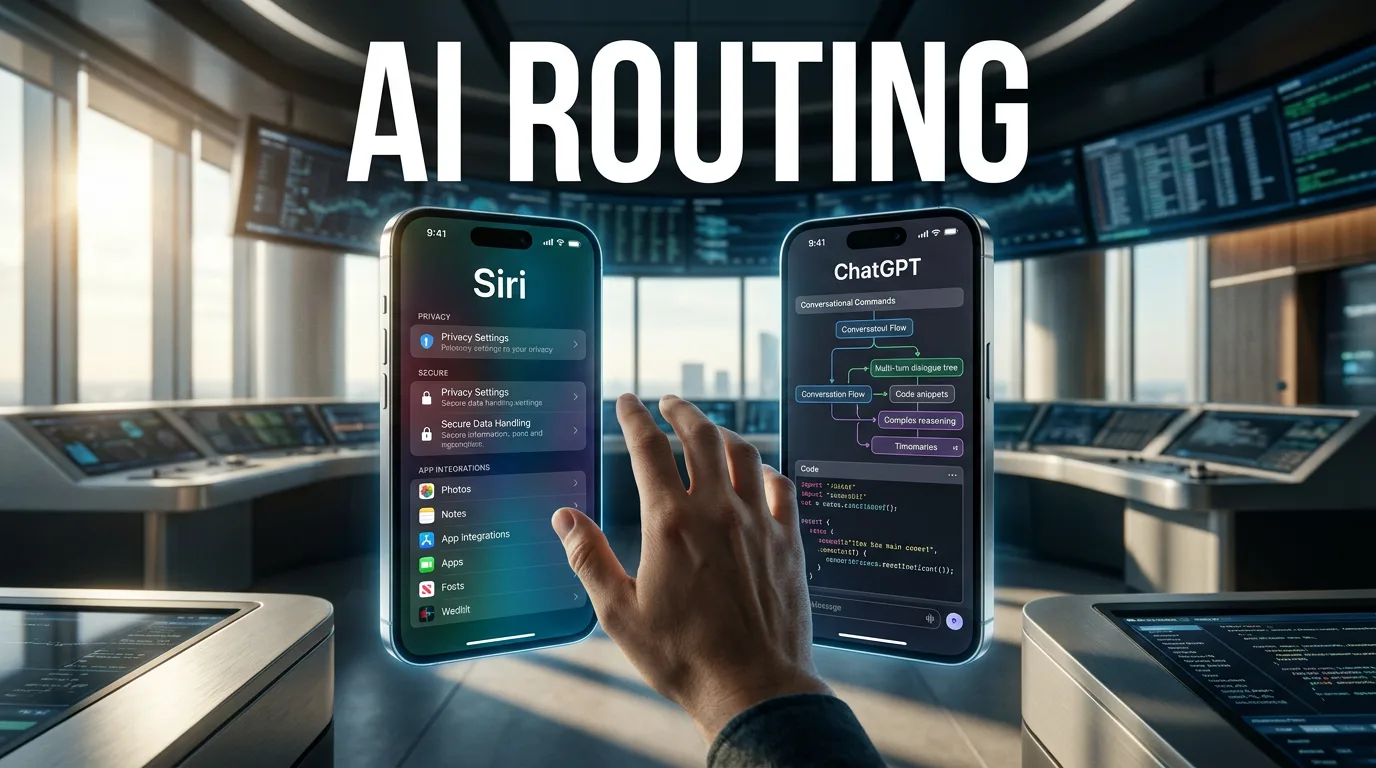
6. “Model routing,” which chooses between cheap and expensive AI, will become a core technology
Going forward, companies will not use just one AI model.
They will automatically choose among multiple models depending on question difficulty, security level, cost, and speed.
This can be thought of as model routing.
Easy questions are assigned to small models, while difficult questions are sent to larger models.
The important thing is that this routing is also getting smarter.
During the day, employees use AI, and at night, GPUs analyze the results on their own.
It is a structure that reviews which questions were sufficiently handled by a small model and which required a large model.
This is similar to how AlphaGo became stronger by playing Go against itself.
Enterprise AI can also move toward a structure where it works during the day and improves itself at night.
The key point here is that using only the most expensive model is not the correct answer.
You do not need Himalaya gear to go to Dobongsan.
For most enterprise work, a reasonably good model plus good data integration is enough to generate a solid ROI.
7. Domestic AI companies are also beginning to turn GPUs into revenue
The domestic companies highlighted in the source are Alice Group and Vessel AI.
Alice Group has grown in the AI education and practical training infrastructure space.
Vessel AI is a company drawing attention in the LLMOps area, helping with LLM operation, management, and deployment.
The important change is that GPUs are becoming revenue assets rather than just research equipment.
If governments or large enterprises secure large-scale GPUs and operate LLM API services based on them, they need specialized operations capabilities.
Securing 1,000 GPUs does not automatically create money.
Models need to be deployed on top of them, served through APIs, cost-optimized, and operated without outages.
LLMOps companies can benefit in this area.
In other words, the AI infrastructure market is not just about Nvidia; it also includes operational companies that connect GPUs to actual services and revenue.
8. A时代 is coming when ordinary companies become “token factories”
Going forward, companies will not be just consumers of AI; they will become organizations that both produce and consume tokens internally.
Employees ask AI questions, AI reads documents, creates reports, and handles customer support, causing internal token usage to surge.
Right now, many companies use external APIs.
But as usage grows, costs become a burden.
At the same time, continuously sending company data to external clouds is also a burden.
That is why companies above a certain size begin to consider their own AI servers.
They may start with equipment worth tens of millions of won, and later scale to hundreds of millions or even billions of won.
This is the essence of private AI.
The structure is to build AI servers inside the company, process sensitive data internally, and call external advanced models only when absolutely necessary.
9. The Big Tech landscape could be shaken again because of private AI
Until now, the main beneficiaries of AI infrastructure have largely been cloud companies like Microsoft, Amazon, and Google.
But if companies start building their own AI servers, the benefit structure changes.
The biggest beneficiary is still likely to be Nvidia.
That is because as private AI spreads, companies will need to buy GPUs directly.
The next companies to watch are infrastructure firms like Broadcom and Dell.
Broadcom has strengths in networking, custom chips, and data center infrastructure.
Dell is strong in enterprise servers and the hardware supply chain.
Microsoft remains strong as well.
Companies find it difficult to give up Word, Excel, PowerPoint, Outlook, and Teams.
Microsoft 365 Copilot and enterprise AI solutions are also likely to remain relevant in the private AI era.
By contrast, Amazon is a cloud-centric company, so as private AI grows, it may face relatively more pressure in terms of growth rate.
Of course, AWS remains powerful, but in the “companies buying GPUs directly” trend, Nvidia, Broadcom, and Dell may receive the more direct benefits.
10. What matters in the Stripe and OpenRouter trend is “AI payment security”
Once AI agents start doing work instead of people, payment issues inevitably arise.
AI may one day book flights, reserve hotels, subscribe to SaaS, and pay for business tools.
But handing over my credit card directly to AI is unsettling.
That is why payment security and authentication infrastructure become important.
This is why payment companies like Stripe matter.
Even if AI carries out the payment, there still needs to be infrastructure that ultimately determines whether “this payment is legitimate,” “this is not fraud,” and “this is an authorized payment.”
In the era of AI agents, payment companies can become gateways to the AI economy rather than just simple payment processors.
This is also a fairly important point for the global economic outlook.
That is because if AI automates consumption and payments, the growth direction of the digital payments market could also change.
11. The most important thing that other YouTube channels or news outlets do not talk about enough
Most news stories say things like, “ChatGPT is good,” “Siri is late,” or “Nvidia is rising.”
But the real important issue is that money in the AI industry is shifting from models to infrastructure and operations.
First, companies will eventually have to think about building their own AI servers.
The more AI they use, the larger the API costs become, and the greater the security risks become.
Second, the core competitiveness of AI is not a single model but the whole system.
Models, data, permission management, security, routing, payments, operations, and evaluation all have to work together.
Third, low-cost Chinese models are not a threat to Nvidia; they can actually increase GPU demand.
When AI becomes cheaper, it gets used more, and when it gets used more, more GPUs are needed.
Fourth, a company’s AI transition is not just the adoption of a productivity tool.
It is a change that alters organizational structure, data management, security systems, workforce allocation, and investment strategy.
Fifth, the winner in the future is likely to be not “the smartest AI model,” but “the company that controls the entire infrastructure that lets AI work safely.”
12. Company groups to watch from an investment perspective
From an investment perspective, the AI ecosystem should be viewed by layers.
- AI models: OpenAI, Anthropic, Google, and Chinese open-source model groups
- AI semiconductors: Nvidia, AMD, Broadcom, and custom ASIC companies
- Servers and hardware: Dell, Supermicro, HPE, and others
- Cloud: Microsoft, Amazon, and Google
- Data center infrastructure: networking, storage, cooling, and power companies
- Enterprise AI operations: LLMOps, security, and data governance companies
- AI payments: payment infrastructure companies like Stripe
The most direct beneficiary here is Nvidia.
That said, rather than looking only at Nvidia, it is more complete to also consider Broadcom, Dell, and data center infrastructure companies.
Microsoft has a strong enterprise software base, so it can also benefit in the private AI era.
Amazon remains large because of its cloud focus, but its growth direction needs to be examined more carefully.
Ultimately, AI investment strategy is shifting from “who builds the best model?” to “who captures enterprise AI spending?”
13. What enterprise practitioners should prepare for now
From the perspective of enterprise practitioners, there are three things to prepare for right away.
- Organize company data into a structure that AI can read
- Create a security classification system that separates sensitive information from public information
- Set a routing strategy for which AI model to use for each task
The gap between companies that use AI well and those that do not is likely to widen.
Simply handing out ChatGPT accounts is not enough.
AI must actually be made to work inside the company’s operational systems.
Going forward, one employee may work alongside multiple AI agents.
On the other hand, companies that fail to adopt AI properly may remain stuck in the old way of sending emails, holding meetings, and organizing spreadsheets person to person.
AI transformation is no longer optional; it is becoming the basic premise of corporate productivity.
< Summary >
The core point of AI competition is not chatbot performance, but who controls the gateway to AI.
Apple is building a three-stage structure that connects on-device AI, private cloud, and external cloud.
ChatGPT and Claude are strong in complex work-oriented AI, while Siri and Gemini are likely to be strong in easier device-based tasks.
The core of enterprise AI is private AI and a security classification system that can safely handle company data.
China’s cost-efficient AI models are creating a price war, and this can actually increase GPU demand.
Nvidia, Broadcom, Dell, and Microsoft can be viewed as major beneficiaries in the private AI era.
Going forward, companies are likely to become token factories that operate their own GPUs and AI servers rather than just consumers of AI.
[Related Articles…]
- How private AI is changing enterprise data center strategy
- The next growth cycle in Nvidia and the AI semiconductor market
*Source: [ 티타임즈TV ]
– 시리, 제미나이, 클로드, 챗GPT 누가 AI의 관문이 될까? (박종천 지란지교소프트 CAIO)