● AI Gold Rush, Power Crunch, SoftBank Dumps Nvidia
Navious-Meta $3 Billion, Softbank’s Full Exit from Nvidia, and CoreWeave Guidance Downgrade: November 11 Global AI and Stock Market Key Summary
Today’s post contains the real bottleneck in the AI semiconductor supply chain, the time lag between neocloud contracts and actual revenue, the strategic shift signified by Softbank’s full exit from Nvidia, and what the CoreWeave guidance downgrade implies for the 2025 AI infrastructure timeline.
It organizes the trends of the US stock market and Nasdaq, interest rate and inflation factors, gold price hedging points, and even the consumer sentiment for Veterans Day in a connected overview.
[News Briefing] Today’s Global Market and AI Headlines
The Nasdaq and S&P 500 closed slightly lower amid a pullback in tech stocks.
Nvidia turned lower, leading to profit-taking across semiconductor stocks.
According to broadcast reports, Softbank sold all its Nvidia shares in October, which is interpreted as a move to secure funds for large-scale AI investments (portfolio rebalancing and capital acquisition).
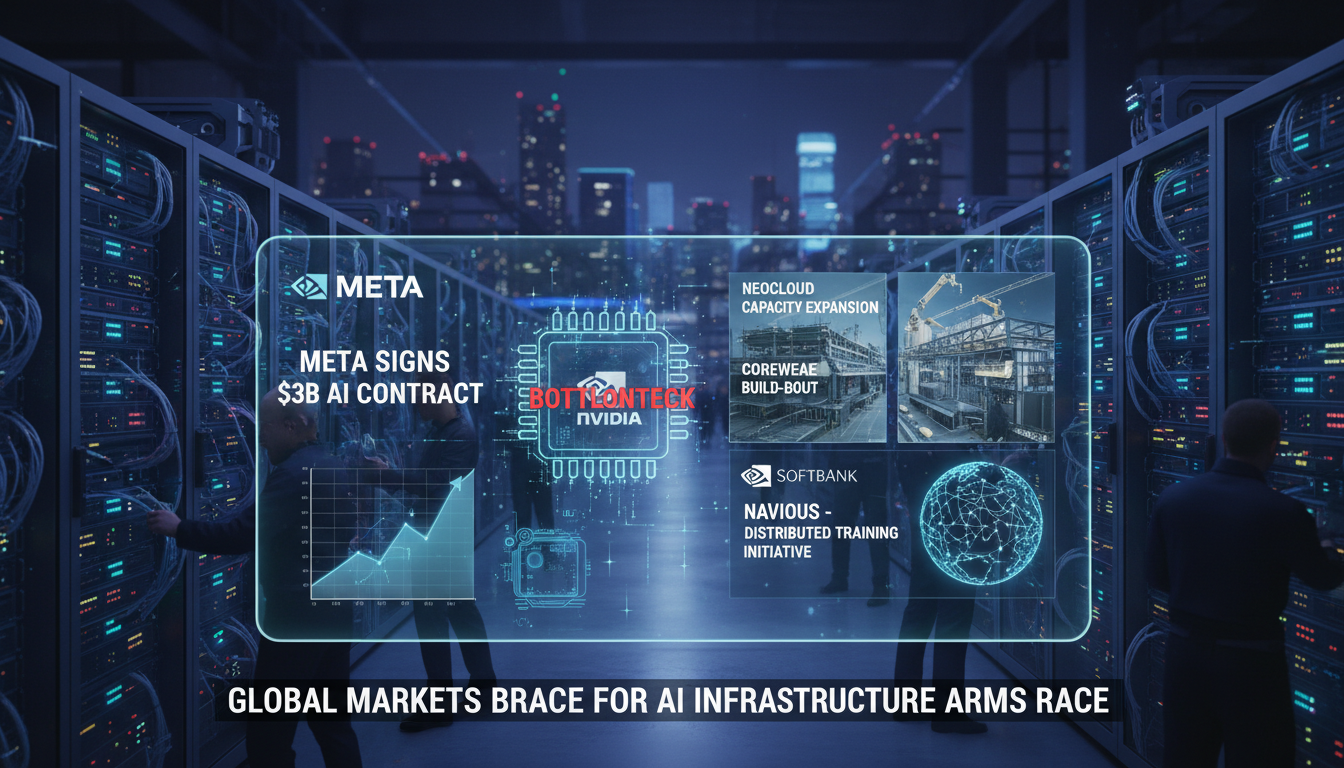
Navious announced a $3 billion supply contract with Meta, displaying strength in the pre-market.
CoreWeave, despite strong revenue growth, lowered its guidance citing delays in data center construction, leading to downward revisions in target price reports.
Navious-Meta $3 Billion Contract: The Role and Risks of ‘Neocloud’
Key Summary.
- Neocloud refers to the new generation infrastructure providers specialized in GPU-based AI workloads.
- Companies like CoreWeave and Navious secure and procure Nvidia GPUs to supply hyperscalers such as Meta, Microsoft, and Amazon.
- In the AI semiconductor market, where supply is lagging behind demand, their ability to “allocate GPUs” is a competitive asset.
Details.
- Navious has demonstrated significant growth year-over-year, consecutively securing major contracts.
- However, a contract does not mean immediate revenue. It takes time for installation, as well as for rack, power, networking, and software integration to be completed.
- The pre-procurement structure of GPUs increases inventory, working capital, and cash flow burdens, raising the possibility of quarterly losses due to expanded capital expenditures.
- In conclusion, it is essential to separate “the headline contract’s impact on stock momentum” from “the timing of cash flow and revenue recognition.”
Main Points to Convey.
- Until the first half of 2025, physical infrastructure (power, cooling, optical modules, switches) bottlenecks will determine the pace of revenue recognition.
- Interpret stock momentum based on contract headlines and assess performance levels based on the completion and power connection of the infrastructure.
CoreWeave: What “Strong Quarter, Lowered Guidance” Indicates
Key Summary.
- CoreWeave confirmed its strength with triple-digit growth year-over-year, but lowered its guidance due to delays in data center construction and issues with power and equipment lead times.
- The stock may face short-term shocks, yet it continues to show significant annual growth.
Details.
- Bottleneck 1: Power connection and substation facilities. Large GPU clusters require power in the megawatt range.
- Bottleneck 2: Networking, optical modules, switches. Cluster efficiency is determined by network topology.
- Bottleneck 3: Cooling and rack density. High-density racks cannot perform without investments in liquid cooling and thermal management.
- Result: More projects might have their revenue recognition pushed to after the second half of 2025.
Main Points to Convey.
- “Contracts accumulate, and revenue follows.” The period from 2024 to 2025 will be about demand verification, while 2025 to 2026 will mark the phase of full revenue recognition and efficiency improvements.
- Check the timing when the “deal turns into cash” in the sequence: hardware delivery → data center completion → power connection → AI software optimization.
Softbank’s Full Exit from Nvidia: A Signal of ‘Governance Restructuring’ Rather Than Profit-Taking
Key Summary.
- Reports indicate that Softbank sold all its Nvidia shares, aiming to strengthen its vertically integrated positioning focusing on direct involvement in AI infrastructure and design sectors (ARM, Ampere, etc.).
- As the differentiation of “training with Nvidia, inference with ARM or dedicated chips” accelerates, the heavyweight of the ARM camp grows.
Details.
- This move aligns with Chairman Masayoshi Son’s consistent message that “not investing is a bigger risk.”
- Rather than passively holding, Softbank is interpreted to have returned to an active strategy of “owning” core assets of the ecosystem (design, IP, specialized chips, and infrastructure).
- Although debates over the AI bubble continue, Softbank’s move is closer to “securing control of the value chain” rather than “avoiding a bubble.”
Main Points to Convey.
- By 2026, as the distinction between training and inference becomes more pronounced, the Nvidia-dominated structure may persist, but ARM-based CPUs and dedicated accelerators will more aggressively penetrate the “inference TAM (Total Addressable Market).”
- This trend is accelerated by the hyperscalers’ pressure on total cost of ownership (TCO), the inflation and interest rate environment, and rising power costs.
The Real Bottleneck of the AI Cycle: Not the GPU, but ‘Power, Networking, and Cash Flow’
Key Summary.
- The tangible bottleneck of the AI semiconductor cycle from 2024 to 2025 is no longer just about securing GPUs.
- It is about power capacity, transformers and switching, optical modules, liquid cooling, network topology, and the working capital needed to support pre-procurement.
Main Points to Convey.
- Short-term investment points include HBM3E, high-bandwidth memory, 800G/1.6T optical modules, Ethernet/InfiniBand switches, liquid cooling solutions, and data center power infrastructure.
- Operational indicators for confirming performance include “data center completion rates, power contract signings, rack density, and reduced delivery lead times.”
Gold Prices and Portfolio Hedging: Balancing in an AI Volatility Era
Key Summary.
- As the AI investment cycle grows, sensitivity to macro factors also increases.
- Gold moves in tandem with inflation expectations, real interest rates, strength or weakness of the dollar, and net central bank purchases.
Main Points to Convey.
- Even with a strong stock market, steady gold indicates that “growth betting and hedging against geopolitical/policy risks” are functioning simultaneously.
- In the portfolio, balance the percentage of US growth stocks with gold and cash-equivalent assets by dynamically adjusting according to the volatility index (VIX) and interest rate trends.
Veterans Day: Consumer Benefits and Defense Sentiment
Key Summary.
- In the US, on Veterans Day, Starbucks, Krispy Kreme, Chipotle, Applebee’s, and others provide free or discounted offers to military personnel and their spouses.
- The “Thank you for your service” campaign is carried out extensively, and defense companies are also strengthening their corporate social responsibility messages.
Main Points to Convey.
- Consumer sentiment is positive on a micro level in dining and retail channels, while on a macro level it reminds one of the consistent fiscal stance on defense and security spending.
- Demand for defense and security tends to sustain irrespective of economic cycles, serving as a portfolio anchor during times of volatility.
Other Key Points Often Overlooked
- The “GPU pre-procurement – bill later” model in neocloud means that cash flow risks come before the headline contracts.
- Data center revenue recognition is determined not by “GPU arrival” but by the “completion of power connection, networking, and optimization.”
- Softbank’s full exit is less about profit-taking and more about fostering an inference ecosystem based on ARM and Ampere, which implies securing a divergent position rather than engaging in a direct face-off with Nvidia.
- 2025 will be a year marked less by resolving delays and more by “redistributing bottlenecks”; when power and networking bottlenecks clear, software optimizations, schedulers, and foundation model cost structures will become the next hurdles.
- The trajectory of interest rates and inflation will dictate the pace of AI CapEx, and if expectations for falling rates diminish, the capital costs for the hardware pre-procurement model could rise sharply.
Investment Checklist and Schedule
- Checklist.
- Updates on hyperscaler CapEx guidance and news on power contracts.
- Lead times for HBM3E, 800G/1.6T optical modules, and switches.
- The remaining backlog of neocloud contracts and the required working capital.
- Comments in Nvidia’s earnings/guidance on the split between training vs. inference.
- Interest rate trends (FOMC minutes, CPI/PPI) and sensitivity of valuations for AI growth stocks.
- Schedule.
- Year-end CapEx updates from big tech.
- US CPI and PPI announcements, FOMC statements.
- Expansion and power connection notices from major neocloud/data center operators.
Positioning Ideas (Principle-Based)
- Short-term.
- React to news momentum (major contracts, power supply contract signings) while gradually entering positions to discount the risks of guidance and cash flow.
- Medium-term.
- Create a basket including AI semiconductors (memory, HBM, optical modules, switches), power/cooling infrastructure, and inference optimization software.
- Risk Management.
- Monitor risks such as rising interest rates/inflation, prolonged power bottlenecks, speed of accelerator generation shifts, and regulatory variables (data center environment and power regulations).
- Adjust the proportions of gold and cash equivalents flexibly in response to market volatility.
- The Navious-Meta $3 billion contract has significant momentum, but revenue recognition will only kick in once the infrastructure is ready.
- CoreWeave’s guidance downgrade signals that power, networking, cooling, and lead time bottlenecks remain significant.
- Softbank’s full exit from Nvidia is interpreted as a move toward strengthening a vertical integration strategy centered on the inference ecosystem and design/IP, rather than simply taking profits.
- In the midst of AI cycle volatility, interest rates, inflation, and gold prices serve as critical balancing factors.
- Veterans Day stimulates both consumer sentiment and defense sentiment concurrently.
[Related Articles…]
- Nvidia: Entering the Second Act of the AI Cycle – At the Intersection of Training Dominance and Inference Differentiation
- The Rise of Neocloud: Mapping the 2025 AI Infrastructure through a Comparison of CoreWeave and Navious
*Source: [ Maeil Business Newspaper ]
– 네비우스, 메타와 30억달러 계약 체결ㅣ코어위브 강력 매출에도 목표가 하향ㅣ11월11일 미국 군인은 커피무료ㅣ홍키자의 매일뉴욕