● China humanoid robots hit the streets, police patrols, brutal kick demo, rental boom, 2026 tipping point
Chinese ‘Humanoid Robots’ Have Now Entered Real “Human Living Spaces”: From Police Patrolling to Impact Demonstrations and Rental Platforms (2026 as the Turning Point)
Today’s article contains exactly 4 core points.
1) The significance of humanoid robot T800 walking “naturally” next to the police on public roads in Shenzhen, China
2) The reason for showcasing a scene where the company CEO is actually kicked: not a show of technology but a ‘market/policy signal’
3) Insights from the Unitree G1 motion capture accident showing the ‘precision risks’ (not a malfunction but normal operation)
4) China’s diffusion model of offering robots as “rentals” instead of “purchases” (a catalyst for popularization in 2026)
1) [Breaking News] T800 Walking Next to Police in Shenzhen Streets: Transition to the “Deployment” Phase
What Happened
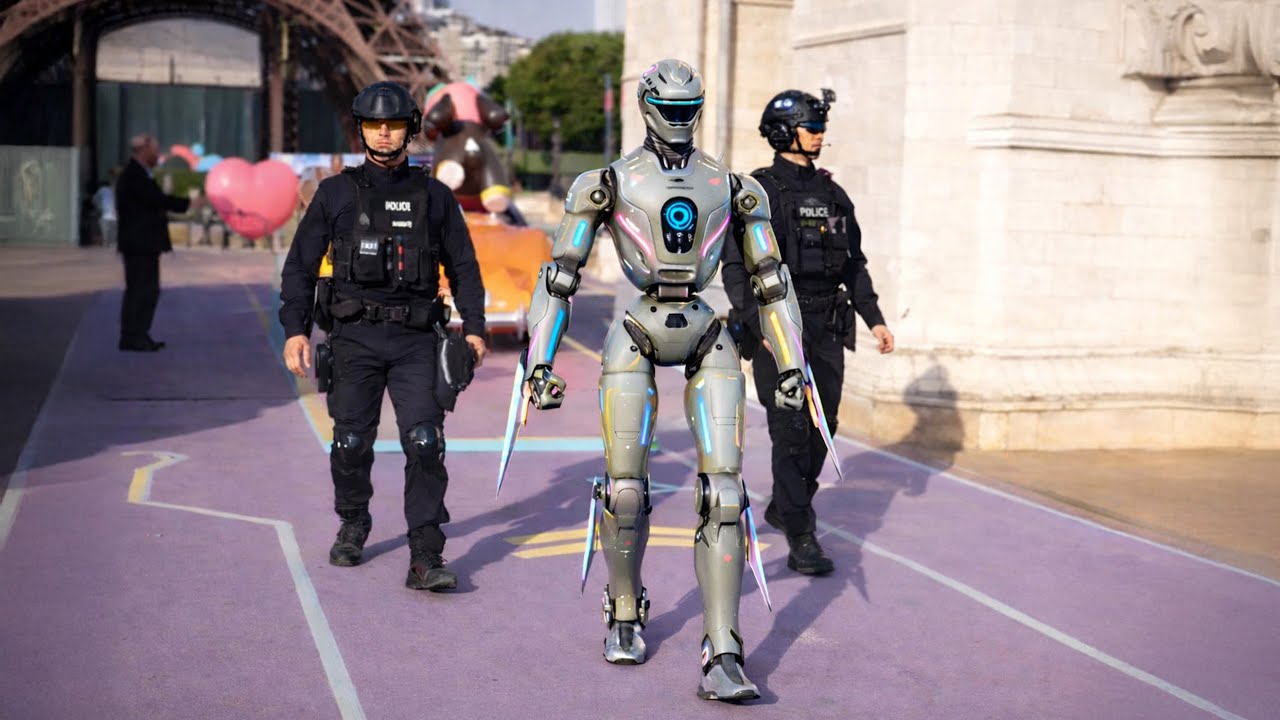
A viral video shows a humanoid robot walking in step next to police (depicted as a special unit) on public roads in Shenzhen, China.
The creepy point is that it doesn’t feel like an ‘event/exhibition,’ but rather just “an ordinary scene”.
Why This Is Important
The essence of a humanoid is its ability to operate in “spaces made for humans” (stairs, sidewalks, crowds, entrances, corridors).
If it enters areas inaccessible to wheeled robots, the applicable industries increase dramatically.
So, this scene can be interpreted as a signal that ‘real-world deployment’ has begun in China, not just a simple promotion.
Market Perspective (Natural SEO Keyword Inclusion)
This trend is likely to align with China’s AI semiconductor investment, the robotic manufacturing supply chain, and the reorganization of the global supply chain.
Especially where labor costs and productivity pressures are high, the scenario of “robot CAPEX (capital expenditure) → operational cost reduction” is strongly activated.
2) [Core Scene] Demonstration of T800 Actually Kicking the CEO: Targeting “Regulation and Demand Market” Rather Than Technology
Which Video Was It
The CEO of Engine AI was shown wearing protective gear and being kicked in the abdomen by a robot, causing him to fall.
It’s something to chuckle at lightly, but the message is very direct.
“This robot can exert real physical force upon command.”
Why The Company Would Reveal This
Most companies opt for a ‘safe and cute’ image, but this one went the opposite way.
This seems to serve three purposes.
1) Targeting Procurement/Contract Market
Areas like security, enforcement, and disaster response directly factor in “strength” and “subduing ability” in purchasing decisions.
Thus, it’s a clear specification for B2G/B2B (public and corporate) demand markets.
2) Ending the ‘CG or Not’ Debate
When the debate over “Is it computer graphics?” arises online, the spread continues, but trust falters.
By adding physical human interaction, the debate ends.
3) Seizing Regulatory Framework
Now, robot regulation will focus not only on “privacy” but on “physical safety.”
By initially setting forth strong scenes, the company increases its chances to be involved in ‘standard-making’ when regulations emerge.
3) [Viral Analysis] Unitree G1 Motion Capture Accident: Not a Malfunction But “Risk of Normal Operation”
What Happened
During a demonstration of kick movements by an operator wearing a motion capture suit, the robot mirrored the action, causing the operator himself to get hit and fall.
Why This Is More Fearful
Many think it was a “malfunction,” but it’s quite the opposite.
The robot was precise, with almost no delay, and carried out its instructions faithfully.
The essence of danger isn’t that the ‘machine is dumb,’ but that precise compliance amplifies small human errors.
Risk Form Emerging as Humanoids Enter Public Spaces
The smarter the robot becomes, the risk manifests not as “rampage” but as “precise execution.”
Hence, future debates may shift to:
– From what robots ‘can do’ to what robots ‘are allowed to do’.
– From performance metrics to liability issues (operators/manufacturers/platforms/data) and insurance.
4) [Trend] Spreading Through ‘Rental’ Not ‘Purchase’: The Real Intriguing Part of China’s Robot Diffusion
What Happened
Chinese Agibot operates a ‘humanoid robot rental platform’ (referred to as Ching and Rent).
They rent out robots by the day for weddings, exhibitions, corporate events, and concerts, including transport and on-site technical support.
Pricing (Based on Original Source)
– (Dance/Performance Focus) Unitree U2: About $690/day
– Robot Dog (Unitree Go2 Air): About $138/day
– Agibot Yuanzhong A2: About $1,380/day
Why Rental Is the ‘Expansion Engine’
The core barrier to early humanoid expansion isn’t “price” but “operational complexity (setup/safety/content/maintenance).”
The rental model allows platforms to solve this instead.
Like the early days of smartphones, once “experience it once” exceeds a critical mass, societal acceptance rises rapidly.
Economic Perspective
This structure is essentially akin to “Uberization of robots.”
When a distribution network flows from the manufacturer to the rental business to events or stores, demand grows at once.
If China’s scale is applied, prices will drop faster, and distribution will increase more quickly.
Connection to Macroeconomics (Natural SEO Keyword Inclusion)
This trend may strengthen the “strategy of enduring through automation” amidst inflationary pressures (service labor costs), expected interest rate cuts prompting investment sentiment, and slowed growth rates in emerging economies competing for productivity.
5) Why 2026 is the Turning Point: ‘Scenario-Based Deployment’ + ‘Mass Exposure’ Comes Simultaneously
Plans Mentioned in the Original Source
Engine AI has secured over $180 million in investment, predicting large-scale deployment and scenario-based testing from 2026.
Why “Scenario-Based” Here is Important
Labs have limited variables.
However, real environments have infinite factors like humans, obstacles, noise, lighting, crowds, and exceptions.
Scenario-based deployment creates the “operational system” rather than focusing solely on “performance.”
This means standardizing the ‘introduction method (procedures, liability, insurance, safety standards, education)’ instead of just technology.
6) The “Most Important Aspects” Other YouTube/News Often Miss (Core Points from a Blog Perspective)
1) Fear Point is Not ‘Violent Robots’ But ‘Indifferent Normalization’
The fear from seeing a robot walking next to police comes not from the threat, but from how natural it looks.
Society changes more from “the speed of acclimatization” than shocking events.
2) Impact Demonstration is Not Just Technological Bravado But ‘Defining the Buyer’
This is closer to a declaration to capture markets that require ‘physical intervention’ like public safety/security/industrial sites, not the home robot market.
3) Risk Arises Not From AI’s Malice But ‘Accurate Execution’
What the motion capture accident symbolizes is that as robots get smarter, the cost of mistakes rises.
In the future, “safe refusal,” compliance control, and a deadman switch will become key competitive elements, more than “error rate.”
4) Rental Platform is Practically ‘Social Deployment’ Infrastructure
What’s daunting about China is not just their ability to make robots but their ability to “establish distribution systems” that enable widespread adoption.
The rental model simultaneously facilitates data collection (environment/human reactions/operation logs) and content dissemination (viral videos).
5) Post-2026 Competition Moves ‘Beyond Model Performance’ into ‘Operational Standards + Insurance + Liability’
Humanoids may become an industry where “accidents happen” likened to cars.
Thus, the winners might not be just the robot manufacturers, but those capturing safety certification, robot insurance, operating control, and maintenance networks.
7) Observation Points to Monitor Going Forward (Investment/Industry/Policy)
A. Policy and Security Applications Expansion
Once co-policing with robots occurs, the next likely expansion includes “event security,” “access control,” and “high-risk area patrols.”
B. Entertainment/Event Market as the ‘Fastest Expansion Route’
Stages like Techfest are not just simple shows but also real tests in terms of lights, noise, vibration, and crowds.
If stability improves here, transitioning to semi-public spaces like stores, lobbies, and airports becomes easier.
C. Manufacturing Competition is ‘Determined by Parts Supply Chain’
If supply chains of actuators, batteries, joint reducers, sensors, and LiDAR become bottlenecks, the price drop will halt.
China is working to internalize these bottlenecks.
< Summary >
In China, humanoid robots are quickly expanding beyond laboratories to public roads, stages, and event markets.
The police co-patrolling of T800 signals a “real-world deployment,” while the CEO impact demonstration targets the physical intervention market (B2G/B2B).
The Unitree G1 motion capture accident demonstrates that “precise execution” can amplify risks rather than malfunction.
The biggest game-changer is the ‘rental platform,’ lowering the purchase barrier and accelerating societal normalization.
From 2026, as scenario-based deployments become mainstream, the competition will shift from performance to operational standards, safety, liability, and insurance.
[Related Articles…]
- Commercialization of Humanoid Robots: Adoption Speed and Key Variants by Industry
- China’s AI/Robot Supply Chain Strategy: Rapid Price Decline Structure
*Source: [ AI Revolution ]
– China’s Shocking New AI Robot Able To Harm Humans