● Claude Hijacks Mars Rover, 400m Autonomous Dash Sparks Physical AI Boom
Anthropic’s Claude Successfully Pilots NASA Mars Rover ‘Perseverance’: The Opening of the Physical AI Era
Today’s story goes beyond simply saying AI is good at coding; it is a monumental event that will change the history of human space exploration.
Now, Large Language Models (LLMs) have stepped out of the monitor to move robots in the physical world, specifically on Mars, outside of Earth.
In this article, I will pinpoint the core points regarding how Anthropic’s Claude piloted the Mars rover, how it differs from existing methods, and what the real impact will be on the 4th Industrial Revolution and the economy.
After reading this, you will surely feel how close the upcoming world of ‘Physical AI’ truly is.
1. News Briefing: Claude Drives 400m Directly on Mars
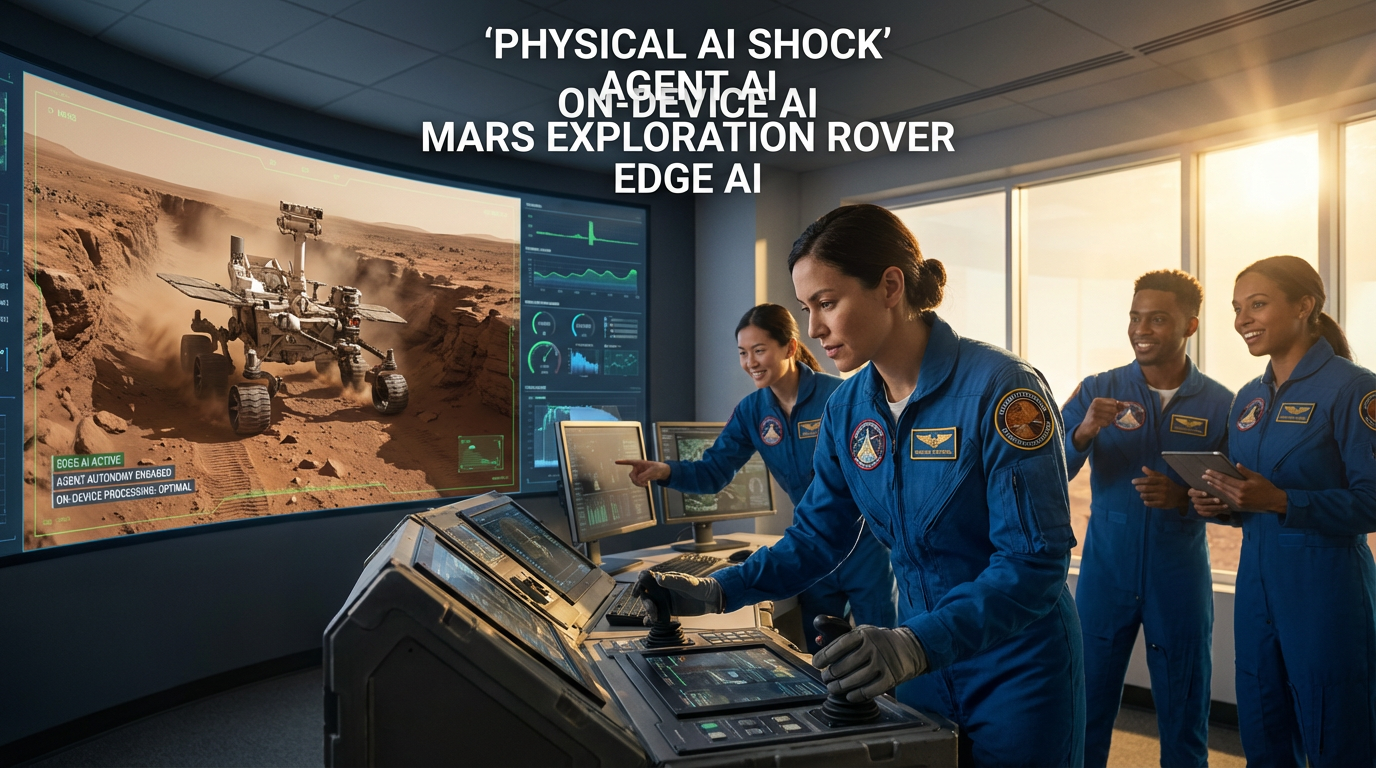
US AI company Anthropic’s ‘Claude’ successfully generated the driving path for NASA’s Mars exploration rover, ‘Perseverance’, and executed the operation.
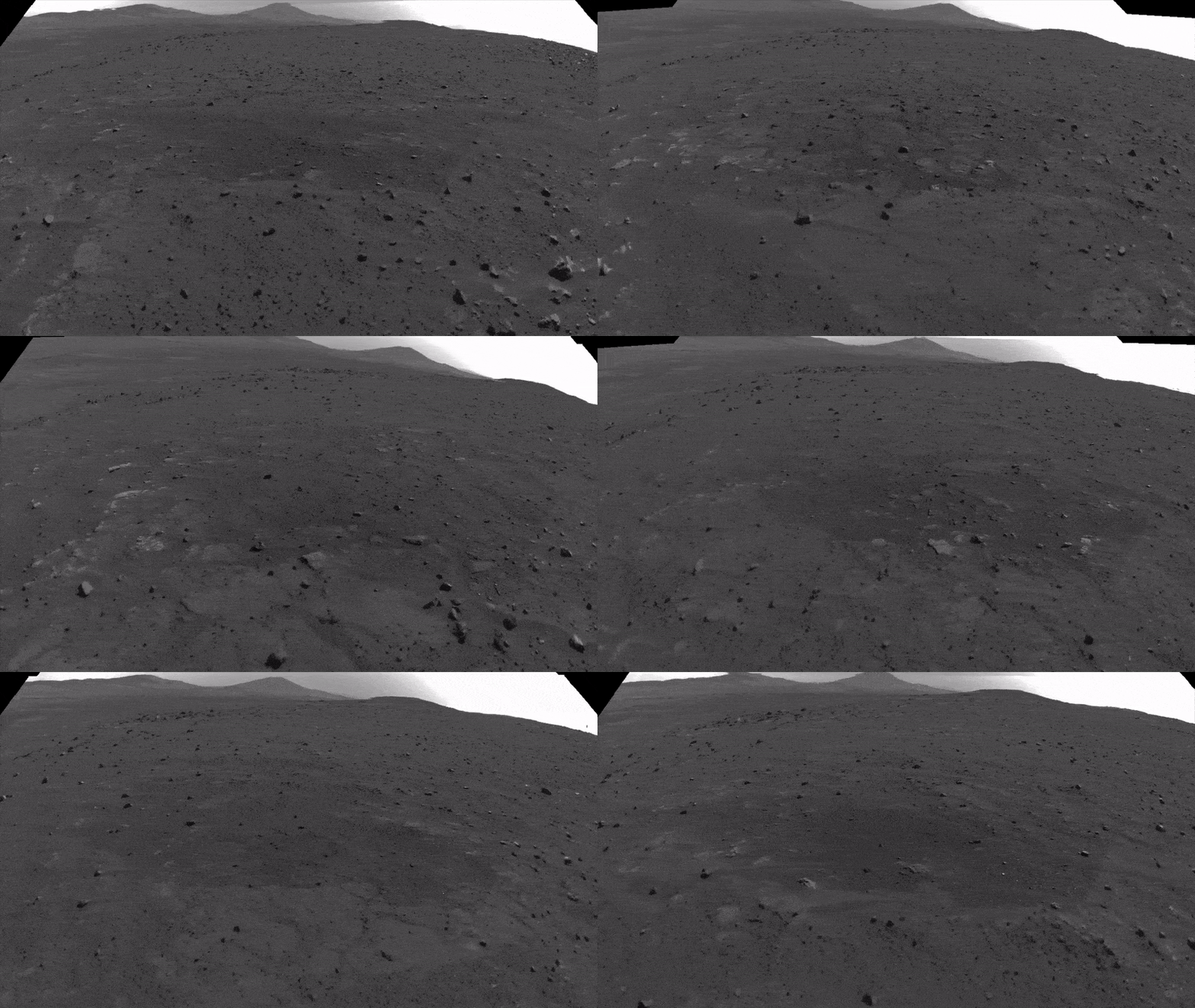
Last December, Claude successfully traversed a section of about 456m of complex rocky terrain on the Martian surface.
This is amazing because Mars has a communication delay of 20 minutes with Earth, making real-time control impossible.
Moreover, it is an extreme environment where a project worth trillions of won can end on the spot if it gets stuck in a sand pit, like the ‘Spirit Rover’ in 2009.
Engineers at NASA’s Jet Propulsion Laboratory (JPL) deployed ‘Claude Code’ this time, tasking the AI to analyze the terrain and plan the path on its own.
The result was a huge success, proving that AI has evolved from simple text generation into a tool for exploring the physical world.
2. Technology Core Points: How Did It Overcome Unexpected Situations on Mars?
The secret to the success of this project lies in its capability as an ‘adaptive coding agent’.
Existing rover systems relied on tens of thousands of rules (Rule-based), such as “avoid if there is a stone larger than 20cm.”
However, the rover would often stop when encountering unfamiliar terrain not covered by the rules.
On the other hand, Claude Code learned from high-resolution photos and terrain data taken by Mars reconnaissance satellites and operated as follows.
1. Situation Awareness and Path Generation:
After identifying risk factors such as bedrock and sand dunes by looking at satellite photos, it instantly writes path codes in 10m units in a language the rover can understand (RML).
2. Self-Error Verification:
It goes through a process of self-reviewing and correcting to see if the code it wrote is executable.
3. Digital Twin Simulation:
The path planned by Claude is tested against more than 500,000 variables through virtual simulation (digital twin) by engineers on Earth before the final upload.
Thanks to this process, the time humans spent manually planning paths was cut in half, allowing the rover to move more frequently and collect more samples.
3. Expert’s Perspective: The Real Meaning Not Mentioned in the News (Insight)
You shouldn’t view this event simply as “AI went to Mars.”
Here, a few core points penetrating the space industry and AI trends are hidden.
First, it demonstrated the ultimate goal of ‘On-Device AI’.
Currently, the code written by Claude is reviewed on Earth and sent, but Anthropic’s final goal is to embed the AI model directly into the rover itself.
Jupiter’s moon Europa or Saturn’s Titan, which are farther than Mars, have even more severe communication delays.
Ultimately, AI needs to make immediate judgments and move on-site, and for this, ultra-lightweight high-performance models are essential.
This foreshadows how fierce the competition for Edge AI technology, to be mounted on smartphones or robots, will become in the future.
Second, ‘Agent AI’ is exploding labor productivity.
The fact that AI reduced the path planning time, which NASA scholars had to cling to, by half represents a tremendous economic effect.
This means that Artificial Intelligence is not replacing humans, but allowing humans to focus on higher-level exploration or research that they couldn’t do due to physical limitations.
In the future, companies will rush to introduce ‘AI Agents’ that perform complex decision-making and coding, going beyond simple task automation.
Third, it is proof of AI reliability in industries where the cost of failure is enormous.
In fields like finance, medicine, and aerospace, where a single mistake is fatal, AI adoption inevitably has to be conservative.
However, this successful drive on Mars has become a strong reference that code generated by LLMs can be sufficiently trusted even in environments with high physical risks.
Due to this, the speed of adopting generative AI is expected to become much faster in fields related to the 4th Industrial Revolution such as autonomous vehicles and smart factories.
< Summary >
- Event: Anthropic’s Claude AI wrote the driving path code for NASA’s Mars rover ‘Perseverance’, successfully driving over 400m.
- Technology: Analyzed satellite data to generate code suitable for the terrain in real-time (RML), overcoming the limitations of existing rule-based systems.
- Achievement: Maximized exploration efficiency by reducing human experts’ path planning time by 50%.
- Outlook: Planned to expand to deep space exploration (Europa, Titan) where communication is difficult by directly mounting AI on rovers in the future.
- Significance: A signal flare announcing the entry into the era of ‘Physical AI’ and ‘Autonomous Agents’, where AI controls the physical world beyond simple information processing.
[Related Articles…]Musk “Starship Carrying Optimus Will Head to Mars at the End of Next Year”Google Integrates ‘Gemini’ into Chrome Browser… Upgrade to AI Browser
*Source: https://www.aitimes.com/news/articleView.html?idxno=206258