● Intel-Explodes, Nasdaq-Surges, AI-Shift-Stuns
Nasdaq Rally, Intel +23%, and Signals of a Generational Rotation in AI Leadership
This move should not be interpreted as a routine “tech stocks up again” session. Multiple drivers converged: debate over Nasdaq overheating, oil-driven disinflation expectations, potential resumption of US-Iran talks, Intel’s earnings surprise, Nvidia nearing record highs, expanded Big Tech AI infrastructure spending, and reduced political uncertainty around the Federal Reserve Chair. The key development is the broadening of AI beneficiaries from GPUs to CPUs, foundry, memory, and power infrastructure. This report summarizes the drivers, why Intel is re-emerging, why markets are responding with FOMO dynamics, and what variables matter most across US equities and the global macro backdrop.
1. Market Snapshot: Tech-Led Strength, Supported by Lower Oil
US equities advanced in a tech-led session. The Nasdaq rose 1.58% and the S&P 500 gained 0.73%, while the Dow fell 0.31%, indicating a rotation toward growth and AI-linked equities rather than cyclicals. The move reflects the combined impact of rates, energy, semiconductors, and AI capex expectations.
Oil was a constructive macro input. WTI fell about 2% and Brent edged lower. Lower oil prices reduce inflation pressure expectations, supporting rate-cut probabilities and easing valuation headwinds for long-duration growth equities. As such, oil weakness functioned as a broad risk-asset tailwind rather than an isolated energy headline.
2. Why Risk Appetite Improved: Three Catalysts Converged
The rally was supported by three concurrent positives:1) renewed expectations for US-Iran negotiations,2) Intel’s upside earnings and guidance,3) reduced political uncertainty around the Federal Reserve Chair.The combination tightened risk spreads and improved near-term sentiment.
2-1. US-Iran Negotiation Expectations: Oil and Risk Assets React
Reports suggested potential contact between US representatives and Iran’s foreign minister in Pakistan. Ongoing diplomatic travel across Pakistan, Oman, and Russia was interpreted as a sign that negotiation pathways remain open. Reduced Middle East tension typically transmits first through oil; lower oil then feeds into softer inflation expectations and supports growth equity performance.
Markets appeared to price a higher probability of dialogue versus escalation. Diplomatic outcomes remain uncertain, but the near-term sentiment impulse was positive.
2-2. Intel Earnings Surprise: The Market Sought Quantitative Evidence of a Turn
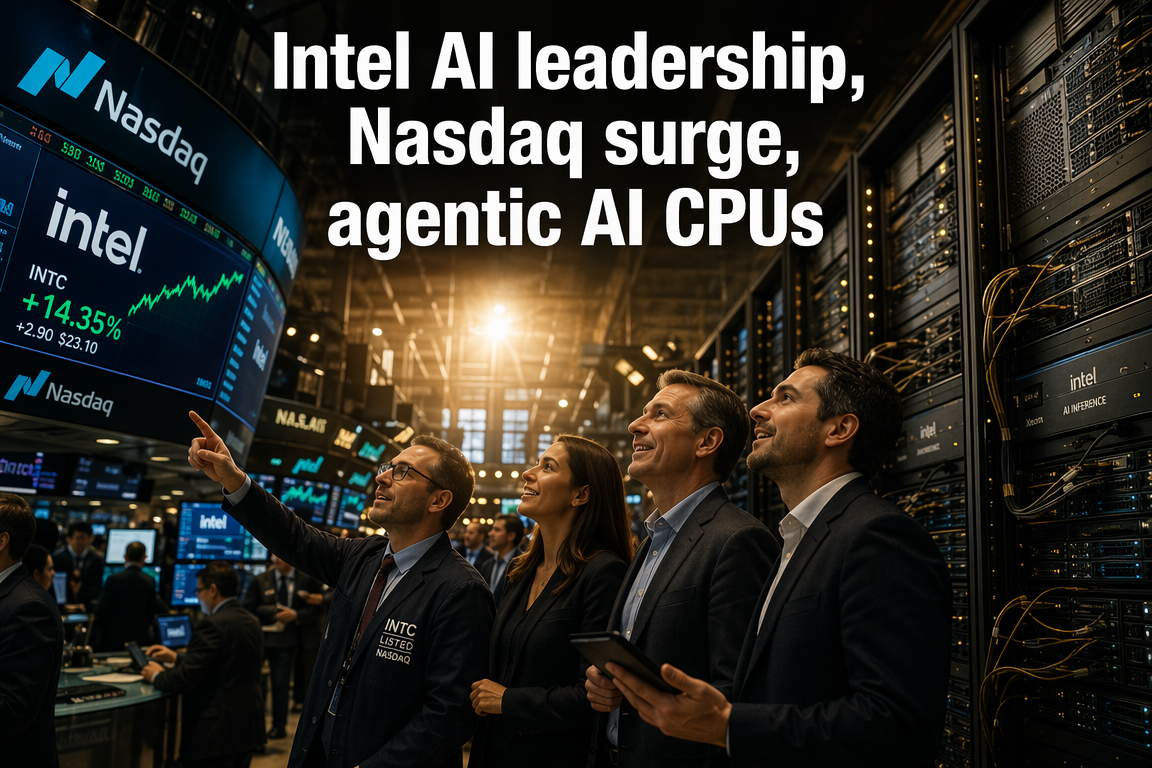
Intel was the session’s focal point, surging 23% post-results. The company delivered better-than-expected earnings and stronger guidance. Notably, results in the foundry segment exceeded expectations, addressing a key area of investor skepticism.
Management stated that demand continues to outpace supply across segments. This implies end-customer pull remains stronger than current capacity. The company also indicated yields were better than internal expectations. In semiconductors, yield improvement is a leading indicator for production stability, cost competitiveness, and potential margin recovery.
3. Why Intel Now: AI Leadership Broadening from GPUs to CPUs
Intel’s move should not be viewed solely as an earnings event. The more relevant context is a shift in AI workload composition. Early generative AI adoption emphasized large-scale parallel compute, where GPUs held a clear advantage, making Nvidia the primary beneficiary.
Market attention is increasingly shifting toward agentic AI: systems that plan multi-step tasks, select tools, manage workflows, and execute complex sequences. As workloads incorporate more orchestration, control logic, and heterogeneous compute, CPU importance can increase alongside GPUs.
This is not a “GPU displacement” thesis; rather, it suggests a more balanced compute stack. Some market commentary has suggested the CPU-to-GPU mix could move meaningfully toward a more even allocation versus prior GPU-heavy configurations. In this framing, Intel’s rebound may signal a broader re-pricing of AI infrastructure beneficiaries.
4. Can Intel Become a Core AI Leader?
It remains premature to conclude a sustained leadership change. However, the move is notable given:
- Intel’s structural position in CPUs,
- early signs of foundry improvement,
- diversification of AI server architectures,
- investor demand for “next-stage” winners beyond the current GPU-centric leadership.
Margin risk remains relevant. The company cited second-half cost pressure from substrates, glass substrates, and memory. This may also indicate improving pricing power across parts of the semiconductor supply chain, underscoring the need to assess the broader ecosystem rather than a single name.
5. Why Nvidia Continues to Rise: AI Capex Tailwinds Remain Intact
Intel’s strength does not imply the end of Nvidia’s cycle. Nvidia moved back toward record-high levels, supported by continued AI data center investment from major platforms. Alphabet, Amazon, Meta, and Microsoft are sustaining or expanding AI infrastructure spend despite broader cost discipline.
Headcount reductions at Meta and Microsoft were interpreted as reallocations toward capex, effectively shifting spending from labor to compute. The center of gravity remains GPU-driven for training and high-throughput inference, keeping Nvidia structurally leveraged to the capex cycle.
6. Alphabet and Anthropic: AI Competition Shifts Toward Capital and Infrastructure
A key development was reports of Alphabet expanding investment in Anthropic, structured as significant upfront funding with potential follow-on investment contingent on milestones, alongside substantial Google Cloud compute support. This underscores that AI competition is increasingly about capital intensity and infrastructure access (compute, power, semiconductors, and cloud capacity), not only model quality.
AI is evolving into a combined software-and-infrastructure industry. Beneficiaries may extend across semiconductors, power generation and delivery, cooling, networking, memory, and optical communications.
7. Federal Reserve Chair Issue: Markets Favor Reduced Uncertainty
Another stabilizing factor was news that an investigation related to the Federal Reserve Chair concluded. Political pressure and leadership uncertainty are negative for risk assets. Resolution improved visibility on potential leadership timelines. The market response reflected reduced uncertainty premia rather than a view on any specific successor scenario.
8. Current Market Regime: FOMO Dominates Over Downside Fear
Recent US equity behavior has been characterized more by fear of missing upside than fear of drawdowns. Nasdaq strength persisted despite overheating concerns, supported by the ongoing AI capex narrative and corroborating signals from earnings and spending plans.
Such conditions can elevate volatility and accelerate sector rotation. Capital may rotate rapidly across AI-linked groups (GPU to memory to power to optical to CPU/foundry). Momentum chasing without a framework can impair risk-adjusted returns.
9. Key Takeaways (News-Style Summary)
- Nasdaq strength reaffirmed leadership from tech and AI-linked equities.
- WTI weakness supported disinflation expectations and rate-sensitive valuations.
- US-Iran negotiation expectations improved oil and risk-asset sentiment.
- Intel was re-rated on earnings, guidance, foundry upside, and yield improvement signals.
- Agentic AI adoption increases the strategic role of CPUs alongside GPUs.
- Nvidia remains the primary beneficiary of sustained Big Tech AI infrastructure capex.
- Alphabet’s expanded support for Anthropic highlights the shift toward capital- and infrastructure-led AI competition.
- Reduced uncertainty around the Federal Reserve Chair supported overall market stability.
10. Underappreciated Point: AI Beneficiaries Are Broadening Across the Stack
The central development is not that “Intel rose,” but that the AI investment cycle is maturing. What initially appeared GPU-dominant is evolving into a full-stack ecosystem spanning CPUs, foundry capacity, memory, power, networking, cloud, and model developers. This is relevant not only for single-name performance but for interpreting capital flows and industrial structure.
Big Tech AI investment increasingly resembles a strategic necessity rather than discretionary spending. Firms are pairing cost reductions with intensified AI capex, implying AI is becoming a required capability. This dynamic links equity leadership, semiconductor cycles, labor trends, productivity expectations, and rate sensitivity.
11. Monitoring Framework
Key items to track:1) whether Intel’s move reflects a one-time earnings shock or the start of a sustained CPU re-rating,2) whether Big Tech capex expands further in reported figures,3) whether oil and rates remain supportive for AI-led growth equity performance.
Semiconductors and AI remain central to US equity direction. The market is transitioning from a single-leader phase to a broader supply-chain assessment, requiring attention to multiple layers of the AI infrastructure stack.
< Summary >
Nasdaq strength reflected the combined impact of AI expectations, lower oil, and easing geopolitical risk. Intel surged on earnings upside and renewed expectations for CPU relevance in evolving AI workloads. Nvidia remains structurally supported by continued AI infrastructure expansion. Alphabet’s increased investment and compute support for Anthropic indicates a shift toward capital- and infrastructure-driven AI competition. The core point is not the end of GPU leadership, but the widening of AI beneficiaries to CPUs, memory, foundry, and power infrastructure.
[Related Articles…]
- Intel Rebound and the Shift in Semiconductor Leadership: Key Takeaways (https://NextGenInsight.net?s=Intel)
- Nvidia Near Record Highs and AI Capex Tailwinds: Analysis (https://NextGenInsight.net?s=Nvidia)
*Source: [ 내일은 투자왕 – 김단테 ]
– 새로운 AI 주도주 바로 ‘이것’