● Trump, Iran, Market Shock
Trump Dinner Event Attempted Shooting and the Cancellation of a Second Iran Ceasefire Negotiation: The Market’s Key Focus Lies Elsewhere
This is not a simple incident recap. It consolidates three investor-relevant angles:
1) Why the attempted shooting at an event attended by former President Trump is not merely a security issue, but a catalyst for both US domestic political risk and Middle East geopolitical risk.
2) Why the second ceasefire/war-termination negotiation with Iran was not merely unsuccessful, but effectively canceled, and the structural reasons negotiations are not progressing.
3) How these events connect to global growth, inflation, crude oil, supply chains, and financial-market transmission mechanisms.
This report also explains why equity markets and the real economy can diverge, why asset prices may remain resilient during prolonged conflict, and which longer-duration risks may be more material.
1. Situation Overview: Headline Summary
- A shooting-related incident occurred at a dinner event attended by former President Trump.
- The key point is that the suspect was neutralized on-site after failing to pass security screening.
- The second US-Iran ceasefire/war-termination negotiation did not simply end without agreement; the schedule itself was effectively canceled.
- While these appear separate, both feed into a broader theme: US political instability, elevated Middle East tension, and rising global uncertainty.
2. Attempted Shooting at the Trump Dinner Event: Key Takeaways
2-1. Less a “Security Collapse,” More a Shift in Threat Profile
The central issue is not whether security was fully breached, but what type of threat nearly materialized. The suspect profile appears more consistent with a lone-actor pattern than an organized network.
This is operationally more difficult for US authorities because traditional detection methods (organizational ties, financing, command structures) are less effective. Security costs and alert levels may rise across political events, international summits, and campaign venues.
2-2. Political Impact Matters More Than Speculation
While some commentary raises false-flag theories, available information does not support definitive conclusions. The investable question is the political effect.
In US politics, assassination or terror-related threats can consolidate a political base. For a polarizing figure, such events can reinforce a “strong leader” narrative. Market sensitivity may therefore hinge on post-event framing and polling dynamics rather than the incident alone.
2-3. Symbolic Context of the Venue
The dinner setting carried broader symbolism tied to media relations, political messaging, and democratic norms. An attempted attack in that context underscores persistent internal polarization.
This may strengthen incentives for messaging centered on “de-escalation” or “national unity,” independent of policy substance.
3. Why the Second Iran Negotiation Was Canceled
3-1. “Breakdown” vs. “Cancellation”
A breakdown implies active bargaining with tradable concessions. A cancellation suggests limited willingness to compromise and insufficient preconditions for a workable meeting.
3-2. Core Issue: Nuclear Constraints
Public discussion often highlights ceasefire terms, access corridors, de-escalation, and sanctions relief. Structurally, the nuclear issue remains central:
- The US seeks strong limits or a practical halt to Iran’s nuclear program.
- Iran treats nuclear capability as a regime-security asset and is unlikely to relinquish it without credible guarantees.
Absent a meaningful middle ground (time-bound freezes, use restrictions, intrusive inspections), negotiations are likely to stall.
3-3. Trump’s Avoidance of Direct Attribution to Iran
Notably, Trump did not immediately and explicitly attribute the incident to Iran. This can be interpreted as preserving optionality for future negotiations. Aggressive attribution would likely reduce diplomatic runway.
4. Three Forward Scenarios
4-1. Scenario 1: Prolonged Ceasefire, No Durable Settlement
A “managed tension” equilibrium: ceasefire-like conditions may persist without a comprehensive agreement. Markets can become desensitized to conflict headlines, but crude oil, shipping, insurance, and logistics costs can remain structurally elevated.
4-2. Scenario 2: Limited Compromise and Negotiation Re-Entry
A narrow bargain may emerge short of full resolution, such as a temporary freeze or constraints framed around non-military use. Politically, partial outcomes can be presented as meaningful achievements, especially in an election-sensitive environment.
4-3. Scenario 3: Expanded Third-Party Mediation (e.g., China)
A larger role for third parties is plausible. China has incentives to reduce maritime disruption due to high dependence on Middle East crude and sensitivity of trade supply chains to sea-lane instability. Mediation could also support broader strategic goals (regional influence, currency and trade initiatives).
5. Macro and Market Transmission
5-1. Why the Real Economy Can Weaken While Markets Hold
Real-economy channels: logistics disruption, higher energy costs, margin pressure, softer consumption, and cost-push inflation.
Financial markets respond more to:
- whether fear is peaking or receding,
- liquidity expectations,
- fiscal expansion and its near-term support for nominal growth.
Therefore, the change in perceived risk often matters more than the conflict’s duration.
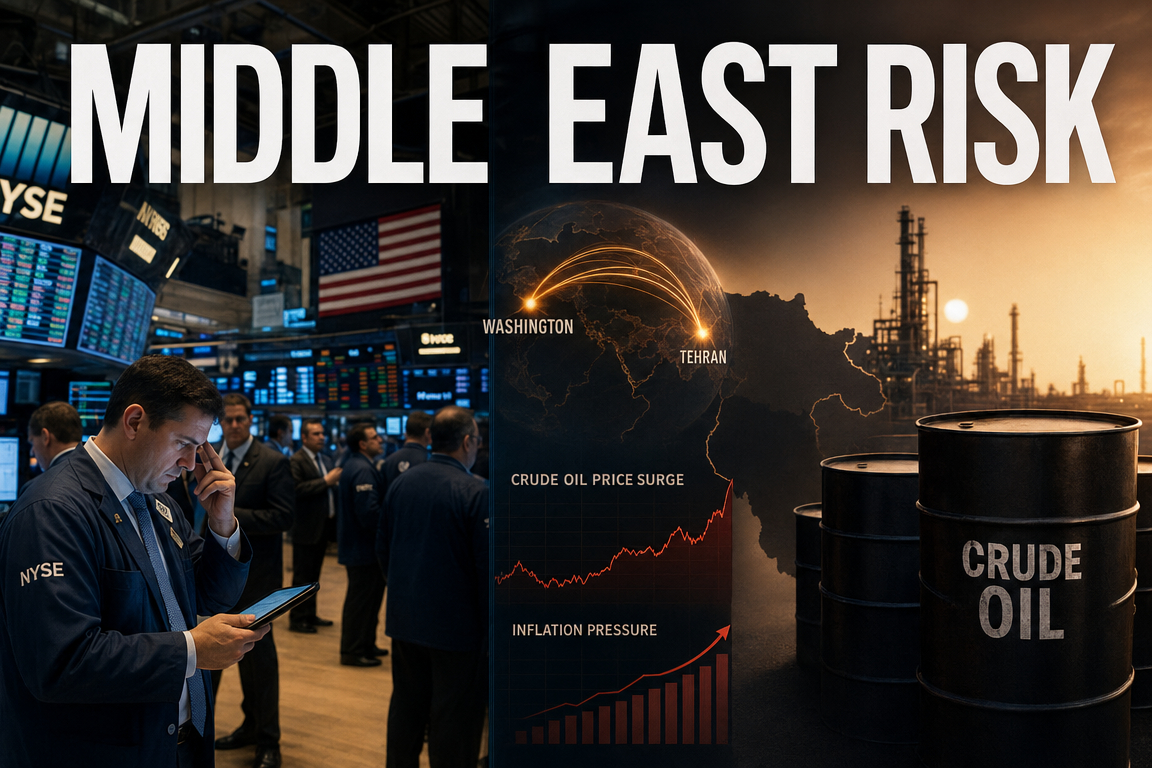
5-2. Crude Oil and the Inflation Pathway
Increased risk around key sea lanes and maritime access can lift oil prices. Higher oil transmits into broader costs (transport, manufacturing, aviation, power), potentially reinforcing global inflation.
If sustained, higher inflation can weaken expectations for rate cuts and tighten financial conditions even if equities initially remain stable.
5-3. A Near-Term Support Mechanism: Fiscal Expansion
Another reason markets may not immediately reprice sharply is the tendency toward higher fiscal outlays during conflict (defense spending, reconstruction, political stimulus incentives). This can support revenues, employment, and liquidity in the short run.
However, the longer-term trade-off is higher public debt, fiscal credibility risk, currency pressure, and elevated term premiums.
6. Indicators to Monitor
6-1. Crude Oil
Assess whether spikes mean-revert or whether successive highs continue to rise.
6-2. US Treasury Yields
A rapid rise can signal renewed inflation concern and repricing of policy expectations.
6-3. Inflation Expectations
If households and markets embed higher inflation, central-bank constraints increase.
6-4. Shipping, Insurance, and Logistics Metrics
Supply-chain stress often appears with a lag. Freight indices, war-risk insurance premiums, and access restrictions can lead real-economy impacts.
6-5. Political Calendar
Trump polling, Congressional actions, election framing, and US-China summit timing can influence risk pricing.
7. Under-Discussed but Material Points
7-1. Normalization of Asymmetric Threats
The core risk is not the single incident, but the potential recurrence of unpredictable, non-linear threats. Such risks can affect political events, corporate gatherings, international conferences, ports, airports, and energy infrastructure.
7-2. Negotiation Failure Reflects “No Room to Concede”
The primary constraint is not diplomatic technique but the limited political capacity for either side to compromise. Nuclear capability is tied to regime security, limiting near-term bargaining space.
7-3. Longer-Term Risk: Debt Dynamics More Than War Headlines
Headlines focus on attacks, canceled talks, and maritime chokepoints. Over a longer horizon, accumulated global debt and rising reliance on fiscal support can be more destabilizing via rates, currency valuation, taxation, and fiscal credibility.
8. Conclusion: Prioritize Managing Prolonged Uncertainty Over Near-Term “Peace” Expectations
The current environment is more consistent with extended ambiguity—coexisting tension and partial ceasefire conditions—than a rapid comprehensive settlement.
The attempted shooting highlights persistent US polarization; the canceled Iran negotiation reinforces constraints on de-escalation. Markets may remain supported in the near term, but a renewed uptrend in oil and inflation could change pricing quickly.
The key is to track transmission channels—energy, supply chains, inflation expectations, and financial conditions—rather than reacting to headlines.
< Summary >
- The attempted shooting at a Trump-attended event is a signal of heightened US political polarization and asymmetric security risk, not merely a protective failure.
- The second Iran ceasefire/war-termination negotiation was effectively canceled; nuclear constraints remain the binding issue with limited room for concessions.
- Forward scenarios concentrate on: (1) prolonged ceasefire without settlement, (2) limited compromise and re-entry to talks, (3) expanded third-party mediation.
- Markets may hold in the near term due to fiscal and liquidity effects; longer-term risk concentrates in oil-driven inflation and rising sovereign debt burdens.
- Focus on how geopolitical risk transmits into supply chains and market psychology, not the headline event itself.
[Related Articles…]
- Trump risk and the impact of US elections on global financial markets: https://NextGenInsight.net?s=Trump
- Post-AI revolution shifts in the global economic landscape and opportunities for Korea: https://NextGenInsight.net?s=AI
*Source: [ 경제 읽어주는 남자(김광석TV) ]
– [LIVE] 트럼프 만찬장 총격과 2차 종전협상 불발. 그 이유와 파장은? [즉시분석]