● AI Capex Anxiety
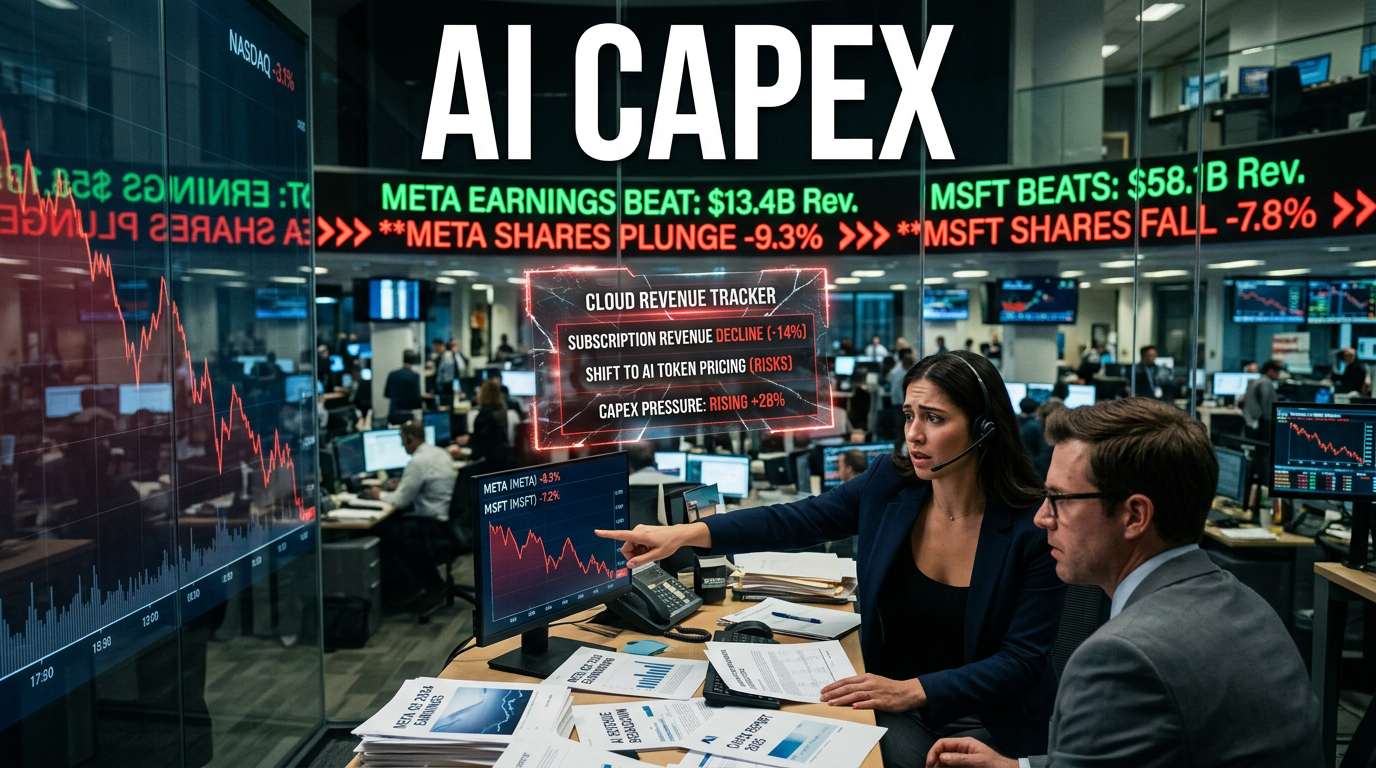
Despite the ‘earnings surprise’ from Meta and Microsoft, the real reason the stock fell: AI investment (CapEx) and the software billing structure changed
Today’s core point is this.
“Even though earnings were strong, the real reason the stock wobbled isn’t AI demand—it’s the ‘AI spending pace (CapEx)’ and the change in the billing structure”.
And this article organizes these two things especially clearly.
- The 기준 that determines big tech stock prices is shifting from being centered on ‘cloud growth’ to ‘cloud + AI CapEx’
- The reason Microsoft gets shaken even though it’s doing well (the seat subscription → token billing transition issue)
- While Meta looks too cheap, the scale of AI investment is making the market even more uneasy
If you catch just this flow, you’ll immediately understand why the stock moves in different directions on the day of the earnings release.
1) Big tech earnings are now split into ‘the good and the bad’: Why do stocks differ even when AI demand is the same?
In this big tech earnings season, the common message was “AI demand continues.”
But the stocks reacted differently.
Here’s the variable that creates the difference.
- Cloud revenue growth
- AI spending size (CapEx, capital expenditures)
- Billing structure change (subscription seats → tokens/usage)
In other words, where previously “cloud growth rate” was the key metric for the stock,
now it has shifted into a phase where in addition to the cloud growth rate, how much money is being poured into AI determines the stock.
2) Strength of the existing big tech model: Cloud was the engine of earnings
Big tech originally had this kind of structure.
(1) Commonality among hyperscalers (Amazon, Google, MS, Meta): Cloud/platform revenue share
- Amazon: AWS share is the core (the cloud is what makes the money)
- Google: Search and YouTube are famous too, but the importance of the business to operating profit is Google Cloud
- Microsoft: Windows/Office images are strong, but the real competitive battle is Azure
Because of this structure, the market became accustomed to the formula “if cloud grows, the stock goes up.”
3) But in this season, the valuation framework changed: from ‘cloud × growth rate’ to ‘cloud × growth rate ÷ CapEx’
This is where the real point comes in.
As AI investment increases, it ultimately connects to higher CapEx (capital expenditures), and the larger the CapEx, the more burden it creates for the stock in the short term.
Why? Because the market thinks this way.
- “They spent a lot on AI? Then that should be good”
- “But how fast does that investment get recovered as revenue?”
- “Since the investment (cash outflow) happens first, how long can the stock withstand it?”
So even with the same “earnings surprise,” the side with stronger AI spending intensity is the one whose stock tends to wobble first.
4) Microsoft (MS): The reason the stock fell despite strong earnings (the gist is a mismatch between ‘AI billing/product expectations’)
Based on the original flow, MS reached this conclusion.
- After-hours soft decline/slide
- Earnings beat expectations
- Still, the reason the market response felt ambiguous was likely that there wasn’t a clear “big win,” or that “AI-related expectations and reality may not have matched as well.”
(1) Key numbers (summary)
- EPS: Expected 4.06 → Beat (beat by 4.27%)
- Revenue: Expected $81.39 billion → Beat (about $83xx billion)
(2) The point that still caused the wobble: Azure growth bounced back to 40%
From the market’s perspective, if “Azure is back to 40%, isn’t that good?” is the normal reaction.
In fact, the original text also evaluates this positively.
- It had been hit at 38% in the previous quarter
- This time, it aligned with consensus (40%) again, easing concerns
And yet, the reason it still fell is elsewhere.
(3) ‘Copilot’ perception/competition issue: Native AI vs competitors that do better
The part the original text particularly emphasized is this.
- MS is embedding AI features (Copilot) into its own apps (Office)
- But the market sensed that it’s not being used as much as expected
- In particular, there’s an awareness that competition (e.g., Anthropic/Claude) is stronger in certain kinds of work
Once this kind of perception forms, even with strong earnings, the question becomes: “Was enough AI momentum already reflected in the stock?”
(4) A bigger structural issue: Weakness of the subscription (seat) economy → shift to token economy
This is the essence of the MS evaluation.
- Traditional software follows a seat subscription model
- But in the AI era, what matters more than seats is ‘how much you use’ (agents/tokens)
Reinterpreting the original wording as-is:
- When one person performs multiple roles with AI,
- you can reduce the number of seats (subscriptions),
- which may weaken MS’s traditional subscription revenue structure
Conversely, the original text judged that cloud could move to pricing more driven by usage (token-based) more strongly, and it also mentions that MS would “change CE (cloud/Copilot-related) billing.”
So for MS, growth itself is good, but whether the billing-structure transition progresses at the pace the market wants becomes the stock’s variable.
(5) Valuation commentary (gist)
- Current price about $424
- Target price $570
- The frame that implies more than 30% upside
However, in the short term,
a stock rebound may not be easy until improvements across pricing (subscription → tokens) are confirmed
That’s the perspective here.
5) Meta (META): The reason the stock fell “even though the earnings were good” (the key takeaway is ‘AI CapEx burden’)
In the original text, Meta was fairly direct.
- A sharp drop after hours (about -7% mentioned)
- Earnings themselves beat expectations
- But the main complaint was “there’s too much spending”
(1) What Meta did well: Ad efficiency is improving
Meta was seen as changing the game with “AI-recommended ads,” and the article lays out the specific shifts like this.
- Increase in Shorts/video viewing: As time spent watching videos grows, there’s more opportunity for ad impressions
- More impressions + higher price per unit
- RAS improvement (revenue relative to ad spend): a signal that performance relative to investment is getting better
In the gist of the original text,
“As advertisers put more money in, Meta’s AI is targeting more accurately.”
That’s the flow.
And revenue growth also came in strong.
- 33% revenue growth (mentioned as the strongest growth among big tech)
(2) Still, why the market punished it: AI CapEx (annual spending) grew more than expected
Here again appears the “real reason” behind the stock’s wobble.
- Previous consensus: $15 billion → expected around $135 billion
- This plan: an additional $10 billion (interpreted as around KRW 1.5 trillion)
So the market asked these questions:
- “Ad revenue is getting better, but the money going into AI is too big?”
- “Does this investment get recovered as revenue right away?”
- “If the recovery pace is slow, won’t the cash flow burden increase?”
That’s why even with an earnings surprise, the side with stronger AI investment intensity responds immediately in the stock.
(3) Meta’s strengths (long-term logic): Ad AI + expansion of commerce + AR/Reality Labs
The original text also mentions future growth options for Meta.
- E-commerce (connecting shopping within the platform)
- A consumption shift based on Shorts (reinforcing the “watch → purchase” structure)
- Expecting AR glasses/Reality Labs as a long-term growth driver
So the “business direction” itself looks positive,
but the conclusion is that, in the short term, “the timing of spending too much money” is the problem.
(4) Valuation perspective
- Current price about $669 mentioned
- Analyst target price $855
- Still, there’s a gap (frame that implies close to 30% upside)
- EPS growth forecasts are also presented as relatively high
However, the market seems to have priced in the spending-risk first, even though it looks “cheap.”
6) “Contrasting conclusion”: Why MS and Meta, both ‘big tech,’ saw different stock reactions
To summarize, you can see it like this.
- MS: Earnings were good, but the expectation for AI billing/product experience (Copilot usage expansion) may not have been fully met
- META: Earnings and ad performance (RAS, impressions/price per unit) were good, but the ‘AI CapEx scale’ worked more strongly and increased investor unease
In the end, the common denominator is this: as AI investment (CapEx) grows, short-term stock volatility increases.
7) Investor takeaway: “Even if fundamentals are good, timing can be driven by momentum”
The important investment viewpoint from the original text is this.
- Right now, even if the technology/business is good, the stock doesn’t necessarily rise immediately
- Instead, stocks that have fallen a lot relative to fundamentals can become a buying opportunity
- However, for the stock to rebound,
- the recovery speed of AI spending
- how concretely the billing-structure transition is defined
- the market’s acceptance of “visibility of the next quarter/next year’s earnings”
needs to follow
8) The single most important line that doesn’t often show up in other news (separate summary)
The next key variable for big tech stock prices is not whether there’s AI demand, but how much (CapEx) is spent for AI and when (cash recovery) that money comes back.
And the second key point is this.
A seat-based revenue model can wobble in the age of AI agents, and the shift to token/usage-based billing is likely to determine stock performance.
Remember only these two lines, and
you can interpret situations like “earnings surprise but stock falls” much faster.
SEO key keywords (naturally reflected in the body):
This article is organized around AI investment, big tech, cloud, CapEx, and valuation trends.
< Summary >
– Big tech evaluation metrics shifted from being centered on “cloud growth” to “cloud growth + AI CapEx burden.” – MS had strong earnings, but it wobbled because expectations for Copilot usage expansion/competitive dynamics and the “subscription (seats) → token billing” transition were not reflected as much as hoped. – Meta had strong ad performance (RAS, impressions/price per unit) and revenue growth (33%), but the stock fell because AI CapEx (annual spending) grew larger than expected. – While long-term business (commerce, AR, etc.) is positive, in the short term, a rebound is easier only after the AI investment recovery pace and the billing-structure transition are confirmed.
[related post tags…]
Why CapEx shakes up the stock: Comprehensive summary of the AI investment cycle
From subscription to token billing: How the software value chain changes
*Source: [ 월텍남 – 월스트리트 테크남 ]
– 메타·MS 실적 서프라이즈… 그럼에도 주가 빠지는 진짜 이유