● Tesla-445, Beijing-Deal, FSD-Breakout
Tesla at $445, 11% Below the All-Time High: Why Beijing This Week Is the Real Inflection Point
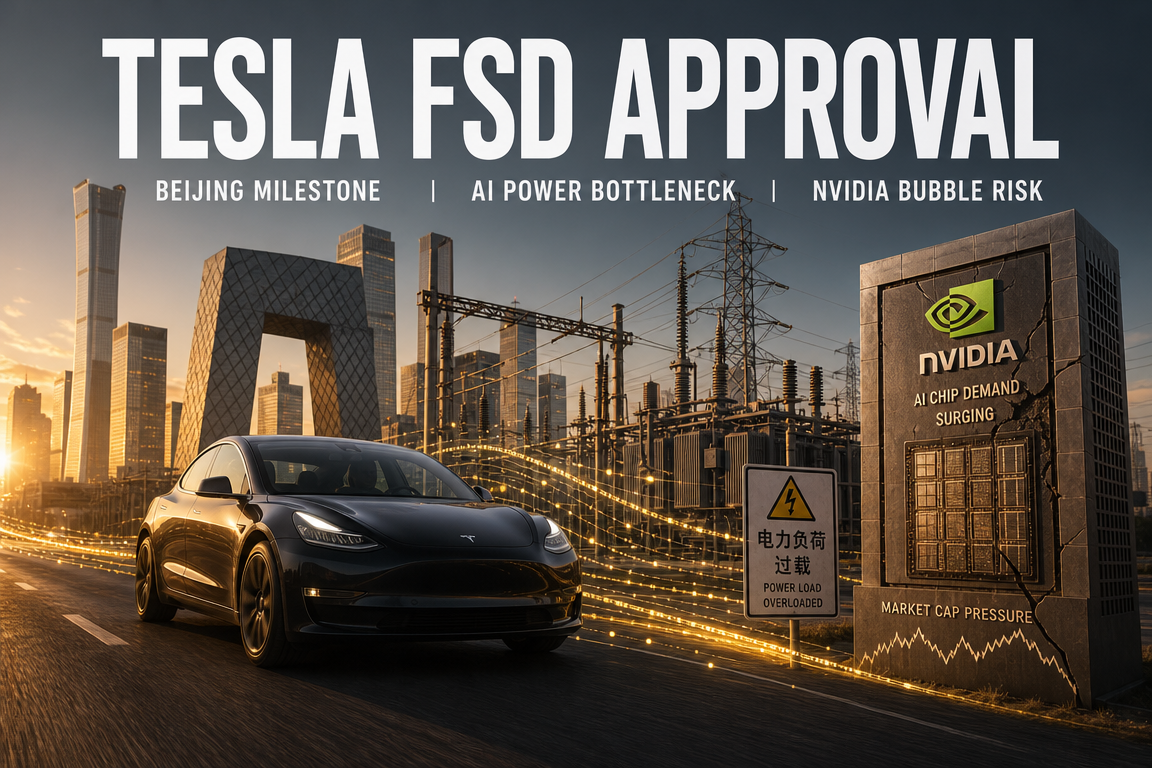
The key issue is not merely that Tesla’s share price has risen. This report summarizes (i) the primary drivers behind the recent move, (ii) why the upcoming Beijing schedule has a materially different significance from Musk’s prior China visits, and (iii) why China’s FSD approval could prompt a re-rating of Tesla from an EV manufacturer toward a software-led platform company.
This note also incorporates the broader U.S. equity backdrop and global supply-chain sentiment, the linkage between U.S.-China trade negotiations and AI regulation, Tesla’s actual positioning within China’s EV market, and why the stock is reacting more sensitively at this point in the cycle.
1. Market context: Tesla’s rally is part of a broader risk-on move
Tesla closed at $445, up approximately 3.89%, following a gain of more than 10% last week.
The move is difficult to attribute to a single company-specific catalyst. The broader U.S. equity environment has turned supportive, with the S&P 500 moving above 7,400 and risk appetite recovering after the early-2025 tariff shock.
In such regimes, growth equities—particularly technology and future mobility exposures—tend to outperform. Tesla has overlapping exposure to EVs, autonomous driving, AI, and robotics, amplifying its sensitivity to improving risk sentiment.
Geopolitical risk in the Middle East is another variable. Escalation related to Iran could raise crude prices, which can improve the relative economics of EV adoption. However, higher oil can also add inflation pressure and influence rate expectations. Tesla is currently trading at the intersection of company catalysts and macro cross-currents.
2. Why this Beijing visit is different: Musk is traveling alongside President Trump
The central catalyst is Musk’s China trip. The differentiator is that he is reportedly joining President Trump’s state visit to Beijing.
Reporting indicates President Trump will visit Beijing from May 13 to May 15 to meet President Xi. Several U.S. CEOs have reportedly been invited, including leaders from major technology, finance, aviation, and platform businesses.
This is more than a conventional business delegation. The agenda likely intersects with trade negotiations, AI export controls, rare-earth supply chains, Taiwan-related risk, and Middle East developments—implying CEO participation may function as part of economic diplomacy.
For Tesla investors, the implication is that China’s FSD approval may shift from a primarily technical/administrative process with regulators to an item with potential relevance in broader bilateral negotiations.
3. Tesla’s distinct position in China: Gigafactory Shanghai operates under an atypical structure
Tesla’s position in China differs from most global automakers. Historically, foreign OEMs often needed joint ventures to operate manufacturing at scale. Tesla received an exceptional arrangement enabling Gigafactory Shanghai to operate effectively as a wholly owned subsidiary structure.
This has operational significance. Shanghai is a critical node in Tesla’s global production and distribution network, and China accounts for roughly 20% of Tesla’s annual revenue.
Tesla’s global supply-chain execution is meaningfully linked to China, while China has benefited from Tesla’s contribution to EV industrialization and manufacturing ecosystems. The relationship is structurally difficult to fully unwind for either side.
4. Why China FSD is still not approved: primarily political and strategic, not technical
A common misconception is that the delay reflects insufficient capability. Tesla has built infrastructure intended to satisfy data localization requirements, including a Shanghai data center and mechanisms to prevent export of China-collected vehicle data.
In April 2024, Musk visited Beijing and reportedly advanced a Baidu mapping partnership, alongside a localized AI training approach for Chinese road conditions.
These steps suggest that key technical and infrastructure prerequisites have largely been addressed. The remaining constraints appear more aligned with issues of data sovereignty, roadway governance, and the influence of a foreign software system operating at scale—making the decision strategic rather than purely regulatory.
5. Readiness signals: owner’s manual updates indicate deployment preparation
A notable datapoint is an update to the owner’s manuals for Model 3 and Model Y sold in China, reportedly adding feature descriptions related to FSD Version 14.
There are also indications the product may be introduced under the name “Tesla Assisted Driving (TAD)” rather than “Full Self-Driving,” with documentation referencing speed profiles and mode-level functionality. This suggests preparation has progressed beyond concept toward operational rollout, pending policy approval.
6. If China FSD opens, Tesla’s valuation framework may shift
China FSD approval is not merely an incremental feature release. It could influence how Tesla is valued.
While automotive revenue remains the dominant component today, FSD supports a subscription revenue model. In the U.S., FSD subscription pricing is widely cited at approximately $99 per month. As of Q1 2026, FSD subscribers were referenced at approximately 1.28 million, up from about 0.85 million a year earlier.
Subscription revenue differs structurally from one-time vehicle sales via recurring revenue, higher predictability, and stronger operating leverage. Markets generally assign higher multiples to scalable recurring revenue models, as seen across consumer and enterprise software.
Accordingly, China FSD could strengthen the market’s view of Tesla as a vehicle-based software platform rather than solely an automaker.
7. China’s market potential: could be larger in aggregate than the U.S.
China is the world’s largest EV market and a region where Tesla has built a substantial installed vehicle base.
This implies that FSD approval would not only support new vehicle demand, but could also monetize the existing fleet through software attach rates. Pricing in China may differ from the U.S. given local price sensitivity and competitive dynamics, but a larger potential subscriber base could still produce material subscription revenue.
Equities typically discount future business-model optionality before it appears fully in reported results, implying potential valuation sensitivity beyond near-term earnings.
8. Street positioning: “sum-of-the-parts” frameworks are gaining prominence
Piper Sandler’s $500 price target has drawn attention, particularly because it reportedly values Tesla across 17 business lines rather than as a single auto manufacturer.
This reflects a shift toward segmenting Tesla into EVs, energy storage, charging networks, autonomous software, robotaxi optionality, and robotics (including Optimus), among others.
Treating FSD subscription as a distinct value driver signals that conventional auto-sector valuation metrics alone may not capture investor frameworks applied to Tesla. China FSD approval could therefore act as a catalyst shaping classification and multiple assignment.
9. China sales appear weak in isolation: production and exports provide context
Negative data points remain. China Passenger Car Association (CPCA) figures cited April China retail sales at 25,956 units, down year-over-year, with year-to-date also below prior-year levels.
This can support concerns that Tesla is losing share to domestic competitors such as BYD and Xiaomi amid intensifying pricing and feature competition.
However, production and exports alter the interpretation. Gigafactory Shanghai April production/shipments were cited at 79,478 units, up year-over-year, with 53,522 units reportedly exported.
Shanghai has historically exhibited intra-quarter seasonality, often exporting more early in the quarter and shifting toward domestic deliveries later. Therefore, retail softness alone is not sufficient to conclude weakening plant utilization or global demand.
10. Stock monitoring: expectation-driven move versus structural change
Tesla is cited as approximately 11% below its all-time high. The central question is whether the rally is primarily expectation-driven or reflects a durable structural shift.
Both elements are present. Expectations around China FSD approval, the symbolic significance of Musk joining the Trump-Xi schedule, and the broader risk-on tape have been priced in.
At the same time, this differs from a purely narrative-driven move because policy, diplomacy, software monetization, and supply-chain alignment are converging. The Beijing outcomes matter: absent tangible progress on FSD, recent gains may partially retrace; credible approval signals or constructive commentary could support a faster move through psychological resistance levels.
11. Key checklist for the week
1) Tesla advanced to $445, extending a strong uptrend.
2) The rally is supported by a stronger U.S. equity tape and the Trump–Musk Beijing delegation narrative.
3) China FSD approval appears driven more by political and diplomatic considerations than technical readiness.
4) Tesla has positioned with localized data infrastructure, mapping partnerships, and localized AI training.
5) Approval could accelerate a re-rating toward a recurring-revenue, software-oriented valuation profile.
6) China retail sales were weak, but Shanghai production and exports remained strong; conclusions require full context.
7) Beijing outcomes may determine whether the stock attempts a new high or undergoes expectation normalization.
12. Underappreciated point: how China may use the approval decision
The primary issue may not be approval itself, but the strategic framing China assigns to the decision.
China may treat approval as an economic-diplomatic signal to the U.S., or treat delay as leverage management within broader negotiations. Under this lens, Tesla functions not only as an automaker but also as a sensitive node within U.S.-China technology competition, contributing to both premium valuation and elevated volatility.
13. Synthesis: this week is a narrative transition test, not an earnings week
A purely financial view—slowing China retail sales, intensifying competition, and policy uncertainty—does not fully explain the price action.
The market appears to be discounting a “next Tesla” framing: a platform spanning AI software, subscription monetization, robotics, and energy infrastructure, alongside vehicles.
The Beijing schedule is a test of whether this narrative can translate into policy-aligned execution. Messaging matters, but policy direction is likely the dominant variable.
< Summary >
Tesla rose to $445, nearing its all-time high.
The primary catalyst is not the China trip itself, but Musk’s participation alongside President Trump.
China FSD approval appears more connected to diplomacy and industrial policy than to technical readiness.
Tesla has largely completed localized infrastructure and software preparation in China.
Approval could support a re-rating from an EV manufacturer toward a recurring-revenue, AI/software platform company.
China retail sales are weak, but production and exports remain strong; the data should be interpreted holistically.
This week’s Beijing outcomes could become a key inflection point for Tesla’s stock, broader global risk sentiment, U.S.-China trade positioning, and the autonomous driving industry.
[Related Articles…]
- Tesla FSD and China EV Market Restructuring: Key Points Investors Should Track (NextGenInsight.net?s=Tesla)
- AI Semiconductors and U.S.-China Tech Competition: A Core Variable for Global Equities in 2026 (NextGenInsight.net?s=AI)
*Source: [ 오늘의 테슬라 뉴스 ]
– 트럼프랑 같이 간 머스크 — 전고점까지 11%, 이번 주 베이징이 $445 주주의 운명을 결정합니다
● AI Bubble Shock, Power Crisis, Nvidia Shift
The Former NVIDIA Korea CEO on the True Nature of the “AI Bubble”: The Key Issue Investors Should Not Miss
This is not limited to the question of whether AI is a bubble. The central points are as follows:
1) The AI industry remains in an early phase.
2) The “bubble” debate is primarily about the speed of capital markets relative to the real economy.
3) The current bottleneck in the AI value chain is shifting beyond GPUs and HBM toward power infrastructure.
4) The next phases after generative AI (agent AI and physical AI) may materially reshape industrial dynamics.
5) Korea is among the few countries able to connect semiconductors, manufacturing, data centers, and power infrastructure within one ecosystem.
This report consolidates, based on remarks by the former NVIDIA Korea CEO, the practical implications of:
- the nature of the AI bubble debate,
- the NVIDIA vs. SK hynix and Samsung Electronics landscape,
- HBM supply bottlenecks,
- data centers and power constraints, and
- the 2026 macro outlook.
The focus is on why power is increasingly a defining economic variable and why AI infrastructure is likely to be a core determinant of national competitiveness.
1. Executive Summary: Primary Message From the Discussion
The core message is:
“AI may look like a bubble, but the industry itself is only beginning.”
Two layers should be distinguished:
- Real economy: the AI industry is still in an early stage.
- Capital markets: overheating can occur in specific stocks and subsectors.
Accordingly, “AI industry growth” and “AI-related equity overvaluation” should be analyzed separately. Equity markets often discount long-term growth paths in advance, resulting in cycles of overvaluation and undervaluation. The bubble debate is therefore less about whether AI is “real” and more about how far capital has moved ahead of fundamentals.
2. What the “AI Bubble” Is: Similarities and Differences Versus the Dot-Com Cycle
The discussion referenced Cisco as a representative dot-com-era example. During the early internet build-out, demand for networking equipment surged; however, once infrastructure was installed at scale, incremental demand growth could decelerate sharply.
AI differs structurally:
- AI is not a one-time installation cycle; compute demand can continue expanding as models improve and services proliferate across industries.
- The technology roadmap extends beyond generative AI into agent AI and physical AI.
Key contrast:
- Dot-com: front-loaded infrastructure investment followed by rapid demand normalization.
- AI: infrastructure investment may be followed by sustained growth in services and compute demand.
Implication: while short-term overheating is possible, it is premature to equate this with an imminent structural end to AI industry growth.
3. Why “AI Is Only Beginning”: Adoption and Total Addressable Market Logic
The discussion emphasized that the potential AI market, particularly as it expands into the physical world, may be substantially larger than current market perceptions imply.
User adoption has accelerated: generative AI services have moved from trial usage into routine workflows, including paid tiers. This suggests progression beyond early experimentation toward operational deployment.
Korea’s relatively fast technology adoption and strong digital infrastructure may support rapid diffusion, with potential spillovers into domestic AI and semiconductor ecosystems.
4. The Current Phase: Transition From Generative AI to Agent AI
The discussion framed AI evolution in four stages:
- Stage 1: Perception AI
- Stage 2: Generative AI
- Stage 3: Agent AI
- Stage 4: Physical AI
The market is moving from generative AI toward agent AI. Agent AI is characterized by task decomposition, tool usage, and multi-step execution rather than single-turn response generation.
Enterprise adoption is central: embedding agent AI into business workflows may have larger economic impact than consumer chatbot usage, potentially expanding both addressable market size and infrastructure requirements.
5. The Larger, Later Market: Manufacturing and Physical AI
Most current user experience relates to service-layer AI (e.g., chat interfaces). The larger industrial transformation may occur in physical domains:
- manufacturing, logistics, robotics,
- equipment and facility management,
- energy management,
- factory automation.
Physical AI is more complex than purely digital agent systems due to sensors, safety constraints, integration, and real-world variability; the discussion implied this remains a preparatory phase rather than an immediate monetization wave.
Korea may be positioned for opportunities in manufacturing-focused AI due to:
- semiconductor supply chain capabilities,
- a large manufacturing base,
- strong digital infrastructure.
6. Full-Stack Perspective: Why Bottlenecks Rotate
A practical framework presented was a full-stack “layered” view of AI:
- Applications and services (top)
- Models (middle)
- Infrastructure (bottom)
Expanded into a “five-layer cake”:1) Energy
2) Chips (GPUs, HBM, foundry capacity)
3) AI systems and infrastructure
4) Models
5) Applications
Bottlenecks shift because the stack is tightly coupled:
- Initial bottleneck: GPU availability
- Subsequent bottleneck: HBM
- Emerging bottleneck: data center power availability and grid capacity
7. Why the HBM Bottleneck Mattered: SK hynix’s Positioning
A key point was that NVIDIA had secured meaningful supply from SK hynix earlier, implying that HBM allocation is strategically decisive.
HBM is a critical performance component for AI accelerators. HBM supply capacity therefore directly affects AI server shipment capacity. Market strength in SK hynix reflected its position at a high-impact constraint point in the value chain.
However, HBM is not the only constraint:
- advanced packaging and system integration can bind,
- foundry capacity can bind,
- upstream and downstream constraints can offset each other.
Conclusion: HBM is critical, but the supply chain must be evaluated holistically.
8. Why Samsung Electronics and SK hynix Results Improved: Pricing Over Volume
The discussion implied that recent earnings momentum is better explained by price (P) than volume (Q), consistent with:Revenue = P × Q
High-value products such as HBM and performance memory exhibit:
- supply constraints,
- higher technical barriers,
- stronger pricing power than commodity memory.
Investor implication: sector recovery should be assessed by identifying products with pricing power rather than assuming broad-based volume-driven cycles.
9. The Ultimate Bottleneck: Power Infrastructure
The most consequential message was that AI’s binding constraint is increasingly power.
Even with sufficient GPUs and HBM, AI compute expansion is limited without:
- adequate electricity supply,
- transmission and distribution capacity,
- cooling systems,
- permitting and siting,
- power pricing and regulatory structures,
- alignment with renewables and nuclear baseload strategies.
This elevates AI competition from a semiconductor-centric contest to an infrastructure and energy competition with direct macro and industrial policy implications.
10. Strategic Framing for Korea: Linking AI Transformation (AX) and Energy Transition (ET)
The discussion emphasized the need to analyze AI transformation and energy transition together, given AI-driven power demand growth and the slower adaptation of legacy energy systems.
Maintaining competitiveness requires more than model capability:
- stable industrial-scale electricity supply,
- scalable data center buildout conditions,
- grid investment and regulatory modernization.
A cooperative framework among the US, Japan, and Korea was positioned as potentially complementary:
- US: platforms and large-scale capital
- Japan: materials/equipment and potential energy collaboration
- Korea: semiconductors, manufacturing, and data center demand linkage
For an export-oriented economy, compute capacity and power availability may become critical determinants of competitiveness.
11. Investor Implications: Monitor the Bottleneck
The primary investment framework was:
“Track where the bottleneck forms.”
In fast-growing industries, the scarcest input often gains pricing power. Recently this has included HBM; at various points it also included GPUs, advanced packaging, and foundry capacity. Going forward, power infrastructure and data center-related equipment may gain prominence.
Sector mapping:
- Applications: monetization occurs here, but competition is intense.
- Models: some segments show signs of overcrowding/overinvestment.
- Infrastructure: remains a core investment axis.
- Chips and memory: profitability rises when supply constraints are binding.
- Energy: may become a long-duration strategic asset class.
12. Underemphasized but Material Points
12-1. The “Bubble” Debate Is Primarily About Capital Allocation Timing, Not Industrial Collapse
The key issue is not whether AI is illusory, but how aggressively markets have priced in future earnings. Misreading this distinction increases the risk of entering structurally sound themes at unfavorable valuations.
12-2. Beyond HBM: Power and the Grid May Be the Larger Long-Run Constraint
Long-horizon constraints may center on power generation, grid buildout, and associated equipment:
- transformers, transmission/distribution upgrades,
- cooling solutions,
- data center REITs,
- energy policy and tariff structures.
12-3. Korea’s Opportunity May Be Stronger in Manufacturing AI Than Consumer AI Services
Korea may be less advantaged in platform-scale consumer AI competition, but better positioned in:
- industrial automation,
- robotics and smart factories,
- semiconductor equipment and process optimization.
12-4. Macro Monitoring: Beyond Interest Rates
In addition to rates, FX, inflation, and employment, investors may need to monitor:
- national compute capacity,
- power supply and grid readiness.
Productivity dispersion may increasingly be driven by compute and power availability rather than solely by the cost of capital.
13. Conclusion: The Core Issue Is an “AI Infrastructure Competition,” Not the Bubble Headline
The bubble debate is a surface-level framing; the underlying dynamic is an AI infrastructure competition.
The value chain is converging:
- semiconductors,
- HBM,
- data centers,
- power infrastructure,
- energy transition.
Within this chain, bottlenecks are likely to determine pricing power and investment outcomes.
The future competitive landscape may depend less on who builds the best models alone and more on who secures:
- scalable compute,
- reliable power to operate it,
- integration into manufacturing and industrial operations.
Summary
-
The AI industry remains early-stage; “bubble” risk is more about market front-running than industrial invalidation.
-
Bottlenecks have rotated from GPUs to HBM and are increasingly shifting toward power infrastructure.
-
The next phase after generative AI is agent AI; the larger later market may emerge in manufacturing and physical AI.
-
Korea has structural strengths in linking semiconductors, manufacturing, and data center deployment.
-
A complete AI macro view requires integrating semiconductors with data centers, power infrastructure, and energy transition dynamics.
-
Related:
-
https://NextGenInsight.net?s=AI
-
https://NextGenInsight.net?s=HBM
*Source: [ 경제 읽어주는 남자(김광석TV) ]
– 전 NVIDIA 대표가 말하는 AI 버블의 진짜 정체 | 경읽남과 토론합시다 | 유응준 대표 [1편]