● Tesla Slumps, SpaceX IPO Shock, Robotaxi Flops
SpaceX IPO Rumors for June 12 and the Key Drivers Behind Tesla’s Drop to $422
The market focus centers on three points:
1) A potential mega-IPO by SpaceX could influence not only space-sector valuations, but also Tesla’s stock and Nasdaq liquidity flows.
2) On-the-ground signals suggest Tesla’s robotaxi service is not yet at full commercial readiness, creating tension with current valuation assumptions.
3) The U.S.–China leaders’ meeting delivered no Tesla-specific outcome, but may have increased the probability of a larger catalyst later in the year.
This report consolidates the primary drivers of Tesla’s decline, the prospective SpaceX listing timeline and market impact, real-world robotaxi assessments, key U.S. equity and rate variables, and the core items investors should monitor.
1. Why Tesla fell to $422 today
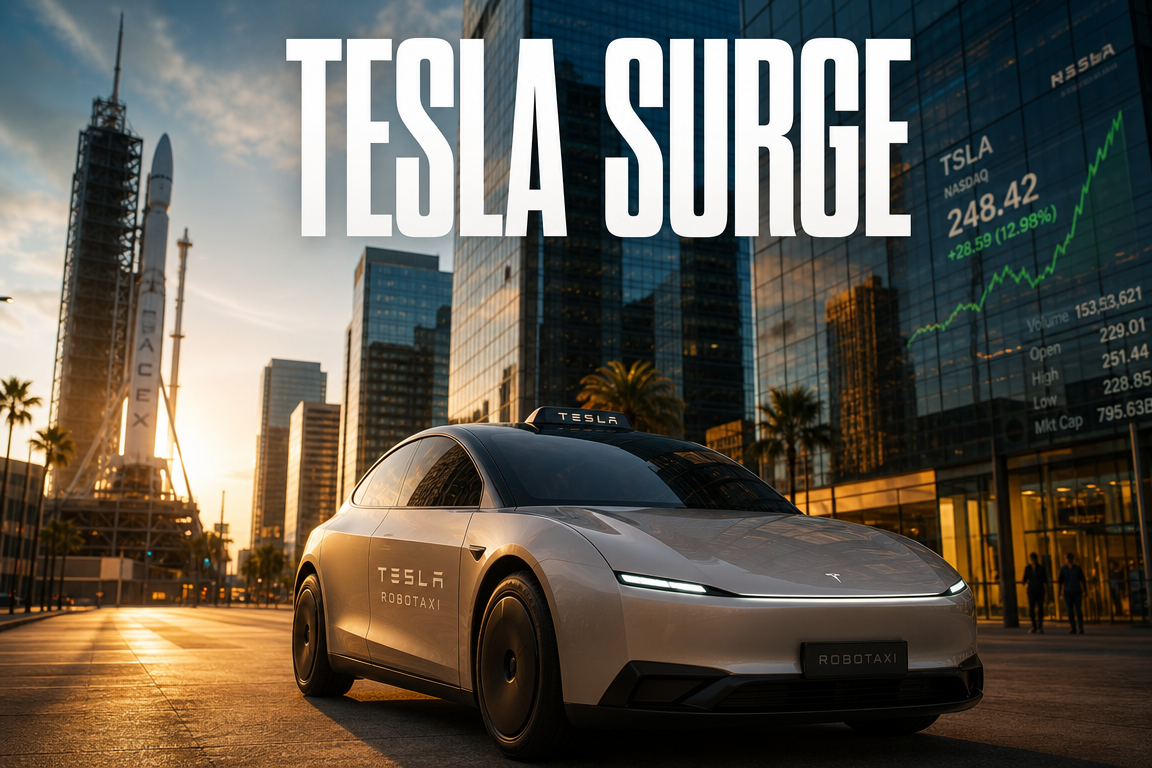
Tesla closed at $422.24, down approximately 4.75% on the day.
After a strong run from the $380s to around $445 over the past month, the stock gave back a meaningful portion of recent gains. The move reflected multiple concurrent factors rather than a single headline.
1-1. Primary near-term driver: Rising U.S. Treasury yields
A key macro pressure point was an increase in the U.S. 10-year Treasury yield.
Higher rates tend to compress valuations for long-duration growth equities. Tesla’s market pricing reflects not only current automotive earnings, but also embedded expectations for autonomy, robotaxi, energy, and AI platform optionality. As the discount rate rises, the present value of those future cash flows declines, increasing valuation sensitivity.
1-2. U.S.–China summit: Expectations reset
Ahead of the U.S. President’s China visit, investors had positioned for Tesla-related developments, including potential progress on FSD approval, robotaxi expansion, or supportive messaging for Tesla’s China operations.
Reported outcomes centered on items such as China’s purchases of U.S. crude oil and a large Boeing aircraft order. No direct Tesla catalyst emerged, consistent with a “buy the rumor, sell the news” dynamic and subsequent profit-taking.
1-3. SpaceX IPO headline: Short-term supply/demand overhang
The most market-sensitive topic was the increased attention to a potential SpaceX listing around June 12.
Given its expected scale, investors flagged a near-term risk of capital reallocation toward a blockbuster IPO, which can temporarily weigh on existing large-cap Nasdaq constituents, including Tesla.
2. Why the SpaceX June 12 listing narrative matters
The significance is not limited to the listing of a high-profile company.
SpaceX is discussed in the market with potential IPO proceeds of approximately $75 billion and an implied valuation near $1.75 trillion. If realized, this would represent an event of historical magnitude in public markets.
2-1. Potential for a record-setting IPO
Saudi Aramco’s 2019 IPO (often cited among the largest) raised roughly $29 billion. The scale discussed for SpaceX would exceed that benchmark and could affect broader U.S. equity flows.
2-2. Nasdaq listing: Relevance of faster index inclusion
Market commentary highlights updated rules that may allow faster inclusion in major indices if market capitalization and liquidity thresholds are met.
If SpaceX were added to the Nasdaq-100 on an accelerated basis, passive strategies and ETFs tracking the index would be required to purchase shares.
2-3. Why this could pressure Tesla
Nasdaq-100 trackers (e.g., QQQ) hold constituents at prescribed weights.
A new mega-cap entrant typically requires rebalancing, potentially reducing weights in existing large constituents. As a major Nasdaq-100 component, Tesla could face incremental technical selling pressure around index and ETF reallocation windows.
3. Why the SpaceX IPO is not purely negative for Tesla
While short-term technical effects may be adverse, longer-term interpretations are more mixed.
3-1. Potential strengthening of a “Musk ecosystem” premium
With both SpaceX and Tesla publicly traded on the same U.S. market platform, investors may increasingly evaluate shared factors such as founder credibility, capital access, technology leadership, and brand strength across the broader ecosystem.
Within themes such as AI, robotics, autonomy, space, and energy transition, a public-market repricing of the broader ecosystem remains a plausible medium-term narrative.
3-2. Increased attention to strategic combinations
When SpaceX was private, structural combinations with Tesla (e.g., equity-linked transactions or mergers) were less practical.
If both were public, markets may more actively price scenarios such as deeper cooperation, infrastructure sharing, or data-related synergies. Execution remains uncertain; however, post-listing, such scenarios could become more relevant as market variables.
4. Reuters field test of Tesla robotaxi: Key observations
Another sentiment driver was a Reuters on-the-ground evaluation.
The core takeaway: the service functions, but operational performance and reliability were assessed as below fully commercial standards.
4-1. Dallas: 8 km trip reported to take 2 hours
Reuters described an attempted trip of roughly 8 km (typically about 20 minutes by car). The app displayed waiting messages, and the trip reportedly took a total of about two hours to complete. The drop-off point was also described as meaningfully distant from the intended destination, requiring additional walking.
4-2. Houston: Dispatch instability
In Houston, the app reportedly showed a vehicle approximately 13 minutes away, then the request was canceled. Additional waiting did not result in a successful dispatch, and the rider ultimately used Uber.
4-3. Austin: Waiting-time pressure
Reuters reported extended waiting times in Austin: waits exceeding 15 minutes occurred more than half the time; waits over 25 minutes were also significant; and some rides were reportedly not available at all.
Reported fleet scale comparisons indicate Waymo operates more than 250 vehicles in Austin versus Tesla at roughly 50, implying a meaningful supply gap.
5. Robotaxi implications: Negative catalyst vs. early-stage scaling friction
Interpretations diverge.
5-1. Bear case
Skeptics argue Tesla’s valuation already embeds substantial robotaxi penetration.
If real-world service performance remains closer to a beta-stage experience, the gap between expectations and delivered capability could expand. High-friction anecdotes (e.g., an 8 km trip taking 2 hours) can materially weaken near-term confidence and revive questions about forward valuation timing.
5-2. Bull case
Supporters argue the current phase is an intentionally limited scaling test rather than full commercialization.
They frame fleet expansion, geographic rollout, safety validation, and dispatch optimization as time-dependent. Reported expansion beyond Austin into Dallas and Houston supports the view that rollout is progressing directionally, even if performance is uneven. No widely validated severe safety breakdown was highlighted as the dominant issue in the reporting.
6. Safety: How to frame current information
Austin police data reportedly includes autonomous-vehicle incident reports, primarily minor contacts, with no injury incidents cited.
Because autonomous vehicles may be subject to heightened reporting thresholds, raw incident counts may not be directly comparable to conventional driving without context. Based on the available characterization, the key challenge appears closer to operational maturity and service reliability than to systemic safety failure.
7. Belgium approves FSD public-road testing: Underappreciated European variable
A less prominent but potentially important update: Belgium reportedly approved public-road testing for Tesla FSD.
Testing is permitted across approximately 5,000 km in Flanders, with an ability to leverage accumulated data from the Netherlands. This may indicate incremental regulatory opening in Europe, which could be relevant to Tesla’s longer-term autonomy and AI data strategy.
8. China Model Y price-increase rumor: Interpreted as demand-defense positioning
Rumors of a Model Y price increase in China circulated, but Tesla China reportedly denied them.
Instead, Tesla continued offering a 0.99% APR financing program through late May, consistent with efforts to support demand amid intense competition in China’s EV market. The posture suggests emphasis on volume and share defense rather than pricing power expansion.
9. U.S.–China relations: No immediate Tesla win, but not a closed file
The absence of a Tesla-specific announcement does not necessarily eliminate future policy or regulatory catalysts.
Discussion of a potential U.S. visit by China’s President in the fall suggests the recent meeting may have been preparatory. Markets may continue to assess the probability of future outcomes affecting U.S. corporate access, autonomy approvals, and data-related constraints. The sequencing of a large Boeing agreement may reinforce expectations that additional U.S. corporate items could follow.
10. Key dates and monitoring items for Tesla shareholders
10-1. SpaceX IPO window around June 12
Focus areas: final pricing, first-day liquidity dynamics, potential Nasdaq-100 inclusion timing, and estimated ETF/passive inflows. Tesla may face relative technical pressure if index rebalancing requires weight reductions.
10-2. Robotaxi operating metrics
Monitor fleet growth, average waiting-time compression, service uptime, and geographic expansion. The principal investment debate remains the pace at which AI/autonomy translates into scalable real-world economics.
10-3. Fall U.S.–China summit optionality
Potential re-emergence of themes: China FSD approval, robotaxi expansion, and data-regulatory easing. The catalyst set appears deferred rather than eliminated.
11. Interpreting Tesla at ~$422
At approximately $422, Tesla reflects both near-term headwinds and longer-term optionality.
Near-term pressures include: higher rates, reset summit expectations, potential SpaceX-related liquidity rotation, and perceptions of delayed robotaxi commercialization.
Countervailing medium-term narratives include: potential strengthening of the broader Musk ecosystem valuation framework, continued (if uneven) robotaxi scaling, and the possibility of renewed China-related catalysts later in the year.
Overall, the market appears to be repricing the timing gap between current execution and long-duration expectations.
12. Core point often missed in related coverage
The key issue is not whether a SpaceX listing is categorically positive or negative.
The more material shift is the market’s evolving framework for Tesla: from an EV manufacturer to an AI- and autonomy-driven platform with exposure to energy infrastructure and broader ecosystem dynamics.
In that structure, Tesla’s stock can be influenced by liquidity, rates, index mechanics, passive flows, regulatory posture, and founder-associated capital-market effects—not solely by vehicle unit sales.
From this perspective, a SpaceX IPO is not only an equity event; it may function as a broader ecosystem repricing catalyst.
13. One-page news-style recap
- Tesla closed at $422.24, down approximately 4.75%.
- Drivers included higher U.S. Treasury yields, disappointment versus U.S.–China summit expectations, and SpaceX IPO-related technical flow concerns.
- SpaceX is discussed as a potential June 12 Nasdaq listing, with approximately $75 billion in proceeds and an implied valuation near $1.75 trillion.
- If rapidly included in the Nasdaq-100, ETF/passive buying of SpaceX could require rebalancing-driven reductions in existing constituents, creating short-term pressure on stocks such as Tesla.
- Over the medium term, markets may assign increased value to a broader Musk ecosystem framework and reassess potential inter-company strategic linkages.
- Reuters’ field reporting indicated Tesla’s robotaxi service has not yet reached consistent commercial-grade reliability, with meaningful waiting times and dispatch instability.
- Current reporting frames the main issue as operational maturity rather than acute safety failure.
- Belgium’s approval of public-road FSD testing and potential future U.S.–China engagement remain longer-term supportive variables.
< Summary >
Tesla’s decline reflects a combination of higher rates, reset expectations from U.S.–China talks, and SpaceX IPO-related flow concerns.
SpaceX’s listing could create short-term technical pressure but may also support longer-term ecosystem repricing narratives.
Robotaxi appears operational but not yet at consistent commercial readiness; scaling direction remains intact.
The relevant investor framework is increasingly Tesla as an AI/autonomy platform rather than a pure EV equity.
[Related Articles…]
- Tesla stock and autonomy momentum; key variables for U.S. equities in 2H
- SpaceX IPO and space-sector investment strategy; implications of Nasdaq fund flows
*Source: [ 오늘의 테슬라 뉴스 ]
– 역대 최대 IPO 6월 12일 확정 — 스페이스X 상장 날 테슬라 주주에게 생기는 일, $422 지금 어떻게?
● Korea-Housing-Boom-Supply-Crunch-Driving-Surge
Greater Seoul Housing Prices: Why Further Upside Risk Remains High
Supply Cliff, Semiconductor Employment, Capital-Area Concentration, and Rental-Market Stress — Key Points
From next year, a material decline in new move-in volume is expected to intensify. At the same time, continued youth migration into Seoul and the capital region, the expansion of the semiconductor industry led by Samsung Electronics and SK hynix, and early signs of stress in the rental (jeonse) market are converging. The market should not be framed simply as “up or down.” A more practical approach is to assess differentiated dynamics within the capital region by submarket.
This report emphasizes three under-discussed drivers:
- Demand concentration that can be more persistent than supply shortages
- Long-term polarization driven by construction-cost inflation
- Structural repricing of residential areas adjacent to high-quality employment hubs
1. Key Takeaway: Why Greater Seoul Prices May Re-Strengthen
Price formation reflects both supply and demand. Going forward, the primary risk is not only reduced supply but also increasingly concentrated demand into the capital region.
Youth migration from non-capital regions is more relevant than headline population decline. Even if Seoul’s total population decreases, household formation continues to fragment, sustaining demand from single-person and newly formed households. With Seoul prices elevated, high-accessibility capital-region submarkets are positioned to capture spillover demand.
A more realistic demand transmission pathway is:Seoul core districts → preferred capital-region districts → housing near major industrial corridors
2. Core Conclusion: Demand Concentration Is More Structural Than the “Supply Cliff”
Market commentary often focuses on the “supply cliff.” This factor is material, but the more structural issue is the sustained preference for the capital region.
- Youth out-migration from provincial areas persists
- Household formation in the 20s generates incremental rental and owner-occupier demand
- Youth migration increases single-person households
- High Seoul prices push substitution demand to select capital-region locations
- Demand concentrates in areas with strong job accessibility
This is less cyclical than investor-led demand because it is anchored in commuting patterns, education, lifestyle infrastructure, and long-term asset formation incentives.
3. Where Next After Seoul: Framework for Identifying Preferred Submarkets
The capital region is not homogeneous. Key screening criteria:
- Job proximity
- Catchment demand from large corporates and industrial parks
- School quality and lifestyle infrastructure
- Redevelopment potential or restructuring capacity in aging planned cities
3-1. Bundang: High Preference, Timing-Sensitive
Bundang remains a high-preference submarket due to:
- Access to Pangyo employment
- Connectivity to Gangnam and southern Seoul
- Strong school districts
- Expectations around redevelopment
However, redevelopment expectations may already be partially priced in. While policy catalysts and pilot-district designations are supportive, execution speed and relocation/transition plans remain uncertain.
A more risk-controlled approach is to recognize long-term locational quality while managing entry timing, including potential price or time corrections.
3-2. Yongin/Hwaseong and the Semiconductor Belt: Increasing Strategic Relevance
A central driver is housing demand from high-income semiconductor employment and the broader supply-chain ecosystem. This is not limited to direct employee purchasing power; the key is ecosystem-wide expansion.
- Growth in anchor corporate employment
- Clustering of equipment/materials/parts suppliers
- Commercial activity and services expansion
- Concurrent growth in owner-occupier and rental demand
- Longer-term upgrades to education, transportation, and lifestyle infrastructure
Areas along the semiconductor corridor (e.g., Yongin, Hwaseong, Icheon, Pyeongtaek) are likely to remain a core thematic focus over the medium to long term, despite near-term volatility.
Where transaction levels remain accessible (including some complexes below KRW 500 million), both Seoul substitution demand and industrial demand may converge, warranting continued investor attention.
3-3. Pyeongtaek: Strong Catalysts, Price Validation Required
Pyeongtaek is frequently cited due to visible catalysts (e.g., U.S. military base relocation, corporate attraction, and new district development). However, prior up-cycles likely pulled forward a meaningful portion of expectations, and the post-2022 rate environment triggered a corresponding correction.
The strategic direction may be constructive, but “a good city” does not necessarily imply “attractive entry pricing.” Owner-occupiers with local job alignment may be better positioned; investors should prioritize valuation discipline, supply pipeline, and entry timing.
4. How to View Major Provincial Cities
Provincial markets require city- and submarket-specific assessment.
4-1. Daegu: Supply Shock Was Severe; Select Core Areas Show Stabilization Signals
Daegu experienced a pronounced correction driven by oversupply. Recently, unsold inventory has been gradually clearing, and select core areas are showing early recovery signals after substantial drawdowns.
In particular, districts with clear local preference (e.g., Suseong-gu) merit focus over broad “citywide” narratives.
4-2. Busan: Demographics Are a Headwind; Development Corridors and Renewal Should Be Assessed Separately
Busan faces structural pressure from population decline and accelerated aging. This weakens the citywide outlook.
However, submarkets with active renewal pipelines, large-scale projects (e.g., North Port redevelopment), landmark large complexes, and established lifestyle cores may diverge. A selective, location- and complex-driven market is more likely than broad-based appreciation.
4-3. Gwangju and Daejeon: Potential Recovery, Likely Slower
While partial recovery may occur, sustained uptrends are not yet well supported. Monitoring should prioritize transaction volume, supply-demand balance, employment base, and new-build supply conditions.
5. The Supply Cliff Is Transitioning from Risk to Reality
Construction conditions deteriorated from 2023 amid higher rates and cost inflation. The more critical issue is that move-in volume is expected to decline more materially starting next year. New supply appears concentrated in limited Seoul submarkets, while many other areas face rapidly worsening delivery conditions.
Key constraints:
- Rising construction costs
- Land cost burden
- Price-cap constraints or weak local price acceptance
- Deteriorating feasibility for reconstruction/redevelopment
- Commodity-price upside risk from geopolitical stress (including Middle East risk)
High-price markets (e.g., Gangnam 3 districts, Yeouido) may sustain supply even at elevated pricing. Elsewhere, identical cost inflation combined with limited pricing power can stall projects.
Implication: supply may increasingly become “available only where it is feasible,” reinforcing divergence.
6. Reconstruction/Redevelopment: The Core Issue Is Rising Polarization
Regulatory easing alone is insufficient; developer profitability and financeability determine project execution.
With construction costs rising sharply:
- Only prime locations may proceed
- Mid-tier areas face delays or cancellations
- Aging housing stock continues to deteriorate
- New-build scarcity increases
- Price dispersion between new and old stock widens
Over time, dispersion can expand within Seoul, within the capital region, and within provincial metros, affecting not only prices but also housing quality, urban competitiveness, and wealth inequality.
7. Why the Rental (Jeonse) Market Has Become More Central
Even when the transaction market is slow, rental tightening can transmit into purchase prices. With fewer completions and limited new-build supply, rental listings can shrink.
- Lower move-in volume → reduced rental supply
- Preference concentration → localized rental strength
- New-build scarcity → rising rents for newer stock
- Rising rents → higher probability of tenant-to-buyer conversion
Monitoring should extend beyond sale indices to include rental pricing, scheduled completions, job-proximity demand, and the feasibility of future new supply.
8. Under-Emphasized Points with High Analytical Value
8-1. Demand Concentration Can Be More Persistent Than Supply Shortages
Supply can be increased over time. Reversing capital-region concentration of youth and high-income employment is structurally difficult and unlikely to change rapidly via incremental policy measures.
8-2. The Semiconductor Belt Is a Structural “High-Income Living-Area Reconfiguration”
When anchor firms, suppliers, R&D, production, and equipment clusters co-locate, surrounding areas can transition from “industrial zones” to durable high-income living areas. This is typically stronger than short-cycle thematic trades.
8-3. Construction-Cost Inflation Is Not Only a Pricing Issue; It Drives Urban Polarization
Cost inflation can permanently separate areas where redevelopment is viable from areas where it is not, compounding divergence over time.
8-4. A Selective Strength Regime Is More Likely Than a Nationwide Up-Cycle
Future performance is likely to be segmented by location quality, employment access, schools, transportation, redevelopment feasibility, and new-build scarcity—raising the importance of granular submarket work.
9. Practical Checkpoints
9-1. For Owner-Occupiers
- Prioritize commute feasibility and daily-life catchment
- Assess rent-to-price ratios alongside scheduled completions
- Validate durability of schools and lifestyle infrastructure
- Avoid momentum buying driven solely by redevelopment narratives
- Identify areas where new-build scarcity is likely to intensify
9-2. For Investors
- Track industrial-park and large-corporate hiring expansion
- Test whether catalysts are already priced in
- Distinguish areas where supply can proceed vs. areas where it is structurally constrained
- Focus on core locations and large-scale complexes rather than citywide averages
- Confirm that rental demand provides downside support
10. Consolidated Outlook: Capital-Region Strength, but Not Uniform
The market focus is shifting from “Will Seoul rise?” to “Which capital-region submarkets are structurally stronger?”
Seoul core districts remain comparatively resilient. Preferred capital-region substitutes remain supported. Semiconductor and advanced-industry catchments may retain medium- to long-term relevance. Conversely, areas with excessive expectation pricing may require price or time corrections.
A single-variable view centered on rates is insufficient. A more robust framework integrates migration-driven demand, completion volume, rental dynamics, industrial employment, and construction-cost inflation. The core structural thesis is that areas combining high-quality employment and high-function residential amenity are more likely to sustain relative strength.
< Summary >
Capital-region price resilience is primarily driven by demand concentration, not only reduced supply. Youth migration and job clustering support spillover from Seoul into preferred capital-region districts. Bundang remains structurally attractive, but valuation and timing are critical. Yongin/Hwaseong and the broader semiconductor belt may benefit from sustained high-income ecosystem expansion. Pyeongtaek has multiple catalysts, but valuation discipline is essential. Provincial markets require selectivity, with some core areas in Daegu and Busan warranting differentiated review. Supply constraints, construction-cost inflation, and rental-market tightening may increase new-build scarcity and reinforce regional and within-city polarization.
[Related Posts…]
- 2026 Real Estate Market Outlook and Capital-Region Core Location Analysis (NextGenInsight.net?s=real-estate)
- Key Summary of AI Industry Expansion and Semiconductor Investment Trends (NextGenInsight.net?s=AI)
*Source: [ 경제 읽어주는 남자(김광석TV) ]
– 수도권 집값, 결국 더 오를 수밖에 없습니다 | 경읽남과 토론합시다 | 김효선 위원 [2편]