● AI-Market-Shift, Big-Tech-Loses, Semi-Rally-Rules
Why Leadership Is Not Rotating Late in the AI Bull Market: Core Sectors to Hold Beyond Big Tech
The current market structure is increasingly straightforward:
- Despite strong Big Tech profitability, equity upside is less explosive than in prior cycles.
- Returns are being reallocated toward AI infrastructure and capex beneficiaries: semiconductors, memory, power equipment, and export-driven East Asian supply chains.
- The market’s center of gravity has shifted from “own US mega-cap tech” to “own AI capex beneficiaries.”
This report consolidates:
1) Why the Nasdaq may become less dominant in relative performance.
2) Why AI semiconductors, memory, and the data center value chain are likely to remain late-cycle leaders.
3) Why “capex-driven competitive escalation” is a more relevant framework than recession risk at this stage.
4) Why East Asia (Korea, Taiwan, Japan) is increasingly central in the global transmission of AI investment.
5) What positioning may remain effective over the next ~12 months, and which narratives warrant caution.
1. Market Core: Big Tech Cash Flows Are No Longer Primarily Returned to Shareholders
In the prior Big Tech-led cycle, the cash-flow loop was clear:
- Mega-cap platforms monetized consumers and enterprises.
- A material share of profits was recycled into buybacks and shareholder returns.
- Capital flowed back into the same equities, supporting sustained multiple expansion.
The current regime differs:
- A larger share of Big Tech cash generation is being redirected to AI capex (data centers, accelerators, networking, power, and related infrastructure).
- The implied spending intensity resembles “earning 100 and investing 150,” financed via cash drawdowns and/or incremental leverage.
Implication:
- Big Tech earnings can remain strong while the portion of cash flow available to shareholders compresses.
- The primary beneficiaries shift toward the suppliers receiving that capex: memory vendors, semiconductor equipment, power infrastructure, optical connectivity, cooling, and data center-related companies.
2. Why the Nasdaq May Underperform Prior Cycles: Strong Earnings, Lower Price Elasticity
The key misunderstanding is:
- “If Big Tech earnings are strong, why is price performance less decisive?”
The constraint is not accounting net income; it is free cash flow.
- Operating results can remain resilient across cloud, advertising, and AI-related revenue expectations.
- However, elevated capex depresses free cash flow, which can limit valuation expansion even amid solid earnings.
Conclusion:
- In this phase, “best business” and “best-performing equity” can diverge.
- Market leadership may follow capex recipients rather than capex spenders.
3. Late-Cycle True Leaders: AI Infrastructure and Capex Beneficiaries
A central late-cycle feature is leadership persistence:
- The strongest groups since the prior year are likely to retain leadership into the late stage of the bull market.
- In a capex-led regime, returns often concentrate within the dominant supply-chain segments rather than broaden into laggards.
3-1. Why Semiconductors and Memory Are Core
AI is fundamentally a compute and throughput race:
- Model performance, inference capacity, service reliability, and data center efficiency require sustained hardware and memory investment.
- Beneficiary areas include GPUs, HBM, DRAM, NAND, CPUs, networking, power equipment, and thermal management.
This is not a one-time demand impulse:
- As long as platform and model developers compete for share and capability, slowing investment unilaterally increases competitive risk.
- The competitive dynamic tends to sustain elevated capex.
3-2. Competitive Escalation as a Prisoner’s Dilemma
A practical framework is game theory:
- Coordinated moderation would improve sector profitability.
- However, if any major participant accelerates, others are compelled to follow to avoid capability and product disadvantages.
Result:
- Capex competition intensifies and persists longer than fundamentals alone would imply.
3-3. Historical Endgames
Comparable patterns have occurred in:
- Telecom infrastructure buildouts during the dot-com era
- Shale investment booms
- Capacity overbuild phases in industrial capex cycles
Common features:
1) Strong early-stage growth expectations
2) Intense competition and/or many participants
3) Investment continues until free cash flow becomes meaningfully constrained
Interpretation:
- The cycle tends to persist beyond “prices have already risen.”
- A more relevant terminal condition is when cash-flow pressure becomes non-linear.
4. Late Stage, Not Immediate Termination
The market can be characterized as late-stage, but not necessarily near-term collapse.
In many late-cycle phases, the slope of gains can steepen before reversal.
4-1. Late-Stage Signals
Four variables are rising concurrently:
- Equity prices
- Corporate earnings
- Interest rates
- Commodities
Historically, this configuration is more consistent with late-cycle leverage and capex acceleration:
- Corporate borrowing and investment demand can keep rates elevated.
- Commodity and intermediate input demand rises alongside buildout activity.
This is a “leverage + capex cycle,” structurally different from the prior decade’s buyback-dominated regime.
4-2. Why the Runway May Extend ~12 Months
Late-stage does not imply immediate drawdown:
- Comparable phases have often persisted roughly 18–21 months.
- Current positioning suggests room for an additional ~12 months, subject to cash-flow constraints and financial conditions.
Practical focus:
- Not “timing the end,” but “positioning for the remaining high-beta segment of the cycle.”
5. The Increasing Relevance of East Asia: Korea, Taiwan, Japan
A critical distinction:
- Non-US exposure is not uniformly attractive.
- The strongest linkage to AI capex transmission is concentrated in Korea, Taiwan, and Japan.
5-1. Why These Three Markets Matter
They host a large share of scalable supply capacity for:
- Memory
- Foundry and advanced manufacturing
- Semiconductor materials and equipment
- Precision components
- Power equipment
- High-end industrial supply chains
Mechanism:
- US hyperscaler and platform capex flows through to East Asian exports and corporate earnings.
- This reflects a material shift in global capital allocation, not a short-lived theme.
5-2. What Export Data Suggests
Export strength in Korea, Japan, and Taiwan is increasingly difficult to explain solely via:
- China’s domestic cycle
- US consumer demand
A more consistent driver is:
- Big Tech investment spending tied to AI data centers and semiconductors.
6. Strategy Implications
6-1. Strategy 1: US as Core, East Asia as Higher Beta to AI Capex
This is not a bearish view on the US.
However, for late-stage upside capture:
- East Asia (especially Korea and Taiwan) may exhibit stronger sensitivity to the AI hardware and infrastructure cycle.
- The supply-chain concentration increases direct earnings linkage to hyperscaler capex.
Positioning summary:
- US: defensive core exposure
- East Asia: more direct capex transmission and higher cyclical beta
6-2. Strategy 2: Leadership May Not Rotate; Maintain Exposure to Capex Beneficiaries
A common question is whether to rotate from winners into laggards.
In a capex-led regime:
- Leadership often narrows rather than broadens.
- “Cheap” may underperform “where capital is actively deployed.”
Therefore, leadership in:
- Semiconductors
- Memory
- Power equipment
- Networking/optical connectivity
- Data center infrastructure
may remain durable until capex decelerates materially.
6-3. Strategy 3: Treat Broad Rotation into Consumer Cyclicals with Caution
In consumption-led expansions, rallies often broaden across:
- Autos, retail, travel, consumer platforms, and downstream assemblers
This cycle is investment-led:
- Returns may concentrate in capex recipients rather than rotate broadly into beaten-down consumer exposures.
- A simple “AI has run; it is time for everything else” narrative may be unreliable.
7. News-Style Key Takeaways
7-1. Market Assessment
- The market can be interpreted as in the late stage of an AI-driven bull cycle.
- Late-stage here implies potential for stronger upside momentum, not imminent breakdown.
- Maintaining a ~12-month forward window remains reasonable.
7-2. Big Tech Interpretation
- Big Tech fundamentals remain strong.
- Free cash flow is pressured by AI capex.
- Prior-cycle “unilateral dominance” in price performance may not repeat.
7-3. Leading Sectors
- AI semiconductors
- Memory
- CPU/GPU-related value chains
- Power equipment and data center infrastructure
- Optical and networking equipment
7-4. Regional Implications
- The US remains important, but Korea/Taiwan/Japan may capture a larger marginal benefit.
- A targeted East Asia framework is more actionable than broad “ex-US” exposure.
7-5. Macro Implications
- Rates may remain sticky due to sustained investment-driven funding demand.
- Commodities and intermediate goods prices may stay supported.
- This aligns with a classic capex cycle.
8. Under-Discussed Core Point: The Destination of Cash Flows Has Shifted
The key is not “AI is positive,” but that cash-flow incidence is changing:
- In the prior decade, platforms absorbed economic surplus and recycled it via shareholder returns.
- In the current cycle, a larger share is being transmitted into AI infrastructure supply chains and manufacturing ecosystems, with significant concentration in East Asia.
This is less an industry rotation than a shift in the capital-market rule set.
A practical analytical lens:
- Who earns the cash
- Who receives the cash via capex orders
- Which countries’ exports and corporate earnings capture that cash flow
Under this lens, the cycle is best characterized as:
- A re-rating of global manufacturing and infrastructure tied to AI capex, rather than a continuation of US platform-only dominance.
9. Clean Framework
Single-sentence summary:
- Big Tech continues to generate substantial profits, but late-stage equity upside may accrue more to the supply chain receiving AI capex.
Investors should separate:
1) Business quality
2) Likely relative equity strength in the current regime
These often aligned in the prior decade; they can diverge now.
< Summary >
- The cycle appears late-stage, but not necessarily near-term terminal.
- Big Tech earnings remain solid, but capital is being allocated to AI capex rather than buybacks.
- AI semiconductors, memory, power equipment, and data center infrastructure may retain relative strength versus Big Tech platforms.
- Leadership is unlikely to rotate rapidly in a capex-led market.
- Korea, Taiwan, and Japan have more direct linkage to AI investment transmission than “ex-US” broadly.
- The core analytical priority is tracking where cash flows are being redistributed.
[Related Articles…]
- https://NextGenInsight.net?s=AI
- https://NextGenInsight.net?s=interest-rates
*Source: [ 소수몽키 ]
– 이번 강세장 주도주 쉽게 안 바뀐다? 끝까지 들고 가야 할 주식들(김성환 수석연구원 2부)
● Semiconductor Boom or Bust, 2026 Outlook, Samsung, Hynix, Nvidia
Semiconductor Supercycle vs. Peak-Out: Will the Upcycle Extend into 2026? A Consolidated View Across Samsung Electronics, SK Hynix, and NVIDIA
This is not merely a matter of strong quarterly earnings by Samsung Electronics and SK Hynix. The core questions are: why 1Q results were unusually strong; whether performance can extend into 2026; whether the industry is entering a semiconductor supercycle or approaching a peak-out; and how key variables such as HBM, data centers, power infrastructure, AI bubble risk, and labor-related risks shape the risk-reward profile.
1. One-line summary of the current semiconductor market
The semiconductor market is not simply “strong”; it is “exceptionally strong.” The more important issue is why it is strong, because misinterpreting the drivers can lead to confusion when earnings remain robust but equity prices become volatile.
- Samsung Electronics and SK Hynix have entered a peak earnings phase.
- The center of strength is AI-driven memory demand led by HBM rather than commodity memory.
- Debate persists on whether the boom is demand-explosion driven or supply-constraint driven.
- As a result, “supercycle” and “peak-out” narratives are unfolding simultaneously.
2. Why 1Q results were unusually strong
2-1. Why Samsung Electronics and SK Hynix results surprised
The key was not only revenue growth, but the quality of margins.
- Samsung Electronics posted strong profitability at the consolidated level.
- SK Hynix delivered operating margins rarely seen in manufacturing industries.
- Memory profitability stood out even versus peers such as TSMC and NVIDIA.
SK Hynix’s outperformance was primarily due to positioning in the most binding bottleneck of AI infrastructure: memory, particularly HBM.
2-2. Earnings are P x Q; this cycle was dominated by P
Semiconductor earnings typically reflect price (P) and volume (Q). This cycle has been closer to a price-led (P-driven) upswing than a broad-based volume expansion.
- HBM supply is structurally constrained.
- Big Tech AI capex demand remains strong.
- Supply has not kept pace with demand, lifting prices sharply.
- Price increases tend to expand operating profit more than they expand revenue.
Foreign exchange tailwinds amplified this effect. This earnings surge has been driven more by higher selling prices than by materially higher unit volumes.
2-3. Structural differences between Samsung Electronics and SK Hynix
While both are semiconductor companies, their business mixes differ meaningfully.
- SK Hynix has higher exposure to memory, particularly AI memory.
- Samsung Electronics combines memory with foundry, system semiconductors, display, and device businesses.
SK Hynix is more concentrated in the highest-margin segment, while Samsung Electronics is more diversified across business lines, which can produce different profitability profiles in the same macro upcycle.
3. Supercycle or peak-out?
3-1. The supercycle argument
The bullish case is based on the durability of AI infrastructure build-out.
- AI infrastructure investment competition remains ongoing.
- HBM demand is likely to stay firm for at least the next 1-2 years.
- Big Tech objectives extend beyond incremental services toward advanced AI stacks (e.g., agentic systems and broader platform ambition).
- Data center expansion and compute scaling appear early in the deployment curve.
- As AI services proliferate, downstream demand for memory, GPUs, and power infrastructure can broaden.
This view emphasizes AI semiconductors as more contract-based and structurally supported than traditional commodity cycles.
3-2. The peak-out argument
The cautious view focuses on the price-heavy nature of the current earnings surge and the historical volatility of memory cycles.
- Current results reflect supply constraints and pricing power more than demand-driven volume growth.
- Pricing cannot rise indefinitely.
- If competitors expand supply, the supply-demand balance may shift.
- Historically, memory pricing peaks have been followed by rapid reversals.
Under this scenario, a price inflection could pressure both earnings and valuations.
3-3. The central confusion: differing definitions of “supercycle”
Industry fundamentals and equity-market behavior can diverge.
- Industry perspective: AI-driven demand may persist, supporting an extended upcycle in real activity.
- Equity-market perspective: equities discount growth rates; decelerating growth can trigger multiple compression even with high absolute earnings.
Without separating these perspectives, investors may misread why stocks correct during strong earnings periods.
4. Can Samsung Electronics and SK Hynix sustain strength into 2026?
4-1. Real-economy perspective
From an operating fundamentals standpoint, it is difficult to argue for a sharp deterioration by 2026.
- HBM demand is likely to track leading accelerator roadmaps for some time.
- Data center capacity expansion remains in progress.
- Expansion of inference workloads may broaden the base of memory demand.
- New demand vectors may emerge across robotics, autonomous systems, and defense-related AI.
A near-term end to the upcycle is not the base case under this framework.
4-2. Equity-market perspective differs
Equities are more sensitive to outcomes relative to expectations than to absolute results.
- If 1Q performance set a high benchmark,
- even higher earnings in subsequent quarters
- may not support prices if the growth rate decelerates.
This is primarily an expectations problem rather than a deterioration in operations. For 2026, the relevant question becomes: can companies exceed already elevated expectations?
5. Why HBM is the pivotal variable
5-1. HBM is not “just memory”
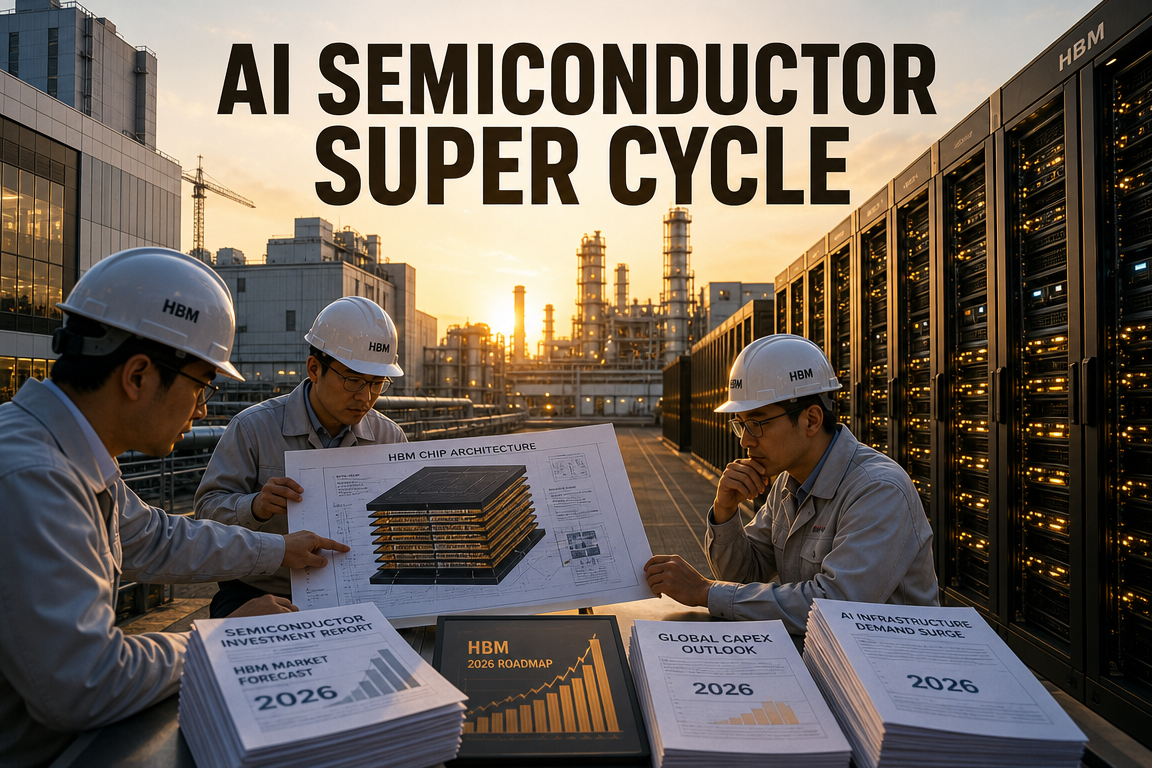
HBM is a performance-critical component for AI servers. If memory bandwidth is insufficient, accelerators become underutilized.
- Large-scale training and inference require extremely high bandwidth.
- Conventional DRAM architectures face limitations.
- HBM’s stacked structure and bandwidth profile are optimized for AI servers.
For NVIDIA and hyperscalers, securing HBM supply is a competitive constraint.
5-2. The bottleneck may be HBM rather than GPUs
While GPUs dominate investor attention, constrained HBM availability can be the binding factor determining AI infrastructure scaling speed. This is less a component shortage than a system-level capacity limiter.
6. The next stage: data centers and power infrastructure
6-1. Semiconductor-only analysis is incomplete
AI-era capacity is constrained by infrastructure below the chip layer: power delivery, cooling, networking, and optical interconnects.
- AI data centers are power-intensive.
- Without grid and on-site power capacity, server deployments cannot scale.
- Without adequate thermal management, efficiency and uptime degrade.
- Optical networking becomes more important as operators seek to reduce losses and congestion at scale.
The competitive landscape increasingly depends on power, cooling, and network readiness in addition to semiconductors.
6-2. From copper to optics: why it matters
As data centers scale, electrical loss and heat become material constraints, increasing the appeal of optical interconnects.
- Improved transmission efficiency
- Lower thermal losses
- Higher operational efficiency at large scale
This is a structural shift affecting AI infrastructure economics rather than a simple component upgrade.
7. AI bubble risk: how to frame it
7-1. Industrial bubbles and asset-market bubbles differ
- Industry view: AI remains early-stage and infrastructure build-out is incomplete.
- Asset-market view: valuation excess is visible in parts of the equity theme.
It is inaccurate to generalize that “AI is a bubble,” and also risky to assume fundamentals will always justify prevailing valuations.
7-2. The timing of de-risking matters more than the label
Bubbles can accompany high-growth platform transitions. The key issue is whether conditions exist for a near-term unwind. Ongoing Big Tech and national-level strategic competition, combined with continued data center expansion, reduces the likelihood of an immediate, broad-based pullback in infrastructure spending.
8. Under-discussed variable: defense-related AI demand
Future semiconductor demand should not be modeled only through chatbots, smartphones, and commercial data centers. Defense AI can become a significant incremental demand driver.
- AI is increasingly central to drones, autonomous systems, ISR, and battlefield analytics.
- Defense modernization translates into semiconductor demand.
- Power infrastructure and data center build-outs can also be linked to defense requirements.
Future volume (Q) expansion could be supported by both physical AI and defense AI.
9. Rates, inflation, and geopolitical risk: implications for semiconductors
9-1. The risk scenario priced by markets
- Prolonged Middle East risk
- Higher energy prices
- Re-acceleration of inflation
- Delayed rate cuts or higher-for-longer policy
- Weaker corporate capex
These factors can weigh on AI infrastructure investment.
9-2. AI capex may be comparatively resilient
AI is increasingly treated as a strategic domain rather than a conventional cyclical segment.
- Big Tech faces competitive lock-in to sustained AI investment.
- Governments classify AI as a strategic industry.
- Funding can include strategic and policy-driven capital, not only private capex.
Therefore, AI semiconductors and infrastructure may attract capital longer than typical cyclical sectors, although sensitivity to macro tightening remains.
10. Underappreciated company-specific risks: labor relations, incentive structure, talent retention
10-1. New challenges created by strong earnings
Compensation and labor-relations issues can become competitiveness issues.
- Dissatisfaction with incentive structures can raise key talent attrition risk.
- Internal equity conflicts across business units may intensify.
- Morale deterioration is possible in loss-making units such as foundry and system semiconductors.
10-2. Why this matters at the national level
Semiconductors are central to export performance and a foundational input across industries.
- Autos
- Home appliances
- Smartphones
- Displays
- Defense
Production disruption can propagate beyond semiconductor exports into broader industrial activity.
10-3. If labor disruption materializes, how far could the impact extend?
Short disruptions may be manageable. Risk rises with low inventories, higher attrition, and prolonged duration.
- Duration exceeding 2 weeks
- Expanded loss of critical process personnel
- On-time delivery risk
- Erosion of global customer confidence
In such cases, market-share loss can become structural rather than temporary.
11. Korea’s potential advantage: physical AI
This is a strategic opportunity given Korea’s industrial base:
- Semiconductors
- Automotive
- Shipbuilding
- Defense
- Home appliances
- Robotics
These sectors are directly connected to physical AI applications. With coordinated access to accelerators, HBM competitiveness, manufacturing depth, and defense capabilities, Korea can strengthen its position in AI hardware-to-industry integration.
12. Key points (news-style)
- Samsung Electronics and SK Hynix have entered a peak earnings phase.
- This cycle has been driven primarily by pricing power and HBM demand rather than unit volume growth.
- The market is split between a supercycle narrative and peak-out concerns following a pricing peak.
- On fundamentals, AI infrastructure investment and HBM demand may extend into 2026.
- Equity prices may respond more to decelerating growth rates and expectation gaps than to absolute earnings.
- Beyond HBM, data centers, power infrastructure, cooling, and optical networks are increasingly critical.
- Korea may have relative strengths in physical AI, defense AI, and manufacturing-linked AI.
- Labor relations, incentive structures, and talent retention are material operational risks.
13. Most important items often omitted in mainstream coverage
- Strong earnings and rising equity prices are not the same outcome.
- This cycle is characterized more by “selling at higher prices” than “selling more units.”
- If pricing weakens, earnings sensitivity may be larger than consensus expects.
- The next bottlenecks extend beyond HBM to power and cooling constraints.
- Physical AI and defense AI can become incremental demand engines.
- Long-term competitiveness depends on talent retention and capital allocation discipline more than headline figures.
- Korea’s opportunity set should be assessed through manufacturing-based physical AI, not only software competitiveness.
14. How to frame the outlook
It is difficult to conclude that the semiconductor operating environment will end abruptly by 2026. However, the mechanism of growth can shift.
- From a price-led profit surge
- to a phase driven by volumes and infrastructure competition
- with operating margins normalizing
- and equity performance hinging on growth rates and expectations
A robust framework requires integrating semiconductor fundamentals with AI infrastructure capacity, power and cooling constraints, geopolitical variables, labor risks, and capital-market sentiment.
< Summary >
Record-level earnings for Samsung Electronics and SK Hynix have been driven significantly by HBM-led pricing strength. From a real-economy perspective, AI infrastructure investment and semiconductor demand may persist into 2026. Equity markets, however, may react negatively to decelerating growth rates and peak pricing risk. Over time, data centers, power infrastructure, cooling, and optical networks are likely to become more important constraints. Physical AI, defense AI, talent retention, and labor relations should be incorporated into forward-looking assessments.
[Related Articles…]
- Semiconductor outlook and AI infrastructure investment trends: https://NextGenInsight.net?s=semiconductors
- HBM demand surge and data center bottlenecks: https://NextGenInsight.net?s=HBM
*Source: [ 경제 읽어주는 남자(김광석TV) ]
– [반도체 모아보기] 슈퍼사이클 vs 피크아웃 논란|삼성전자·SK하이닉스, 2026년에도 계속 갈까? | 이형수x이주완x유응준