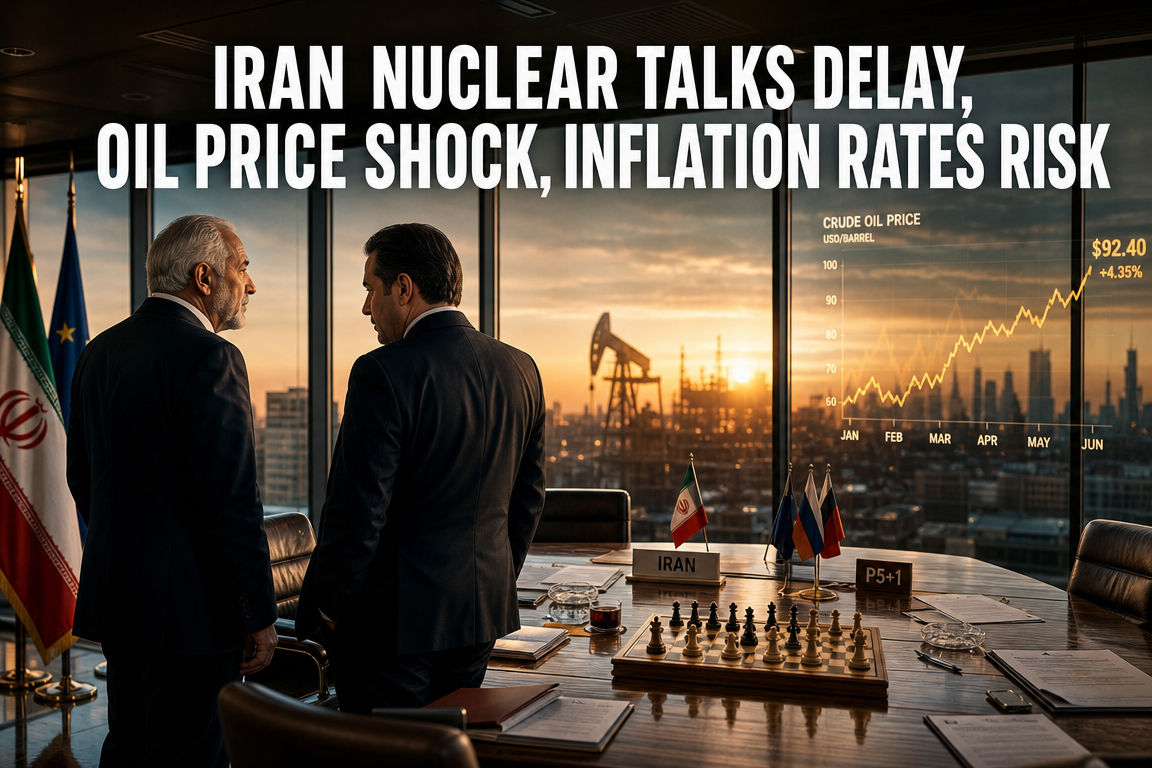
● Iran Deal Delay, Oil Shock, Inflation Threat, Market Jitters
Iran Nuclear Talks Delayed Again: Key Takeaways Moving Oil, Inflation, and Rates
This delay is not a routine diplomatic headline. It is directly linked to crude oil direction, renewed global inflation pressure, US long-end rate sensitivity, a reassessment of Middle East risk, and broader risk sentiment in equities.
This report summarizes: (i) why negotiations paused again near a potential agreement, (ii) why messaging associated with Trump is disproportionately market-relevant, (iii) how Hormuz-related supply risk transmits into the global macro backdrop, and (iv) Iran’s negotiating incentives that are under-covered in mainstream reporting.
1. Issue Snapshot: Why Markets Reacted
The negotiations have not collapsed, but the probability of a near-term comprehensive deal has declined materially.
Messaging from the Trump side can be summarized as: “Talks are constructive, but there is no need to rush.” Markets interpret this as a signal that a fast agreement is unlikely.
Investors had partially priced in:
- sanctions relief,
- a limited de-escalation framework,
- reduced Hormuz-related tensions,
- improved oil supply stability.
With expectations pushed out again, crude oil sensitivity increased and risk assets, including Bitcoin, showed modest pressure.
2. Why Talks Were Delayed Again: US–Iran Gaps
2-1. Core dispute: whether to prioritize the nuclear file
A key point is Iran’s apparent preference to exclude the nuclear issue from an initial understanding.
Iran has been assessed as prioritizing a two-step approach:1) settle non-nuclear items first (sanctions relief, de-escalation, Hormuz shipping stability, release of frozen assets),2) negotiate nuclear constraints later.
The US has been assessed as preferring a comprehensive package that includes nuclear restrictions from the outset.
This difference is significant: excluding the nuclear file would provide Iran near-term economic relief while deferring the US’s primary leverage point.
2-2. Why the US prioritized structure over speed
The phrase “time is on our side” implies a preference for an agreement with verifiable architecture rather than an ambiguous phased arrangement that could increase future risk.
US domestic politics also matter: prior nuclear arrangements are often framed as failures, raising the threshold for accepting an outcome that does not clearly block pathways to weaponization.
This delay is therefore better characterized as a dispute over agreement design than as a breakdown in negotiations.
3. Iran’s Incentives: Why Defer the Nuclear File
3-1. Acute economic constraints
Iran’s domestic economy is a binding constraint. Official-media reporting has referenced:
- elevated inflation,
- sharp increases in medicine prices,
- rising household cost burdens,
- increased strain on insurance finances.
Inflation pressure has been cited at levels exceeding 70%, indicating strong incentives to secure near-term economic relief ahead of politically costly nuclear concessions.
3-2. A phased deal is structurally advantageous for Iran
A phased approach benefits Iran by:
- avoiding immediate, stringent limits on its nuclear program,
- leveraging Hormuz stability and regional de-escalation for sanctions relief and asset release,
- enabling a domestic narrative of gains without capitulation.
3-3. Internal approval process as a timing constraint
References to remaining approvals by the Supreme Leader and the national security apparatus indicate that internal power dynamics can slow finalization even when negotiators are close to a draft.
4. Impact on Crude Oil: Why Small Headlines Move Prices
4-1. Why oil responded immediately
When progress is reported, markets price in potential increases in Iranian supply and a reduced geopolitical risk premium. When talks are delayed, the risk premium can rebuild.
Iran’s impact is amplified by its linkage to Hormuz, which carries outsized symbolic and strategic importance for energy markets.
4-2. Why the Strait of Hormuz matters
Hormuz is a critical artery for global crude transport. Even without an actual blockade, elevated tensions can raise:
- insurance costs,
- shipping costs,
- risk premia.
These channels transmit quickly into crude benchmarks and then into global prices and corporate cost structures.
4-3. Markets price prolonged uncertainty aggressively
Extended negotiation delays can be more disruptive than a single, clear shock because they keep oil, inflation expectations, and policy-path assumptions unstable simultaneously, complicating positioning and valuation.
5. Global Macro Transmission: Inflation, Rates, and Growth
5-1. Higher oil can re-accelerate inflation pressure
Higher crude feeds through to:
- freight and logistics,
- electricity and utilities,
- input commodities,
- manufacturing costs.
With inflation not fully normalized in the US and Europe, renewed energy-driven pressure can disrupt disinflation.
5-2. Rate-cut expectations can be pushed out
Persistent oil strength can make central banks more cautious. For the Federal Reserve, energy-driven inflation risk can:
- delay easing,
- support restrictive guidance,
- keep long-term yields elevated.
This matters because markets have been pricing meaningful easing expectations; higher-for-longer long-end rates increase equity valuation headwinds.
5-3. Growth faces a dual burden
Energy price increases raise corporate costs and reduce real household purchasing power, increasing the risk of a stagflationary mix (higher inflation with weaker growth).
6. Market Implications: Equities, Bitcoin, and Bonds
6-1. Equity impacts are sector-differentiated
Potential relative beneficiaries:
- energy,
- defense.
Potentially pressured areas:
- airlines,
- transportation,
- consumer sectors,
- manufacturing with high input-cost sensitivity.
In US equities, technology is particularly sensitive to long-end yields, while cyclicals can face margin pressure from higher energy costs.
6-2. Why Bitcoin softened
Despite “digital gold” narratives, Bitcoin often trades as a risk asset in the short term. In risk-off episodes tied to geopolitical uncertainty and oil instability, flows commonly favor:
- cash,
- USD,
- US Treasuries,
- gold.
6-3. Bonds: monitor long-end yields and breakevens
Higher oil can lift inflation expectations, keeping long-term yields from falling. Elevated US 10-year yields can weigh on growth stocks and other duration-sensitive assets.
This is a cross-asset macro variable spanning equities, rates, commodities, and FX.
7. News-Style Summary: Confirmed Core Points
US positioning
- Negotiations continue, but emphasis has shifted toward verifiable structure over speed.
- A comprehensive deal including nuclear constraints is preferred over a preliminary non-nuclear framework.
Iran positioning
- Iran appears to prefer securing sanctions relief and access to frozen assets first, deferring nuclear constraints to a later phase.
- Internal approval processes and political optics remain meaningful constraints.
Market reaction
- Crude oil rose modestly; Bitcoin weakened modestly.
- The move reflects renewed concern over supply risk, inflation pressure, and risk aversion.
Key watch items
- Whether a comprehensive framework re-emerges or a phased approach returns.
- Whether Hormuz-related tensions ease in practice.
- The trajectory of Iran’s internal approvals.
8. Under-Emphasized Points
8-1. The dispute is primarily about sequencing, not “peace versus conflict”
The central issue is what gets agreed first. Iran seeks economic relief first; the US seeks nuclear controls first. The delay reflects strategic conflict over sequence and structure.
8-2. Trump-linked messaging targets both diplomacy and domestic politics
“Do not rush” functions as external pressure on Iran and as domestic differentiation from prior nuclear deals. This can remain a recurring factor in the political cycle.
8-3. Iran’s inflation limits its ability to prolong negotiations indefinitely
While coverage often focuses on military options and regional tensions, Iran’s domestic economic stress may be a decisive driver of negotiating timing and pragmatism.
9. Investor Checklist
9-1. Near-term indicators
- Direction and persistence of crude’s rebound.
If crude stabilizes quickly, markets may treat the delay as noise. If it continues rising, inflation and rate concerns can reprice.
9-2. Medium-term indicators
- US sanctions posture toward Iran,
- signals around Iran’s internal approval process,
- Hormuz-related statements and incidents,
- regional diplomacy signals from neighboring Gulf states.
9-3. Asset-class framing
- Equities: energy and defense relative strength; growth equity sensitivity to long-end yields.
- Bonds: inflation expectations and term premium.
- Commodities: crude and gold dynamics.
- Digital assets: risk appetite and liquidity conditions.
10. Conclusion: A Delay, Not an Endpoint
The delay is negative for near-term certainty, but it does not imply negotiations are terminated. It may reflect a push toward a more comprehensive framework that includes nuclear verification.
From a market perspective, a longer timeline increases macro sensitivity: unstable crude prices can reintroduce inflation pressure, delay rate cuts, keep long-end yields elevated, and raise valuation headwinds across global risk assets.
< Summary >
- The US–Iran talks are not fully broken, but the likelihood of a near-term comprehensive deal has diminished as sequencing and scope remain unresolved.
- Iran appears to prioritize early economic relief (sanctions and asset access), while the US prioritizes nuclear constraints and verification.
- The delay has increased crude sensitivity and may reintroduce inflation and rate pressure.
- This is a macro-relevant catalyst linking energy pricing, monetary policy expectations, US equities, and overall risk sentiment.
[Related Articles…]
- https://NextGenInsight.net?s=international%20oil%20prices
- https://NextGenInsight.net?s=inflation
*Source: [ Maeil Business Newspaper ]
– [속보] 결국 또 연기… 협상 과정서 나온 이란의 본심 I 홍장원의 불앤베어