● Tesla-SpaceX Merger Bombshell, Musk Power Play, Market Wary
Why the Market Responded with Calculations, Not Euphoria, to CNBC’s “Tesla–SpaceX Merger” Story
This topic contains material considerations beyond a routine rumor.
Key points:
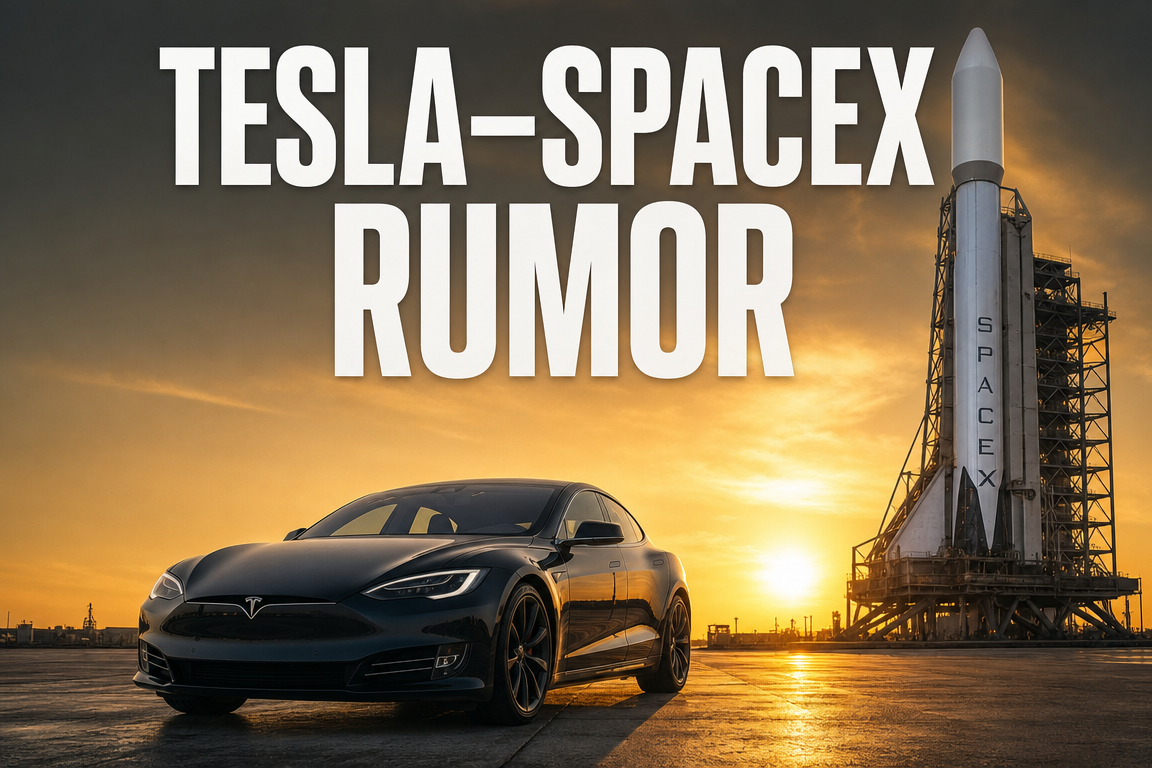
1) CNBC reported that Elon Musk has been actively discussing a potential merger of Tesla and SpaceX.
2) Prediction markets have not shown sustained, high-conviction pricing for a merger outcome.
3) Despite Tesla trading around the $433 level, equity market reaction has remained cautious rather than explosive.
This report focuses not only on whether a merger occurs, but also on why the story is resurfacing now, who could benefit under different structures, what it could mean for Tesla shareholders, and why it matters in the context of global macro conditions and AI infrastructure competition. It also highlights under-covered issues such as incentive design, governance risk, and implications for the AI infrastructure race.
1. Why Today’s Market Backdrop Matters
Tesla-related price action should be assessed alongside the broader market environment.
U.S. equities reflected improved risk appetite. Expectations of de-escalation in Middle East tensions, particularly involving Iran, contributed to lower oil prices and supported sentiment toward growth equities.
This aligns with a recurring macro pattern:
- Lower oil prices → reduced inflation pressure expectations
- Reduced geopolitical risk → weaker flight-to-safety demand
- Potential rotation toward technology and growth equities
- If rate-cut expectations persist, Nasdaq relative strength is supported
Accordingly, Tesla’s rebound is not fully attributable to idiosyncratic catalysts; macro conditions are a relevant driver.
2. Core of the CNBC Report: The Weight of “Actively Discussed”
The central claim is that Musk has been discussing a Tesla–SpaceX combination with colleagues.
This does not imply an imminent announcement. The framing suggests a serious evaluation scenario rather than an execution-ready plan.
However, market attention increased because the reporting came from a major outlet and referenced internal sourcing, rather than originating from retail speculation channels.
3. Why the Merger Narrative Resurfaced Now
Timing is relevant. A key driver is potential re-rating of SpaceX valuation.
As SpaceX approaches an IPO or IPO-adjacent valuation-setting phase, the market naturally considers combined-entity valuation scenarios.
In parallel, investor focus is increasingly drawn to the fact that AI, space, mobility, satellite communications, and robotics are being developed across entities under a single controlling figure. This is also consistent with an industry-level theme: platform boundaries across sectors are increasingly blurred.
4. How Interconnected Tesla and SpaceX Already Are
The report highlights that intercompany linkages may be deeper than commonly assumed.
4-1. Commercial Transactions
SpaceX has reportedly purchased Tesla Megapacks at scale for energy infrastructure uses.
Cybertruck purchases have also been reported at meaningful scale.
These appear to be operationally relevant procurements rather than symbolic collaboration.
4-2. Capital Linkages
Tesla invested in Musk’s AI company, xAI. If xAI is structurally connected to SpaceX, Tesla shareholders may already have indirect exposure to parts of the SpaceX ecosystem.
This implies economic linkage even without a legal merger.
4-3. Supply Chain and Resource Allocation
Past reports of Nvidia GPU allocation shifting from Tesla toward xAI illustrate a broader point: Musk’s businesses may function as a consolidated demand base from suppliers’ perspectives.
In a period of accelerating demand for AI semiconductors, data centers, and power, this is a sensitive consideration.
The market’s practical question becomes: if the ecosystem is increasingly integrated operationally, what is the rationale for maintaining formal separation?
5. Why Prediction Markets Remain Cautious
Despite elevated social and media attention, prediction markets have not converged on a high-probability outcome.
Platforms such as Kalshi and Polymarket reflect capital-at-risk probability setting rather than sentiment polling, and therefore tend to incorporate execution risk more explicitly.
Observed pricing behavior is consistent with the following interpretation:
- The concept is compelling
- The strategic rationale can be articulated
- Management intent may exist
- Execution barriers remain high
Markets are differentiating between theoretical feasibility and implementation probability.
6. The Potential Primary Catalyst: Incentive Design, Not Synergy
A critical but under-emphasized issue is management incentive structure.
While the headline narrative centers on strategic synergy and an “AI empire” framing, the underlying economic driver could relate to Musk’s compensation or performance milestones tied to SpaceX valuation targets.
If compensation is linked to valuation thresholds, constructing a larger valuation base via structural consolidation may be more attractive than pursuing independent value accretion across separate entities.
For investors, this distinction is material: a transaction motivated by shareholder value maximization differs from one optimized for control and incentive outcomes.
7. Does Musk Have the Ability to Execute?
SpaceX governance is generally viewed as highly founder-controlled, enabling decisive strategic direction-setting.
Tesla differs materially: it is a public company with a broad shareholder base, higher institutional oversight, and greater regulatory and litigation exposure. Consequently, structural resistance is more likely to arise on the Tesla side.
Key issues would include:
- Which entity is the acquirer
- Equity exchange ratio methodology
- Dilution magnitude for existing Tesla shareholders
- Post-merger governance and control allocation
- Minority shareholder protection mechanisms
8. Implications for Tesla Shareholders
This is primarily an investor question.
8-1. Bull Case
Supporters frame the scenario as a potential AI infrastructure super-platform.
Tesla is positioned beyond EV manufacturing, with capabilities in:
- Grid-scale storage
- Robotics
- Autonomy
- Data collection and fleet distribution
- Physical manufacturing and deployment
SpaceX provides:
- Launch capability
- Satellite networks
- Starlink
- Space infrastructure
- Global communications coverage
Combined, this would not resemble a conventional industrial merger, but rather a vertically and horizontally integrated platform spanning energy, communications, mobility, AI compute demands, and deployment.
In AI competition, model quality alone is insufficient; power, data, networking, compute, and distribution capacity increasingly matter.
8-2. Bear Case
Skeptical views emphasize transaction mechanics and valuation discipline.
If Tesla were to acquire SpaceX via substantial equity issuance, Tesla shareholders could face meaningful dilution.
The higher SpaceX’s valuation, the greater the risk that Tesla shareholders view the transaction as overpaying.
In addition, greater structural complexity could increase governance and regulatory overhang and introduce a conglomerate discount, particularly given Tesla’s already debated valuation.
“Good asset + good asset = higher multiple” is not assured; complexity, conflicts of interest, and governance risk can compress valuation.
9. Why Tesla Shares Did Not Spike
A restrained equity response is consistent with:
- No official announcement
- No disclosed plan in regulatory filings
- High structural and execution complexity
- Unclear distribution of benefits across constituencies
Large-cap equities typically react more to terms and conditions than narrative. Without deal structure, pricing remains constrained.
10. Why This Matters for the Global Macro and AI Outlook
This is not solely an individual-company story. It contains signals about broader economic and technological trajectories.
10-1. Erosion of Industry Boundaries
Legacy separations among automotive, aerospace, telecom, and AI are weakening.
Competitive advantage increasingly accrues to entities controlling data, power, compute, networks, and hardware simultaneously.
10-2. AI Competition as an Infrastructure and Capital Contest
AI is no longer purely a software domain. It requires:
- Semiconductors
- Power grids
- Cooling
- Data centers
- Network infrastructure
- Satellite connectivity
- Robotics
This implies competitive outcomes may depend on who controls the most complete infrastructure stack, not merely who has the best model.
10-3. Rates and Liquidity Sensitivity
Mega-transactions are sensitive to liquidity conditions.
When rate-cut expectations support higher growth equity valuations, stock-for-stock M&A becomes more feasible. If monetary tightening re-accelerates, execution timelines may extend or stall.
Accordingly, the narrative intersects with inflation, rate expectations, and broader U.S. equity regime dynamics.
11. Related Developments with Incremental Significance
11-1. Expansion of Supercharger Access in Europe
Opening Tesla’s Supercharger network to additional OEMs (e.g., Volvo EVs) supports the view that charging is evolving from a proprietary competitive lever into an independent infrastructure revenue stream, potentially supporting re-rating of the energy and charging segment.
11-2. Camera Lens Cleaning Patent
Seemingly minor hardware features can be critical for autonomy reliability. Sensor contamination is a practical failure mode; addressing such operational constraints may be a gating factor for FSD and robotaxi commercialization.
11-3. Growing Airline Adoption of Starlink
Broader in-flight connectivity adoption reinforces SpaceX’s positioning not only as an aerospace company but as a cash-flow-generating communications infrastructure provider, which can influence valuation frameworks relevant to any combination scenario.
12. Under-Covered but High-Impact Considerations
12-1. The Core May Be Control Optimization More Than Synergy
The public rationale may emphasize ecosystem integration, while the functional objective could be tighter control of multiple assets within a single capital markets framework.
Shareholders prioritize synergy; founders may prioritize control and incentive alignment.
12-2. Markets May Trust the Vision, but Not Yet the Structure
A limited price reaction does not necessarily reflect rejection of strategic ambition; it reflects uncertainty about whether transaction terms would be shareholder-aligned.
12-3. AI Winners May Be Determined by Infrastructure Completeness
The market focus appears centered on model performance, but competitive outcomes may hinge on integrated access to power, networks, mobility platforms, satellites, robotics, and data capture.
From this perspective, Tesla–SpaceX linkage functions as a signal about next-cycle industrial organization.
12-4. Even Without a Merger, Integration May Intensify
Legal merger status is not the sole determinant of practical integration.
Cross-entity capital ties, procurement, staffing, and AI resource allocation are already increasing. As a result, both synergies and conflicts of interest may expand even absent a formal transaction.
13. Variables to Monitor
- Official SpaceX IPO-related materials or formal valuation disclosures
- Changes in Tesla investment activity and ownership structure
- Asset or resource transfers among xAI, SpaceX, and Tesla
- Equity issuance probability and dilution risk
- U.S. regulatory and antitrust posture
- Reactions from institutional investors and Tesla shareholders
- Direct statements from Musk
14. One-Line Summary
This is less a routine rumor than a test of whether Musk’s asset ecosystem can be consolidated into a coherent capital markets structure spanning AI, space, and mobility; markets are withholding full endorsement pending clarity on terms, governance, and shareholder benefit allocation.
< Summary >
CNBC reported that Elon Musk has been actively discussing a Tesla–SpaceX merger.
However, prediction markets have not priced the outcome as certain, reflecting high execution barriers and potential shareholder conflicts.
While the stated rationale centers on AI ecosystem integration and expanded capital capacity, a key underlying issue may be Musk’s incentive structure and governance consolidation.
For Tesla shareholders, the upside is exposure to a potential platform-scale infrastructure entity, while near-term risks include dilution, valuation discipline concerns, and complex exchange mechanics.
Overall, the topic is relevant not only to Tesla but also to AI infrastructure trends, U.S. equity regime dynamics, and the evolving structure of the global economy.
[Related Articles…]
-
Tesla Stock and Autonomy Momentum: The Core Points the Market Is Repricing
https://NextGenInsight.net?s=Tesla -
The AI Infrastructure War and U.S. Equities: Who Could Be the Next Big Tech Winner
https://NextGenInsight.net?s=AI
*Source: [ 오늘의 테슬라 뉴스 ]
– CNBC “테슬라·스페이스X 합병 실제 논의” — 그런데 정작 베팅하는 돈은 왜 빠지고 있나, $433 주주는?
● Memory Boom-Samsung, Hynix Surge
The Underlying Drivers of Today’s Sharp Gains in Samsung Electronics and SK Hynix: Key Factors Beyond a Simple “Semiconductor Rally”
Today’s market move is easy to misread as a generic “semiconductors up” session. The advance reflects a convergence of: (i) a U.S.-led reassessment of the memory cycle, (ii) upward target revisions for Micron, (iii) valuation re-rating of Korea’s large-cap semiconductor complex, and (iv) incremental flows linked to domestic single-stock leveraged ETF launches.
The strength in Samsung Electronics and SK Hynix is therefore better interpreted as an early signal that the semiconductor industry is regaining a premium within global equity markets, rather than as a purely thematic rebound.
This report summarizes how U.S. developments transmitted into Korean semiconductor performance, the implications for the KOSPI, the critical variables to monitor, and under-discussed drivers.
Market Snapshot: Summary of the Drivers Behind the Samsung Electronics and SK Hynix Surge
On May 27, the rally in Samsung Electronics and SK Hynix was primarily driven by two factors:
1) A sharp rise in Micron shares in the U.S. market.
2) expectations for demand/flow effects following the listing of single-stock leveraged ETFs referencing Samsung Electronics and SK Hynix.
In combination, improved offshore semiconductor risk appetite and a domestic flow mechanism reinforced upside momentum.
1. What Changed in the U.S.: The Signal from Micron’s Surge
UBS Research Shifted Market Framing
Micron’s strong performance overnight was catalyzed by a UBS report raising its target price. The more material point was not the target increase itself, but the implied reframing of the sector’s earnings profile.
Historically, memory has been treated as highly cyclical: strong profitability in upcycles and rapid deterioration in downcycles, leading to structurally conservative valuation multiples.
The current thesis differs: HBM penetration, AI server memory demand, and a greater share of longer-term supply arrangements may reduce earnings volatility versus prior cycles. This supports the view that memory is increasingly linked to AI infrastructure build-out rather than solely to macro-sensitive cycles.
Why Micron’s Re-rating Transmits to Samsung Electronics and SK Hynix
The global memory market is tightly linked across Micron, Samsung Electronics, and SK Hynix. When the U.S. market re-rates Micron’s earnings durability, Korean peers tend to reprice under a similar framework (“valuation alignment”).
SK Hynix is viewed as a more direct beneficiary given leadership in HBM. Samsung Electronics may also benefit if investors gain confidence in a recovery in HBM execution and advanced packaging competitiveness, potentially reinforcing foreign inflows.
2. Why the Move Was Larger Domestically: Single-Stock Leveraged ETF Effects
Why Today’s Listing Event Matters
The listing of single-stock leveraged ETFs tied to Samsung Electronics and SK Hynix is not a routine product launch. It introduces a higher-beta channel for directional positioning, enabling faster and more concentrated capital deployment into the underlying names.
Early activity in some products drew significant turnover, increasing market attention. By design, single-stock leveraged structures amplify volatility: they tend to intensify upside moves during rallies while increasing sensitivity during pullbacks.
Given the large index weight of Samsung Electronics and SK Hynix, this mechanism can transmit into broader KOSPI risk sentiment.
Why Flows Matter
Equities are not driven by fundamentals alone. Even with improving earnings expectations, upside can be capped without incremental demand. Conversely, when fundamental expectations and flows align, price action can accelerate over short horizons.
This session reflected a simultaneous improvement in cycle expectations and a reinforcement from flow dynamics.
3. Company Lens: How to Frame Each Name
Samsung Electronics: Potential Large-Cap Re-rating
Samsung Electronics is not just a semiconductor exposure; it is a key determinant of KOSPI direction and a core conduit for foreign positioning in Korean equities. As a result, its strength often reflects broader risk-on conditions.
Key variables to monitor:
- whether memory-cycle improvement translates into a sustained earnings turnaround;
- progress in HBM and advanced packaging competitiveness within AI supply chains;
- whether foreign buying persists beyond a single-session event.
Sustained upside in Samsung Electronics typically supports broader index participation rather than remaining isolated to the stock.
SK Hynix: Primary Listed Proxy for AI Memory
SK Hynix is increasingly treated as the leading listed proxy for AI memory, driven by HBM leadership, expectations for major AI accelerator supply chains, and structural demand for high-performance memory.
This positioning explains higher sensitivity to Micron-led re-rating events. Investors are focusing less on conventional DRAM pricing alone and more on the durability of high-value memory demand under continued data center expansion.
SK Hynix is therefore being positioned as both a cyclical memory name and, increasingly, a structurally linked AI infrastructure beneficiary.
4. Implications for the KOSPI
KOSPI Sensitivity to Semiconductor Leadership
KOSPI has a high semiconductor weight. Concurrent strength in Samsung Electronics and SK Hynix can materially change index tone. Foreign investors typically assess Korea through the semiconductor lens; improved industry conditions can support broader market inflows.
In this context, today’s move can be interpreted as renewed traction in Korea’s principal growth engine.
Can the Tailwinds Extend Through 2026?
The notion of a multi-year supportive environment is not purely aspirational if AI infrastructure investment, data center capacity additions, HBM demand growth, and server refresh cycles remain intact.
Key conditions:
- memory price improvement must translate into realized earnings;
- the cycle must avoid a supply-driven overshoot;
- U.S. rates, USD dynamics, and global growth risk remain critical constraints.
5. Key Points (News-Style Summary)
- Micron rallied sharply on a UBS target-price upgrade.
- Markets increasingly emphasize the potential for reduced earnings volatility in memory, supporting valuation re-rating.
- Samsung Electronics and SK Hynix strengthened in sympathy as Korea’s memory complex repriced.
- The listing of single-stock leveraged ETFs tied to both names likely added incremental flow expectations.
- The combination of U.S.-led cycle optimism and domestic flow catalysts improved broader KOSPI sentiment.
6. Under-Discussed but Material Takeaway
The Core Issue Is a Potential Shift in Market Classification
Many narratives reduce the move to “Micron up, Korea memory up.” The more consequential development is how the market is classifying memory producers.
Historically categorized as cyclical, memory companies are increasingly viewed as core AI infrastructure suppliers. If earnings visibility improves, the sector can command higher multiples than typical cyclical frameworks allow.
Accordingly, the move may reflect not only short-term momentum but also early evidence of a potential change in the sector’s market status.
Leveraged ETF Listings Can Amplify Both Upside and Downside
While the new products can add momentum during rallies, the same structure can accelerate drawdowns during corrections. Investors should monitor not only turnover spikes but also the persistence and composition of flows.
7. Practical Investor Checklist
Positive Signals
- global improvement in memory-cycle expectations;
- sustained demand for AI-related semiconductors;
- high index impact and flow concentration into Samsung Electronics and SK Hynix;
- potential for simultaneous engagement by foreign and domestic investors.
Risk Signals
- memory remains sensitive to supply/demand shifts;
- elevated HBM expectations increase downside risk if delivery or earnings underwhelm;
- leveraged ETFs mechanically increase volatility;
- higher U.S. rates, FX pressure, or global slowdown concerns can trigger short-term corrections.
8. One-Sentence Summary
Today’s sharp gains in Samsung Electronics and SK Hynix reflect a U.S.-led re-rating of memory as AI infrastructure exposure, reinforced by domestic flow catalysts, with potential implications for broader KOSPI risk sentiment.
- Micron’s surge supported a reassessment of memory earnings durability and valuation.
- Samsung Electronics and SK Hynix rose in tandem, with single-stock leveraged ETF listings adding flow momentum.
- The key issue is the potential reclassification of memory producers from cyclical stocks toward AI-linked structural growth exposures.
- Leveraged ETF flows can magnify rallies but also increase downside volatility; earnings delivery and macro conditions remain essential monitoring points.
[Related…]
- Semiconductor cycle recovery and KOSPI direction: key variables to monitor (NextGenInsight.net?s=semiconductors)
- Impact of expanding AI infrastructure investment on Korean equities (NextGenInsight.net?s=AI)
*Source: [ 내일은 투자왕 – 김단테 ]
– #삼성전자 #하이닉스 오늘도 떡상하는 이유 (5월 27일)