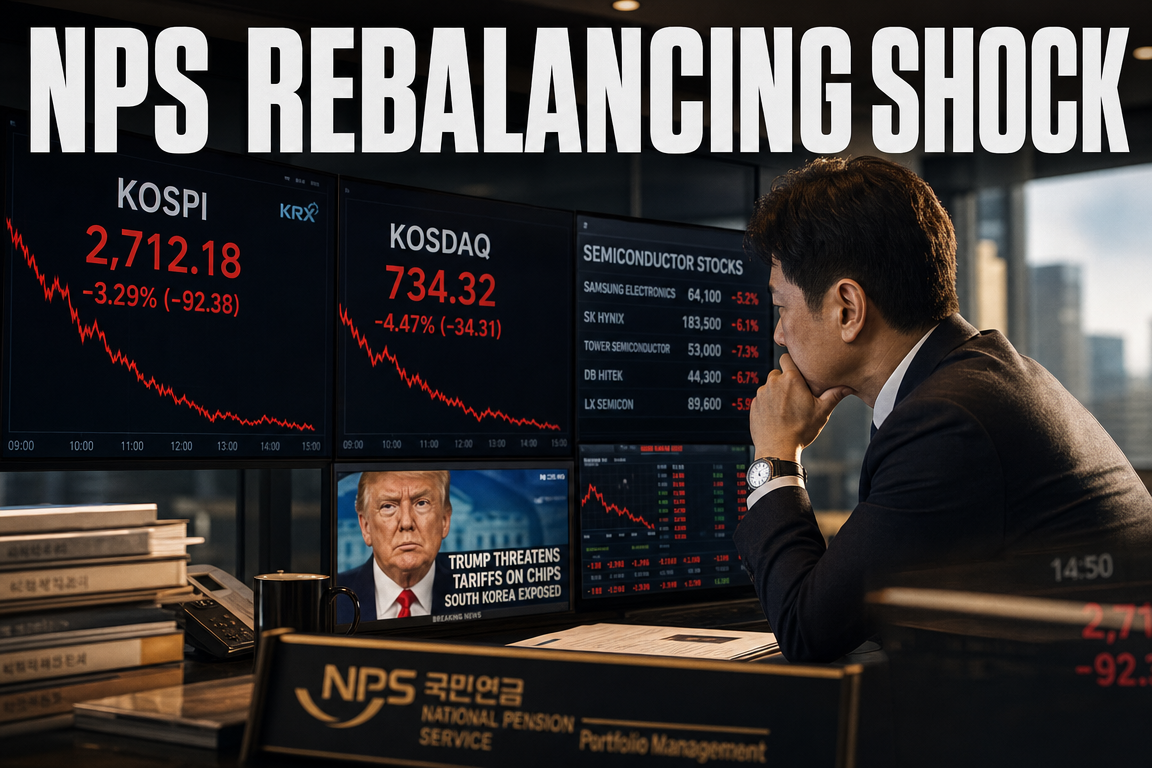
● NPS Selloff Shock, KOSPI Crash Fears
Potential KOSPI Sell-Off on June 3 Driven by the National Pension Service Rebalancing? Key Claims, Facts, and Variables to Monitor
A widely circulated market narrative argues that a large-scale equity sale by the National Pension Service (NPS) could trigger a sharp decline in the KOSPI. This topic contains a mix of verifiable facts and common misconceptions. This report consolidates the core issues: NPS rebalancing mechanics, the relationship between foreign flows and the index, the drivers behind Samsung Electronics and SK Hynix performance, and the primary variables investors should monitor into June.
1. Bottom line: The claim that the NPS “pushed the KOSPI to 8,000” is not supported by evidence
A key misconception is that recent KOSPI gains were primarily driven by NPS buying pressure.
- There is no clear evidence that the NPS was an aggressive net buyer during the rally.
- On an aggregate basis, domestic pension-related flows have been closer to net selling year-to-date.
- The more plausible interpretation is that the NPS largely maintained holdings or executed limited adjustments rather than materially lifting the market.
Conclusion: Characterizing the recent rally as an artificial, NPS-driven distortion is not well supported.
2. Why the market is highly sensitive to the NPS rebalancing issue
The narrative persists because of the perception that the NPS holds domestic equities above its strategic allocation target. If the fund were to mechanically reduce exposure, selling volume could be meaningful.
2-1. The market’s feared scenario
- The NPS initiates a large, rapid sale to bring domestic equity weights back to target.
- Selling concentrates in index heavyweights such as Samsung Electronics and SK Hynix.
- The resulting supply shock drives an abrupt index decline.
2-2. The scenario is directionally plausible, but key assumptions are missing
- A rapid, concentrated sale could pressure prices, particularly given the KOSPI’s heavyweight concentration.
- However, the assumption that the NPS must immediately sell in a mechanical manner is not necessarily valid.
2-3. Core fact: The NPS has previously operated under a rebalancing deferral posture
- The NPS has demonstrated flexibility via rebalancing deferrals.
- Exceeding target weights does not automatically imply immediate forced selling.
- As a systemically significant allocator, the NPS typically evaluates market stability, pacing, and implementation methods (e.g., phased execution, time diversification).
Implication: Claims framing rebalancing as unavoidable, immediate, and mechanical oversimplify the decision process.
3. The critical factor is not “June 3,” but the timing and structure of the rebalancing decision
Market narratives often anchor fear to a specific date. The more relevant variable is when and how asset allocation and rebalancing parameters are finalized and implemented.
- The decision content (scale, pace, instruments, and timing) matters more than the calendar date itself.
- Date-driven sell-off narratives should be treated as noise unless supported by confirmed policy action.
4. The rally in Samsung Electronics and SK Hynix is more consistent with a global semiconductor cycle than with NPS flows
Recent index strength has been concentrated in Samsung Electronics and SK Hynix, leading some to attribute gains to domestic flow distortion. Cross-market comparison suggests a more global driver set.
4-1. The move is not unique to Korea
In memory upcycles, correlated gains typically appear across the global semiconductor complex, including US and Japanese ecosystem names.
- A domestic-flow-only explanation is incomplete.
- A more consistent framework includes global semiconductor recovery, AI infrastructure capex, and expectations of improving memory pricing.
4-2. The key question is global co-movement, not whether Korea alone is overheated
- A distorted, local-only rally would likely show Korea materially decoupling from global peers.
- Broad sector strength across regions supports the view that industry cycle factors are playing a larger role than domestic flow effects.
5. Foreign selling: risk signal, but not a deterministic trigger for a KOSPI decline
Foreign net selling is often interpreted as an immediate bearish signal. Historical patterns show the relationship is not stable.
5-1. Foreign selling has coincided with prior bullish phases
Past KOSPI uptrends included periods where foreign investors were net sellers while the index rose, driven by combinations of domestic flows, sector leadership, and global cycle expectations.
5-2. “Foreigners” are not a single decision-making entity
Foreign flow data aggregates heterogeneous actors with different mandates, benchmarks, and risk constraints. Simultaneous selling and buying by different foreign strategies is common.
5-3. Recent foreign selling may reflect sector rebalancing rather than broad Korea risk-off
A plausible interpretation is profit-taking or exposure reduction in outperforming semiconductor positions, consistent with standard global portfolio rebalancing behavior.
Investor focus should shift from headline net selling to:
- What is being sold vs. bought (sector and name-level detail)
- Changes in foreign ownership levels
- Positioning relative to benchmarks
6. The claim that “there is no buyer base to absorb NPS selling” is overstated
This argument assumes domestic markets lack sufficient incremental capital to absorb large sales.
6-1. Available liquidity is material
Domestic financial markets hold sizable pools of deployable capital (e.g., brokerage cash balances, CMA, MMF, and other short-duration instruments). While not all funds convert to equities immediately, the assertion of no absorption capacity is not accurate.
Potential buyers may include:
- Retail flows
- Domestic institutions
- Foreign investors with differentiated views
- Passive ETF flows
6-2. Market impact depends more on execution speed than total volume
- Large volumes can be absorbed if distributed over time.
- Concentrated, short-duration selling increases impact and volatility.
Key monitoring question: implementation path (paced vs. front-loaded), not just theoretical aggregate size.
7. A near-term correction is possible, but not solely attributable to NPS rebalancing
Rejecting an exaggerated narrative does not eliminate downside risk.
7-1. Technical overheating indicators warrant attention
A rapid advance can generate overextension signals (e.g., widened gaps versus moving averages). These conditions can produce consolidation even without a discrete catalyst.
7-2. Corrections are typically multi-causal
Relevant concurrent variables include:
- US rates and expectations
- Global growth deceleration risk
- FX volatility
- Semiconductor expectations already priced in
- Peak earnings concerns
- Profit-taking and positioning
NPS rebalancing is one potential pressure factor, not necessarily the dominant driver.
8. News-style key points
Issue 1. The claim that NPS flows drove the KOSPI rally lacks strong evidence.
Pension-related aggregate flows have leaned closer to net selling year-to-date.
Issue 2. NPS rebalancing is a legitimate market overhang.
However, exceeding target allocations does not imply immediate mechanical selling; deferral and phased execution are plausible.
Issue 3. Gains in Samsung Electronics and SK Hynix align more with global semiconductor recovery than with NPS effects.
Cross-market sector co-movement is a key supporting datapoint.
Issue 4. Foreign net selling does not automatically imply an imminent index collapse.
Selling may be consistent with sector rotation and rebalancing rather than a broad abandonment of Korea exposure.
Issue 5. Downside risk remains.
Attribution should incorporate technical conditions and global macro variables, not a single domestic-flow narrative.
9. Under-discussed but high-importance points
9-1. Date-based fear narratives are marketing; markets price structure and implementation
The relevant question is not whether a specific date becomes a turning point, but how policy decisions translate into executable flow.
9-2. Semiconductor cycle durability is likely more important than the NPS headline
Near- to medium-term index direction is likely to be more sensitive to semiconductor earnings momentum than to a single flow narrative, including:
- Sustainability of AI server capex
- Memory demand trajectory
- HBM and high value-added memory pricing and supply dynamics
Flow variables affect short-term pricing; earnings variables dominate over longer horizons.
9-3. Ownership levels and sector positioning matter more than headline foreign net flow
A more actionable framework emphasizes:
- Changes in foreign ownership ratios
- Sector-level positioning shifts
- Whether selling is concentrated in semiconductors or offset by buying in other sectors
10. Practical investor checklist
10-1. Treat the NPS issue as a manageable flow variable, not a confirmed crash catalyst
Monitor official communication, execution design, and pacing rather than extrapolating worst-case scenarios.
10-2. A KOSPI framework should integrate semiconductors, FX, US rates, and global liquidity
Korea is structurally sensitive to semiconductors and external macro conditions; domestic policy narratives alone are insufficient.
10-3. In overheated conditions, risk management can dominate return maximization
Operational considerations include:
- Cash allocation
- Staggered entries and exits
- Sector diversification
Avoid binary positioning based on extreme narratives.
11. Final synthesis
NPS rebalancing can represent a meaningful overhang for the KOSPI. However, the claim of an inevitable, immediate large-scale sell-down culminating in a sharp collapse tied to a single date is not well substantiated.
Recent market strength is more consistent with semiconductor cycle recovery, global technology momentum, domestic flows, and shifting expectations. Foreign selling may reflect sector-level rebalancing rather than a broad Korea risk-off signal.
The primary requirement is disciplined differentiation between flow-driven headlines and fundamentals-driven drivers, with emphasis on policy execution details, semiconductor earnings durability, and macro conditions.
< Summary >
- The assertion that the NPS drove the KOSPI surge lacks strong supporting evidence.
- Rebalancing is a legitimate overhang, but immediate mechanical mass selling is not a base-case assumption.
- Samsung Electronics and SK Hynix performance is more consistent with global semiconductor cycle factors.
- Foreign selling may reflect sector rebalancing rather than broad Korea abandonment.
- A correction is possible, but attributing it solely to an NPS narrative is not analytically robust.
- The key variables are policy implementation details and semiconductor earnings momentum, not a specific fear-driven date.
[Related Articles…]
- NPS rebalancing and key implications for domestic equities: https://NextGenInsight.net?s=NPS
- How the semiconductor recovery may affect the KOSPI outlook: https://NextGenInsight.net?s=semiconductors
*Source: [ 내일은 투자왕 – 김단테 ]
– 6월 3일 코스피 대폭락한다고? 증시 괴담에 대한 저의 생각
● Trump Shock, Pentagon Picks, AI Surge
Why Do Prices Rise When Trump Mentions a Name? This Is No Longer a “Political Theme” Trade; It Is the Era of U.S. Strategic-Asset Investing
One of the strongest current market currents is not a simple rotation among theme stocks.
The driver is structural.
The U.S. government is increasingly treating semiconductors, quantum computing, memory, critical minerals, nuclear power, and space/defense not merely as subsidy targets, but as domains for direct capital deployment and strategic national-asset management.
This report goes beyond the idea that “a stock rose because Trump mentioned it” and addresses:
- why Intel, IBM, Micron, Dell, and space-related equities are attracting attention simultaneously,
- which industries are most likely to be next in the context of U.S. economic strategy and supply-chain reconfiguration,
- which macro market framework matters more than individual tickers, and
- the key points often missed in mainstream coverage.
The current setup is best understood by connecting U.S. equities, semiconductor investment, the AI value chain, quantum computing, and supply-chain restructuring in a single framework.
1. Core Issue: Not Trump’s “Influence,” but a Shift in U.S. Industrial Investment Mechanics
At the surface level, the narrative can be reduced to “stocks rise when Trump names them.”
Intel, Dell, Micron, and quantum-computing-linked equities have, in practice, responded quickly to political remarks and administration announcements.
The more material point is that this reflects an industrial-policy evolution: the U.S. is moving toward direct capital deployment into strategic sectors to strengthen national security and industrial competitiveness.
Where prior policy leaned on subsidies, tax incentives, and deregulation, the direction increasingly resembles “the government will invest directly when required.”
This distinction is material: subsidies provide support, whereas equity-style investment aligns incentives around scaling outcomes.
In effect, strategic industries are being treated as core assets within a national portfolio.
2. Why the Quantum Computing Investment Announcement Moved Markets
U.S. Department of Commerce: Direct Funding Into Quantum Computing
A key signal was the Department of Commerce announcing investment into quantum computing.
The total is reported at approximately $2.0 billion, allocated across nine companies.
The key message is not concentration in a single name, but an intent to scale the quantum ecosystem at a national level.
The stated rationale is clear: maintaining AI leadership and strengthening national security.
Quantum computing is being positioned less as an experimental technology and more as a security- and dominance-critical capability.
Why IBM Was Viewed as a Primary Beneficiary
Among the nine recipients, IBM reportedly received the largest allocation, approximately $1.0 billion.
IBM is expected to add roughly $1.0 billion of internal capital, implying a combined ~$2.0 billion program to build a U.S.-based quantum-computing-dedicated foundry.
Conceptually, this resembles an effort to create a “TSMC analogue for quantum chips.”
This matters because while markets are focused on AI semiconductors, U.S. policy appears to be extending to the next layer: a domestic manufacturing stack for quantum hardware.
Industry-Level Investment Is the More Important Signal
The policy signal is more informative than any single-company outcome.
Given multiple competing technical approaches and unclear eventual winners at this stage, capital is being diversified across several pathways.
This resembles a venture-style portfolio approach aimed at increasing the probability of sector-wide success rather than selecting a single champion.
3. The Intel “Recovery” Narrative: From Earnings Cycles to Strategic Asset Status
Intel Is No Longer Treated as a Conventional Semiconductor Company
A notable data point was management indicating periodic progress updates to the President.
Such direct reporting is atypical for a standard public company and implies Intel is being managed as a pillar of domestic semiconductor self-sufficiency and industrial policy.
Why Intel Is Strategically Distinct
From a U.S. perspective, the priority is not only strong design capability but domestic manufacturing capacity.
Even if TSMC and Samsung lead technologically, they are not U.S. firms.
To mitigate geopolitical and supply-chain risk, the U.S. seeks leading-edge fabrication capability onshore. Intel remains a principal candidate to anchor that effort.
Advance Funding and a Policy-Driven Recovery Push
Intel faced multi-year competitiveness erosion and weak operating performance.
Recent dynamics have shifted, with the government advancing semiconductor support and the company accelerating hiring and capacity rebuilding.
A central implication is that market-only logic is insufficient to explain the policy posture. Intel is increasingly framed as a “must-succeed” asset rather than simply a “nice-to-have” turnaround.
4. Why Micron Is Emerging as the Next Strategic Pillar
Scarcity Value: The Only Major U.S. Memory Manufacturer
Micron’s relevance extends beyond near-term earnings expectations.
Its strategic significance stems from being the only major U.S.-based memory manufacturer.
Memory is foundational for AI servers, data centers, defense systems, cloud infrastructure, and autonomous systems. Heavy offshore concentration creates strategic vulnerability.
Supply-Chain Reconfiguration as a Structural Tailwind
Company messaging emphasizes not only technology, but U.S. identity and the feasibility of expanding domestic production.
While current U.S. memory manufacturing share is limited, medium-term plans target a meaningful increase, aligned with government objectives.
Micron can therefore be interpreted as both an AI-cycle beneficiary and a core component of reshoring strategy.
Why Intel and Micron Should Be Viewed Together
Intel represents foundry and logic manufacturing sovereignty; Micron represents memory sovereignty.
A credible onshore semiconductor supply chain requires both pillars.
Accordingly, semiconductor investment should not be assessed solely through demand for AI accelerators; it also reflects a manufacturing-ecosystem restoration agenda.
5. Why Dell Attracted Attention: Not Just a Server Vendor, but a “U.S. Industrial Revival” Proxy
Trump’s favorable public reference to Dell drew market attention.
The relevance is not rhetorical; Dell sits at the intersection of AI servers, data-center infrastructure, and domestic investment expansion.
In addition, the firm can be perceived as politically aligned with pro-manufacturing narratives, reinforcing its positioning as a “U.S.-friendly” infrastructure name.
The market is increasingly valuing Dell as part of the AI infrastructure buildout rather than as a legacy PC manufacturer.
6. Potential Next Targets: Nuclear Power, Rare Earths, Lithium, Space/Defense
1) Nuclear Power: A Leading Candidate
Nuclear power appears among the most plausible next sectors.
AI-driven data-center expansion is increasing electricity demand, while nuclear can address both decarbonization objectives and energy security.
For policymakers, nuclear connects national security, industrial competitiveness, and grid reliability within a single strategic framework.
2) Rare Earths and Lithium: Core Nodes in the Supply-Chain Contest
Critical minerals such as rare earths and lithium are already treated as strategic assets.
They underpin EVs, batteries, defense, semiconductors, and advanced equipment.
As pressure increases to reduce dependence on China, policy support for domestic and allied supply chains is likely to remain prominent.
In a reshoring framework, upstream materials are not secondary; they are foundational inputs for industrial rebuilding.
3) Space/Defense: An Area Less Fully Reflected by Markets
Recent signals around space policy are notable.
References to SpaceX, concepts such as space-based data-center infrastructure, satellite-enabled power utilization, and renewed emphasis on “space force” imagery support the interpretation that space is being framed as strategic infrastructure, not a purely commercial sector.
Space and defense are tightly coupled via ISR, communications, missile defense, data connectivity, power, and AI compute. This linkage can accelerate space’s elevation within strategic-asset prioritization.
7. SpaceX and the Space Theme: Why Reassessment Is Warranted
Space Is Shifting From Long-Duration Optionality to Security and Infrastructure
Historically, space was treated largely as a long-term growth narrative.
In an AI-driven economy, the importance of communications, data transmission, LEO satellite networks, defense integration, and global internet infrastructure has increased materially.
Space is increasingly framed as an infrastructure layer connecting data, energy, and security.
The Signaling Value of SpaceX
SpaceX remains central to this stack through launch capability, Starlink connectivity, and potential AI-adjacent integration.
While its financial profile reflects heavy investment, its strategic platform characteristics and security relevance can sustain policy and market attention.
Why ETF Exposure May Be More Practical
Space equities are highly volatile, with complex business models, irregular revenue recognition, and sensitivity to government contracts.
As a result, diversified exposure via space-focused ETFs is often a more practical risk-management approach, particularly where vehicles provide broader exposure including private-market linkages.
8. Key Investor Interpretation: Focus on “Industries the U.S. Must Secure,” Not “Trump Mentions”
A narrow, short-term framing leads to the question: “Should investors buy whatever Trump names?”
A more actionable framework is identifying which industries the U.S. treats as essential to national security and economic leadership.
The common set includes:
- semiconductor manufacturing
- memory
- quantum computing
- critical minerals and rare earths
- nuclear power and grid infrastructure
- space/defense
- AI infrastructure and data centers
These are “must-have” sectors in a resilience and sovereignty framework.
The primary investment question becomes less about whether prices have already moved, and more about whether policy and capital will continue to support these sectors over a 3- to 5-year horizon.
9. News-Style Key Points
1) The U.S. is expanding direct equity-style investment into strategic industries
A shift is visible from subsidy-led support toward direct investment mechanisms.
2) Quantum computing has been elevated into a national-security industry category
Distributed funding across multiple firms, including IBM, signals intent to build the sector at scale.
3) Intel is positioned as a core lever in restoring U.S. semiconductor manufacturing
Support dynamics suggest treatment closer to a strategic asset than a conventional cyclical equity.
4) Micron’s strategic premium reflects its status as the only major U.S. memory manufacturer
AI memory demand and supply-chain restructuring reinforce the positioning.
5) Dell is being re-rated via AI infrastructure and domestic investment exposure
Industrial role and political signaling have contributed to renewed attention.
6) Potential next areas include nuclear, rare earths, lithium, space, and defense
Sectors combining power security and national security appear most likely to receive continued policy focus.
7) A secondary beneficiary of an IPO wave may be financial intermediaries
Rising expectations for large listings (e.g., SpaceX, OpenAI, Anthropic) can support underwriting and advisory revenues at major investment banks.
10. Most Material Point Underemphasized in Mainstream Coverage
The key is not “what Trump said,” but “which assets the U.S. government is beginning to treat as part of a national financial strategy”
While markets often trade political remarks as catalysts, a deeper reading suggests strategic industries are being framed as both national-security necessities and potential contributors to fiscal capacity.
The implicit construct is:
“Invest in industries required for national security; scale them; participate in capital gains; and potentially recycle proceeds to reduce fiscal burden.”
This differs from conventional industrial policy by integrating industrial development, fiscal strategy, and security strategy.
As a result, market outcomes may increasingly reflect strategic premia beyond near-term earnings logic. Conversely, sectors lacking strategic priority may remain relatively less supported even in cyclical recoveries.
11. Investor Checklist
First, prioritize sector frameworks over chasing single-name momentum
Rather than following post-catalyst price moves, map the sectors likely to receive sustained policy backing.
Second, integrate reshoring and supply-chain restructuring into the thesis
Semiconductors, memory, materials, power, and defense are interlinked components of a structural shift.
Third, avoid an overly narrow definition of AI beneficiaries
AI exposure extends beyond leading GPU vendors to memory, data centers, power, nuclear, quantum computing, and satellite communications.
Fourth, consider ETFs where single-name risk is structurally high
In areas such as quantum, space, and materials, ETFs can offer more stable exposure and risk control than concentrated positions.
12. Conclusion: Beyond “Policy Beneficiaries” Toward a “National Strategic Portfolio” Regime
Current market action is not best explained as a short-lived political-event trade.
The U.S. is increasingly bundling semiconductors, memory, quantum computing, critical materials, nuclear power, and space/defense into a strategic-asset portfolio and scaling them with direct support and capital.
Accordingly, the forward-looking question is less “Which stock will Trump mention next?” and more “Which industries will the U.S. seek to secure domestically over the next five years?”
< Summary >
The U.S. government is strengthening direct investment and strategic-asset framing across semiconductors, memory, quantum computing, critical materials, nuclear power, and space/defense.
IBM’s quantum investment, support for Intel’s manufacturing rebuild, Micron’s memory sovereignty positioning, and Dell’s AI infrastructure role are components of the same policy-aligned framework.
The operative lens is not “Trump beneficiaries,” but “industries the U.S. must secure.” For investors, supply-chain restructuring, reshoring, AI infrastructure, and national-security linkage are more informative than single-name narratives.
[Related Articles…]
U.S. Semiconductor Supply-Chain Restructuring and Key Investment Considerations
AI Infrastructure Expansion: Beneficiaries and Implications for Global Economic Change
*Source: [ 소수몽키 ]
– 트럼프의 밀어주기는 계속된다, 다음 후보가 될 주식들