● Micron Shock Rally Sparks AI Chip Bubble Frenzy
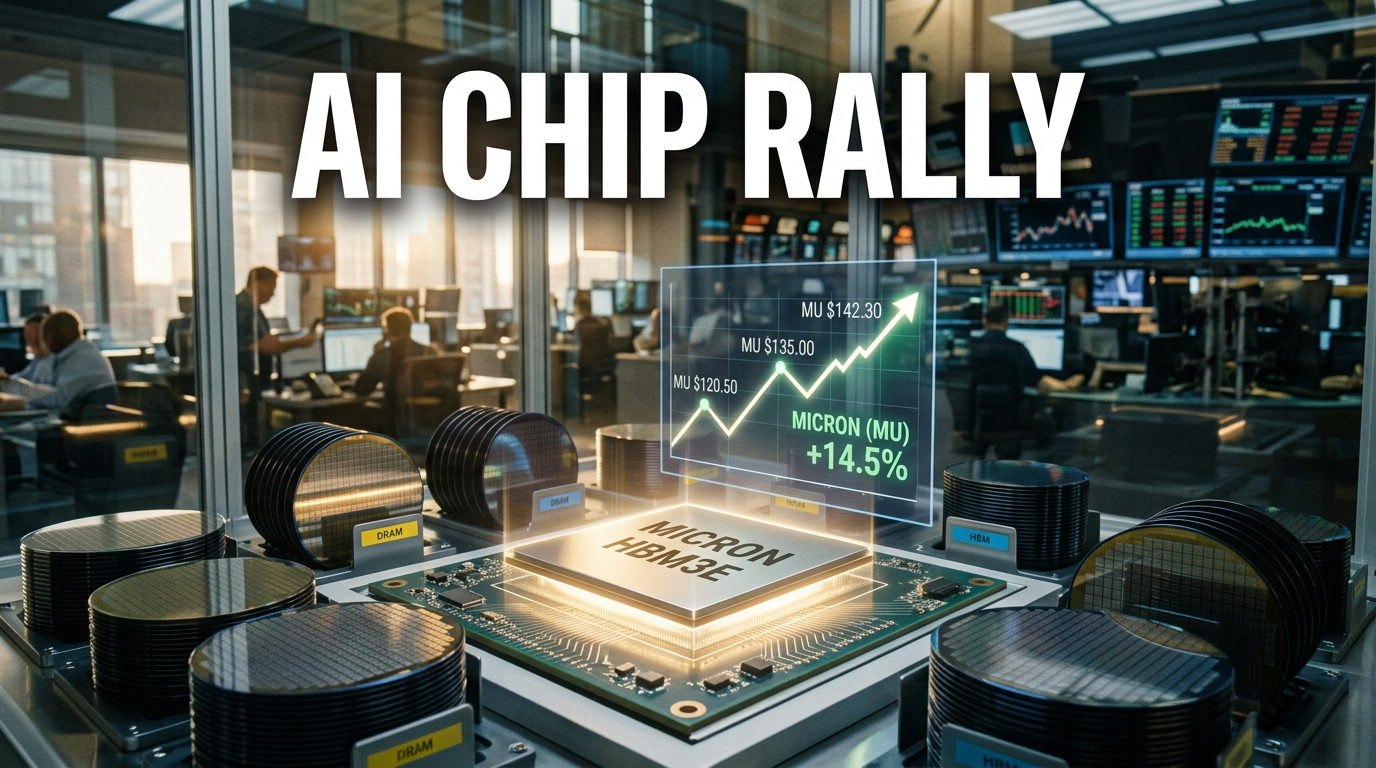
Micron surges 20%: Why “it goes up another 3 times” is coming out—core point of the AI semiconductor rally (organized together with the bubble debate)
One-line summary of today’s article (core point first)
Micron is jumping as a U.S.-listed semiconductor bellwether, and it’s creating a broad strength across the memory and AI semiconductor value chains.
And while there’s a big warning that “it’s overheated now, so isn’t it a bubble?”, the debate has intensified because, conversely, the same piece of evidence also appears that “memory is structurally changing its cycle (long-term contracts, supply-physics constraints, HBM rescaling).”
The conclusion that must be included in this article (emphasized first)
- Bubble warning: RSI overheating in the Philadelphia Semiconductor Index (highest level in 24 years), an extreme zone for 1-year returns
- Reversal logic: the memory price is shifting from “spot (cycle)” to a “long-term (LT) contract structure,” reducing volatility
- HBM bottleneck: as HBM grows, supply gets tangled due to “rescaling,” where the amount of D-RAM produced from the same wafer declines
- Factory physical limits: cleanroom and capacity expansion constraints continue until 2027, making it hard to expand supply
- Fundamental alignment: arguments that it’s hard to call it a “bubble where only the stock price ran,” since profit margins (gross margin) and EPS outlooks are rising in tandem
1) News flow: Why Micron’s surge is pushing the “semiconductor index” up
① Micron jumps ~20% + semiconductor index rises together
Based on the original text, as Micron surged to nearly 20%, the semiconductor sector index also moved higher in strength.
In this scene, what the market is usually saying comes down to two things.
- First, a sign that the memory market outlook is recovering/improving faster and deeper than expected
- Second, an interpretation that the pace at which expanded AI investment translates into memory demand (HBM/DRAM) is even faster
② KOSPI hits a new high + strength in Samsung Electronics / SK hynix
At home as well, the context is that money has been flowing into semiconductors (especially leading stocks tied to AI semiconductors), leading to a new-high momentum.
In other words, it’s not just “one U.S. stock is strong,” but rather a 분위기 where the entire AI semiconductor value chain is being repriced at once.
2) Bubble debate: What’s behind the warning that “it’s gone up too much”
① The interpretation that 1-year returns are in an extreme zone (4-sigma level)
In the original text, the semiconductor index’s 1-year return is around 160%+, and it’s described as having statistically reached the extreme zone (4-sigma).
In such cases, the market typically looks at it like this.
- Near-term chasing buys become riskier
- If earnings don’t catch up, volatility expansion (a correction) may occur
- Check whether expectations have already been priced in too much
② Mention of RSI overheating (highest level in 24 years)
There’s also talk that the Philadelphia Semiconductor Index’s RSI is in the high 80s (highest overheating level in 24 years).
The key point here is that the warning is closer to “even if it’s overheated, a crash isn’t guaranteed—this is a period where a correction wouldn’t be strange.”
3) Reversal logic: UBS-style reinterpretation that “this cycle is different”
① Core claim: memory might not be a typical cyclical industry
In the original text, the UBS report appears as an important piece of evidence.
The existing conventional wisdom was that memory is a cyclical industry, so when supply increases, prices fall and earnings fluctuate.
But this time the logic shifts direction.
- Spot-centric → higher volatility
- A phase where supply can’t catch up to demand → buyers sign long-term (LT) contracts
- By fixing prices in 3–5 year units, “price swings” shrink
In other words, it’s an argument that instead of being “a cycle,” there will be structural endurance that makes prices swing less.
② Aggressive upward revision to the target price / valuation
According to the original text, UBS raised its target price from 535 to 1,625 dollars, and it also points to room for memory to surpass the average semiconductor multiple (e.g., the 10x range).
The core point the market focuses on is simple.
“If earnings change, valuation (multiple) follows upward too.”
4) The supply-demand dilemma created by the HBM bottleneck (rescaling)
① The larger the HBM gets, the fewer D-RAM units are produced per wafer
If you unpack the original explanation as faithfully as possible, it’s this.
- HBM size increases
- The number of D-RAM units extracted from a single wafer decreases
- So when you “make a lot of HBM,” D-RAM becomes scarce, and when you “make a lot of D-RAM,” HBM becomes scarce—creating a trade-off
In the original text, this phenomenon is expressed as rescaling (rescaling).
② A surge in HBM demand (example: NVIDIA generation roadmap)
In the original text, it mentions that the HBM capacity in H200 (9th generation) is roughly at the 141GB level, and that in the next generation (Rubin Ultra), around 1TB is required.
This means,
the “total memory” going into AI training/inference can grow exponentially.
③ The result: memory demand rises, while supply gets “even more tangled”
The point is that HBM isn’t solved simply by “producing more”—it’s a structure that causes conflicts with production of other products (DRAM), so supply-demand tightness could become even more severe.
5) Why “increase supply to fix it” doesn’t work: cleanroom / capacity-expansion physical limits
① Shortage of cleanrooms (mentioned: through 2027)
One of the most intuitively compelling parts in the original text is the explanation that “there aren’t enough cleanrooms.”
In other words, even if there is equipment, you can’t scale immediately—the manufacturing environment (cleanrooms) itself becomes the bottleneck.
② New production constraints + even running existing capacity may still be insufficient
There’s also a viewpoint that “even if Samsung / SK hynix / Micron were to run all of their new production, supply might still be short.”
If that logic is correct, the scenario where supply expands and prices fall—what the market is expecting—could be delayed or weakened.
6) Fundamental alignment logic: “If it’s a bubble, earnings wouldn’t keep up—but now they do”
① Claim that valuation (next year’s PER) looks low
According to the original text, next year’s PER
- SK hynix: about 7x
- Samsung Electronics: about 7x
- Micron: about 8x
- SanDisk (mentioned): about 9x
is presented as looking low.
② Big EPS growth-rate outlook
In the original text, strong numbers are presented, including that Micron’s predicted next-year EPS rise is about 72%
In such cases, the market interprets it like this.
“Even if the stock price runs ahead, if earnings improve quickly, it might be ‘a repricing’ rather than ‘a bubble.’”
③ A period where gross margin (profit margin) is very high
The original text emphasizes that gross margins are coming out high at Micron / SanDisk, Samsung Electronics (semiconductor division), SK hynix, and so on.
The key message is only one.
“Not only are revenues increasing, but profit margins are also doing well.”
This can be read as a sign that the AI semiconductor market isn’t just expanding demand and ending there—rather, the price / product mix has improved.
7) NVIDIA’s next-generation architecture roadmap lifts memory component prices
① Analysis of the VeraRubin BOM: cost increases are large
The original text includes Morgan Stanley data saying that the cost of VeraRubin materials has generally risen by close to 2x.
② Mention that memory prices rise by 435%
As the strongest point, the rise in memory prices is presented as around 435%.
This implies two big things.
- First, the imbalance between memory supply and demand is severe enough to be reflected in actual costs
- Second, AI investment (servers / accelerators) may ultimately keep pulling the “memory share” higher
③ Related components like PCB / MLCC also move higher
A picture is drawn where PCB boards rise about 233%, and MLCCs (stacked capacitors) are connected as beneficiaries (such as Samsung Electro-Mechanics).
In other words, AI semiconductors aren’t only “chips”—they’re tied to the upstream industries (boards, passive components, parts) as well.
8) Points people miss: investor return data showing “not everyone is a winner”
① Investor realized returns are much lower than chart returns
Based on data from Mirae Asset Securities accounts (about 150,000 people) in the original text,
- Even if cumulative chart returns are in the 200% range
- The average investor’s return is around 47%
- Those holding more than 100 million KRW are very few (mentioned: 0.6%, etc.)
The same results are presented.
Why is this important?
Because what the market talks about (“stock price”) and your actual “trading timing / position sizing / mindset” can’t help but differ.
② The more you get swayed by a theme / FOMO, the more likely average returns get shaved
The original text says to be wary of the illusion where only the people who “made big on the side” are visible.
In conclusion,
People who invest with knowledge (understanding fundamentals + checking technical/financials) are more favorable in the long run.
9) Re-cap from an investment perspective: the ‘core checklist’ the market is looking at right now
If you summarize the original text into one block, the checklist points that support the “possibility that the rally keeps going” are below.
- Is price stabilizing via LT contracts rather than spot cycles?
- Does the rescaling bottleneck worsen due to HBM expansion?
- Do cleanroom / capacity-expansion physical limits actually restrict supply expansion?
- Do fundamentals like profit margins / EPS track the stock price?
- Can we verify whether valuation is still “excessive” relative to earnings?
And at the same time, on the bubble-warning side,
- In short-term RSI / return overheating zones, volatility can increase
- Instead of chasing buys, “staged entries / risk management” may be more important
Seeing these two axes together leads to a balanced judgment.
Main points to convey (only the points that are not well organized elsewhere)
The essence of this phase is not whether “semiconductors are rising or it’s a bubble,” but that both “the structural reasons it has to rise” and “the period where a correction wouldn’t be strange” coexist.
And the core of that structure can be compressed into these three.
- LT long-term contracts → a force that lowers near-term spot-cycle volatility
- HBM rescaling bottleneck → rising HBM demand can make supply bottlenecks worse
- Cleanroom / capacity-expansion physical limits → it’s unlikely that “producing more” instantly solves it
If earnings (EPS, margins) also improve together, it’s hard to label it as a “bubble where only the stock price ran,” and conversely, in overheated indicator (RSI) periods, you should always keep the possibility of a correction / volatility expansion on the table.
SEO keyword insertion naturally (the topic this article is targeting)
This article interprets an AI investment cycle from the perspectives of the memory semiconductor market outlook and AI semiconductor demand, the HBM supply bottleneck, semiconductor index overheating / correction risks, and changes in the long-term contract (LT) structure.
It’s also a key point that it addresses, from an investor’s point of view, the issues of “realized returns” and “timing” as well.
(Core elements that help with search traffic: semiconductor supercycle, HBM, AI semiconductors, LT contracts, valuation)
< Summary >
- Micron’s surge (about 20%) comes with strength in the semiconductor index, and there’s also a new-high trend domestically
- However, bubble warnings are also strong due to RSI / return overheating (4-sigma, highest RSI in 24 years, etc.)
- The reversal evidence is that even memory could reduce spot-cycle volatility via an LT long-term contract structure
- With HBM expansion, rescaling—where wafer production is reduced—can magnify bottlenecks
- Cleanroom / capacity-expansion physical limits (mentioned: through 2027) mean supply expansion may not be an immediate fix
- If fundamentals like EPS / margins move together, there’s a possibility of a “fundamentals-led repricing,” not just a bubble
- Data that realized investor returns were lower than chart returns suggests the need to guard against FOMO
[Related articles…]
- Latest outlook on the HBM bottleneck and AI semiconductor supply chain
- Memory market check points after the Micron rally
*Source: [ 월텍남 – 월스트리트 테크남 ]
– 마이크론 20%급등 3배 더가는 이유 4가지 “삼전 60만 하닉 400만”