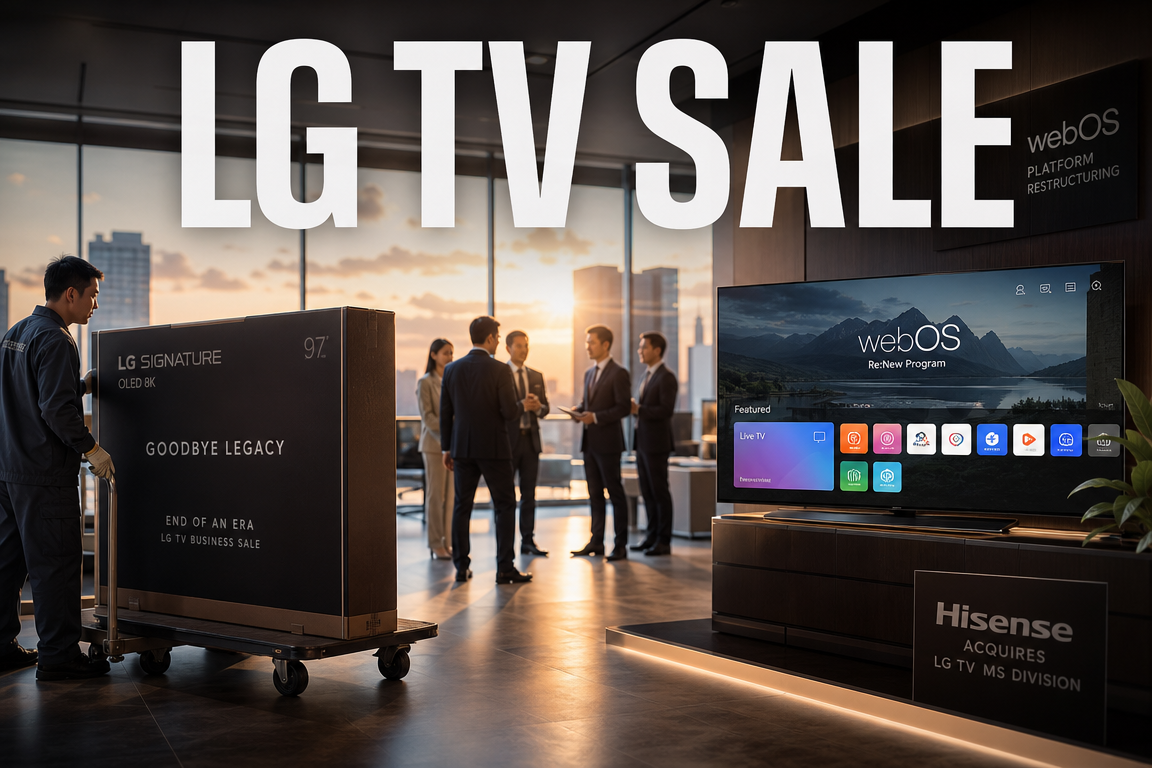
● LG TV Restructuring Shock
Reasons Why Discussions on LG Electronics’ TV Business Sale Should Be Seen Not as Simple Restructuring, but as a Signal of a Global Manufacturing Reorganization
As news broke that LG Electronics had discussed a potential sale of its TV business with China’s Hisense, including the possibility of a business restructuring, the issue is expanding beyond a simple corporate headline and into something that could shake Korea’s manufacturing sector and the global TV market as a whole.
The core points are threefold.
First, the low-growth, low-profit structure of the TV market has become far more deeply entrenched than expected.
Second, the rapid advance of Chinese TV manufacturers is quickly eroding the traditional advantage of Samsung Electronics and LG Electronics.
Third, this issue could become a turning point in which LG Electronics is restructured around webOS, platforms, and vehicle components rather than simply being a matter of a potential sale.
Below, we will summarize this news in a news-style format and also highlight key points that other articles often fail to address.
1. What Was Reported: LG Electronics and Hisense Discuss TV Business
LG Electronics reportedly contacted senior executives at Hisense to discuss structural changes, including the possibility of selling the TV business under its MS Business Division.
On the surface, this is a one-line “sale consideration” story, but in reality, its meaning is much larger.
It should be read as a signal that LG Electronics has begun a strategic review of whether to keep its TV business or fundamentally redesign it through separation, restructuring, or even a sale.
In particular, what matters here is that this discussion did not arise because the TV market is booming, but because it represents a survival-driven decision made in response to weakening profitability and eroding competitive advantage.
2. Why Now: Deteriorating Profitability and China’s Low-Price Offensive
The biggest reason LG Electronics’ TV business is under pressure is not simply declining sales.
The real problem is that the structure in which even strong sales do not translate into much profit has persisted for a long time.
Although TVs may look like premium products, once panel costs, logistics, production line maintenance, and marketing expenses are taken into account, margins are much thinner than people think.
On top of that, Chinese manufacturers have aggressively lowered prices, making it difficult even for established global premium brands to protect profitability.
According to Omdia, LG Electronics’ global TV shipment share has remained in the low teens for several years.
Meanwhile, TCL and Hisense have been rapidly gaining ground, and the combined share of China’s major three manufacturers—TCL, Hisense, and Xiaomi—has already surpassed the combined share of Samsung Electronics and LG Electronics.
This is not just a competition over market share numbers.
It means that a structural shift in global TV market leadership from Korea to China is already underway.
3. Looking at the Numbers: Big Revenue, Thin Profit
LG Electronics’ MS Business Division recorded revenue of KRW 5.1694 trillion and operating profit of KRW 371.8 billion in the first quarter.
At first glance, these numbers may not look bad, but the TV hardware business is estimated to account for roughly 40% to 60% of the division, and the actual profit from the TV business is estimated at about KRW 148.7 billion to KRW 223.1 billion.
The problem is that these figures are not stable.
From the second to the fourth quarter of last year, the business posted losses, resulting in about KRW 750 billion in operating losses, and while there has been some recovery this year, it remains uncertain whether this trend will continue over the long term.
In other words, the TV business is becoming a business with large revenue but heavy investment burden relative to its cash-generating power.
In this kind of structure, the question for a company is less “Should we keep it?” and more “How should we reorganize and redeploy it?”
4. The Real Reason LG Electronics Is Rethinking Its TV Business
The core point of this discussion is not simply a sale.
Behind it lies LG Electronics’ broader effort to transform itself from a hardware manufacturing company into a platform-, solution-, and high-value business-centered company.
TVs are symbolically important brands, but in the long term, they belong to a low-growth industry.
By contrast, vehicle components, HVAC, webOS, and B2B solutions are relatively higher-growth areas with potentially more stable profit structures.
So for LG Electronics, the question is whether continuing to carry the TV business is a “dignified form of retention” or a choice to “shed a costly business and focus on future growth areas.”
This is a textbook example of what companies call “selection and concentration.”
5. The Key Point Often Missed by Other Articles: The TV Business Is a Problem of Structure, Not Just a Business Unit
This is the most important point.
The TV business is struggling not just because products are not selling, but because the industry itself has shifted into a low-margin competition structure.
In other words, this is not a problem that can be solved by one or two successful new product launches.
It is tied to the panel supply chain, manufacturing costs, global logistics, exchange rates, price competition, and the spread of mid- and low-end Chinese brands.
In addition, as LG Display has stopped domestic production of LCD panels for TVs, LG Electronics’ bargaining power in external sourcing has weakened as well.
This ultimately means that cost competitiveness is likely to become even more difficult.
Many media outlets focus only on the question of “Will they sell it?”, but the real issue is the likelihood that the structure in which TVs do not make money will continue for a long time.
6. If a Sale Becomes Reality, What Process Would Be Needed?
Industry insiders say that if a sale is actually pursued, a spin-off would likely be considered first.
That is because the TV business is currently housed within the MS Business Division, and assets and profit structures are not clearly separated.
Therefore, it may be more realistic to first split it into a separate legal entity, reassess its corporate value, and then look for a buyer.
This process is not simple.
It requires resolving organizational separation, workforce reassignment, production base adjustments, supply chain restructuring, and brand usage rights issues together.
In other words, a sale is not a one-step transaction, but rather a complex structural reform project.
7. LG Electronics’ Next Step: From Hardware to webOS and Platforms
If the TV business is separated or reduced, LG Electronics will likely move even further away from its image as a hardware manufacturing company and accelerate its transition into a webOS-based platform company.
LG Electronics has already reorganized its former HE Business Division, centered on TVs, into the MS Business Division and strengthened its platform-centered strategy by integrating IT and signage businesses.
In particular, webOS can expand beyond a simple TV operating system into monitors, signage, in-vehicle infotainment, and advertising and content platforms.
This is a structure that can generate recurring revenue, which is far more attractive than simple product sales.
This is exactly why investors prefer platform businesses these days.
Compared with hardware that is sold once and ends there, a structure that continuously adds data and services is much more powerful.
8. What the Market Should Pay Attention To: Chinese TV Makers Are No Longer “Latecomers”
In the past, Chinese TV makers were often viewed as companies that were simply cheap.
But that is no longer the case.
TCL, Hisense, and Xiaomi are no longer just low-cost brands; they are also strengthening global market share, production efficiency, and supply chain integration.
Especially in the mass-market TV segment, where price sensitivity is high, Chinese manufacturers are already showing strong competitiveness.
In this environment, it is becoming increasingly difficult for Korean companies to defend themselves through premium strategies alone.
Ultimately, the TV industry is being reorganized into a market where economies of scale and cost competitiveness determine everything.
9. What Investors and Readers Should Take Away
This news is not limited to LG Electronics’ business restructuring.
Looking more broadly, it shows the future strategy of Korea’s flagship manufacturing sector.
First, the shift in portfolio toward growth industries may accelerate.
Second, the disposal of low-profit businesses may spread across major Korean conglomerates.
Third, AI and platform-based services may emerge as core revenue sources in manufacturing.
Fourth, traditional TV, home appliance, and display industries may face even stronger restructuring ahead.
10. What This Means for the Global Economic Outlook and AI Trends
From the perspective of the global economic outlook, this news shows how quickly traditional durable goods markets come under pressure amid slowing growth and weakened consumer demand.
TVs are a representative consumer durable.
When the economy weakens, replacement cycles lengthen first, and demand for premium products also slows.
From an AI trend perspective, the important point is that manufacturing is expanding beyond simple production into AI-based user experience, content recommendations, smart homes, and in-vehicle infotainment.
In other words, the industry is moving from the age of hardware to the age of data and software.
LG Electronics’ webOS strategy is directly aligned with this trend.
11. The Most Important Conclusion: This Is Not About “Selling TVs,” but About “Reallocating the Future”
Many people may interpret this news simply as “Is LG Electronics getting out of TVs?”
But at a deeper level, this is about reorganizing low-profit manufacturing assets and moving capital and organizational resources into future businesses.
In other words, the possibility of a TV business sale may not represent retreat, but rather a strategic reallocation to move toward a new portfolio.
And this is a trend we are likely to see more often across major Korean corporations in the future.
< Summary >
The background behind LG Electronics’ discussion of restructuring with Hisense around its TV business is deteriorating profitability, the rise of Chinese competitors, and a deeply entrenched low-margin structure.
If a sale becomes reality, LG Electronics is likely to move even faster from hardware toward webOS, platforms, and vehicle components.
The core takeaway is not whether TVs are sold, but that Korea’s manufacturing sector is reorganizing low-growth businesses and reallocating resources to future growth areas.
[Related Articles…]
LG Electronics, Workforce Expansion in Heat Pumps and Business Restructuring Trends
Why Samsung and LG Are Strengthening Their OLED Alliance to Counter China’s Rise
*Source: https://v.daum.net/v/20260528110120880