● Tesla, Robotaxi, Optimus, Shock
Why Musk’s “Uncrewed Cybercab” Footage Matters More Than Tesla’s Stock Price Right Now
The key point is not simply that Tesla closed at $442.1. The more material signals were captured at Giga Texas:
1) An uncrewed Cybercab reportedly exited the factory by passing through the plant doors autonomously.
2) The dedicated Optimus facility has advanced to the structural steel phase.
These are not merely promotional visuals; they indicate Tesla’s transition from an EV manufacturer toward an AI-driven platform company. The narrative is also being shaped by U.S. PCE inflation, renewed rate-hike risk, expectations for overseas FSD approvals, intensifying Chinese EV competition, and ongoing speculation around a Tesla–SpaceX combination. Interpreting the current setup as a simple price-action story risks missing the core drivers.
1. The Scene That Matters More Than Today’s Tesla Stock Move: What the “Uncrewed Cybercab” Implies
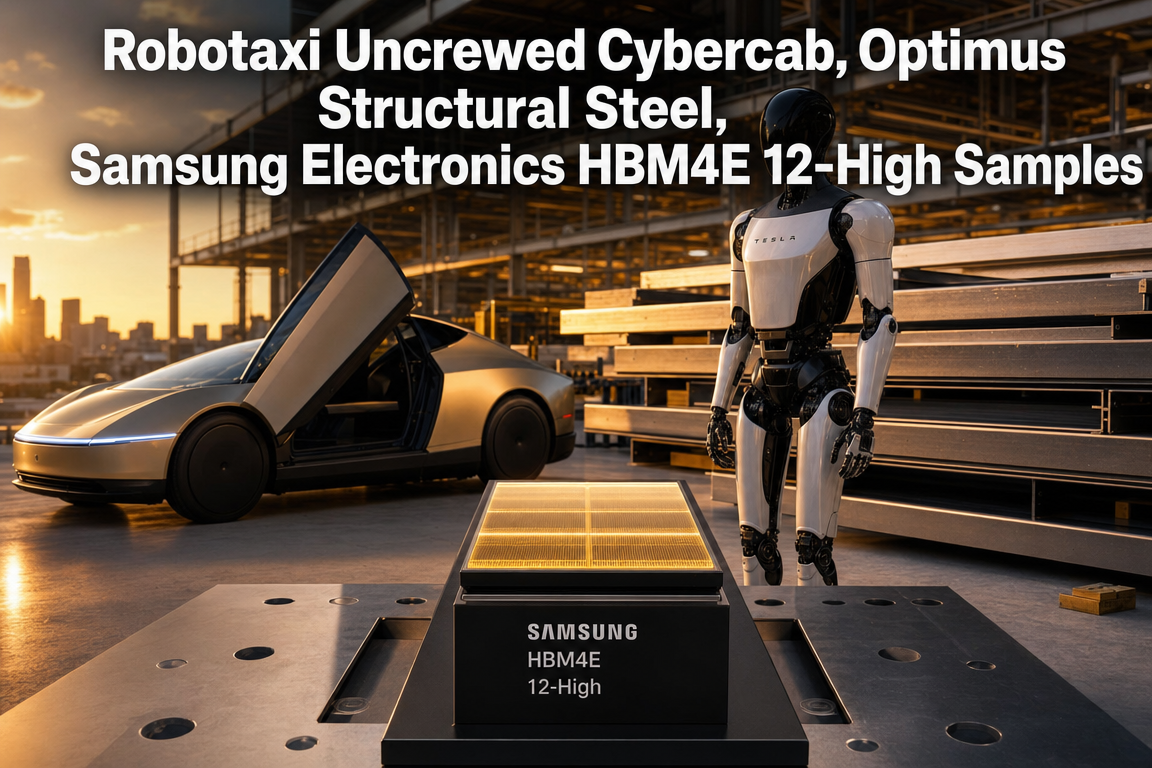
Elon Musk posted video on X showing a Cybercab moving out of the Giga Texas facility. The vehicle appears to have no steering wheel or pedals, and no occupant is visible. Despite this, it traversed internal lines, passed through the doors, and moved outside.
1-1. Why this footage is a strong market signal
Cybercab is designed for autonomy from inception, not as a conventional vehicle later upgraded with autonomous capability. Autonomous movement inside the factory suggests potential integration across production, internal logistics, deployment, and service operations.
Market interpretation typically converges on one question: whether Tesla is moving from demonstrations to operational readiness for a robotaxi service.
1-2. What exiting the factory suggests
A vehicle without steering controls is not aligned with traditional retail distribution. The practical end-state is service deployment rather than consumer sales. Based on Musk’s prior positioning, market discussion has centered on potential linkage to a robotaxi rollout in Austin. The footage can therefore be read as not only “production complete,” but also “pre-deployment validation.”
2. Tesla Up for Six Consecutive Sessions, Yet the Gain Was Limited
Tesla closed at $442.1, up 0.4%, extending a six-session advance. The trend is constructive, but the magnitude is modest relative to the scale of bullish company-specific narratives.
2-1. U.S. PCE inflation and rate risk continue to pressure growth equities
U.S. PCE inflation was cited around 3.8%, described as the highest level since May 2023. As a key input for Federal Reserve policy, this increases sensitivity to energy-driven inflation shocks and geopolitical risks. If disinflation expectations weaken, markets may reprice toward “higher for longer,” with some participants discussing renewed hikes.
This environment typically compresses valuation for long-duration growth equities, including Tesla, even when idiosyncratic catalysts (AI, robotaxi) remain supportive.
2-2. Investor takeaway: company catalysts and macro conditions price simultaneously
Positive company news does not mechanically translate into outsized price appreciation. Current conditions resemble a regime where internal momentum is improving while macro factors constrain multiple expansion.
3. How Far Has Robotaxi Commercialization Progressed?
The central market question is timing and scale of real-world commercialization. The Cybercab footage increases expectations, but investability depends on measurable milestones and scheduling.
3-1. Production appears to be entering meaningful phases
Reported sequencing suggests: initial Cybercab production referenced in February; transition toward volume production in April; and interpretation that Giga Texas targets hundreds of units per week. This remains below mass commercialization, but indicates progress beyond event-driven prototypes.
3-2. Limited but notable ongoing autonomous operations
Beyond Cybercab, tracking sources have cited approximately 39 uncrewed vehicles in operation. The number is small, but the market focus is shifting from feasibility (“can it work?”) to scaling dynamics (“how quickly can it expand?”).
4. FSD Subscription Monetization Could Reshape Earnings Quality and Valuation
A core element of the thesis is software monetization rather than unit sales, with FSD subscription as a primary lever.
4-1. Reported subscription scale
FSD paid subscribers are cited around 1.3 million, with a monthly price referenced near $99. The implication is a recurring revenue stream with different durability than cyclical vehicle demand.
4-2. The largest markets are not fully open
China, Europe, and South Korea are not fully open markets for FSD. Market attention is therefore increasingly on regulatory approval pathways and launch timing, which would translate into observable subscriber growth and financial impact. China and European approvals are viewed as particularly consequential to forward estimates and broader risk sentiment.
5. China EV Variables: Is Competitor Weakness Automatically a Tesla Tailwind?
Early-session volatility was partly attributed to weaker-than-expected results from Chinese EV peers and concerns about market softness. NIO, Li Auto, and XPeng reported Q1 outcomes viewed as below expectations, alongside a datapoint that China’s new-car market fell 7% YoY in Q1.
5-1. Evidence of market absorption
Tesla traded down intraday to $436 but recovered to close at $442.1. This suggests the market did not intensify risk-off positioning in Tesla solely on China-demand concerns, keeping greater weight on longer-duration themes (AI, robotaxi, FSD approvals).
5-2. Reasons for continued caution
China risk is not only volume-driven; it includes price competition, brand dynamics, local regulatory constraints, and data policy. A China FSD approval could be a material catalyst; extended delays could increase the risk of expectations being priced in prematurely.
6. The Other Critical Giga Texas Signal: Structural Steel Appears at the Dedicated Optimus Facility
Drone footage indicates the first visible structural steel at the dedicated Optimus site.
6-1. Why structural steel is a meaningful milestone
Industrial builds typically progress from site preparation to foundations, steel, envelope, and internal systems. Steel marks the transition from planning to visible physical execution and capital deployment, which markets often treat as more credible than announcements.
6-2. Timeline appears accelerated
Observed sequencing: site preparation cited in November 2025; foundation equipment observed in April; steel visible in May. A one-month gap between equipment arrival and steel visibility implies high prioritization.
6-3. Scale implications
Tesla has referenced a long-term target of producing 10 million Optimus units annually. The facility has been discussed at over 5.2 million square feet with implied investment estimates of $5–10+ billion. With the current Giga Texas complex cited around 10 million square feet, this facility would represent roughly half that footprint, indicating a high-conviction capital allocation toward robotics.
7. Can Optimus Reach 10 Million Units Annually?
The numeric target appears aggressive relative to today’s baseline. Demand formation may be the binding constraint, not only manufacturing capacity.
7-1. Demand adoption is likely staged
Humanoid robotics remains an early-market category. Early adoption is more likely in industrial, logistics, and manufacturing applications, followed by services, then consumer/home use. The demand curve is expected to be progressive rather than immediate.
7-2. Interpreting Tesla’s approach through an S-curve framework
References to initial small-scale builds at Fremont and an intermediate 1 million-unit goal suggest staged scaling. Musk has also indicated early progress may be slow, consistent with an S-curve adoption model. If a second-generation Texas line enters high-volume production around summer 2027, that period could represent an important re-rating window contingent on execution.
8. Negative Coverage: How to Frame Reuters Reporting on FSD
A Reuters investigative report presented critical perspectives on FSD.
8-1. Core claims highlighted by Reuters
- Data labeling: interviews with former employees; 7 of 9 reportedly expressed lack of trust in FSD.
- Safety claims: challenges to Tesla’s “10x safer than humans” framing, citing differences between Tesla’s incident definitions and U.S. federal datasets.
8-2. How investors may interpret the report
Safety verification and regulatory trust are structurally important for autonomy. Methodology disputes over definitions can matter over time. However, the sample size is limited, and former-employee sentiment is not sufficient to characterize system-level performance.
8-3. Offsetting signals
User communities report perceived performance improvements, and regulators such as the Netherlands’ RDW have been reviewing autonomy frameworks over extended periods. The appropriate framing remains multidimensional: technology, regulation, operational data, and incident-definition comparability.
9. Tesla–SpaceX Merger Speculation: How Much Weight to Assign?
Some market participants continue to discuss potential Tesla–SpaceX combination scenarios, with prediction markets assigning non-trivial probabilities within a year.
9-1. Why the narrative persists
Investors see potential strategic linkages across AI, robotics, space, communications, energy, and manufacturing within Musk’s ecosystem, especially as Tesla is increasingly framed as an AI infrastructure platform rather than solely a carmaker.
9-2. Distinguish narrative from executable reality
Any merger would involve complex exchange ratios, governance, regulatory review, shareholder alignment, and valuation of private assets. Near-term investment relevance is lower than concrete milestones in FSD approvals, robotaxi deployment, and early Optimus manufacturing.
10. Model 3 Plaid Possibility: The Automotive Business Still Has Optionality
While AI and robotics dominate discourse, vehicle-product catalysts remain relevant. Tesla’s SVP of Engineering, Lars Moravy, implied on a podcast that a Model 3 Plaid could be possible. With ongoing debate around contraction or discontinuation of Model S/X, a performance variant in Model 3 could help stimulate demand. Automotive execution remains important because it continues to drive a substantial share of reported financial results.
11. The Most Important Points Often Underemphasized in Other Coverage
11-1. The Cybercab footage is more about operating systems than autonomy optics
Many narratives focus on “it moved without a driver.” The more material implication is an end-to-end operating stack: self-directed movement inside the factory, integration into logistics flows, and potential dispatch into service territories. If realized, Tesla shifts from unit sales toward vehicle-network operations.
11-2. Optimus facility steel is an explicit signal of AI monetization prioritization
AI narratives are inexpensive; large manufacturing builds reflect capital allocation. Markets tend to weigh CAPEX-backed execution more heavily than presentation-level claims.
11-3. A restrained stock reaction may indicate more realistic pricing
Limited price response amid large headlines suggests the market is incorporating rates, regulation, approvals, and production scaling constraints. If execution materially validates the narrative, re-pricing could be more durable.
11-4. The valuation debate is shifting toward recurring revenue, not units delivered
Key variables increasingly include FSD subscriptions, robotaxi take rates, Optimus sales/services, and energy/software revenues. If recurring revenue expands, Tesla’s multiple may trend toward platform-like comparables rather than manufacturing peers.
12. Key Milestones Investors Should Monitor
- Progress on FSD regulatory approvals in Europe
- FSD authorization in China and changes in data-regulatory posture
- Timing of an actual robotaxi service launch in Austin
- Cybercab production ramp rate and growth in deployed fleet size
- Construction pace of the dedicated Optimus facility
- Feasibility of high-volume second-generation Optimus production around 2027
- U.S. PCE inflation trajectory and Federal Reserve policy shifts
- Recovery in China EV demand and competitor pricing intensity
13. Conclusion: Focus on Phase Transition, Not the Daily Close
The core signal is a structural transition. The Cybercab exiting the factory autonomously makes robotaxi commercialization more concrete, while visible steel at the Optimus facility indicates robotics has moved from concept to execution.
Risks remain: rate pressure, regulatory approval uncertainty, China competition, safety scrutiny, and expectation overhang. However, activity at Giga Texas increasingly reflects a tangible reshaping of Tesla’s future business model. The $442 close is less informative than the evidence of operational build-out across autonomy and robotics.
< Summary >
Tesla closed at $442.1, extending a six-session gain, but the more consequential signals were the uncrewed Cybercab at Giga Texas and the emergence of structural steel at the dedicated Optimus facility.
Cybercab supports the interpretation that robotaxi commercialization is moving beyond demonstrations toward operational deployment, while the Optimus build indicates substantial real-world capital commitment to humanoid robotics.
Key risks include higher PCE inflation, rate pressure, FSD safety scrutiny, and China EV market softness. The primary forward indicators are overseas FSD approvals, Austin robotaxi launch timing, Optimus scale-up progress, and expansion of recurring revenue. In the current phase, the relevant focus is the speed of Tesla’s transition across AI, autonomy, and robotics rather than short-term stock fluctuations.
[Related Posts…]
Tesla AI and robotaxi expansion: why the market is reassessing the narrative
Optimus scale-up: an inflection point for the humanoid robotics market
*Source: [ 오늘의 테슬라 뉴스 ]
– 머스크가 오늘 올린 영상 한 장면 — 아무도 없는데 사이버캡이 기가텍사스 문 통과, $442 주주는 지금 어떻게?
● Samsung Soars, Hynix Trails, AI Firestorm
The Real Reason Samsung Electronics Outperformed SK Hynix: Key Drivers Behind the KOSPI Rally on May 29
Today’s session cannot be explained by a generic “semiconductor-led rally.” Positive U.S. market sentiment, expanding AI server demand, the HBM competitiveness narrative, and renewed foundry expectations converged. Both Samsung Electronics and SK Hynix strengthened, but the market reaction was more pronounced in Samsung Electronics.
This report summarizes: (i) why Samsung Electronics showed stronger relative performance, (ii) why DRAM and NAND are being re-rated within the AI semiconductor supply chain, (iii) the significance of the HBM4E 12-high sample development, and (iv) why Samsung Foundry’s link to Anthropic-related chip orders is more material than a headline.
1. Market backdrop on May 29: headline drivers vs. underlying momentum
On May 29, Korean equities reflected improved risk appetite. U.S. equities provided a supportive backdrop, and AI-related investment sentiment rebounded, extending into Korea’s large-cap semiconductor complex.
Beyond “U.S. strength lifting Korea,” the more specific driver was renewed confirmation of AI infrastructure demand and the industry’s current bottlenecks.
2. Catalyst: AI server vendor earnings and the spillover to memory suppliers
The most direct trigger was strong earnings from AI server-related companies. Positive results were interpreted as confirmation that AI infrastructure capex remains active.
Investors continue to assess whether AI demand is cyclical or structural. Strong server earnings increased confidence in ongoing data center expansion.
A critical market takeaway was the identification of key bottlenecks in AI server production: NAND, DRAM, and CPUs. This signaled that the AI investment cycle is broadening beyond GPUs into the full compute and memory stack.
3. Implications of “NAND and DRAM are bottlenecks”: the start of a memory re-rating
AI infrastructure requires more than GPUs: high-capacity, high-bandwidth DRAM for rapid data access and NAND for storage throughput and supply.
Positioning NAND and DRAM as bottlenecks reinforced that the memory upcycle is increasingly tied to AI-driven infrastructure growth rather than a purely cyclical recovery.
This supported gains in both Samsung Electronics and SK Hynix as global memory leaders.
4. Why Samsung Electronics outperformed SK Hynix today
Recent market positioning has generally favored SK Hynix on HBM leadership. However, the May 29 move differed.
Samsung Electronics benefited from the common memory upcycle thesis plus two incremental upside catalysts specific to Samsung.
5. Catalyst #1: significance of Samsung’s HBM4E 12-high sample milestone
News that Samsung Electronics shipped the industry’s first HBM4E 12-high samples attracted immediate attention.
HBM (High Bandwidth Memory) is a core enabler for AI accelerators and GPUs. The equity market focus was not the sampling event itself, but what it implies: Samsung may be positioned to regain influence in next-generation HBM.
The combination of “first,” “HBM4E,” and “12-high” functions as a proxy for technology leadership, stacking/process maturity, and customer responsiveness.
Accordingly, Samsung’s strength reflected not only expectations for conventional memory recovery, but also a renewed premium linked to AI-era HBM competitiveness.
6. Practical message for equity valuation
Equities discount future outcomes. Even absent immediate revenue impact, indications of credible positioning in next-generation HBM can affect valuation.
Samsung’s diversified platform (memory, foundry, packaging, mobile, and broader server supply exposure) increases the probability that a single technology milestone leads to broader segment re-rating.
This structure can translate into higher multiple expansion potential relative to peers when catalysts emerge.
7. Catalyst #2: Samsung Foundry and potential Anthropic-related chip orders
Another market focus was media coverage suggesting Samsung Foundry could secure production tied to Anthropic-related chips.
Anthropic is a prominent U.S. AI company. A linkage to Samsung Foundry would be interpreted as more than a one-off order; it could signal improved credibility and customer relevance within the global AI compute supply chain.
Samsung Foundry has faced skepticism versus TSMC, particularly regarding customer depth and market trust. A high-visibility AI customer association could support a reassessment of Samsung’s position from “follower” to “active participant” in the AI manufacturing ecosystem.
8. Why the Anthropic-related narrative is material
Foundry engagements typically expand beyond a single project, spanning design enablement, production, testing, packaging, and node migration.
The AI chip market is in an expansion phase; early customer capture can translate into multi-year positioning advantages.
The market response reflected the possibility that Samsung could broaden its AI exposure beyond memory into non-memory manufacturing and platform integration.
9. What the market differentiated between Samsung Electronics and SK Hynix today
In summary:
- SK Hynix: confirmation of an already well-established HBM leadership narrative.
- Samsung Electronics: additional evidence that areas previously perceived as weaker may improve more rapidly than expected.
SK Hynix benefited naturally from AI server demand and memory bottleneck commentary. Samsung, however, added two fresh narratives: next-generation HBM progress and a potential foundry re-rating via high-profile AI customer linkage.
Equity markets often react more strongly to incremental improvement potential than to continued strength in already-priced advantages.
10. Implications for the broader KOSPI
Samsung Electronics and SK Hynix are index-level drivers. When both rise, the KOSPI typically gains momentum.
If foreign inflows concentrate in large-cap semiconductors, index moves can outpace sector rotation effects.
This rally is better framed as alignment between the AI infrastructure investment cycle and Korea’s semiconductor competitiveness, potentially supporting broader index-level re-rating given the KOSPI’s semiconductor weight.
11. News-style key takeaways (condensed)
- Improved U.S. equity sentiment supported risk assets in Korea.
- Strong AI server-related earnings reinforced expectations for continued AI infrastructure investment.
- NAND, DRAM, and CPUs were identified as AI server bottlenecks, supporting a memory re-rating.
- Both Samsung Electronics and SK Hynix benefited from this backdrop.
- Samsung Electronics gained additional support from HBM4E 12-high sample shipment news, strengthening next-generation HBM expectations.
- Further support came from potential Samsung Foundry upside tied to Anthropic-related chip orders, amplifying relative price momentum.
- Samsung’s outperformance reflected a combined effect: memory recovery + HBM narrative reversal + foundry re-rating potential.
12. The most important point often missed in coverage
The key issue is not simply why Samsung outperformed on the day, but whether the market’s valuation framework for Samsung is changing.
Most coverage treats HBM sampling, foundry order speculation, and server earnings as separate items. The market tends to consolidate them into a single composite thesis:
Samsung is being positioned simultaneously as:
- a beneficiary of the memory upcycle,
- a credible next-generation HBM participant,
- and a potential AI chip manufacturing platform via foundry capability.
This composite narrative could serve as an early stage of valuation reassessment into 2025–2026, subject to execution.
13. Key follow-up variables to monitor
- Whether Samsung’s HBM4E samples progress to customer qualification and volume orders
- Whether foundry-related Anthropic coverage translates into confirmed contracts or additional customer wins
- Whether AI server earnings strength is sustained rather than one-off
- Whether memory price increases broaden across both DRAM and NAND
- Whether foreign inflows continue to favor KOSPI large-cap semiconductors
If these variables align, the move may extend beyond a short-term event into a medium-term semiconductor upcycle scenario.
14. One-line conclusion
Samsung Electronics outperformed SK Hynix because, on top of shared AI server demand and memory recovery drivers, Samsung added two incremental premiums: next-generation HBM4E progress and potential foundry re-rating tied to Anthropic-related chip orders.
< Summary >
The May 29 KOSPI advance was led by semiconductors. Strong AI server-related earnings reinforced expectations for continued AI infrastructure investment, and the identification of NAND and DRAM as bottlenecks supported a re-rating in memory, lifting both Samsung Electronics and SK Hynix.
Samsung Electronics outperformed due to additional catalysts: HBM4E 12-high sample shipment strengthened expectations for next-generation HBM competitiveness, and the potential for Anthropic-related foundry orders supported a further re-rating of its non-memory exposure.
The central market takeaway was an emerging view of Samsung not only as a memory recovery beneficiary, but as a broader AI-era semiconductor platform.
[Related Articles…]
- Samsung Electronics: AI Semiconductor Strategy and HBM Competitiveness Reassessment (https://NextGenInsight.net?s=Samsung%20Electronics)
- Why Large-Cap Semiconductors Matter in a KOSPI Rebound Phase (https://NextGenInsight.net?s=KOSPI)
*Source: [ 내일은 투자왕 – 김단테 ]
– 삼성전자가 하이닉스보다 더 오른 진짜 이유 (5월 29일)