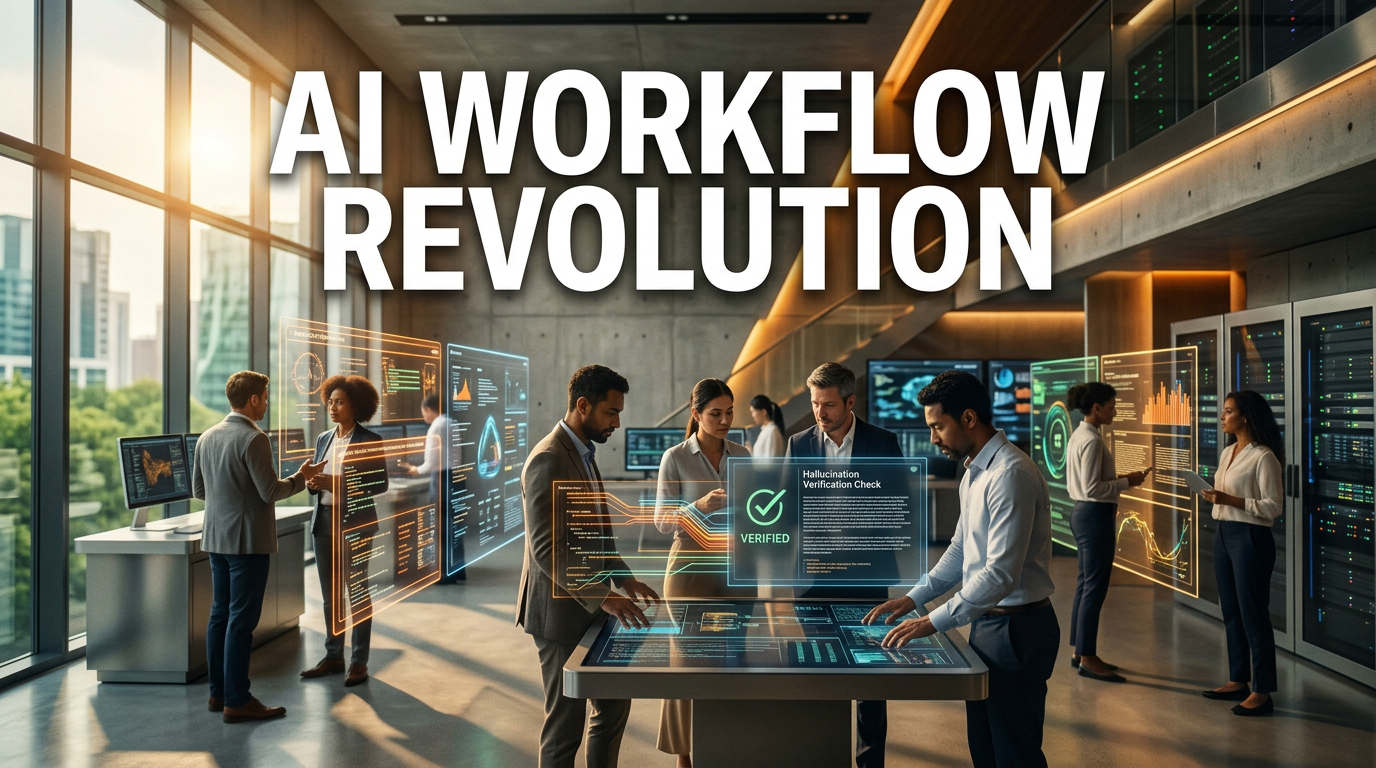
● Claude Opus 4.8 Dynamic Workflows Slash Hallucinations
Claude Opus 4.8 + Launch of Dynamic Workflows: “Agent Native” Transforms the Landscape of Work Automation
Core Point You Must Know Right Now (the most important content included in this article)
- Opus 4.8’s “Workload (effort level)” and Adaptive Thinking (high/max routing) make it possible to adjust result quality and speed·cost more precisely—even for the same request
- Dynamic workflows: designed to run up to 1,000 sub-agent-class parallel executions as an “orchestration script” within a single session, and verify before delivering results to the user
- The concepts of workflows vs agent teams are clarified (both look like parallelism, but they work differently)
- In practical demos like “searching/analyzing 40 papers,” the workflow validation structure to reduce hallucination (fake paper) risk is revealed
- It also summarizes the perspective on why companies should pay attention to this capability now, within an “AI native (Agent Native)” flow
News Briefing: Claude Opus 4.8 Released + Dynamic Workflows Launches at the Same Time
1) Model Update: Opus 4.8 strengthens operational control with “workload” and “adaptive thinking”
- A new Workload (effort level) menu appears
It’s explained that the higher the effort level, the more thorough the response you can expect, but it may take longer and the limits (consumption speed) can increase faster - Added Adaptive Thinking (high/max) options
There was already a concept of routing by “thinking level,” but now users can choose the default more clearly
Keeping high as the default is generally presented as the safe option, but it’s explained that in complex and difficult tasks, max can sometimes be better
Core Point
- Moving from an era where people only look at “good answers” to a way of using it that designs quality-speed-cost-limits together
- The impact could be especially noticeable for work with lots of repeat·validation·decision-making, such as corporate marketing/research
2) Opus 4.8 vs 4.7: Same question, but the “processing approach” looks different
- In a demo marketing research example that asks about concepts like AO/GO, it emphasizes that Opus 4.8 goes through more exploration·planning·procedures before answering
- Meanwhile, Opus 4.7 is compared as converging relatively quickly into a conclusion-like form
- Mention of benchmarks: It says that in items such as agent-style coding/multidomain reasoning/agent-style computer use/knowledge work/financial analysis, there were cases where Opus 4.8 showed advantages
However, it also suggests that “agent-style terminal coding” may be stronger for other models
Core Point (what users are likely to feel)
- It feels strongly tuned toward increasing the amount and depth of the output
- Opus 4.8 may be especially well-suited for research used for decisions that require deep investigation
3) New Feature: Dynamic Workflows — Parallel orchestration within a single session
- Dynamic workflows are described as handling difficult tasks end-to-end from the start based on “translated descriptions,” and running dozens to hundreds of parallel sub-agents within a single session, while performing verification in advance before delivering results to the user
- Available environments: it’s explained that it can be used in CLI (terminal), and is also available in desktop/Max Teams/enterprise plans
- In the demo, it’s introduced that the workflow family expands at “/eoffault,” and that a new bundled concept called “Ultra Code” becomes visible
In other words, it flows into a user experience where the existing thinking-level setting + workflow execution are more tightly combined
The most important thing here is the “workflow design approach”
- Dynamic workflows aren’t just about running many agents in parallel “all at once”; the key is that they include dynamic flows like fan-out (branching by round) → meeting verifiable conditions → continue/stop
- That’s why result quality is less likely to depend on “luck”
4) Clarifying what was confusing: “Workflows” vs “Agent Teams” (explained with analogy)
- Workflows (dynamic workflows)
A feeling of pulling volume out by mass-replicating the same employee (the same sub-agent)
(Analogy) In a kitchen, several part-time workers make the same recipe (gimbap recipe) simultaneously
There are limits like the number of sub-agents that can run concurrently on a single CPU due to CPU/resource constraints (e.g., up to 16)
“1,000 people” is interpreted not as 1,000 people doing it at the exact same time immediately, but as implementing large-scale parallelism within the bounds of a session - Agent teams
A team composed of roles and recipes (skills) that differ from each other
(Analogy) Chefs responsible for jeon/guk/bap/namul each make their assigned recipes, and the orchestrator coordinates them to complete one table of dishes
Core Point
- Just looking at the word “parallel execution” makes them seem similar, but dynamic workflows = mass replication of the same worker + orchestration
agent teams = role specialization + completion through discussion/collaboration
5) Hands-on Demo: Integrating KCI paper search/analysis into a “40-paper literature matrix”
- Request example (demo prompt): Find at least 40 by broadly searching KCI academic papers related to plans to strengthen early-stage startup marketing capabilities using generative AI, and attach one agent to each paper and process them simultaneously
- Output format: Organize author/year/research purpose/research method/key results/relevance to the body (or main text) into a table format, and integrate the results into a single literature matrix
- A logic for controlling hallucination risk is mentioned: Under the mindset that “if you run an expensive orchestration without verification, fake papers could appear,” it explains that it will test first whether the actual search works and design the workflow to handle only verified papers
How it works (demo flow)
- Setup phase: literature search → paper analysis → integration
- Round operation: Fan out the search entries by round, and proceed up to a maximum of 4 rounds until obtaining 45 unique papers or more
- On the screen, it keeps running in the background, and you can monitor progress by separately seeing the “workflow execution”
User control/save features (practical points)
- Stop: press X
- Pause/resume feature: P (explained in the demo)
- Save: S to save
It’s explained that the save scope is divided into project scope / user scope
In other words, you can choose between “only in my work folder” versus “load it anywhere”
6) Cost/constraints: token usage can be quite high (must check in real work)
- Based on the demo, token usage could increase significantly, so there’s a warning to “do it when you have plenty” (it mentions that usage rose from 20% to 42%)
- Opus 4.8 provides a separate fast mode, explained as being run in the form of a waitlist (registration after applying)
Core Point
- For dynamic workflows, it’s not “done as long as you look at performance”—you need to set the token budget (cost) and session conditions first to achieve practical efficiency
7) Safety/alignment perspective: positioning based on the system card (mid-role between 4.7 ↔ Mythos)
- Based on the system card (about a 244-page PDF), Opus 4.8 is mentioned as focusing on “stability” and “honesty (or a transparent attitude)”
- The nuance is that “Mythos has strong performance but carries risk, and Opus 4.8 brings that risk into a state where it can be controlled”
- Overall, Opus 4.8 feels positioned as a bridge between Mythos preview and Opus 4.7
Why this matters…
- When a company adopts AI, what it looks at first isn’t just performance—there’s also stability/alignment/governance feasibility
- The more you move toward “agent native,” the more important this becomes
8) Next direction: a stepping stone toward AI Native (Agent Native)
- In videos/explanations, “AI native” is described as going beyond AX—shifting toward placing AI at the center of company work
- There’s also mention of the perspective that companies should become agent-native
- From that viewpoint, it’s interpreted that Opus 4.8 + dynamic workflows could serve as a stepping stone that helps you manage agents better
Main message being conveyed (reinterpretation from my perspective)
- The essence of this update is not just that “the model got a bit smarter,” but that a way to run work like a system (workflows/orchestration/verification) has been strengthened
- So for roles like marketing, research, planning, and literature analysis, it’s highly likely that it will shift from “ask once” to designing and executing repeat tasks with conditions
If you extract only the “most important content” that other places don’t cover well
- The true meaning of dynamic workflows is less about “parallelism” and more about dynamic fan-out + verification conditions + pre-checking before delivery as an operating philosophy to reduce hallucinations/errors
- That’s why in jobs where “numbers/sources/structure” matter—like a literature matrix—this looks like a signal that result quality will move from “instant generation” toward “ensuring consistency after procurement”
- In that sense, Opus 4.8’s “workload/adaptive thinking” is essentially akin to unlocking that operating philosophy as an UI that lets you control speed, cost, and accuracy
SEO core keywords incorporated naturally (points woven into sentences)
- Along with the latest AI model update trends, the key point is the shift in how enterprises apply generative AI in real work toward a “workflow-based” approach
- In areas like research automation and literature verification, AI agents change from being just conversational partners into process executors
- The perspective that considers tokens/limits/operational costs ultimately ties directly to AI cost efficiency
- Opus 4.8 emphasizes model stability in terms of safety and alignment
- Overall, it can be summarized as a change that shows the path toward “agent native”
< Summary >
- Opus 4.8 makes it easier to adjust quality-speed-limits through workload (effort level) and adaptive thinking (high/max).
- In the comparison of Opus 4.8 vs 4.7, there was a strong impression that 4.8 goes through more exploration and planning steps before answering.
- The newly introduced dynamic workflow is designed to orchestrate parallel sub-agents within a single session and perform pre-verification before delivering results.
- Workflows are distinguished as a concept where the same workers are mass-replicated to process volume quickly, while agent teams are distinguished as a concept where agents with different roles collaborate to increase completeness.
- In the demo that integrates 40+ KCI papers into a literature matrix, verification procedures to reduce hallucination (fake paper) risk were emphasized.
- However, since token usage can be high, budget/limit operations are important, and fast mode is provided on an application basis.
- From the system card perspective, Opus 4.8 appears positioned to balance stability/honesty/alignment between Mythos and Opus 4.7.
[Related Articles…]
*Source: [ AI 겸임교수 이종범 ]
– 이제 클로드 혼자 1000명 몫 합니다. 클로드 오퍼스 4.8 및 동적 워크플로우 출시