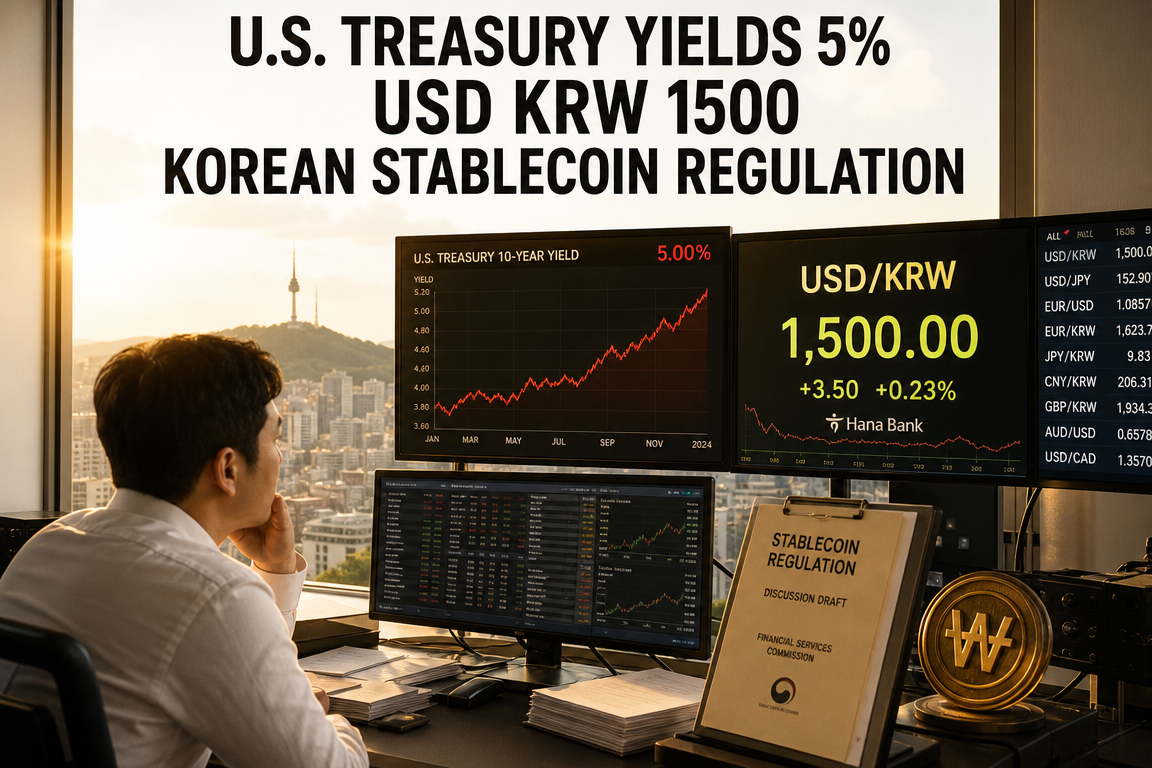
● Bond Shock, Won Slump, Stablecoin Turmoil
U.S. Treasury Yields at 5%, USD/KRW at 1,500, and Stablecoins: Key Market Drivers in One View
This issue cannot be reduced to a single headline about rising U.S. Treasury yields. The current market requires an integrated view of: (i) why long-end yields are rising, (ii) why KRW weakness is persistent, (iii) why expectations for Federal Reserve easing continue to be repriced, and (iv) why stablecoin policy discussions in Korea remain misaligned with practical adoption.
1. Core Market Focus: The Primary Macro Variable Is Shifting Back from FX to Rates
- Over recent years, FX was the dominant macro variable; the market’s focal point is moving back to rates, specifically long-term sovereign yields.
- Long-end yields embed expectations for: growth, inflation, fiscal expansion, private-sector funding demand, and the credibility of money.
- U.S. 10-year yields above 4.5% are widely treated as a valuation and risk-allocation threshold, increasing pressure on equities, strengthening the USD, and raising the risk of EM outflows.
- The move should be interpreted as a higher global asset-allocation baseline, not a localized bond-market disruption.
2. Why U.S. Treasury Yields Are Rising: Supply/Demand and Real Rates Matter More Than Inflation Alone
While inflation expectations are a factor (geopolitical risk, oil prices, and pass-through into food and logistics), the primary drivers emphasized are:
2-1. Increased Treasury Supply
- Persistent fiscal expansion increases net issuance.
- Higher supply depresses prices and lifts yields.
- Structural deficits raise the term compensation investors demand.
2-2. Elevated Private-Sector Capital Demand
- Significant funding needs are emerging from AI, semiconductors, grid investment, data centers, energy infrastructure, and advanced manufacturing reshoring.
- This is framed less as a cyclical impulse and more as a structural capex regime shift.
- When investment demand outpaces savings, real rates rise, implying a potential increase in the economy’s neutral rate.
2-3. Repricing of the Term Premium
- Long-duration exposure requires confidence in long-run policy, fiscal sustainability, and macro stability.
- Fiscal uncertainty, political risk, central-bank independence concerns, energy shocks, and geopolitical risk raise the term/risk premium.
- The yield move therefore reflects a more cautious market view of the long-run distribution of outcomes.
3. Is a Financial Crisis Imminent? Conditions Point to “Stress” Rather Than “Crisis”
- A systemic crisis typically begins with dysfunction in short-term funding markets (e.g., repo, interbank liquidity), not solely with higher long-end yields.
- The current situation is described as a long-end repricing driven by real-economy funding needs and duration risk.
- However, prolonged high long-term yields can sequentially pressure: equities, real estate, high-duration growth assets, highly levered corporates, and fiscally constrained sovereigns.
4. The Underlying Issue: Credibility of Money, Not Rates Alone
- Rates are the time price of money; FX is the relative price of money; inflation is money’s purchasing power; equities discount future cash flows.
- Broad volatility across these prices signals questions about the credibility of the monetary-fiscal framework.
- Key market questions include:
- U.S. fiscal trajectory and sustainability
- Federal Reserve independence and political influence risk
- The durability of USD safe-haven status
- The likely persistence of higher inflation and higher real rates
- Markets express these doubts through higher long-end yields, elevated FX volatility, and risk-asset repricing.
5. Can the Fed Cut Rates This Year? More Difficult Than Markets Previously Expected
Key constraints on near-term easing:1) Inflation expectations are being re-stimulated (including via energy channels).
2) Producer-price dynamics have surprised markets.
3) Internal disagreement within the Fed remains material.
4) Political optics: cutting rates under heightened political pressure risks credibility damage.
- The critical asset for a central bank is credibility and independence, which conditions policy transmission and currency confidence.
6. A “Kevin Warsh” Regime: Focus on the Fed’s System, Not Only the Policy Rate
- The relevant question is not solely hawkish vs. dovish bias, but potential changes to: operating framework, balance-sheet policy, and communication.
6-1. Balance-Sheet Reduction Is Operationally Constrained
- Liquidity withdrawal is materially harder than liquidity provision; tightening can expose fragilities.
- Aggressive QT increases the probability of stress in short-term funding markets.
- Combining significant balance-sheet contraction with rate cuts is operationally challenging in practice.
6-2. Communication May Be Streamlined, Not Eliminated
- Criticism of excessive signaling (e.g., dot plots, heavy forward guidance) is plausible.
- A return to opaque central banking is unlikely because communication is now part of the policy toolset and is priced ahead of meetings.
7. Why USD Credibility Matters: A Global Pricing-System Issue
- The USD anchors trade invoicing, cross-border finance, reserve management, commodity pricing, and safe-asset preference.
- If USD dominance is perceived to be over-politicized, if fiscal expansion is viewed as unchecked, or if central-bank independence is questioned, investors may gradually adjust required premia on USD assets.
- This is framed as premium repricing, not an imminent collapse scenario.
- Shifts in USD premia affect Treasury yields, FX, global portfolio allocation, and EM capital flows.
8. Why KRW Weakness Persists: Structural Adjustment, Not a Simple Crisis Template
The KRW’s depreciation is explained primarily as a structural flow story.
8-1. Korea’s Post-2010 Excess Savings and Outbound Allocation
- Retirement-related pools (pensions, insurers, asset managers, household financial assets) expanded materially.
- Domestic markets have limited capacity to absorb these flows at scale, encouraging overseas allocation.
- The national pension fund is a key example: portfolio construction increasingly requires global exposure.
8-2. Corporate Overseas Investment Is Also Structural
- Firms invest abroad for market access (U.S., Europe, Mexico) and for supply-chain and cost optimization (including Southeast Asia).
- These are competitiveness-driven decisions typical of a mature economy, but they increase USD demand in FX markets.
8-3. U.S. Asset Returns Have Been Superior
- Since the 2010s, global capital has favored U.S. assets due to productivity, innovation, and equity-market performance.
- Relative return differentials translate into persistent KRW weakness via capital-flow channels.
9. Is 1,400 USD/KRW a New Normal?
- A mid-1,300s to 1,400s regime is framed as consistent with structural shifts.
- Additional risk factors (tariffs, conflict, oil, prolonged Fed restrictiveness) can drive overshoots toward ~1,500.
- Current dynamics are increasingly dominated by capital flows rather than trade balances; strong exports alone do not guarantee currency appreciation if outbound investment flows are larger.
10. Korea’s Policy Response: FX Smoothing Has Limits; Capital-Market Competitiveness Is Core
- Near term: smoothing operations may be warranted to limit overshoot dynamics driven by expectations.
- Structural solution: increase the domestic rationale for investment through:
- capital-market reforms
- governance improvements
- tax and regulatory modernization
- corporate value enhancement
- development of new industries
- strengthened AI and semiconductor-led growth engines
- FX stability is framed as a function of domestic expected returns and investment attractiveness, not only FX intervention.
11. Is KRW Weakness Primarily About Money Supply? Interpretation Should Be Cautious
- In modern financial systems, monetary aggregates (e.g., M2) have limited direct explanatory power for FX and inflation in isolation.
- Central banks emphasize rates and broad financial conditions and their transmission channels.
- With Korea’s inflation running below U.S. inflation, attributing KRW weakness solely to comparatively easier domestic liquidity conditions is not presented as robust.
12. Stablecoins: The Practical Bottleneck Is Ecosystem Demand, Not Regulatory Jurisdiction
12-1. Stablecoins Are Transactional Infrastructure Within Digital-Asset Markets
- Stablecoins do not fully replace sovereign currency, but they function as a stable medium of exchange, collateral, and liquidity layer within crypto markets.
- Given volatility in non-pegged tokens, demand for fiat-linked stable value units is structurally embedded in the ecosystem.
12-2. Korea Needs Ecosystem Design Before Rulemaking
- The U.S. is legislating against a relatively developed DeFi and token-market infrastructure.
- Korea’s ecosystem connectivity and scale are more limited; regulation-first approaches risk misalignment with real usage.
- Core question: in which industries and platforms would a Korea-linked stablecoin have sustained demand (AI, content, gaming, platforms, and digital-asset infrastructure).
13. News-Style Key Takeaways
U.S. Long-Term Yields
- The move reflects not only inflation risk but also increased Treasury supply, private capex demand, and a rising term premium.
Federal Reserve Policy
- Near-term cuts appear constrained by inflation expectations, internal divergence, and political-neutrality considerations.
USD Credibility
- The USD remains the primary reserve currency, but politicization, fiscal concerns, and independence risk can alter required premia.
USD/KRW
- KRW weakness is characterized more as structural outbound flows and U.S.-asset preference than as an immediate crisis signal.
Korea’s Response
- FX intervention can smooth volatility; durable stability requires higher domestic expected returns via structural reforms.
Stablecoins
- Demand and ecosystem design precede effective regulation; stablecoins gain relevance when anchored to actual use cases.
14. Under-Discussed but Material Points
1) Long-end yield increases may reflect a structural rise in real/neutral rates driven by AI, semiconductors, power, and infrastructure capex, implying rate declines may be less mechanical in downturns.
2) KRW weakness is less about insufficient capital and more about limited domestic absorption capacity for accumulated savings.
3) Stablecoin debates should prioritize ecosystem and use-case formation over restriction-first frameworks.
4) For Fed leadership transitions, balance-sheet strategy and communication framework may matter as much as rate preferences.
5) Monetary credibility erosion is typically incremental; markets price early cracks through yields, FX volatility, and risk premia.
15. Indicators to Monitor
1) Whether U.S. 10-year yields stabilize above 4.5%
2) Whether higher oil prices re-accelerate inflation expectations
3) Whether Fed communications shift from cuts toward renewed tightening bias
4) The duration of USD/KRW trading around ~1,500
5) Whether Korean market reforms and new-industry investment translate into measurable inflows
6) Divergence between U.S. stablecoin legislation and Korea’s digital-asset policy trajectory
< Summary >
- The rise in U.S. Treasury yields reflects not only inflation risk but also increased issuance and a capex-driven increase in real rates linked to AI and semiconductor investment.
- Fed rate cuts within the year appear constrained by inflation risks and credibility considerations under political scrutiny.
- USD/KRW strength reflects structural outbound Korean capital flows and persistent preference for U.S. assets more than a short-term crisis dynamic.
- Korea’s durable response lies in enhancing capital-market competitiveness and expanding investable growth opportunities, not solely FX intervention.
- Stablecoin relevance depends on ecosystem demand and implementable use cases; regulation is secondary to adoption infrastructure.
- The core market issue is the evolving assessment of where monetary credibility is being challenged.
[Related]
- https://NextGenInsight.net?s=sovereign-bond-yields
- https://NextGenInsight.net?s=stablecoin
*Source: [ 경제 읽어주는 남자(김광석TV) ]
– [풀버전] 국채금리 5%, 흔들린다. 돈의 신뢰가 무너지는 진짜 이유 | 경읽남과 토론합시다 | 이승헌 교수