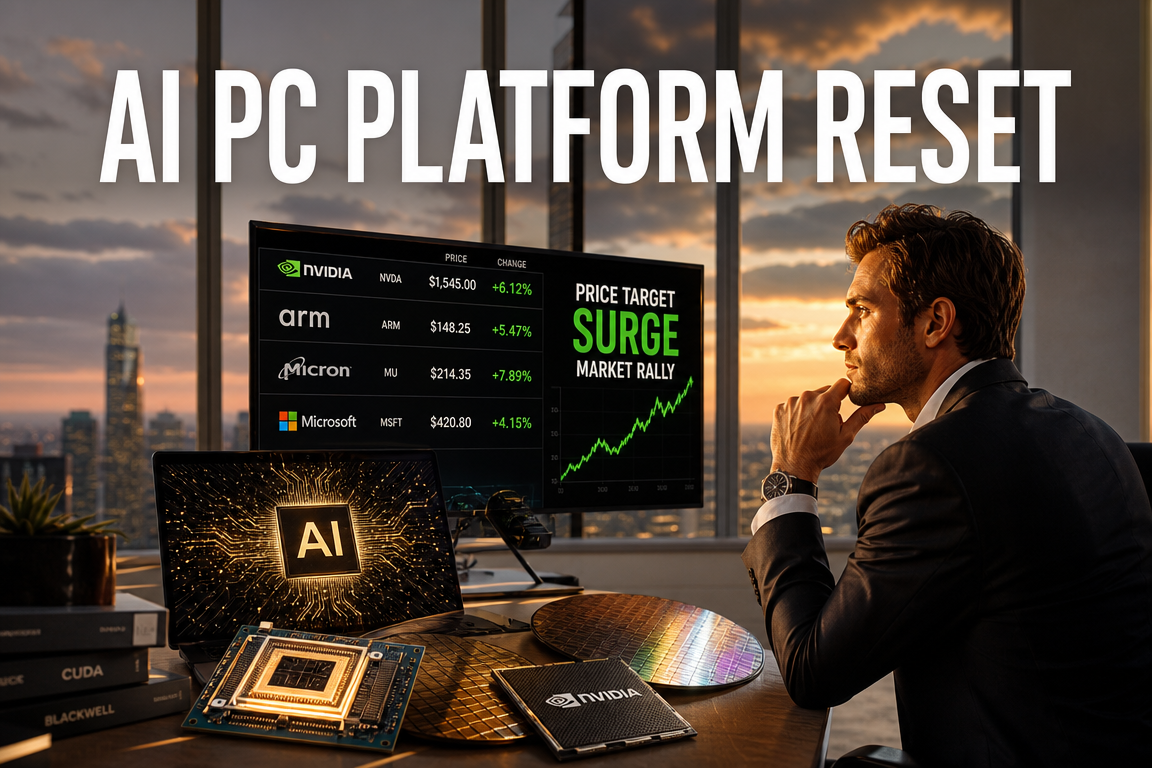
● AI PC Shock, Nvidia, ARM, Micron Soar
Drivers Behind the NVIDIA, Arm, and Micron Rally: The Core Thesis Is an AI PC Platform Reset
The key market takeaway was not the magnitude of NVIDIA’s move in isolation. The price action reflected a broader linkage across: the Nasdaq rally backdrop, the acceleration of the AI PC cycle, beneficiaries across the semiconductor supply chain, expansion of the Arm ecosystem, and rising memory intensity.
The central development is a structural shift in which AI extends beyond data centers into PCs and edge devices, implying a broader competitive reset across hardware and software stacks.
This report summarizes: (i) why NVIDIA, Arm, and Micron moved in tandem, (ii) why AMD and Intel faced relative pressure, and (iii) potential transmission to semiconductor equities beyond the US, including Korea.
One-line market summary
Following NVIDIA’s Taiwan GTC messaging alongside Arm and Microsoft, markets interpreted the event less as a product announcement and more as a signal of a next-generation computing platform transition.
NVIDIA rose ~4%, Arm surged ~18%, and Micron benefited from renewed expectations for memory demand leverage. By contrast, Intel and AMD underperformed amid concerns that AI PC platform competition could intensify and shift share dynamics.
1. Why NVIDIA rose: Positioning AI expansion from servers to PCs
Core message from NVIDIA’s GTC
The key message was that AI workloads are expected to expand from data centers into mainstream personal computing.
NVIDIA’s primary growth narrative has been data center GPU-led AI capex. A shift toward AI-capable PCs implies a broader addressable market (TAM) and a less single-source growth profile, potentially diversifying forward earnings drivers.
Why the equity market reacted
Equities typically discount future growth pathways. The messaging suggested NVIDIA aims to extend influence beyond data center infrastructure into the AI device ecosystem, supporting a higher-growth platform narrative.
2. Why Arm surged ~18%: Expectations for CPU architecture shifts in the AI PC era
Why Arm moved with NVIDIA
As AI PCs scale, the platform requirement extends beyond GPUs to include power-efficient CPU architectures, battery life, thermals, and mobile-PC convergence. Arm’s architecture is positioned for these constraints.
Arm’s footprint has historically been concentrated in mobile, but its presence in laptops and PCs is expanding. If Microsoft continues to broaden Windows-on-Arm support and NVIDIA aligns with that ecosystem, markets can price in higher royalty and influence potential.
The underlying driver of Arm’s rally
The move reflected a re-rating tied to the question: which architectures are advantaged if AI PCs become mainstream? The market view favored Arm’s power-efficiency and on-device AI suitability.
3. Why Micron benefited: AI PC expansion implies higher memory intensity
Why memory may be a primary beneficiary
AI compute expansion typically increases memory demand. AI PCs require higher bandwidth and capacity to support local model execution and AI-assisted features, implying higher DRAM and NAND content per device versus legacy PCs.
Market expectations for Micron
Micron’s cyclical memory recovery thesis is being supplemented by AI-driven demand leverage. Beyond server-class AI memory, AI PC adoption could raise consumer device memory content, supporting price, unit, and mix upside if adoption translates into volume.
Relevance for Korean semiconductors
An AI PC-driven increase in memory intensity is constructive for Korean memory leaders. The dynamic can support sentiment for large-cap memory names, and is particularly relevant to suppliers with established AI memory positioning.
4. Why AMD and Intel underperformed: Platform transition risk for incumbent PC leaders
Why incumbents face relative pressure
Underperformance does not imply structural impairment. However, platform transitions tend to shift investor attention toward perceived next-cycle winners.
The legacy PC stack has been x86-centered. In the AI PC cycle, competitiveness depends on integrated CPU/GPU/NPU capability, power efficiency, OS-level optimization, and AI software ecosystem alignment. Strong visibility for an NVIDIA-Arm-Microsoft alignment can position incumbents as relatively defensive in the near term.
Interpretation of market reaction
The price action more likely reflects a rotation of attention toward new growth vectors than a definitive loss of competitiveness. A key watch item is the product and partnership response from AMD and Intel.
5. Broader implications for global markets
Implications for US equities
This was not purely idiosyncratic single-name momentum; it reinforced AI-led risk appetite in US tech. If AI PCs represent an incremental cycle, earnings estimates could improve across semiconductors, software, cloud, and device-related segments.
Macro perspective
Despite rate and growth uncertainty, AI investment has remained comparatively resilient due to its productivity linkage. AI PCs map directly to enterprise productivity use cases (workflow automation, on-device assistants, document and meeting summarization, security, and local inference), potentially influencing IT spending priorities.
6. Potential impact on Korea: KOSPI and KOSDAQ
KOSPI large-cap semiconductors
Strength in NVIDIA, Arm, and Micron can lift expectations for memory and core semiconductor leaders. If memory recovery and AI demand reinforce each other, large-cap semiconductors may contribute to index support.
KOSDAQ equipment and components
If AI PC volume ramps, attention can broaden from chip designers to the supply chain, including semiconductor equipment, advanced packaging, substrates, power semiconductors, and AI PC-related components. Volatility risk remains elevated; fundamentals such as orders and earnings should be monitored.
7. Key points (news-style)
First. NVIDIA’s Taiwan GTC messaging highlighted AI PC ecosystem expansion with Arm and Microsoft, contributing to strong equity performance and supportive Nasdaq sentiment.
Second. Arm surged ~18% on expectations that low-power, high-efficiency architectures may gain share in AI PCs.
Third. Micron attracted incremental interest as AI PC adoption could increase memory capacity per device and demand for higher-performance memory.
Fourth. AMD and Intel lagged amid concerns over near-term platform leadership and intensified competition in AI PCs.
Fifth. The theme can extend beyond US markets, potentially supporting sentiment across Korean semiconductor equities.
8. Underappreciated takeaway
The central shift is the migration of AI’s center of gravity
The key development is a potential shift from data center-only AI growth to broad deployment across personal computing devices. If realized, the competitive arena expands beyond a narrow set of server GPUs to an integrated ecosystem spanning CPU, memory, NPU, operating systems, OEMs, and software.
Memory may become a binding constraint and a key lever
AI adoption often exposes bottlenecks in memory capacity/bandwidth and power efficiency. This increases the strategic importance of memory suppliers, including major Korean players.
AI PCs could catalyze replacement demand
While the PC market is mature, AI functionality may create a new replacement rationale for enterprises and consumers, potentially benefiting both semiconductors and downstream hardware/component ecosystems.
9. Monitoring framework
1) Verify whether AI PC messaging translates into unit growth and revenue contribution.
2) Track the pace at which Microsoft standardizes the Windows-based AI PC user experience; OS enablement is a gating factor.
3) Monitor memory pricing, mix shift, and adoption of higher-value products to assess earnings leverage for memory vendors.
4) Assess AMD and Intel product roadmaps and partnership strategies as competitive responses.
10. Conclusion
The rally in NVIDIA, Arm, and Micron reflected market pricing of AI expansion from data centers into PCs and personal devices. NVIDIA was re-rated on ecosystem expansion, Arm on architecture positioning for power-efficient AI PCs, and Micron on memory-intensity leverage.
The theme is relevant beyond the US and may influence semiconductor sentiment across Korea. The critical competitive question is not only who builds the best AI, but who can embed AI across the broadest set of devices and ecosystems.
< Summary >
NVIDIA’s upside reflected expectations tied to AI PC market entry and ecosystem expansion.
Arm rallied on the view that power-efficient architectures are advantaged in AI PCs.
Micron benefited from expectations that AI PCs increase memory content and demand for higher-performance memory.
Intel and AMD lagged on platform-transition and near-term leadership concerns.
The broader signal is a potential structural shift toward AI deployment in personal devices, with positive read-throughs for semiconductor supply chains, including Korea.
[Related Articles…]
NVIDIA earnings outlook and key points in the AI semiconductor market reset
https://NextGenInsight.net?s=NVIDIA
Signals of semiconductor cycle recovery and KOSPI beneficiaries
https://NextGenInsight.net?s=semiconductors
*Source: [ 내일은 투자왕 – 김단테 ]
– 엔비디아, ARM, 마이크론 급등 이유
● Nvidia Soars, Microsoft Surges, MSTR Dumps Bitcoin, Buffett Bets on Housing
NVIDIA +4% Surge, Microsoft $550 Price Target, MSTR’s First Bitcoin Sale in Four Years, and Berkshire’s Housing Bet—Key Takeaways
Key US market drivers extended beyond isolated single-stock headlines, reflecting simultaneous repricing across AI, capital allocation, housing, and risk assets.
1. US Equity Market Snapshot
US equities opened mixed. The Nasdaq and S&P 500 traded slightly lower, while the Dow and Russell 2000 underperformed.
Market breadth diverged meaningfully, with capital concentrating in select AI-linked segments rather than lifting indices broadly.
- NVIDIA strength
- Micron strength
- Microsoft strength
- Broad software sector strength
- Relative weakness: Intel, AMD, Qualcomm
- Relative weakness among select mega-caps: Tesla, Meta, Alphabet, Amazon
The session was characterized by increased concentration in AI infrastructure and platform beneficiaries.
2. Market Centerpiece: Why NVIDIA Re-accelerated
NVIDIA led performance following messaging from its keynote at Computex, which reinforced market expectations around its platform strategy.
2-1. Strategic Message: Expansion From GPU to CPU
The core signal was not incremental GPU news, but a more explicit push into CPUs for PCs and servers—areas historically dominated by Intel and AMD, with Qualcomm building presence in ARM-based Windows AI PCs.
The strategic direction implied tighter integration across CPU, GPU, OS-level optimization, and AI runtime environments in coordination with Microsoft.
AI competition is increasingly defined by integrated stacks: hardware, software, developer tooling, and operating-system alignment.
2-2. Core Moat: CUDA Ecosystem
NVIDIA’s defensibility is increasingly driven by the CUDA ecosystem rather than chip performance alone.
Developer workflows, toolchains, and deployed codebases are deeply embedded in NVIDIA’s platform, raising switching costs and reducing the likelihood that alternative silicon wins purely on benchmarks.
CPU entry should be interpreted as a move toward vertical integration across the full AI compute stack.
2-3. Why Intel, AMD, and Qualcomm Weakened
- Intel: perceived risk of intensified competition in core CPU franchises
- AMD: increased competitive pressure across server and PC CPU segments
- Qualcomm: incremental uncertainty in Windows AI device positioning if NVIDIA deepens its footprint
Market focus shifted from “who builds AI chips” to “who controls AI-era platform standards.”
3. Microsoft: $550 Price Target and Re-rating Drivers
JMP Securities raised its price target on Microsoft to $550, reflecting platform-level AI monetization rather than a generic cloud thesis.
3-1. Microsoft’s Lead in AI Monetization
- OpenAI partnership
- Azure expansion
- Copilot commercialization
- AI embedded across enterprise productivity products
- Integration across Windows and the device ecosystem
Microsoft is viewed as converting AI capability into subscription and enterprise revenue at a comparatively advanced pace.
3-2. Implications of Microsoft’s Strength
Microsoft’s performance also reflected a clearer linkage to NVIDIA across AI PCs, enterprise automation, software distribution, and cloud infrastructure.
From a portfolio perspective, AI exposure may increasingly favor companies combining infrastructure leverage, enterprise software monetization, and platform lock-in.
4. Why Software Outperformed: AI Agents as a Usage Multiplier
Software strength reflected the view that AI agents can increase aggregate software consumption (API calls, automation workloads, and managed services) rather than displace demand.
Always-on digital agents can drive materially higher utilization than human-only workflows, supporting software revenue intensity.
5. MSTR: Sale of 32 Bitcoin After Four Years
MicroStrategy sold 32 Bitcoin for the first time in four years. While immaterial in size, the action carried signaling value.
5-1. Why the Market Reacted Despite Small حجم
- Reframing Bitcoin from a “never-sell” reserve to a monetizable treasury asset
- Balancing shareholder-return initiatives with corporate treasury management
- Potential softening of previously rigid signaling
Bitcoin moved back toward the low-$70,000 range, consistent with heightened sensitivity to marginal sentiment shifts.
5-2. Bitcoin and Liquidity Sensitivity
Bitcoin should be assessed alongside rates, USD liquidity conditions, risk appetite, and ETF flow dynamics.
The episode is less indicative of structural weakness and more consistent with increasingly selective risk-asset preferences.
6. Oil Spike and Iran-Related Risk: Why No Broad Market Panic
Brent and WTI rose approximately 5–6%, reviving inflation concerns amid elevated Middle East tension and stalled US–Iran dynamics.
6-1. Macro Transmission of Higher Oil
- Higher transportation costs
- Higher input costs
- Upward pressure on consumer inflation
- Reduced probability of near-term Fed easing
6-2. Why Equities Did Not De-risk Aggressively
Price action suggested investors were not fully pricing a worst-case escalation scenario, treating the event primarily as a short-term price shock rather than a structural macro break.
7. Key Weekly Catalysts: US Labor Data and Broadcom Earnings
- Manufacturing PMI
- JOLTS job openings
- ADP private payrolls
- Nonfarm payrolls
- Broadcom earnings
7-1. Why Payrolls Matter
The Fed’s reaction function depends on both inflation and labor-market resilience.
Upside labor surprises could further delay rate-cut expectations; downside surprises could ease policy pressure.
Given ongoing big-tech restructuring and hiring moderation, internals may matter more than headline figures.
7-2. Why Broadcom Matters
Broadcom spans AI infrastructure, networking, custom silicon, and enterprise software.
Its results are a key indicator of whether AI demand is broadening beyond NVIDIA-centric supply chains.
8. Fed and Rates: “Hold” Base Case, With Hike Risk Discussed
The market’s base case remains policy on hold, though some commentary has raised the possibility of a July hike.
8-1. Drivers Behind More Hawkish Discussion
- Oil rebound
- Persistent services inflation
- Insufficient labor-market cooling
- Risk of rising inflation expectations
8-2. Counterpoint: Underlying Inflation Measures
Some underlying metrics (e.g., trimmed-mean PCE) have been interpreted as more stable, implying that parts of recent inflation prints may reflect episodic shocks (geopolitics, tariffs, category-specific spikes).
Policy remains constrained between limited room to cut and high bar to hike.
9. Berkshire Hathaway: Rationale for Interest in Homebuilders Such as Taylor Morrison
Berkshire’s move toward acquiring a homebuilder should be viewed as a structural housing call rather than a standalone M&A headline.
9-1. Housing Market Structure Under High Rates
Despite high mortgage rates, US housing supply remains constrained.
Low-rate lock-in discourages existing homeowners from selling, potentially shifting relative advantage toward new-home builders.
9-2. What Berkshire’s Positioning May Signal
Berkshire typically emphasizes long-duration cash flows, asset values, and durable demand.
The transaction is consistent with a view that housing demand can remain resilient even under restrictive rates due to supply limitations.
10. Goldman Sachs View: Not Yet a Classic Bubble Setup
Bubble concerns persist due to AI-related concentration. Goldman Sachs has emphasized offsetting supply-demand dynamics.
10-1. IPO Supply Impact Viewed as Manageable
While large IPOs are expected, the implied supply is not considered excessive relative to total US equity market capitalization.
10-2. Buybacks as Dominant Demand
Large-scale buybacks remain a meaningful support factor.
If repurchases exceed net issuance, aggregate equity supply can remain constrained, supporting market technicals.
11. Key Considerations for Korea-Based Investors
11-1. AI Positioning Requires Greater Selectivity
The “all AI benefits” regime is less reliable. Positioning may increasingly favor ecosystem leaders (NVIDIA), scalable monetizers (Microsoft), and diversified infrastructure enablers (Broadcom).
11-2. Monitor Rates Alongside Oil
Even if AI-driven earnings remain strong, oil-driven inflation risk can pressure multiples and shift rate expectations.
11-3. Bitcoin: Monitor Sentiment Inflection Points
MSTR’s sale does not negate long-term narratives, but it highlights increased market sensitivity to signaling and liquidity conditions.
12. News-Style Summary
- NVIDIA rallied on a platform expansion message extending beyond GPUs into CPUs and software ecosystem control
- Microsoft received a $550 price target on AI monetization and platform positioning, reinforced by NVIDIA-linked optionality
- Software outperformed on expectations that AI agents can increase software consumption and automation spend
- Intel, AMD, and Qualcomm underperformed amid perceived competitive pressure from NVIDIA’s broader stack ambitions
- MSTR sold 32 Bitcoin for the first time in four years; markets reacted to the signal more than the quantity
- Oil’s sharp rise revived inflation and rates concerns, but markets did not price a full escalation scenario
- Nonfarm payrolls and Broadcom earnings are key near-term catalysts
- Berkshire’s Taylor Morrison move is consistent with a structural housing supply-shortage thesis
- Goldman Sachs emphasized buybacks as a stronger demand factor than incremental IPO supply
13. Underappreciated Points
13-1. NVIDIA: Not a Product Headline, but an Order-Setting Move
The market relevance lies less in individual launches and more in NVIDIA’s attempt to re-architect AI-era compute standards around its stack.
13-2. Microsoft as a Toll Collector in Enterprise AI
Once enterprises operationalize AI, spending routes through Microsoft’s distribution and control points across OS, cloud, productivity, security, and collaboration.
13-3. Berkshire’s Housing Move Challenges Simple Recession Narratives
The positioning aligns with a view that structural supply scarcity can sustain housing activity, potentially supporting broader economic resilience.
13-4. MSTR’s Sale as a Cash-Flow Realism Signal
Even high-conviction treasury strategies face constraints from dividends, funding needs, and corporate financial management.
13-5. Focus Shifts From “AI Bubble” to “Earnings Capture”
The practical question is which companies convert AI capex into revenue and profit. Current leadership signals concentrate toward NVIDIA, Microsoft, and Broadcom.
14. Conclusion: Evidence of AI-Centric Capital Reallocation
The session reflected a re-ranking of US market leadership around AI platform control and monetization pathways, alongside macro constraints from oil and rates.
Positioning may increasingly reward companies with demonstrable earnings capture, ecosystem leverage, and durable distribution advantages within the AI cycle.
< Summary >
NVIDIA rallied as Computex messaging reinforced its ambition to control a broader AI compute stack spanning GPUs, CPUs, and software ecosystems.
Microsoft’s $550 target reflected accelerating AI monetization and platform leverage, with additional support from its alignment with AI infrastructure buildouts.
Software outperformance was consistent with expectations that AI agents expand automation usage and software consumption.
MSTR’s Bitcoin sale was small but symbolically important; oil’s surge raised inflation concerns without triggering broad risk-off pricing.
Berkshire’s Taylor Morrison move aligned with a supply-driven housing thesis.
Overall, market action pointed to AI-centered capital reallocation and a tighter linkage between AI investment and earnings capture by platform leaders.
[Related Articles…]
- NVIDIA-led AI ecosystem reshaping and US equity strategy
- Microsoft price-target revisions and AI monetization dynamics
*Source: [ Maeil Business Newspaper ]
– MSTR 4년만에 비트코인 32개 매각ㅣJMP시큐리티스, MS 목표가 $550 제시ㅣ버크셔, 주택 건설업체 테일러모리슨 인수ㅣ홍키자의 매일뉴욕