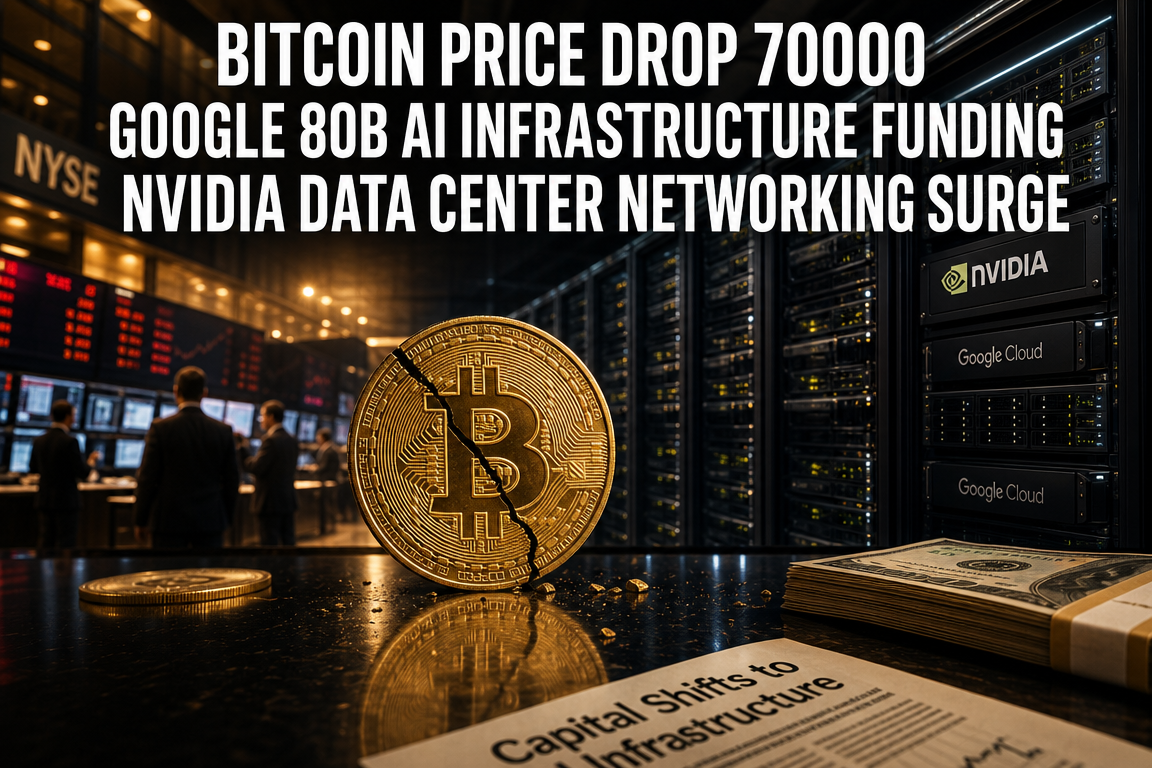
● Bitcoin Crash, Google AI Power Play, Nvidia Surge
Bitcoin Breaks Below USD 70,000; Google’s USD 80B AI Infrastructure Funding; A Single-View Briefing Across Nvidia, Broadcom, and Fluence Energy (June 2, 2026, New York Session)
The session was characterized less by index direction and more by capital concentration. The dominant allocation theme remained AI infrastructure: semiconductors, data centers, networking, and power-related buildout.
U.S. Equities at a Glance: Mixed Indices; AI Infrastructure Still Driving Flows
On June 2, U.S. equities were mixed at the index level, while dispersion across sectors and single names widened.
- Nasdaq: opened weaker, then recovered intraday
- S&P 500 and Dow: range-bound around flat
- Russell: comparatively resilient
More relevant than index levels was flow concentration into AI infrastructure and its supply chain:
- Nvidia: continued strength
- Broadcom: sharp gains
- Marvell Technology: repricing higher
- Hewlett Packard Enterprise, Cisco: strong moves in legacy server/networking
- Power-related and energy infrastructure names: rising expectations of demand pull-through
This setup is better framed as an industry retooling cycle centered on AI infrastructure rather than a generic growth-led rally.
Bitcoin Drops Below USD 70,000: Liquidity and Market Structure Shift, Not a Simple Pullback
Bitcoin’s break below USD 70,000 triggered a risk-off response. Headlines cited MicroStrategy-related selling, Mt. Gox overhang, and a bearish Coinbase note. The more material drivers were structural.
1. AI and Semiconductors Are Absorbing Incremental Liquidity
Historically, a strong Nasdaq often coincided with strength in Bitcoin via a shared “risk asset” factor. The current regime differs: capital is rotating toward AI exposure supported by realized earnings, orders, and capex visibility.
From an institutional portfolio perspective, the relative attractiveness of earnings-backed AI infrastructure has increased versus narrative-dependent crypto exposure.
- Spot Bitcoin ETFs reportedly saw approximately USD 3B of net outflows over roughly the last three weeks, consistent with this liquidity migration.
2. The Market Is Shifting from Spot to Derivatives-Led Exposure
A key feature of the move was reduced spot support. With broader regulatory acceptance and platform expansion for crypto derivatives, more investors can express exposure through futures and options within familiar brokerage ecosystems, reducing reliance on spot exchanges and custody.
In a derivatives-heavy structure:
- Price can move without commensurate spot accumulation
- Order books can thin
- Downside moves can become more discontinuous on negative catalysts
3. Forced Liquidations Amplified the Decline
Once Bitcoin breached USD 70,000, leveraged long positioning faced cascading liquidations.
- Reported forced liquidations exceeded USD 130M over a short interval, with longs comprising the majority
This reinforced a feedback loop: price decline → risk reduction/forced selling → deeper decline.
4. The Coinbase Sell Rating Signals Spot-Exchange Margin Compression
The negative call on Coinbase is less about a single equity and more about the economics of spot trading. If volumes migrate toward regulated derivatives venues with lower perceived regulatory friction, spot exchanges face structural pressure on fees and market depth.
Overall, the drawdown is most coherently explained by:
- Liquidity rotation into AI infrastructure
- Weaker spot bid
- Greater derivatives concentration and leverage-driven instability
Google’s Planned USD 80B AI Infrastructure Funding: Why It Read as Near-Term Headwind
Google disclosed a plan to raise up to USD 80B to expand AI infrastructure. The market response reflected a common tradeoff: long-term strategic investment versus near-term financing and margin concerns.
1. The Market Is Now Evaluating AI Spend on Returns, Not Narrative
AI capex is no longer automatically rewarded. Investors increasingly demand evidence that incremental spend translates into revenue and operating leverage. The scale of USD 80B elevated scrutiny of:
- Funding cost and dilution/financing structure
- Near-term margin impact
- Pace of monetization
2. Sector-Level Implication: Strong Positive for the AI Data Center Supply Chain
While potentially a near-term burden for Google equity, such funding is a direct demand signal for the broader ecosystem, including:
- Servers and accelerators
- Networking and interconnect
- Memory and storage
- Power delivery, cooling, and site infrastructure
- Semiconductor design and manufacturing services
Beneficiaries cited by market positioning include Broadcom, Nvidia, Marvell, memory suppliers, data center equipment vendors, and power infrastructure providers.
Nvidia, Marvell, Broadcom: Why the Market Is Focusing on the Linkages
A notable feature of the session was how commentary from Nvidia’s CEO translated into a broader rerating of networking/custom silicon exposure.
1. Marvell’s Move Reflects Custom Silicon and Data Center Networking Demand
Repricing in Marvell was interpreted as a signal that custom AI silicon and data center networking remain high-growth segments tightly coupled to hyperscaler buildouts.
2. Broadcom’s Strategic Positioning Is Central to Hyperscaler Customization
Even if hyperscalers reduce direct reliance on Nvidia by expanding internal accelerators (e.g., TPU-style strategies), Broadcom’s role in design enablement and broader networking/ASIC ecosystems remains pivotal. Increased data center capex therefore extends upside sensitivity to Broadcom.
3. AI Infrastructure Capex Appears to Be in a Continuing Expansion Phase
JPMorgan estimates implied a step-change in hyperscaler investment compared with the prior decade:
- Prior 10-year average annual increase in data center investment: ~USD 10B
- 2026 estimated annual increase: ~USD 250B
- 2027 estimated annual increase: ~USD 285B+
This is a scale shift consistent with infrastructure replacement and expansion rather than a standard cyclical IT recovery.
Fluence Energy and Power Infrastructure: A Critical Constraint in the AI Cycle
Power availability is increasingly treated as a binding constraint on AI scaling. Companies exposed to storage, grid optimization, and power delivery systems are being evaluated as second-order AI infrastructure beneficiaries.
1. AI Data Centers Are Fundamentally Power-Constrained
Compute density increases are only monetizable with secured power. JPMorgan estimates for North American data center power capacity:
- 2026: ~65 GW
- 2027: ~85 GW
- Pipeline projects: materially larger than installed capacity additions
This implies that semiconductor exposure alone provides an incomplete view of the AI investment chain.
2. Grid, Storage, Generation, Cooling, and Transmission Are Coupled
As data center demand scales, complementary infrastructure requirements rise in parallel:
- Energy storage systems
- Smart grid and power management
- Gas turbines and generation capacity
- Transmission and distribution buildout
- Thermal management and cooling solutions
Fluence Energy is positioned within this operational layer, increasingly evaluated less as a conventional ESG proxy and more as part of the system required to run AI at scale.
Under-Emphasized Market Point: “Physical AI Infrastructure” Is Being Valued More Than “AI Software”
Capital allocation is currently more concentrated in tangible buildout components:
- Semiconductors
- Servers
- Networking
- Memory
- Power
- Cooling
- Energy storage
Market behavior indicates higher confidence in near-term revenue visibility for physical infrastructure relative to application-layer monetization.
Bitcoin Weakness as a Capital Allocation Outcome, Not a Crypto-Only Issue
The recent Bitcoin drawdown can be interpreted as a reprioritization in global portfolios rather than an isolated crypto-market event. In an environment balancing inflation, rates, and macro uncertainty, capital has been migrating toward exposures with clearer earnings and capex transmission.
Big Tech Capital Allocation: Cash Flow Being Redirected Toward AI
Analyses referenced a shift from shareholder returns and diversified investment toward AI infrastructure as a primary use of operating cash flow, with some estimates suggesting data center capex could approach 80% to 90% of operating cash flow for certain platforms.
This signals a structural change in capital deployment that can influence index-level valuations and broader economic investment patterns.
Global Macro Interpretation
This is not solely a technology rally; it has broader macro implications.
1. U.S. Equities Are Using AI Capex Momentum to Offset Growth Concerns
Despite elevated rate sensitivity and demand uncertainty, AI-related investment and asset-price support appear to be contributing to resilience in parts of the real economy via equipment orders, construction, and power-related spending.
2. Implications for Korea: AI Memory and Semiconductor Supply Chain Revaluation
The framing suggests that Korea-linked semiconductor exposure is increasingly assessed through the lens of AI memory and the global supply chain connected to hyperscaler capex rather than traditional sector rotation.
3. Energy and Power Are Emerging as the Next Bottleneck Variable
As AI deployment scales, constraints shift toward:
- Power supply
- Cooling
- Land and permitting
- Transmission capacity
These constraints may shape regional investment strategies across the U.S., Korea, the Middle East, Europe, and Southeast Asia.
Investor Checklist
- Bitcoin’s decline: interpret through liquidity rotation and derivatives-driven structure, not only near-term sentiment
- Google’s USD 80B funding: near-term equity overhang; medium-term demand signal for the AI infrastructure supply chain
- Nvidia, Broadcom, Marvell: core exposures to the AI infrastructure buildout
- Fluence Energy and power/energy infrastructure: increasing relevance as enabling constraints for AI scaling
- U.S. equities: earnings- and capex-supported AI leadership remains the central driver
- Key macro bottleneck: power availability may become more binding than semiconductor supply
Conclusion: Capital Is Pricing “AI-Backed Earnings” and “Secured Power”
Bitcoin’s move reflected expectations and leverage mechanics, while AI infrastructure continued to benefit from earnings visibility and accelerating capital expenditure.
The market’s focal point is not a single equity; it is the integrated system required to deploy AI at scale: chips, networking, memory, data centers, power, storage, and financing capacity. The operative question has shifted from “which AI product wins” to “who can build and power the capacity.”
< Summary >
- Bitcoin’s drop is best framed as a structural outcome of liquidity rotation into AI infrastructure, weakening spot support, and derivatives concentration.
- Google’s USD 80B funding plan is a near-term burden for the stock but a broad positive signal for data centers, semiconductors, and power infrastructure.
- Nvidia, Broadcom, and Marvell remain core nodes in the AI infrastructure expansion, while power and energy names such as Fluence Energy may represent consequential second-order beneficiaries.
- Current market priorities emphasize physical infrastructure and power security over application-layer narratives.
[Related Posts…]
- https://NextGenInsight.net?s=Bitcoin
- https://NextGenInsight.net?s=Nvidia
*Source: [ Maeil Business Newspaper ]
– 비트코인 7만달러 이탈 급락ㅣ플루언스에너지, 엔비디아 데이터센터 설계 참여ㅣ구글, AI 인프라 위해 $800억 자본조달 계획ㅣ홍키자의 매일뉴욕