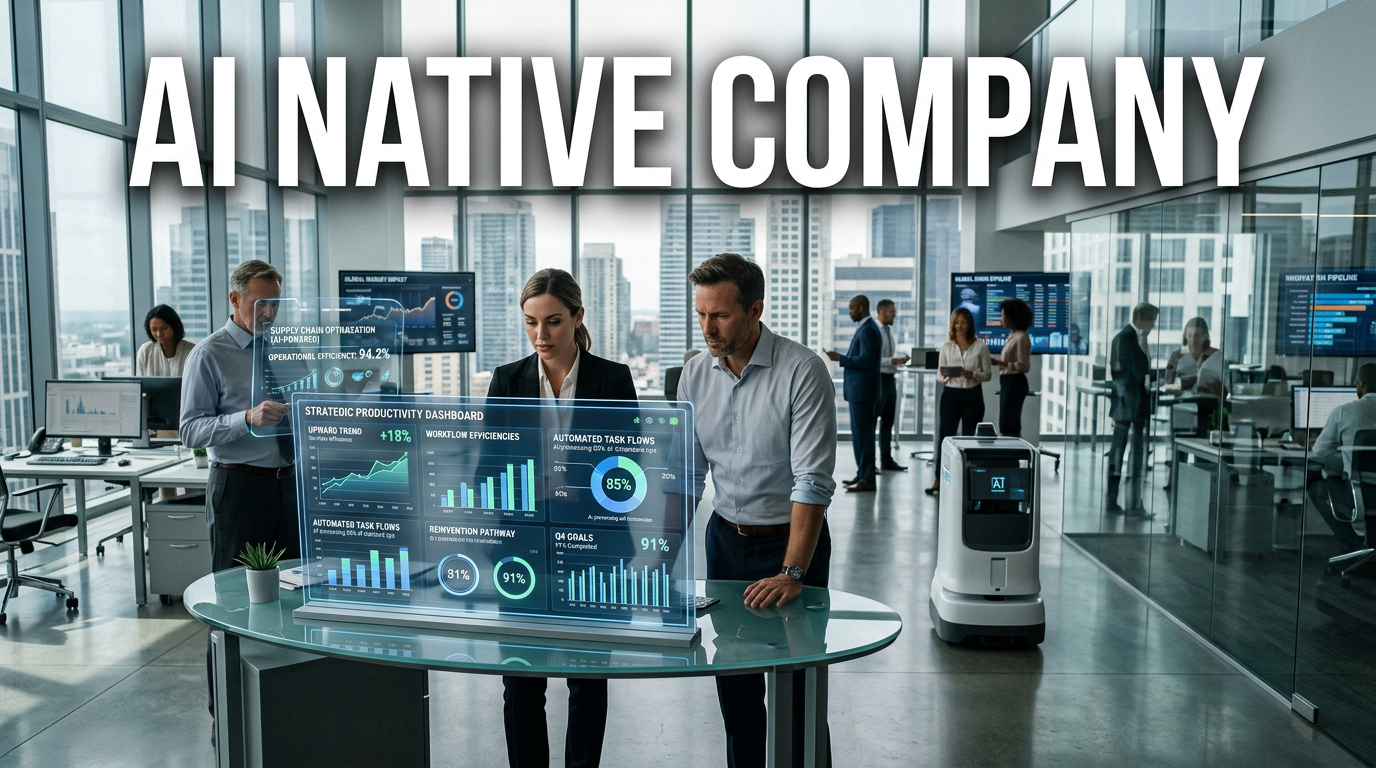
● AI Reshapes Companies Forever
A YC partner’s one-line remark: “AI is not a productivity tool; it is a technology that forces companies to be redesigned.”
Let’s look at the core point first
This article covers why an AI-native company is fundamentally different from a traditional organization,
why a Roman legion-style hierarchical structure has reached its limits,
why the key to changing a company is not a copilot but a self-improvement loop,
why records, data, and context are the real assets in the AI era,
and how middle managers and internal software are likely to be reshaped going forward.
In particular, this piece ties together the widely discussed themes of global economic outlook, AI trends, productivity innovation, business automation, and AI agents so you can read them as one connected story.
News in one line
Y Combinator partner Tom Blomfield stressed that “the era of attaching AI to a company is ending; now companies must be rebuilt into structures where AI can read, judge, and improve them on its own.”
This is not just a technology story. It is a story that could change corporate workforce structures, operating methods, investment priorities, and even productivity gaps in the global economy.
1. Most companies still move like a Roman legion
Tom Blomfield believes that most companies are still trapped in hierarchical organizations.
Orders go from top to bottom, while information moves from bottom to top.
This model worked fairly well in the industrial era, but in the AI era it is too slow and inefficient.
When people are reduced to mere conduits for information, organizations become slower as they grow, and decision-making becomes increasingly blurred.
He compared this structure to a Roman legion.
The important point is that the problem is no longer “who works harder,” but “is the organization structure right in the first place?”
2. Seeing AI only as a copilot has major limits
The way AI is commonly used today is as a copilot.
It boosts engineer productivity by 20%, helps people get work done faster, and adds AI to existing workflows.
But Tom called this approach a “broken way of thinking.”
That is because it is like putting an engine on a horse carriage.
The outer form stays the same while only the power increases, so the system still cannot overcome its structural limits.
The key is not to use AI as a productivity aid, but to redesign the company’s operating logic itself.
3. Real change starts with an AI-native company
What Tom emphasized is clear.
An AI-native company is not a company with AI attached to it; it is designed from the ground up so AI can read, judge, and improve it.
In such a company, people are no longer running around carrying information. Instead, AI understands data and context and continuously improves the system.
In other words, the company no longer relies on human memory.
The company’s intelligence accumulates in emails, Slack, documents, meeting recordings, CRM data, and product data.
That becomes the competitive advantage, and in the future this accumulation ability is likely to create meaningful differences in corporate value.
4. The core point is turning domain knowledge into context AI can read
One of Tom’s most striking observations was this.
Most know-how inside a company is scattered across people’s heads, Slack conversations, emails, and Notion documents.
If you structure this into context and skills that AI can understand, the company can become much smarter.
In other words, the important asset is not the “person” alone, but the “way that person works and accumulates knowledge.”
This is closer to capitalizing knowledge than to simple automation.
From a global economic perspective, the productivity gap between companies with well-structured knowledge and those without it could widen further.
5. A company now needs to become a “self-improving AI loop”
The future company Tom described runs on multiple AI feedback loops.
It is not a system you build once and leave alone; it is a structure that observes, fixes, and learns again and again.
The reason this matters is simple.
The company keeps improving even when people are not at work.
He described this structure as a recursive self-improvement loop.
In other words, AI performs work, analyzes failures, builds the next version, and learns from those results again.
Once this takes hold, the company becomes not just an “operating organization” but an “evolving system.”
6. A self-improvement loop operates through five layers
Tom explained this structure in five layers.
6-1. Sensor layer
This layer collects signals from the outside world, such as customer emails, support tickets, code changes, subscription cancellations, and product usage data.
In simple terms, it is the company’s eyes and ears.
6-2. Policy and decision layer
This is the set of rules that determines what AI can execute immediately, what requires human approval, and which tasks must always be recorded.
Without this layer, AI is fast but dangerous.
6-3. Tool layer
This refers to APIs and execution tools that AI can use, such as database queries, calendar checks, and CRM access.
AI must do more than speak well; it must actually be able to get work done.
6-4. Quality gate
This is the checkpoint that verifies results.
It includes evaluation tests, safety filters, and human review for high-risk tasks.
This stage prevents AI automation from running out of control.
6-5. Learning mechanism
This is the stage that analyzes actual failures and makes the system better.
In the end, AI should not only execute; it must also upgrade itself through failure.
7. A YC internal case showed the turning point
It began with a simple database lookup agent.
It answered questions like, “When was the last office hour with this company?”
Then it became smarter.
It could recommend founders in specific industries, analyze relevant context, and search using RAG.
But even then, it was still only a support role.
The real turning point came when a monitoring agent was added.
This agent monitored every query, analyzed why failures happened, identified missing tools or data structures, and even submitted code change requests on its own.
And that work was handled automatically overnight.
This was not simple automation; it was self-correction of the work system.
8. The same loop can reshape product, customer support, and sales
This approach can be expanded across the entire organization.
AI can review product analytics data, identify bottlenecks in the sales funnel, run A/B tests, and deploy better versions.
Customer support works the same way.
AI can classify incoming inquiries, solve the ones it can handle immediately, and pass risky cases to humans.
In the future, departments may no longer operate separately; instead, they could function as one operating system connected by AI.
At this point, business automation becomes not just cost reduction, but a transformation of management structure.
9. Companies will burn tokens, not headcount
One of Tom’s strongest lines was this:
“The age of burning headcount is over; now it is the age of burning tokens.”
In the past, the number of people was equal to productive capacity.
But in the future, productivity may be determined by how effectively a company uses AI, meaning how well it uses tokens and model calls.
Companies where revenue per employee has already risen sharply are emerging, and this trend is likely to continue into Series A and B stages.
Ultimately, the bottleneck for a company may become not hiring, but AI utilization capability.
10. Middle managers will shrink, while DRI and hands-on workers become central
Tom identified middle managers as a role likely to disappear.
That is because AI can handle much of the coordination, connection, and repeated checking.
Instead, two roles become important.
First, the hands-on builder, or IC.
Second, the DRI who owns one task end-to-end.
Committee-style diffusion of responsibility may actually slow things down.
In the AI era, “who made the decision” matters less than “who is responsible for finishing it.”
11. If it is not recorded, it does not exist for AI
The operating principle Tom emphasized most strongly was record keeping.
Emails, Slack, DMs, office hour recordings, meeting notes, and everything else must remain in a form that AI can read.
Why? Because work that is not recorded is, from AI’s perspective, the same as work that never happened.
This is not just an archiving issue.
It is about building the company’s memory and creating the fuel AI needs to understand work.
12. Records must be compressed, and context must be broken into smaller pieces
Of course, you cannot simply dump 100,000 hours of recordings into AI as-is.
That is why compression matters.
You need to extract the key points, organize them by topic, and leave only the clues AI can follow.
If this is done well, the company becomes not a storage room but a living knowledge engine.
This is especially tied to the information economy in the AI era.
What matters is not who has more information, but who structures it better.
13. User manuals should also be rewritten with AI
At YC, they rebuilt their user manual using roughly 2,000 hours of office hour recordings collected over the past three months.
AI classified the material, grouped it into topics like fundraising, hiring, and cofounder disputes, and then wrote a new manual.
The result was a 150-page document that was far better than the old version.
This manual is not a one-time document; it becomes a living operating guide updated every month.
This is a glimpse of the future of corporate documentation.
14. Software is becoming increasingly “disposable”
Tom said internal software built with AI should be treated almost like something disposable.
Instead of software you build once and use for years, it may be more natural to regenerate it whenever needed.
As models become smarter, rebuilding software may become better than maintaining old systems.
This trend changes internal dashboards, workflow tools, and analytics tools alike.
In other words, the value of data and prompts may become greater than the value of software assets.
15. What should be kept is not software, but data and understanding
Tom’s conclusion is very clear.
Throw away the software; keep the data.
Emails, work context, collaboration know-how, and operating methods are the real assets.
Software is just a vessel that temporarily holds that understanding.
This perspective shows very clearly where company value in the AI era comes from.
The key is not code itself, but understanding why the code exists.
16. Where will people remain?
People will remain at the edge of the company’s brain, where it meets reality.
New situations, ethical judgment, moments with strong emotional involvement, and high-risk decision-making still require humans.
In particular, cofounder conflicts, complex sales negotiations, and sensitive face-to-face situations are difficult for AI to replace.
In the end, people become not central operators, but judges at the boundary.
17. The most important point not to miss in this story
The key point that most other news or YouTube coverage misses is this:
The essence of AI is not a “tool,” but an “engine for organizational redesign.”
Many people see AI only as faster search, better writing, or a smarter copilot.
But the real change begins when a company’s memory, decision-making, verification, and learning are tied together into a single feedback structure.
In other words, AI does not just help work; it changes the way work is organized.
This is the point most likely to affect economic growth rates, corporate productivity, and labor market structure going forward.
18. From the perspective of the global economy and AI trends
This is not just a startup trend.
Worldwide, productivity innovation, digital transformation, automation investment, and the spread of AI agents are all happening at once.
In an environment with high interest rates, economic slowdown, and cost pressure, companies need to achieve more with fewer people.
That is why AI is becoming not a choice, but a necessity.
If you look at the U.S. stock market, global economic outlook, and the tech sector, what the market is likely to reward is not simply “how well AI is attached,” but “how fundamentally AI has redesigned the company.”
19. What companies and founders should start doing now
First, record everything your company does.
Second, organize emails, Slack, documents, and meetings so AI can read them.
Third, turn repetitive work into agents.
Fourth, build a structure that automatically tracks the causes of failure.
Fifth, keep updating internal manuals and operating documents with AI.
If these five things accumulate, the company can change from an organization that merely uses AI into one that evolves with AI.
< Summary >
Tom Blomfield argued that AI should be seen not as a copilot, but as a company redesign technology.
The core point is to move away from hierarchical organizations and build a self-improvement loop where recording, judgment, execution, verification, and learning all keep running.
In the future, tokens may matter more than headcount, context more than documents, and data more than software.
Middle managers will shrink, hands-on workers and DRIs will become central, and people will remain in areas requiring high-risk, ethical, and face-to-face judgment.
[Related articles…]
Codex is no longer just a coding tool; now it runs your entire day
How a YC partner says to build a company that improves itself with AI
*Source: https://maily.so/ahoy/messages/deKgrtgyNbawhfHKIK3fmBNKcHUZrTjV/click?signature=993285c00d40cfe1519d027140da4a470fb57a35&url=https%3A%2F%2Fmaily.so%2Fjosh%2Fposts%2Fwdr9q8x1olx%3Ffrom%3Demail%26mid%3Dgz26k3x9wo3