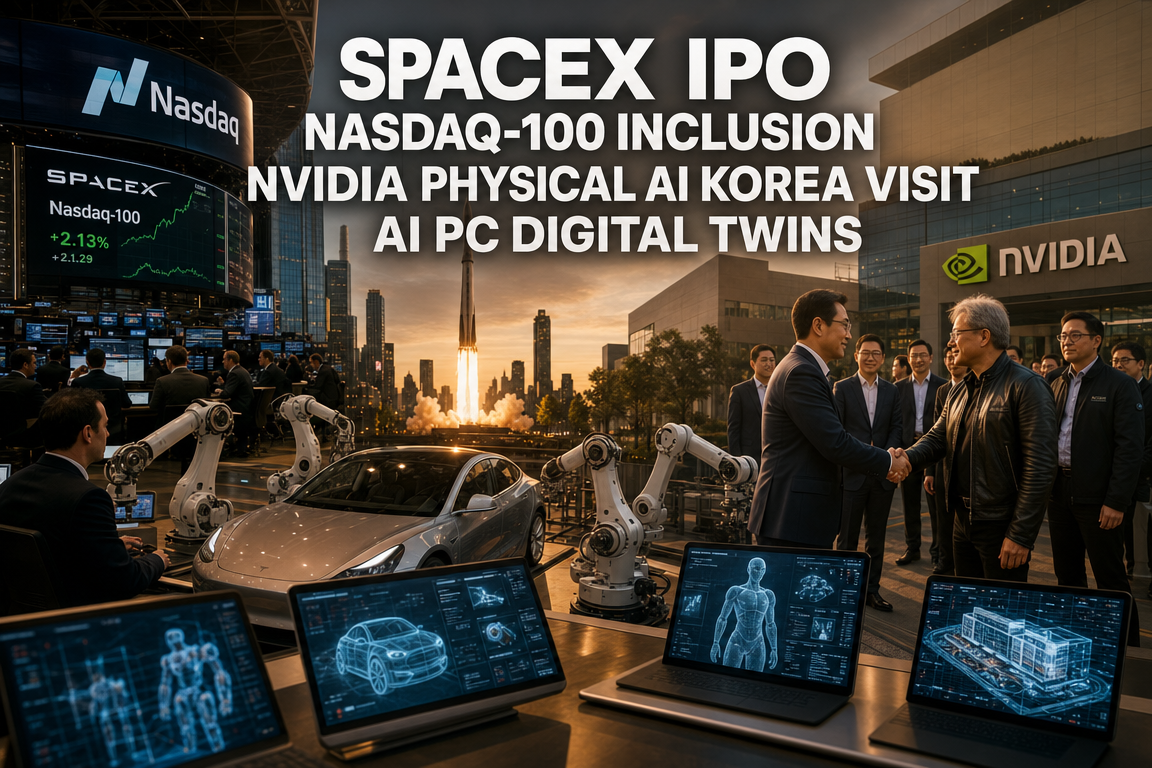
● SpaceX IPO Shock, Tesla Flat, Texas Power Play
SpaceX IPO Priced at $135; Tesla Flat at $423 — The Market Focus Is Not “IPO Hype,” but Capital Reallocation, Index Inclusion, and Texas Legal Structure
This development is not limited to a single IPO headline. Key issues include: (i) why a fixed IPO price signals a break from traditional Wall Street process, (ii) why Tesla shareholders should treat SpaceX’s listing as a direct flows and valuation event, and (iii) how a Texas legal structure may reshape future restructuring, governance, and potential combination scenarios.
The market impact should be evaluated through Nasdaq-100 inclusion mechanics, ETF rebalancing-driven flows, near-term volatility in Tesla, joint semiconductor/AI infrastructure build-out, and potential structural effects on US equity market positioning for mega-cap technology.
The central question is not the IPO itself, but who becomes a forced buyer, which incumbents are mechanically diluted, and which entities gain structural advantages.
1. US market context and Tesla price action
Tesla closed essentially flat around $423.7.
Major indices were broadly weaker, with downside pressure across the S&P 500, Dow, and Nasdaq.
Key overhangs include Middle East geopolitical risk and rising oil-price expectations.
If WTI moves toward the $95/bbl area, markets typically re-price inflation risk, raising concerns around sustained tight monetary conditions.
This is a cross-sector factor that can weigh on growth equities, particularly rate-sensitive large-cap technology, AI-exposed names, and EV-related stocks.
2. SpaceX IPO at $135: why the pricing approach matters
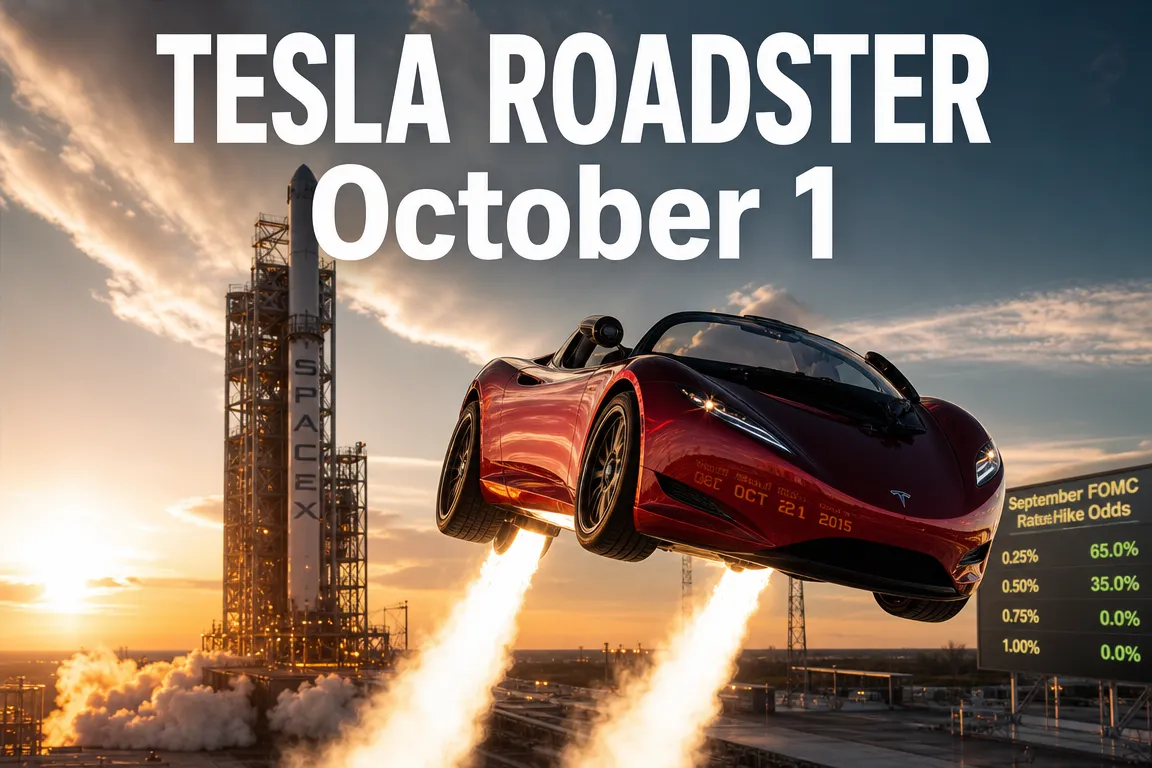
SpaceX is entering public markets with an effectively fixed price of $135 per share.
Traditional IPOs typically follow a book-building process: demand discovery, institutional roadshows, price range adjustments, and final pricing based on investor feedback.
Here, the sequence appears inverted: the issuer is signaling sufficient demand such that price negotiation is not a binding constraint.
This is not only a confidence signal; it suggests issuer brand power and platform narrative may be overriding conventional underwriting dynamics.
In this framing, the IPO reflects a market regime where monopoly-like platform expectations and technology narrative can dominate traditional capital markets convention.
3. Why the market is assigning a premium valuation to SpaceX
The valuation focus is less on current financials than on perceived future market control.
SpaceX is not being priced solely as a launch services provider. The premium is linked to four perceived pillars:
- Starlink-based satellite communications dominance
- Structural entry barriers in launch and space infrastructure
- Longer-term optionality around AI-era data transport and space-based compute infrastructure
- Platform value through integration with the broader Musk ecosystem
Investors are increasingly treating SpaceX as next-generation global infrastructure rather than a single-industry aerospace company.
4. Key implication for Tesla shareholders: capital reallocation risk
SpaceX’s listing may appear directionally positive for the broader ecosystem, but public-market mechanics require reallocation when a major new constituent emerges.
A larger SpaceX does not imply Tesla automatically rises in tandem.
Index inclusion and ETF rebalancing can force passive capital to buy the new name and reduce weights in existing holdings.
For Tesla holders, the primary near-term question is whether mechanical weight compression and flows create temporary pressure independent of company fundamentals.
5. Potential forced inclusion in the Nasdaq-100: why this can be a market shock point
If a newly listed company reaches market-cap and eligibility thresholds, it may enter the Nasdaq-100 relatively quickly.
In that case, index funds and ETFs such as QQQ would be required to purchase SpaceX.
This is structural, not discretionary: passive vehicles must transact regardless of preference.
Such forced demand typically supports near-term price stability in the new constituent, while mechanically reducing weights elsewhere.
As a result, SpaceX inclusion could expand attention toward growth and AI-linked equities broadly, but still generate short-term noise for specific incumbents, potentially including Tesla.
6. Is this positive or negative for Tesla? Scenario framework
6-1. Near-term downside scenario
The first-order risk is fund flow rotation.
Some investors may view Tesla as more mature while assigning a higher growth premium to the newly listed SpaceX, prompting rotation.
If this coincides with ETF/index rebalancing, Tesla could face supply pressure unrelated to operating results.
This effect may be amplified during periods of macro fragility driven by rates and oil.
6-2. Medium- to long-term upside scenario
Over a longer horizon, public-market pricing of SpaceX could increase the perceived ecosystem premium.
If SpaceX links the narrative of space, satellite communications, AI infrastructure, autonomy, robotics, and semiconductors into a unified platform view, Tesla may be re-rated away from a pure EV framing toward AI/robotics optionality.
In this structure, the market impact can differ by horizon: near-term flow pressure versus longer-term multiple re-evaluation potential.
7. Why M&A speculation persists: precedent for ecosystem consolidation
The market is not raising combination scenarios without context; Musk has historically restructured and integrated assets when strategic alignment required it.
As batteries, vehicles, semiconductors, AI platforms, data centers, and robotics stack components converge, the boundary between firms can narrow through operational integration even absent formal M&A.
The market focus is therefore less on an immediate deal announcement and more on whether the ecosystem is already being functionally integrated.
8. The Texas legal structure: governance and restructuring implications
A less-publicized but material issue is SpaceX’s use of a Texas legal structure.
If reported constraints hold, shareholder challenges to merger-related actions or governance changes may require unusually large ownership thresholds, effectively limiting intervention by most institutions and minority holders.
This implies that public listing may broaden capital access while preserving highly concentrated control.
If combined with non-voting or dual-class structures, the result is capital raised externally with limited dilution of control—favorable to the issuer but potentially a governance discount factor for public investors.
9. Underappreciated driver: physical infrastructure and chips, not the IPO headline
Coverage often concentrates on IPO pricing, market cap, and index inclusion.
A more operationally relevant signal is physical infrastructure build-out.
A large-scale semiconductor facility project in Grimes County, Texas indicates the Tesla-SpaceX linkage is moving from narrative to shared supply chain and production capacity.
If chip design and manufacturing, AI compute silicon, vehicle/robot chips, and space-infrastructure compute systems converge, competitive advantage shifts from software alone to an integrated system spanning chips, data, power, and manufacturing.
10. Significance of approval despite local resistance
Local concerns included water, power, and environmental impacts.
Approval suggests local authorities prioritized growth, jobs, and cluster effects.
The US policy backdrop includes reshoring, semiconductor autonomy, and AI infrastructure expansion. In that context, companies such as Tesla and SpaceX may function as de facto industrial policy anchors.
Alignment among government, local communities, and capital markets can extend the duration of investment cycles in targeted industries.
11. Why the market reaction to Tesla robotaxi messaging was muted
Tesla emphasized expansion of unsupervised autonomy across the Austin metro area, but markets are prioritizing operating scale over statements.
Perception remains that fleet size and service coverage are limited versus expectations.
Relative to competitors, the view persists that demonstrations are strong, while commercialization velocity requires further proof.
To sustain autonomy/AI premium, the market is likely to require operating metrics, real-world utilization data, and pace of scale-up.
As SpaceX draws attention via listing dynamics, Tesla may need measurable progress in robotaxi, Optimus, and energy to regain focus.
12. News-style key takeaways
- SpaceX effectively set an IPO price at $135, signaling a departure from traditional demand-discovery conventions.
- The market is valuing SpaceX as a satellite communications, AI infrastructure, and platform-control story, not only as a space company.
- Potential rapid Nasdaq-100 inclusion elevates expectations of forced buying by ETFs and index funds.
- Existing constituents, including Tesla, may face near-term flow-driven weight reductions.
- Texas legal structure and potential non-voting share design could limit external governance checks during future restructuring.
- The core linkage between Tesla and SpaceX is increasingly semiconductor and AI infrastructure build-out, not IPO optics.
- Tesla’s robotaxi narrative has had limited price impact due to insufficient evidence of operational scale.
13. Key points underemphasized in mainstream coverage
First, the primary near-term driver is passive-flow mechanics, not subjective judgments about which company is “better.”
Second, the Texas structure is not a legal footnote; it may operate as a control-preservation mechanism that constrains minority influence during future restructuring.
Third, the larger strategic picture is vertical integration across Tesla-SpaceX-semiconductors-AI infrastructure, potentially creating an ecosystem premium rather than isolated company premia.
Fourth, investors should scrutinize why positive headlines do not immediately translate into price response: the market is weighting execution and flows more heavily than forward narratives.
14. Forward monitoring checklist
- SpaceX price action during the first three trading sessions post-listing
- Timing and likelihood of accelerated Nasdaq-100 inclusion
- Estimated size and timing of ETF and index rebalancing flows
- Whether Tesla trades in tandem with SpaceX or diverges due to rotation
- Additional permits and final investment decisions for the Texas semiconductor facility
- Pace of Tesla robotaxi deployment and fleet expansion
- Commercial milestones for Optimus, energy storage, and AI silicon
- US rates, oil prices, and inflation re-acceleration risk
15. Conclusion
The market is treating SpaceX’s listing as a catalyst for capital flow reallocation and a potential reshaping of the US technology equity landscape.
For Tesla shareholders, this is a relevant inflection point. Near-term pressure may emerge from index-driven reweighting and rotation, while medium- to long-term optionality may increase if the ecosystem is re-valued around AI infrastructure and vertical integration.
The appropriate framing is not Tesla versus SpaceX in isolation, but how EVs, autonomy, robotics, satellite communications, semiconductors, and AI infrastructure converge into a unified industrial map.
< Summary >
SpaceX’s $135 IPO pricing approach is not merely a listing headline; it signals a break with traditional Wall Street process.
The core drivers are potential forced buying from Nasdaq-100 inclusion, index/ETF rebalancing that can compress weights in existing mega-cap technology (including Tesla), and governance implications from a Texas legal structure that may preserve concentrated control.
Near-term, Tesla may face flow-driven pressure; over longer horizons, ecosystem-level re-rating is possible as AI infrastructure, semiconductors, autonomy, and space assets are increasingly integrated.
The most material signal is not IPO “success,” but tangible joint build-out of chips, manufacturing capacity, and AI platform infrastructure.
[Related Articles…]
- https://NextGenInsight.net?s=SpaceX
- https://NextGenInsight.net?s=Tesla
*Source: [ 오늘의 테슬라 뉴스 ]
– 스페이스X $135 확정, 합병을 막으려면 $500억 필요 — 텍사스 법이 만든 구조, $423 테슬라 주주는 지금 어떻게?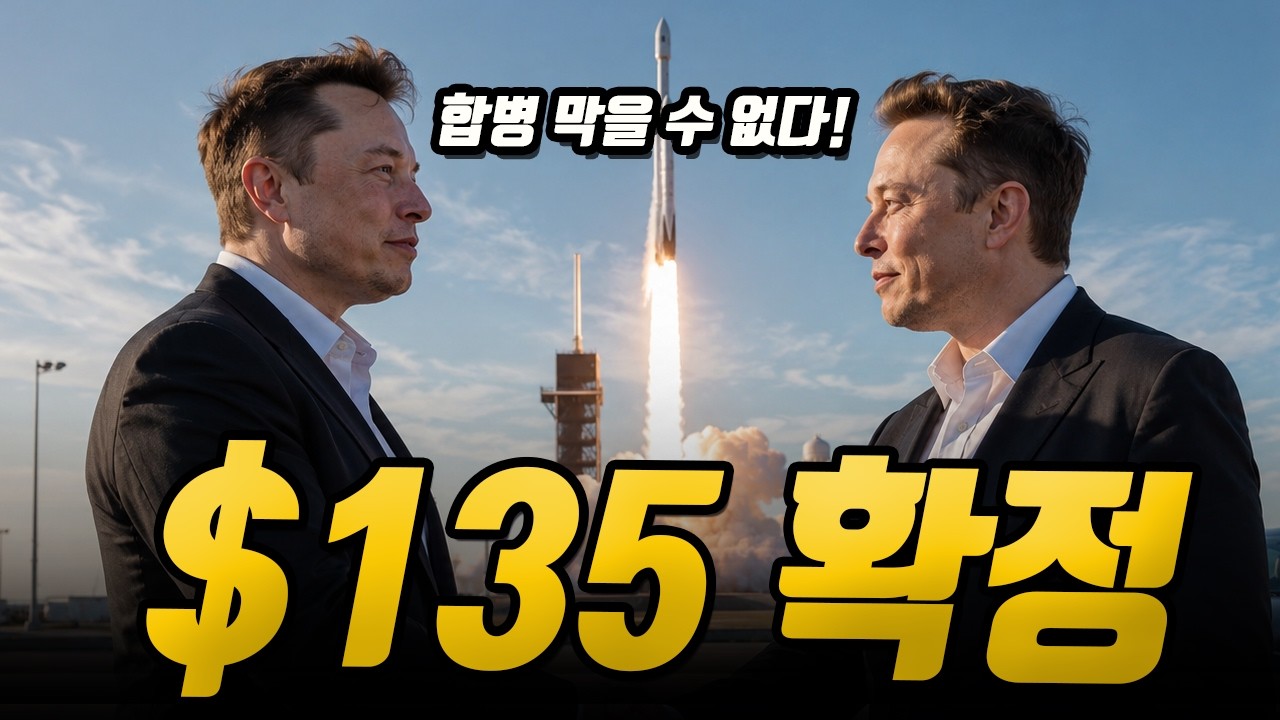
● Nvidia-Korea AI Power Play
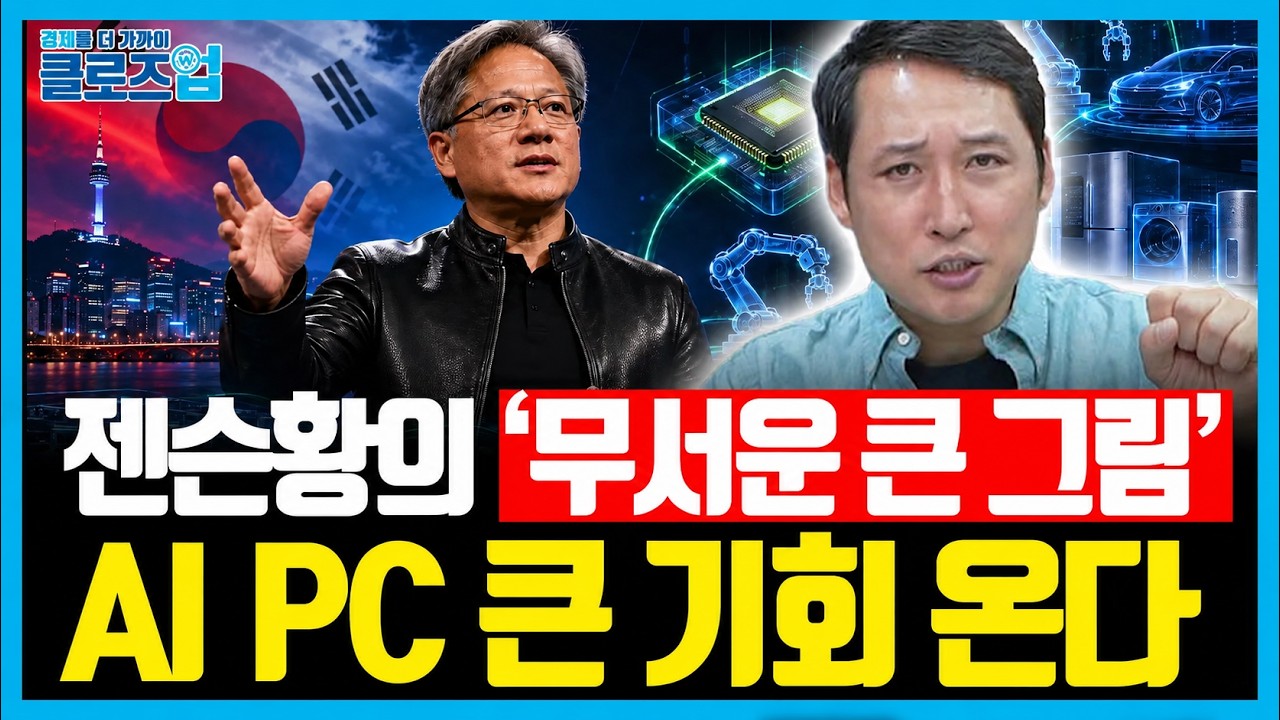
Jensen Huang’s Visit to South Korea: Timing, Strategic Rationale, and the AI “Big Picture” Behind the High-Profile Meetings
This visit is more than a goodwill tour or event-driven engagement. It signals Nvidia’s intent to deepen Korea’s role from a memory supplier toward an integrated partner for deploying “physical AI” across real-world products, industrial systems, and infrastructure.
Below is a news-style summary, followed by a keyword-based structure, and concluding with under-covered strategic implications.
1. Key Points in a News-Style Summary
1) The visit reflects “physical AI alliance-building,” not merely supply-chain verification.
Nvidia’s AI systems require both GPUs and high-bandwidth memory (HBM). Korea is central to HBM supply through Samsung Electronics and SK Hynix. The agenda, however, extends beyond memory procurement toward broader ecosystem alignment.
The visit connects multiple Korean industrial pillars in parallel:
- Consumer electronics (Samsung Electronics, LG Electronics)
- Automotive and robotics (Hyundai Motor Group, Doosan)
- Platforms and services (Naver)
- Telecom and power/energy infrastructure (SK, LG Uplus, Doosan Enerbility)
This indicates a move toward end-to-end implementation of AI systems, rather than component-level cooperation.
2) The primary operative theme is “physical AI.”
AI is shifting from cloud-only workloads into devices and environments: appliances, PCs, vehicles, robots, factories, and buildings. Korea offers a rare combination of advanced manufacturing, scale production, and enabling infrastructure (power and connectivity), making it a practical deployment partner.
3) The near-term commercialization focus is the AI PC.
While AI phones, appliances, and vehicles are important, AI PCs are positioned as the earliest mass-market catalyst due to existing global installed base and relatively clear replacement cycles. This supports Nvidia’s expansion from data-center AI into enterprise and consumer endpoints.
4) Digital twins represent a larger long-duration platform opportunity.
Digital twins replicate physical assets (buildings, plants, robots, vehicles) in virtual environments to simulate performance, optimize operations, and enable remote management. Given Korea’s manufacturing density, digital twin deployment has clearer pathways to monetization than in markets with weaker industrial bases.
2. One-Line Rationale for Why Korea, Why Now
Nvidia is evolving from a GPU provider into an AI platform company aiming to connect computation, software, simulation, and real-world deployment. Korea uniquely combines HBM capacity, manufacturing depth, product scale, connectivity, and power infrastructure—enabling “physical AI” value chains to be assembled and validated in one market.
3. Key Theme #1: The Physical AI Value Chain
Physical AI refers to AI moving from digital interfaces into physical systems and devices—where models perceive environments, make decisions, and drive actions in real-world settings.
3-1. Starting Point: HBM + GPU
Modern AI infrastructure is anchored by GPUs for parallel compute and HBM for high-throughput memory access. Scale expansion is constrained without both. Korea’s strategic leverage is therefore direct: Samsung Electronics and SK Hynix are critical HBM partners for Nvidia’s platform growth.
3-2. Data Centers Are the Base Layer, Not the End State
AI investment is often framed as data-center capex, but data centers primarily train and serve models. The longer-term monetization path extends into endpoints (PCs, appliances, vehicles, robots) that both consume AI capabilities and generate continuous feedback data.
3-3. Role Mapping by Korean Corporates
Samsung Electronics
HBM and broad device endpoints (smartphones, TVs, appliances, PCs). High leverage to AI phone, AI appliance, and AI PC diffusion.
SK Hynix
Core HBM supplier; revenue sensitivity is closely tied to expansion of Nvidia’s AI compute deployments.
LG Electronics
Strong position in premium consumer appliances; relevant to household “physical AI” adoption (refrigerators, washers, air conditioners, TVs).
Hyundai Motor Group
Automotive + robotics exposure; potential linkage across autonomous driving, in-vehicle AI, and mobility robotics.
Doosan Robotics
Collaborative and industrial robotics; complements AI “brains” with scalable physical actuation platforms.
Doosan Enerbility
Power generation and related infrastructure. AI growth is power-intensive; grid, generation, and industrial energy systems become binding constraints.
Naver
Service/platform layer; potential role in localized AI services, data utilization, and application distribution.
Telecom operators (e.g., SK Telecom, LG Uplus)
Connectivity is critical for real-time device-to-cloud interaction; latency, reliability, and network quality condition service viability.
4. Key Theme #2: Why AI PCs Are Emphasized First
AI PCs offer a near-term demand mechanism that can translate platform strategy into volume shipments. They may create a replacement cycle by redefining baseline device capability, similar to prior platform transitions that reset consumer and enterprise purchasing criteria.
4-1. AI PCs as a Replacement-Cycle Trigger
PC penetration is already high across households, education, and enterprises. If AI-native features become standard expectations, refresh cycles may accelerate.
4-2. What Differentiates an AI PC
Relative to cloud-dependent AI usage, AI PCs perform a portion of inference locally, enabling:
1) Lower latency
2) Reduced dependency on constant connectivity
3) Improved privacy and on-device handling of sensitive enterprise data
4) Potential efficiency gains through workload placement and optimization
This positions AI PCs as early-stage personal AI endpoints rather than incremental performance upgrades.
4-3. Compute Stack: CPU, GPU, NPU
CPU
General-purpose computing and OS-level responsiveness.
GPU
Parallel compute acceleration for graphics, video, and AI workloads (including generative AI).
NPU (or equivalent AI accelerator)
Energy-efficient AI-specific computation; reduces reliance on GPU for always-on or sustained inference workloads.
4-4. Practical User-Level Use Cases
Email summarization, task prioritization, meeting transcription and minutes, draft generation, automated photo/video enhancement, upscaling, gaming optimization, and offline AI execution. Early adoption may concentrate in enterprise productivity workflows, with consumer pull via content creation and entertainment.
5. Key Theme #3: Why Digital Twins Matter More Over Time
Digital twins replicate physical assets and operations in a virtual environment to simulate outcomes, predict failures, and optimize performance before executing changes in the real world. They also serve as training and validation environments for robots and autonomy systems.
5-1. Simple Framework for Digital Twin Use Cases
- Buildings: replicate lighting, temperature, energy usage, and security for optimization and remote management
- Factories: simulate production lines to identify bottlenecks, predict maintenance, and improve throughput
- Agriculture: integrate soil, water, temperature, and growth variables for controlled optimization
5-2. Nvidia’s Strategic Motivation
Physical AI requires models that can interpret and control complex real environments. Digital twins reduce real-world trial costs by enabling controlled experimentation, training, and validation. This supports a platform revenue model beyond hardware—combining compute, software, simulation, and industry-specific workflows.
5-3. Why Korea Has Structural Fit
Korea’s industrial concentration (semiconductors, automotive, shipbuilding, batteries, consumer electronics, robotics, plant engineering) provides immediate deployment surfaces where digital twins can generate measurable operational value.
6. Why the Visit Should Be Read as an Ecosystem Move, Not Individual Corporate “Wins”
The core signal is not isolated beneficiary selection, but ecosystem architecture. Nvidia’s trajectory implies a shift from chip supplier to ecosystem designer across devices, factories, mobility systems, and infrastructure.
Korea’s advantage lies in the co-location of:
- HBM supply
- Scaled manufacturing and endpoints
- Advanced connectivity
- Energy and industrial infrastructure
7. Market and Industry Watchpoints
This should be evaluated as an early signal of structural repositioning rather than a short-term thematic trade.
7-1. First-Order Exposure: HBM and AI Infrastructure
Near-term sensitivity remains highest for HBM supply and data-center buildout.
7-2. Second-Order Exposure: AI-Enabled End Products
As adoption expands into AI PCs, appliances, vehicles, and robots, valuation may shift toward companies that ship AI-integrated finished goods.
7-3. Third-Order Exposure: Power, Cooling, Connectivity, and Industrial Equipment
AI scale is constrained by electricity and networking. Power equipment, cooling systems, telecom networks, and industrial infrastructure may see sustained demand.
8. Under-Covered Strategic Implications
8-1. Nvidia’s Goal Extends Beyond “AI’s Intel” Toward an AI-Platform Operating Layer
The objective appears to be standard-setting across hardware plus software, simulation, and industry partnerships—positioning Nvidia as an enabling layer for AI-driven physical systems.
8-2. Korea’s Potential Upgrade: From “Memory Supplier” to “Physical AI Validation Market”
Korea could become a reference market for early deployment of AI in real products and industrial operations, improving bargaining power and strategic relevance in global standards formation.
8-3. The Primary Bottleneck May Shift from Chips to Power and Connectivity
Compute availability matters, but power delivery and network performance can become the tighter constraint for data centers, autonomy, and industrial robotics. The inclusion of power and telecom stakeholders is consistent with this constraint view.
9. Follow-On Signals to Monitor
1) HBM supply progression and qualification milestones at Samsung Electronics and SK Hynix
2) Specific product roadmaps and commercialization plans for AI PCs and AI appliances at Samsung Electronics and LG Electronics
3) Depth of platform integration between Nvidia and Hyundai Motor Group across autonomy and robotics
4) Evidence of contracts or joint projects involving robotics and power infrastructure (e.g., Doosan Robotics, Doosan Enerbility)
5) The role of domestic platforms (e.g., Naver) in application-layer services for physical AI
10. Conclusion: Not a Symbolic Meeting, but a Korea-Centered Physical AI Blueprint
The strategic meaning of the visit is the bundling of HBM procurement, AI-enabled end-product manufacturing, robotics and automotive deployment, connectivity and power infrastructure, and digital twin validation into a coherent implementation pathway.
The near-term adoption vector is AI PCs, while the longer-duration platform expansion centers on digital twins and physical AI across appliances, mobility, robotics, and smart manufacturing.
< Summary >
- The visit indicates physical AI alliance-building rather than a routine executive meeting.
- Core themes: HBM + GPU as the infrastructure base, AI PCs as the near-term mass market, and digital twins as the long-duration platform.
- Samsung Electronics and SK Hynix align on memory; Samsung Electronics and LG Electronics on AI PCs/appliances; Hyundai Motor Group and Doosan on mobility/robotics; telecom operators and Doosan Enerbility on connectivity and power; Naver on platform services.
- Korea’s strategic position may expand from memory supply into real-world physical AI implementation and validation.
- Monitoring should extend beyond semiconductors to power, networks, end-product cycles, and digital twin execution.
[Related Articles…]
- https://NextGenInsight.net?s=HBM
- https://NextGenInsight.net?s=AI
*Source: [ 경제 읽어주는 남자(김광석TV) ]
– 젠슨황이 한국에 온 진짜 이유|삼겹살 회동 뒤에 숨은 AI 빅픽처 | 클로즈업 |