● Dollar-Driven Shock
The USD/KRW Move Toward 1,530: Key Drivers and What the Market Is Overlooking
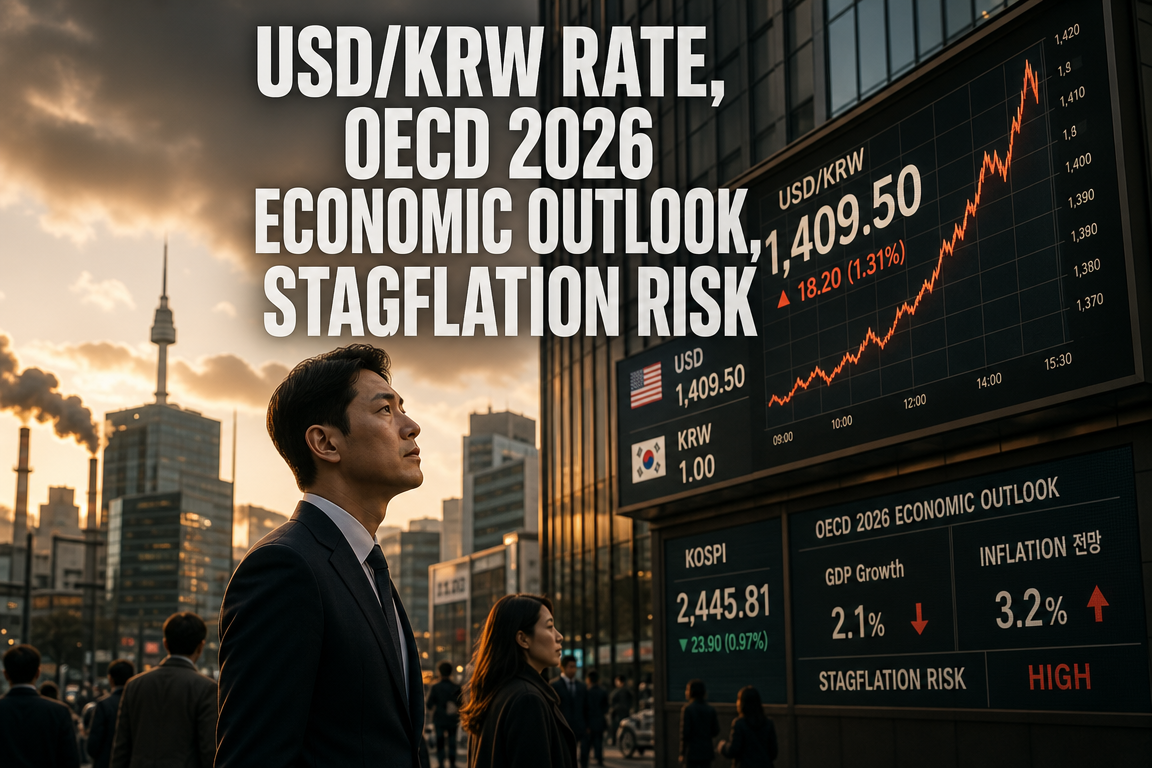
The recent increase in the USD/KRW exchange rate is not adequately explained by “broad USD strength” alone. The move reflects a combined impact of Middle East geopolitical risk, higher crude prices, offshore cash retention by Korean corporates, large-scale US investment commitments, and shifts in foreign equity flows following a sharp KOSPI rally.
The central mechanisms are (i) higher real demand for USD, (ii) structural changes in FX supply/demand, (iii) equity-market rebalancing pressures, and (iv) a weakening linkage between export performance and KRW appreciation. The result appears more structural than purely sentiment-driven and therefore less likely to normalize on a single short-term headline.
1. Why the Market Is Highly Sensitive at Current Levels
Approaching the 1,530 level is viewed as a high-stress zone for the market, with implications beyond day-to-day volatility. A weaker KRW lifts import prices and raises cost pressures, especially for an economy with high dependence on energy and commodity imports. The exchange rate directly transmits into inflation dynamics, consumption, corporate margins, equity performance, and monetary-policy expectations.
Global risk aversion and sustained USD strength have coincided with domestic FX flow imbalances, intensifying depreciation pressure.
2. Driver #1: Middle East Risk Raises Oil Prices, Increasing FX Demand
Elevated tensions involving the US and Iran and broader regional instability limit downside in crude prices. Korea’s low energy self-sufficiency means oil, gas, and key commodities are largely imported and predominantly settled in USD.
When oil rises, importers must purchase more USD to settle the same physical volume, increasing USD demand in the local FX market. This is transactional demand rather than a purely psychological effect, and therefore tends to have a stronger and more persistent impact.
3. Driver #2: Strong Exports, but USD Inflows Do Not Repatriate as Before
Historically, stronger exports often supported KRW appreciation via repatriation of export proceeds. That linkage has weakened. Large Korean exporters increasingly retain offshore cash to fund local capex, R&D, M&A, logistics buildouts, and supply-chain investments.
As a result, even when headline exports and the current account appear resilient, the domestic FX market may not receive proportional USD supply. This structural shift helps explain why “strong exports” do not automatically translate into a stronger KRW.
4. Driver #3: USD 350 Billion US Investment Commitments Create Latent USD Demand
The referenced USD 350 billion scale of US investment commitments influences market pricing by increasing expectations of future KRW-to-USD conversion needs. Even if execution is staged, FX markets often price anticipated flow directionality ahead of realized transactions.
This expectation can affect foreign investors and macro allocators who incorporate forward-looking balance-of-payments and flow considerations into positioning, adding to KRW depreciation pressure.
5. Driver #4: Post-Rally KOSPI Rebalancing Can Convert Equity Gains into FX Outflows
A rapid rise in the KOSPI can mechanically increase rebalancing-driven selling by global funds operating under regional and benchmark constraints. If Korea exposure rises above target weights, funds may sell to normalize allocations.
Foreign equity selling can translate into USD conversion and capital outflows, increasing USD demand in the FX market. Therefore, “equity strength equals KRW strength” is not a stable relationship, particularly after sharp index gains.
6. Four Primary Pillars Behind the Recent Move
1) Middle East tension lifted oil prices, raising Korea’s USD settlement needs for energy imports.
2) Corporates retained more export-generated USD offshore, reducing domestic USD supply.
3) Large-scale US investment plans increased expectations of future USD demand.
4) KOSPI-driven foreign rebalancing contributed to equity outflows and additional FX pressure.
7. Underappreciated Point: Structural FX Market Change, Not a Sudden Collapse in Fundamentals
The current episode is better framed as a shift in FX market structure rather than a sudden deterioration in Korea’s macro fundamentals. With supply-chain reconfiguration and expanded overseas production, export growth no longer guarantees equivalent FX inflows.
Additionally, the exchange rate is not determined by interest-rate differentials alone. While US rates and the dollar index matter, real-economy flows—energy import payments, overseas investment funding, institutional rebalancing, and corporate USD liquidity strategies—can dominate at key junctures.
8. Why Perceived Instability Rises Even If Macro Fundamentals Are Resilient
Korea retains global competitiveness in semiconductors, autos, shipbuilding, batteries, defense, and biotech, with potential support from improving external balances and a strong manufacturing base.
However, a weaker KRW quickly affects consumer-facing prices (fuel, raw materials, air freight, imported food), worsening inflation sensitivity. Corporate impacts also diverge: exporters may benefit via translation effects, while import-dependent manufacturers and domestic-demand sectors face margin pressure, increasing dispersion across industries and market segments.
9. Key Variables to Monitor
1) Middle East stabilization: a prerequisite for oil price relief and reduced transactional USD demand.
2) Federal Reserve policy path: delayed easing or hawkish guidance can extend USD strength.
3) Timing and scale of offshore investment execution by Korean corporates: determines realized USD conversion demand.
4) KOSPI level and foreign flows: whether foreign buying persists or profit-taking/rebalancing accelerates.
5) Bank of Korea and FX authority actions: verbal guidance, direct intervention risk, liquidity management, and policy communication may dampen short-term volatility.
10. Investor and Household Framework
Avoid interpreting the exchange-rate level as a standalone crisis indicator. The critical issue is the persistence of structural FX flow changes.
For investors, the relevant bundle is USD strength, crude prices, KOSPI performance, foreign flow direction, and US Treasury yields. Isolated indicators tend to produce inconsistent conclusions.
For households, KRW weakness affects living costs, borrowing conditions, overseas travel, cross-border consumption, and portfolio outcomes. A diversification review across USD assets, domestic equities, and cash-like holdings is warranted.
11. One-Sentence Summary
The USD/KRW surge reflects the combined impact of oil-driven transactional USD demand, offshore retention of corporate USD, latent USD demand tied to large US investment plans, and foreign equity rebalancing following a strong KOSPI rally—within a broader structural shift in Korea’s FX flow dynamics.
< Summary >
The USD/KRW spike cannot be explained by USD strength alone.
Middle East risk lifted oil prices, increasing Korea’s USD settlement demand.
Exporters retained more USD offshore for local investment, reducing domestic USD supply.
Large US investment plans increased expectations of future USD demand.
Post-rally KOSPI rebalancing contributed to foreign outflows and additional FX pressure.
The key point is that FX flow structure has changed, partially decoupling macro fundamentals from near-term KRW direction.
[Related Articles…]
- https://NextGenInsight.net?s=exchange%20rate
- https://NextGenInsight.net?s=KOSPI
*Source: [ 내일은 투자왕 – 김단테 ]
– 환율이 박살난 진짜 이유
● Stagflation Shock, Debt Risk, Korea Semis Boom
OECD 2026 Economic Outlook — Immediate Takeaways: Stagflation Risk, Sovereign Debt Pressure, and Korea’s Semiconductor-Driven Optical Illusion
This OECD 2026 Outlook has four investor-relevant messages:
1) The global economy is not merely slowing; structurally weak growth is now facing rising stagflationary pressure.
2) A Middle East–driven supply shock is simultaneously impacting energy, logistics, and commodities, re-accelerating inflation risk.
3) Fiscal outlays to stabilize energy and cushion growth are increasing sovereign debt vulnerabilities.
4) Korea’s growth forecast was materially upgraded on semiconductor strength, but broad-based recovery remains limited, widening the gap between headline indicators and on-the-ground conditions.
This note reframes the OECD report in a news-style format, focusing on: drivers of the global downgrade, the mechanics of stagflation pressure, monetary–fiscal policy tension, the interpretation of Korea’s upgrade, and key points underemphasized in mainstream coverage.
1. OECD 2026 Outlook at a Glance
OECD assesses the global economy as re-entering a regime of uncertainty and cost shocks rather than a stable normalization path.
Core message:
- Growth is weakening,
- Inflation risks are rising,
- Governments are likely to expand fiscal support,
- Fiscal sustainability risks may increase.
Key forecasts:
- World GDP growth: 2.8% (revised down)
- G20 growth: 3.0% (unchanged)
- United States: 2.0% (unchanged)
- Japan: 0.9% → 0.6% (revised down)
- Korea: 1.7% → 2.6% (revised up)
- Korea (next year): 1.9%
2. The Core Context: Global Growth Is Already in a Structurally Low-Growth Regime
The deterioration is not attributable to a single temporary shock. Post-pandemic rebound effects have faded, and global growth has been running below long-term averages. The additional Middle East and supply-chain shocks are occurring on top of an already weakened baseline, explaining the OECD’s emphasis on “stagflationary pressure.”
2-1. Global Growth Below Long-Run Averages
OECD, IMF, and the World Bank broadly converge on a view that the global economy is unlikely to revert mechanically to prior high-growth norms. The 2026 revision should be interpreted as an incremental shock layered on a structurally lower trend.
2-2. Counterfactual: Without Conflict, Growth Would Likely Be Higher
OECD indicates global growth would likely have been stronger absent Middle East tensions. Small headline changes (e.g., 0.1–0.4 percentage points) translate into material absolute output losses at the global GDP level.
3. Why OECD Flags Stagflation Risk
The primary issue is not growth deceleration alone, but the possibility of simultaneous weak growth and higher inflation. Middle East risks can raise prices across crude oil, LNG, shipping, and commodities, weakening activity while lifting costs—consistent with stagflation dynamics.
3-1. “Stagflation” Is Framed as Pressure, Not a Certainty
OECD does not assert a definitive stagflation outcome; it argues conditions are moving toward a stagflation-like configuration and the probability distribution is shifting adversely. Markets and policymakers typically respond to the change in risk, not only to realized outcomes.
3-2. Why the Middle East Matters Disproportionately
While the region’s GDP share is limited, its importance in energy supply, critical commodities, and maritime chokepoints is high. Disruption risk is therefore more meaningful through supply and transit channels than through direct demand weight.
3-3. How Energy Inflation Propagates
Higher oil and gas prices flow into petrochemicals and input costs, affecting fertilizer, packaging, transportation, and manufacturing costs, ultimately lifting food and goods prices. This is predominantly supply-driven inflation, which is more challenging for central banks to address using interest rates alone.
4. Why Rate-Cut Expectations Weakened, and Why Further Hikes Remain a Tail Risk
The report implies restrictive monetary conditions may persist longer than previously expected. In jurisdictions where policy rates remain relatively low, renewed inflation pressure could reopen the door to additional tightening.
4-1. Why the Euro Area and Japan Are More Sensitive
Lower nominal policy rates can translate into less restrictive real policy settings under renewed inflation. As a result, supply-driven inflation may create greater tightening pressure in the Euro Area and Japan.
4-2. The United States: Higher Probability of “Hold for Longer” than Immediate Hikes
With policy rates already higher, the near-term response is more likely to be delayed easing rather than immediate additional hikes. However, a more prolonged or severe shock that materially lifts energy prices and inflation could shift the stance more hawkishly.
5. Sovereign Debt Warning: The Central Medium-Term Risk
Beyond growth revisions, OECD’s sovereign debt signal is a major medium-term concern. Fiscal capacity deterioration can become the binding constraint in future shocks.
5-1. Why Governments Are Likely to Spend More
Energy price spikes and supply instability increase pressure for subsidies, tax relief, and stabilization programs. Fiscal expansion can be required for both growth cushioning and cost-of-living mitigation.
5-2. The Core Risk: Reduced Capacity in the Next Crisis
The critical issue is not only higher debt today, but reduced policy space when the next large shock emerges (pandemic-like events, financial instability, or geopolitical escalation). This is a national resilience issue as much as an accounting metric.
5-3. Higher Sovereign Yields and the Fiscal Paradox
Expanded issuance can lift sovereign yields and tighten financial conditions. Yet capital markets may still concentrate into select growth themes, producing a divergence where real activity softens while targeted asset segments rally. AI and semiconductors are central to that concentration.
6. Korea’s Upgraded Outlook: Not Unambiguously Positive
Korea’s growth forecast increase from 1.7% to 2.6% is the most prominent upgrade. OECD cites semiconductor exports, private investment, and gradual consumption improvement. The key question is whether this reflects broad recovery or sectoral concentration.
6-1. The Upgrade Is Largely Semiconductor-Led
The dominant driver is semiconductors, supported by advanced-node demand and price recovery. This implies a scenario where headline growth improves while employment, small business conditions, and non-tech sectors remain subdued.
6-2. Ex-Semiconductors, the Macro Picture May Be Weaker
A semiconductor-led export rebound can mask weakness in broader manufacturing, services, and domestic demand. Monitoring should therefore extend beyond aggregate GDP to:
- Ex-semiconductor exports
- Ex-semiconductor industrial production
- Ex-semiconductor investment and labor-market indicators
6-3. Why Next-Year Growth Is Lower: Base Effects
OECD’s next-year Korea forecast of 1.9% is consistent with base effects after an outsized semiconductor upswing. A strong current-year cycle raises the comparison bar, reducing the likelihood of repeating the same contribution rate.
7. Korea: Upside and Downside Factors (OECD Framing)
7-1. Upside Factors
- Expansion in advanced semiconductor demand
- Potential semiconductor upcycle
- Export-driven recovery in private investment
- Gradual consumption improvement supported by fiscal policy
7-2. Downside Factors
- Prolonged Middle East conflict and supply disruptions
- Higher energy costs and input-cost pressure
- Industrial disputes and labor actions
- Export restrictions and renewed global supply-chain instability
Korea retains semiconductor-linked upside, but remains highly sensitive to external shocks.
8. Why This Matters for AI Trend Investors
Although presented as a macro outlook, the report is relevant for AI-focused investors because AI infrastructure and semiconductors have become key pillars supporting parts of global capex and equity performance.
8-1. Why Capital Concentrates in AI and Semiconductor Value Chains
Even under slower growth and elevated rates, capital concentrates where revenue visibility and capex pipelines remain robust:
- Generative AI adoption
- Data-center buildout
- Higher-bandwidth memory demand
- Advanced packaging expansion
The market implication is concentration risk: capital may not diffuse broadly across sectors, but instead cluster in segments with validated earnings momentum.
8-2. Korea: Opportunity and Risk
Korea is positioned to benefit from AI-linked memory competitiveness. However, an AI/semiconductor-centric narrative can obscure structural underperformance elsewhere. Semiconductor strength is not a sufficient condition for economy-wide health.
9. News-Style Key Summary
9-1. Global
OECD sets 2026 global growth at 2.8% and warns Middle East–driven supply shocks could weaken growth while lifting inflation, raising stagflationary pressure.
9-2. Policy
Governments are expanding fiscal measures for energy stabilization. This may dampen near-term shocks but increases medium-term sovereign debt and fiscal sustainability risks. Central banks face a sharper trade-off between growth stabilization and inflation control.
9-3. Korea
Korea receives a significant upgrade driven primarily by semiconductor-led exports rather than broad-based recovery. Assessment should emphasize sector dispersion and the gap between headline data and underlying conditions.
10. Underemphasized but High-Value Points
10-1. The Core of Stagflation Risk Is Policy Difficulty, Not the CPI Print
Supply-driven inflation is less responsive to rate hikes. With growth already weak, central banks face a tighter constraint set: tightening risks recession; easing risks inflation unanchoring.
10-2. Sovereign Debt Is More Dangerous in the Next Shock
The strategic risk is reduced fiscal space when the next large shock occurs. Cross-country divergence in crisis-response capacity may widen.
10-3. Korea May Be Experiencing Concentrated Improvement, Not Broad Recovery
Semiconductor outperformance can distort macro interpretation and policy calibration if non-semiconductor industry, SMEs, and domestic demand are not assessed separately.
10-4. AI-Era Winners Are Those That Diffuse Productivity Gains Broadly
Long-term outcomes depend less on exporting semiconductors and more on whether AI-driven productivity gains spread across manufacturing, services, finance, logistics, and healthcare. Without diffusion, the cycle risks remaining a narrow, temporary upswing.
11. Near-Term Monitoring Checklist
- Whether Middle East conflict risk resolves quickly or becomes prolonged
- Direction and volatility of crude oil and LNG prices
- Probability of additional hikes in the Euro Area and Japan
- Duration of delayed easing in the United States
- Sovereign yield sensitivity to expanding fiscal deficits
- Korea’s ex-semiconductor recovery trajectory
- Whether AI capex expands from memory and equipment into power and infrastructure
12. Conclusion
OECD’s 2026 Outlook is not a routine forecast revision. It signals a more complex regime characterized by low trend growth, supply shocks, fiscal strain, and a tighter monetary–fiscal policy constraint. Korea appears resilient on a semiconductor-led basis, but the key risk is over-interpreting headline growth without validating breadth.
The principal questions are:
- Can the global economy absorb renewed inflation pressure?
- How much fiscal capacity remains across countries?
- Can AI and semiconductors remain durable growth pillars in a slowing macro environment?
< Summary >
OECD lowered 2026 global growth to 2.8% and warned of rising stagflationary pressure. Middle East risk is lifting energy, logistics, and commodity costs, increasing inflation risk. Governments are expanding fiscal spending, raising sovereign debt and sustainability concerns. Korea’s forecast upgrade to 2.6% is primarily semiconductor-driven and may not reflect broad recovery. Key monitoring areas include ex-semiconductor activity, duration of geopolitical disruption, the rate path, and whether AI investment diffuses across the broader economy.
[Related Articles…]
- https://NextGenInsight.net?s=Semiconductors
- https://NextGenInsight.net?s=AI
*Source: [ 경제 읽어주는 남자(김광석TV) ]
– OECD 2026년 경제전망 보고서 : 스태그플레이션과 정부부채 경고 [즉시분석]