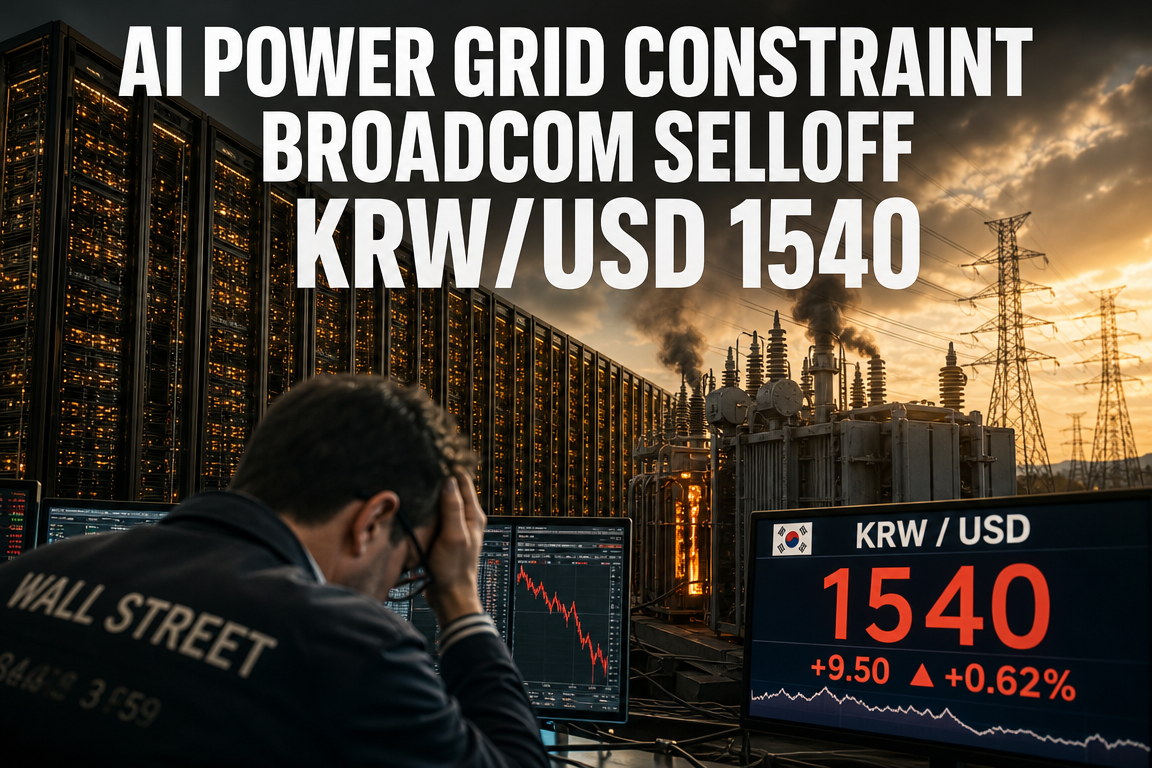
● Broadcom Shock, Won Crash, Bitcoin Slump
Deutsche Bank Raises Broadcom Target; KRW/USD Breaks 1,540; Bitcoin Hits a 4-Month Low — The Key Market Drivers Are Elsewhere
Today’s market action appears straightforward: Broadcom sold off, the Nasdaq weakened, the KRW/USD exchange rate moved above 1,540, and Bitcoin touched USD 61,000. The more relevant signal, however, is not the price move itself but what it implies about positioning and the evolving AI investment cycle.
This setup reflects multiple concurrent shifts: a restructuring of the AI semiconductor value chain, rising risk in a narrow U.S. equity rally, the migration of global bottlenecks toward power infrastructure, currency-driven pressure on Korean assets, and liquidity rotation from crypto toward AI-linked equities.
This note focuses on: why Broadcom fell despite solid results; why Deutsche Bank raised its price target to USD 515; why U.S. equities can look resilient while remaining structurally fragile; and why the likely constraint in the AI capex cycle may shift from chips to power and grid infrastructure.
Key emphasis:
- The primary constraint in the AI era may be electricity supply and transmission capacity, not chip availability.
- Broadcom’s sell-off may reflect perceived erosion of a monopoly premium rather than earnings deterioration.
1. Market Snapshot: Headline Summary
U.S. equities were mixed. The Nasdaq weakened on Broadcom’s decline; the S&P 500 fell modestly; the Dow held up on strength in cyclicals, healthcare, and consumer names.
- Nasdaq: Weak, driven by Broadcom sell-off
- S&P 500: Limited downside, large-cap support
- Dow: Relatively resilient, led by cyclicals, healthcare, retail
- Broadcom: Results strong; guidance viewed as conservative; shares fell sharply
- KRW/USD: After-hours trading above 1,540
- Bitcoin: Touched USD 61,000, a 4-month low
- WTI/Brent: Lower on easing geopolitical risk expectations
At the surface: “semiconductor pullback + FX stress + crypto weakness.” More importantly, the tape indicates where liquidity is rotating.
2. Broadcom Sell-Off: Why a Double-Digit Decline Despite Strong Results
2-1. Reported results were broadly strong
Broadcom’s quarterly figures were not weak.
- Total revenue: +48% YoY
- AI semiconductor revenue: +143% YoY
- Consensus: Generally exceeded
The reaction underscores a “expectations-driven” market rather than a pure earnings-driven market.
2-2. The key issue was not guidance, but perceived erosion of a “monopoly premium”
The market focused on messaging tied to Alphabet (Google), a key customer. Broadcom has been central to Google’s TPU-related supply chain, and investors had expected Google’s AI capex expansion to translate directly into incremental Broadcom growth.
Conference call commentary was interpreted as suggesting potential supply-chain diversification by Google. That implication can be read as weakening Broadcom’s monopoly or quasi-monopoly premium. For a stock with elevated valuation and substantial forward growth already priced in, any perceived loss of exclusivity can drive an outsized repricing even if near-term results remain strong.
2-3. Relative positioning versus Marvell amplified the move
Broadcom is viewed as the incumbent that must consistently deliver. In contrast, Marvell is increasingly framed as an upside beneficiary in custom AI silicon. In AI infrastructure rallies, the market can favor perceived “share-takers” over established leaders, reinforcing relative valuation pressure on the incumbent.
3. Why Deutsche Bank Raised Its Target to USD 515
3-1. Street view: not business impairment, but communication style
Deutsche Bank raised its target from USD 430 to USD 515 during the sell-off. The interpretation: the company’s fundamentals remain intact, and the negative reaction was driven more by conservative framing than by a deterioration in demand.
Broadcom’s CEO is widely viewed as structurally conservative in forward commentary, typically guiding cautiously and executing against those targets.
3-2. The market demanded “upside narrative”; management emphasized “confirmed items”
In the current AI mega-cap regime, results alone can be insufficient; investors often expect a strong forward narrative. Relative to peers that articulate aggressive demand visibility, Broadcom’s tone was viewed as subdued, creating a gap versus market expectations and triggering short-term selling.
3-3. Focus on medium-term AI revenue trajectory
Deutsche Bank highlighted potential upside to AI revenue versus company indications.
- 2027 AI revenue: Potentially USD 125 billion vs. USD 100 billion indicated
- 2028 AI revenue: Approximately USD 190 billion projected
The implication is that near-term volatility can coexist with a supportive medium-term demand backdrop tied to data center buildout.
4. U.S. Equities: Resilient Optically, Narrow Structurally
4-1. Nasdaq down while Dow up: rotation, not collapse
The divergence suggests reallocation rather than broad risk-off.
- Semiconductors: Pullback
- Consumer: Relative strength
- Healthcare: Defensive support
- Financials/retail: Rotation inflows
This aligns with partial deconcentration from crowded AI/semiconductor exposure.
4-2. S&P 500 pace may signal overheating risk
The market has advanced rapidly. Some commentary compares the speed of gains to historically unstable periods. The point is not an imminent crisis, but that price action appears increasingly influenced by systematic flows (passive allocation, options, algorithmic execution). In such conditions, small disappointments can generate large moves, as seen in Broadcom.
4-3. A rising market with elevated volatility
Long-term AI growth narratives can remain valid while near-term pricing reflects heavy expectation-loading. Sensitivity to incremental news, guidance language, and management tone remains high.
5. KRW/USD Above 1,540: Why It Matters More for Korea-Focused Investors
5-1. FX is a financial-conditions shock, not a standalone print
A move above 1,540 is material for Korean markets and can tighten domestic financial conditions.
- Increased risk of foreign outflows
- Higher import-cost pressure
- Inflation risk re-accelerating
- Greater policy constraint for the central bank
- Higher equity valuation discount pressure
Given Korea’s reliance on imported energy and raw materials, FX weakness can transmit into the real economy.
5-2. U.S. rates and dollar strength remain a headwind to EM assets
If U.S. labor and inflation data remain firm, rate-cut expectations may shift out, supporting a stronger dollar and extending pressure on EM FX and risk assets. Korea-focused positioning should incorporate U.S. macro and rates alongside equity signals.
6. Bitcoin at USD 61,000: Bottoming or Momentum Breakdown
6-1. Closer to demand deterioration than a routine pullback
The decline to a multi-month low is notable both technically and psychologically. Recent price action resembles a weak-demand pattern, with limited rebound traction.
6-2. Liquidity is rotating toward assets with earnings-linked narratives
Flows appear more supportive for AI semiconductors, data centers, and power infrastructure where capex and earnings pathways are clearer. Crypto may require renewed catalysts (policy signals, ETF-related inflows, institutional re-risking) to regain relative strength.
7. Core Point: The AI-Era Bottleneck Is Shifting to Power
7-1. Power constraints are delaying U.S. data center deployment
Capital availability and chip demand are not the only gating factors. Power availability and grid approvals are emerging as binding constraints.
- More than 60% of data centers targeted for completion by 2027 may face delays due to power constraints
- Facilities can be physically completed while remaining idle pending grid connection approvals
- Constraints center on high-voltage transmission, transformers, and distribution capacity
This reframes the AI capex cycle: power, grid, and cooling infrastructure may gain share of attention and returns.
7-2. AI leaders are increasingly acting like energy procurement platforms
Large-scale AI competition is moving beyond compute procurement to securing stable power.
- Microsoft: Expanding nuclear-related power contracting
- Google/Amazon: Increasing investment in next-generation energy and nuclear-related initiatives
- xAI and others: Exploring on-site generation solutions
Competitive advantage increasingly depends on:
- Compute availability
- Data center construction speed
- Reliable power access
7-3. The next AI investment theme may extend beyond semiconductors into power infrastructure
A broader AI value chain framing includes:
- Power generation operators
- Transmission and grid equipment suppliers
- Thermal management and cooling providers
- Gas turbines and generation equipment
- Transformers and power management solutions
- Data center REITs and infrastructure operators
This shift is tied to physical constraints and industrial capacity, not only market narratives.
8. What the Pelosi Portfolio Signals: Infrastructure and Security, Not Only AI Services
8-1. Concentration in Broadcom, Alphabet, Palo Alto Networks, and power exposure
The composition is notable for its emphasis on infrastructure and enablers.
- Broadcom: AI networking and custom silicon
- Alphabet: AI services and cloud platform exposure
- Palo Alto Networks / CrowdStrike: Security demand tied to AI adoption
- Vistra: Potential beneficiary of power constraints
8-2. Cybersecurity as a structural companion sector to AI
As model size, data volumes, and enterprise AI deployment scale, exposure to hacking, data leakage, and infrastructure attacks rises. Cybersecurity increasingly functions as a required layer rather than an optional adjunct.
9. Near-Term Checklist for Investors
9-1. U.S. labor data and the implied Fed path
Nonfarm payrolls and unemployment prints remain key for rate-cut timing expectations. Strong data can reinforce dollar strength and extend FX pressure.
9-2. AI semiconductors: durable theme, elevated near-term expectations
The long-term thesis may remain intact, but short-term pricing can be vulnerable to small expectation misses.
9-3. Korea: monitor FX and U.S. rates jointly
For Korea-linked returns, FX can reduce realized performance and compress risk appetite, affecting equities and macro conditions.
9-4. Bitcoin: limited evidence of a decisive reversal
A tactical “dip-buy” premise remains unconfirmed without improving flows and momentum.
10. Under-Discussed Key Takeaways
- Broadcom’s decline appears driven more by monopoly-premium erosion risk than by earnings weakness
- Deutsche Bank’s target raise signals divergence between short-term sentiment and medium-term fundamentals
- U.S. equity strength remains narrow, centered on AI and semiconductors, increasing volatility risk
- The AI-era bottleneck is increasingly power supply and transmission capacity
- Potential beneficiaries may include power, cooling, security, and infrastructure operators, not only chip designers
- KRW/USD above 1,540 can pressure Korean equities, inflation, and monetary policy flexibility
- Bitcoin weakness may reflect liquidity rotation toward AI infrastructure-linked assets
Framework:
- Round 1 of AI investment: Semiconductors
- Round 2: Power and infrastructure
- Round 3: Security and operational efficiency
11. Conclusion: Emphasize Structure Over Headlines
Broadcom’s sell-off, KRW weakness, and Bitcoin’s drawdown are less informative as isolated events than as signals of an evolving market structure. Broadcom reflects expectations compression; FX reflects tighter domestic conditions for Korea; Bitcoin reflects shifting liquidity preferences. Power constraints in U.S. data centers indicate where the next binding constraint may emerge.
The appropriate framing is not a single “AI beneficiary” bucket, but an integrated chain: semiconductors, power, data centers, security, FX, and rates.
< Summary >
Broadcom declined despite strong results, driven by conservative guidance and perceived risk of Google supply-chain diversification. Deutsche Bank viewed the move as sentiment-driven rather than fundamental impairment and raised its target to USD 515.
U.S. equities remain supported but are characterized by a narrow AI/semiconductor leadership structure, raising volatility sensitivity. KRW/USD above 1,540 increases pressure on Korean assets, inflation dynamics, and policy flexibility. Bitcoin fell to a 4-month low amid weakening demand and liquidity rotation.
The central point is that the AI-era binding constraint may be shifting from semiconductor supply to power generation, transmission, and data center infrastructure. Investors may need to broaden focus beyond AI chips to include power infrastructure and cybersecurity.
[Related Articles…]
-
Broadcom after the sell-off: AI semiconductor positioning points
-
How KRW weakness affects Korean equities and real estate markets
-
https://NextGenInsight.net?s=Broadcom
-
https://NextGenInsight.net?s=FX
*Source: [ Maeil Business Newspaper ]
– 도이치뱅크, 브로드컴 목표가 515달러로 상향ㅣ원·달러환율 야간거래 1540원 넘겨ㅣ비트코인 4개월만 최저치 6만1천불 터치ㅣ홍키자의 매일뉴욕