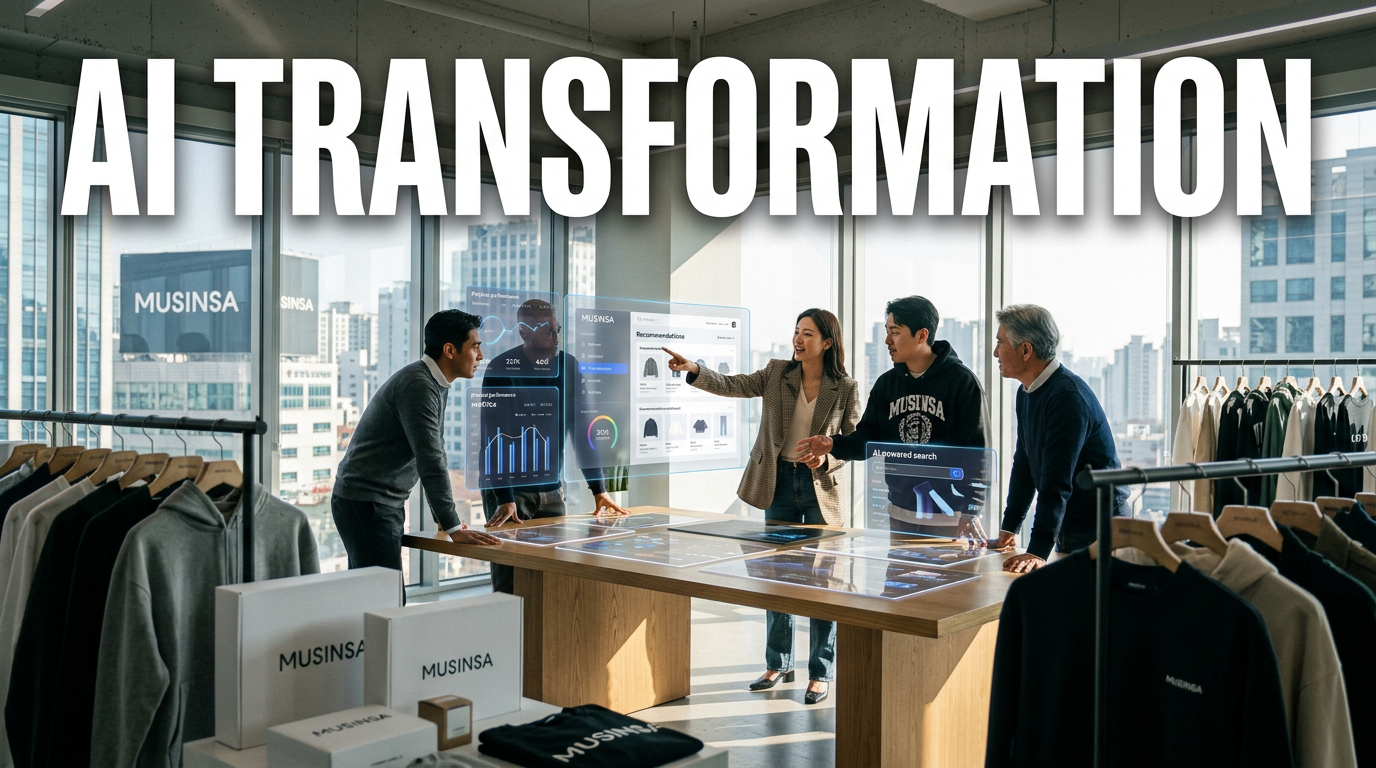
● Musinsa Rebrands as AI Native
Why Musinsa is being redefined from a “fashion platform” to an “AI company”
Musinsa is no longer just a shopping mall.
Through AI-native hiring, the company is rewriting its very identity,
and this shift is a significant signal that connects digital transformation, AI trends, platform economy, generative AI, and commerce innovation all at once.
In particular, this change is meaningful because it is not just at the level of “a company that uses AI well,”
but rather because it is elevating Musinsa into “a company that first defines talent standards for the AI era.”
1. First, the core takeaway of the news
Musinsa is a major fashion platform with 17 million members and annual revenue of 1.2 trillion won.
But what is drawing attention this time is not revenue or traffic, but the change in its hiring process.
By placing AI-native at the center of its first open recruitment in four years,
it has begun to treat AI not as a work tool but as a criterion for evaluating talent.
This is not merely an HR policy.
It is close to a declaration about what kind of talent the company will hire in the future,
and how it will operate its organization.
In other words, Musinsa is now beginning to redefine itself not as a fashion company but as a fashion tech company,
and more broadly, as an AI company.
2. Why Musinsa should not be seen as an “online shopping mall”
Musinsa’s origins are well known.
It started as “Mujinjang Shoe Photos,” a sneaker community created by CEO Cho Man-ho when he was in high school,
and expanded into commerce with the launch of Musinsa Store in 2009.
But today’s Musinsa is difficult to describe in just one sentence.
- Musinsa
- 29CM
- Soldout
- Empty
- Musinsa Global
It has grown into a multi-platform commerce group operating these five platforms.
Its revenue structure is also not simple.
- Platform fees
- Musinsa Standard, its own brand
- Musinsa Trading, a subsidiary handling product distribution
These three pillars are balanced in roughly a 4:3:3 ratio.
What does this mean?
It means Musinsa is not just a company that sells ads or only collects marketplace commissions,
but a full-stack fashion platform that handles product planning, distribution, and platform operations.
This structure is extremely important in today’s market.
While pure distributors are easy to automate with AI,
companies that combine platforms, data, operations, and product planning become even more competitive as AI is introduced.
3. Musinsa’s real battleground is its “ratio of technical talent”
There is one part of this article that deserves special attention.
That is the size of its technology organization.
Musinsa’s engineering organization has about 770 people across the group.
That means nearly half of the company’s 1,604 employees are technical staff.
This sends a very strong message.
For a fashion company to operate such a large technology organization means
the company is already adopting the operating style of a tech company beyond just a commerce company.
In other words, Musinsa is not only a company that sells clothes,
but also a technology company that mobilizes data, recommendations, search, logistics, personalization, automation, and AI model usage.
This is the key point that investors and the industry should pay attention to.
4. The meaning of CTO Joon-hee Jeon’s first message
The message from CTO Joon-hee Jeon, who joined at the end of 2024, was clear.
Musinsa must be reborn not as a fashion company,
but as a fashion tech company in the AI era.
And the starting point for that transformation was people.
This is a very strategic choice.
Because AI transformation is ultimately not about adopting tools,
but about who you hire, how you make them work, and what problems you ask them to solve.
More important than people who can simply use AI well is hiring people who treat AI as the default.
Musinsa is embedding that standard into hiring.
5. Why AI-native hiring matters
AI-native hiring is not simply about hiring people who have experience using AI tools.
It goes much deeper than that.
- Do they understand AI as a baseline assumption rather than an added feature of work?
- Do they make decisions and execute based on data?
- Can they reduce repetitive work with AI and design higher-value work instead?
- Can they restructure collaboration inside the organization through AI workflows?
In other words, AI-native is not a matter of skill, but of mindset.
If this standard spreads, the hiring market itself will change.
Going forward, “What is your major?” may become less important than
“How much have you improved work efficiency by using AI?”
This connects to a much larger shift in future education, future jobs, and HR innovation.
6. Industry significance in news format
Musinsa’s change is not just a hiring story for one company.
At the industry level, three trends are visible at once.
① The platformization of the fashion industry
The fashion industry has moved beyond an era where brand power alone could sustain it,
and is entering a stage where platform operations and data utilization are core competitive advantages.
② AI transformation in commerce
Recommendations, search, product planning, customer service, logistics forecasting, and marketing automation are all targets for AI application.
Going forward, the battle in commerce may be less about “who sells more” and more about
“who predicts faster and more accurately.”
③ Restructuring of the talent market
As AI-native hiring becomes more common,
companies will go beyond simply looking for technical talent and will want people who can define and solve problems based on AI.
From that moment on, the criteria for evaluating the job market will also change.
7. The most important point that other articles often miss
The real core point of this article is not that “Musinsa introduced AI.”
What matters most is that Musinsa first defined the talent standards for the AI era.
This difference is enormous.
Most companies introduce AI first and then look for the right people.
But Musinsa is doing the opposite:
it is first deciding what kind of people are needed to become an AI company.
That means the company’s direction is much clearer.
And more importantly, this strategy is not a short-term trend.
Hiring standards change organizational culture and performance structures,
and ultimately change the company’s future.
In other words, Musinsa is not just adopting AI;
it is designing an organization where AI can operate.
That is the real essence.
8. Interpretation from the perspective of the global economy and AI trends
Today’s global economy is facing low growth, high interest rates, and uncertainty,
making productivity improvement the most important issue.
In this context, AI is not merely a trend but a productivity engine that determines corporate survival.
In particular, when AI innovation, digital economy, platform strategy, commerce automation, and big data utilization are combined,
a company’s valuation structure itself can change.
Musinsa’s case shows how Korean companies should respond to AI in practice.
Even if a company is not a giant AI model builder like a U.S. big tech firm,
it can still create strong competitiveness by first designing an AI system tailored to its own industry.
9. Future points to watch
Musinsa’s next moves are even more important.
- Which job functions will first adopt AI-native hiring in practice
- How AI will be applied to recommendations, search, product planning, marketing, and logistics
- What kind of efficiency AI will generate in Musinsa Standard and its global business
- Whether a technology-led organization will translate into revenue growth and improved profitability
- Whether competitors will begin following similar hiring standards
By watching these five points, we can determine whether Musinsa’s AI transformation is merely a declaration
or a real structural overhaul.
10. In one sentence
Musinsa is now transforming from a company that sells fashion into
a platform company that first designs talent and operating methods suited to the AI era.
This change is not just a hiring announcement,
but an important signal of where Korea’s commerce and fashion industries are headed.
< Summary >
Musinsa is being redefined as an AI company beyond a fashion platform through AI-native hiring.
The core point is not the hiring change itself, but the shift in talent standards and organizational operations.
17 million members, 1.2 trillion won in revenue, and a technology organization of 770 people show Musinsa’s tech capability.
This trend connects to the platformization of the fashion industry, the AI transformation of commerce, and the restructuring of the talent market.
The most important point is that Musinsa is not merely introducing AI, but first designing an organization where AI can operate.
[Related articles…]
- “From hours to seconds”… How AI agents changed Samsung Electronics’ decision-making speed
- Anthropic IPO overtakes OpenAI… Revenue surges on the back of the agent boom
*Source: https://themiilk.com/articles/a5674f94f?utm_source=Viewsletter&utm_campaign=81dff6aad7-viewsletter744_COPY_01&utm_medium=email&utm_term=0_-66ea647efa-385751177