● Tesla Crash, JP Morgan Shock, Bullish Flip, Growth Pain, Supply Chain Risk
JPMorgan Raises Tesla Price Target by 227%, Yet Shares Sell Off: Three Key Points Investors Should Monitor
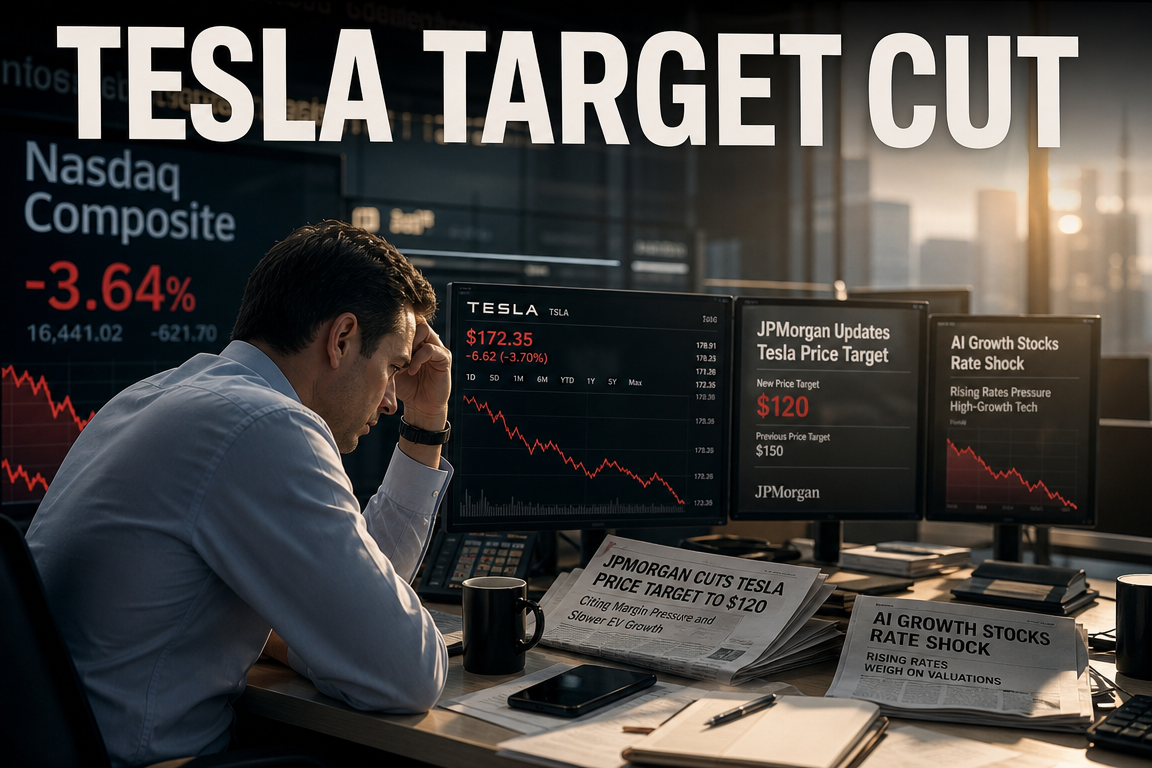
JPMorgan raised its Tesla price target from $145 to $475 (+227%), while the stock declined 6.56% in a single session. The move reflects a macro-driven risk-off event and a valuation framework shift rather than an immediate change in near-term fundamentals.
1. Market Context: The Decline Was Not Tesla-Specific
The sell-off was broad-based across U.S. equities:
- Nasdaq: -4.18%
- S&P 500: -2.64%
- Dow: -1.35%
- VIX: +40%+ (single day)
This indicates generalized de-risking rather than idiosyncratic Tesla selling.
1-1. Strong U.S. Employment Data Reduced Rate-Cut Expectations
U.S. May nonfarm payrolls exceeded expectations, leading markets to reprice the path of Fed easing. Strong labor data, in this context, was treated as negative for duration-sensitive assets because it implies higher-for-longer policy rates.
High-multiple growth equities are disproportionately impacted when discount rates rise, as a larger share of their valuation is tied to long-dated cash flows.
1-2. Broadcom Guidance Added to AI-Trade Fragility
Broadcom issued AI-related guidance viewed as below market expectations, contributing to concerns about the pace of AI infrastructure monetization. This weighed on AI-linked sentiment broadly.
Tesla is indirectly exposed to this factor because recent valuation has been increasingly driven by AI, autonomy, robotaxi, and robotics narratives rather than near-term vehicle unit growth.
2. Why JPMorgan Shifted Its Tesla View
The material development is not the magnitude of the target increase alone, but the signaling effect from a historically cautious institution.
- Prior price target: $145
- New price target: $475
- Increase: ~227%
- Rating: Underweight → Neutral
JPMorgan explicitly framed Tesla as more than an automaker.
2-1. Core Reframing: EV Manufacturer vs. AI/Autonomy/Robotics Platform
JPMorgan’s thesis is that Tesla investors are increasingly underwriting optionality in:
- Autonomous driving software
- Robotaxi network economics
- Humanoid robotics
- Energy infrastructure
- Licensing and related platform monetization
This implies a valuation approach closer to a platform or software-adjacent model than a traditional OEM multiple.
2-2. Sum-of-the-Parts Approach Across Five Business Lines
JPMorgan segments Tesla into:
- Automotive
- Energy
- Robotaxi
- Humanoid robotics
- Infrastructure and licensing
It estimates these markets could reach approximately $3.9 trillion by 2035, with valuation upside contingent on Tesla capturing meaningful share.
2-3. Why the Rating Is Neutral, Not Buy
Despite the higher target, the rating remains Neutral, implying:
- Reduced downside conviction versus prior skepticism
- Limited endorsement for aggressive near-term accumulation at current levels
This diluted the immediate bullish signal.
3. Three Reasons Tesla Fell Despite the JPMorgan Upgrade
3-1. Macro: Growth Equities Sold Off on Higher-for-Longer Repricing
As rate-cut expectations declined, duration-sensitive equities were sold broadly. Tesla’s valuation, increasingly linked to long-dated autonomy and AI cash flows, is particularly exposed to discount-rate changes.
3-2. The $475 Target Embeds Execution-Dependent Assumptions
The target is conditioned on multiple uncertain milestones:
- Regulatory trajectory for FSD
- Commercialization timing for robotaxi
- Optimus production scalability and unit economics
- Energy supply chain stability
- Demand resilience amid potential global slowdown
Markets discounted these as unverified.
3-3. Valuation Remains Elevated on Near-Term Earnings
JPMorgan’s cited 2026 EPS estimate is approximately $1.95. At ~$391, this implies a forward P/E exceeding ~200x.
JPMorgan argues the relevant anchor is 2030 EPS (estimated near $7.5), implying substantial earnings expansion. The market’s near-term reaction suggests limited confidence in timing and probability-weighting of that pathway.
4. Framework for Holders Near $391
At this level, investors are implicitly underwriting Tesla as an autonomy/AI platform rather than primarily an EV volume story.
- If the thesis is vehicle deliveries and cyclical auto fundamentals, valuation sensitivity is high.
- If the thesis is FSD commercialization, robotaxi scaling, energy platform expansion, and robotics monetization, near-term volatility may be treated as secondary to execution milestones.
Key question: whether the position is based on current automotive cash flows or long-dated platform optionality.
5. Google–SpaceX Computing Contract: Why It Matters Indirectly
Reported contract terms:
- Monthly value: ~$920 million
- Term: Oct 2026 to Jun 2029
- Total value: ~ $30 billion
The relevance is not direct revenue linkage to Tesla, but evidence that AI-era value accrues materially to compute, data center capacity, power availability, cooling, and infrastructure. This context supports platform-style valuation frameworks that incorporate AI infrastructure constraints.
A related implication: AI competition may increasingly shift from model performance alone toward access to data, compute, and energy infrastructure.
6. U.S.–Mexico Auto Parts Negotiations: Mixed Implications for Tesla
Reported direction under USMCA discussions:
- Current rule: 75% North American content for duty-free status
- Proposed tightening: 85%+ North American content, with 50%+ U.S.-origin content
This has second-order effects across supply chains, reshoring costs, inflation pressure, and OEM margin structures.
6-1. On Vehicle Components, Tesla May Be Relatively Better Positioned
Tesla’s U.S.-centric manufacturing footprint (e.g., Texas, Fremont, Nevada) and high domestic content rankings may provide relative insulation versus legacy OEMs with heavier Mexico-based supply chains.
6-2. Primary Vulnerability: LFP Battery Supply Chain Exposure
Even if vehicle component localization is favorable, LFP cell sourcing has historically had meaningful China exposure, including for energy storage deployments and certain vehicle configurations. A more restrictive stance toward China-linked inputs could increase cost and constrain supply flexibility.
6-3. Mitigation: U.S. Battery Value Chain Build-Out
Noted initiatives include:
- Sparks, Nevada: LFP battery plant development
- Austin, Texas: cathode material capacity expansion
- Texas lithium refining: domestic raw-material processing capability
These initiatives are relevant to energy storage margins, EV cost structure, and eligibility for U.S. industrial policy incentives.
7. Additional Items to Monitor
7-1. Roadster Timing Delays
Further delays risk shifting investor focus from product optionality to execution credibility, particularly given Tesla’s expanding pipeline of long-dated projects.
7-2. In-Vehicle AI Assistant Expansion
Incremental rollout of in-vehicle AI assistant functionality supports the longer-term thesis of vehicles as software-upgradable platforms, enabling recurring revenue through subscriptions and feature monetization.
8. News-Style Summary
Market
Stronger-than-expected U.S. employment data reduced rate-cut expectations, driving a sharp sell-off in growth equities and elevating volatility. Tesla participated in the broader macro-driven drawdown.
Tesla
JPMorgan raised its price target to $475 and reframed Tesla as an autonomy/robotics/AI platform. The rating remained Neutral, limiting near-term buy-side signaling.
AI Infrastructure
The Google–SpaceX contract underscored the scale of AI infrastructure economics and the strategic value of compute and power. This context is supportive of platform-style valuation narratives but does not directly alter Tesla financials.
Supply Chain
Potential tightening of North American content rules may be comparatively favorable for Tesla on vehicle localization, while LFP battery sourcing remains a key exposure point.
9. Underappreciated Point
The central development is a shifting valuation framework:
- Under an automaker framework, valuation appears demanding.
- Under an AI/autonomy/energy platform framework, a meaningful portion of value is embedded as execution-dependent optionality.
- Key drivers shift from unit sales to regulatory approvals and software monetization.
- The primary localization risk is less the vehicle BOM and more the battery supply chain, particularly LFP.
- AI-era winners may be differentiated by control of data, compute, power, storage, and deployment hardware.
10. Conclusion
The decline reflected macro repricing of rates and growth-risk, not the weakness of the JPMorgan report itself. The upgrade is notable as a symbolic shift toward platform-style valuation of Tesla, but realization depends on measurable progress in:
- FSD commercialization and regulatory pathways
- Robotaxi deployment economics
- Optimus scalability and unit margins
- Battery supply chain localization
- Energy business scale and supply reliability
< Summary >
JPMorgan’s 227% price-target increase reflects a reclassification of Tesla from an EV manufacturer toward an AI/autonomy/robotics and energy platform narrative. However, strong U.S. labor data pushed out rate-cut expectations, triggering a broad growth-equity sell-off and contributing to Tesla’s 6.56% decline.
Potential U.S.–Mexico rules tightening may be relatively favorable for Tesla on vehicle component localization, but LFP battery supply chain dependence remains a material risk. Near-term price action is likely to be driven less by delivery volume and more by regulatory progress and software monetization visibility, alongside battery localization execution.
[Related Articles…]
- Tesla valuation and autonomy market repricing: key points to monitor (https://NextGenInsight.net?s=Tesla)
- AI infrastructure investment expansion and U.S. equity volatility linkages (https://NextGenInsight.net?s=AI)
*Source: [ 오늘의 테슬라 뉴스 ]
– JP모건 227% 올린 날, 테슬라 왜 -6.56% 빠졌나 — 세 가지 이유 완전 분석, $391 주주는 지금?
● Nasdaq Shock, Fed Fear, Tech Rout
Nasdaq Sell-Off: Why Now Matters — The Market’s Core Warning on June 6
This event should not be reduced to “Nasdaq fell.” Key drivers include: why a jobs upside surprise turned negative, how rising hike probabilities shifted sentiment, the linkage between U.S. Treasury yields and tech valuations, how crude inventories can transmit inflation into the real economy, and the near-term implications for AI-related equities and Nasdaq positioning.
Headline strength in employment increased market anxiety. That dynamic is central to this drawdown.
1. One-line market takeaway: “Strong data produced weak equities”
The primary catalyst on June 6 was a U.S. employment report that came in stronger than expected.
Typically, stronger employment reduces recession risk and can support equities. In this instance, the market reaction reversed because overly strong labor conditions reduce the likelihood of near-term Fed easing and revive the risk of additional tightening.
Given its heavy weight in long-duration growth equities, the Nasdaq is structurally more sensitive to rates, amplifying the impact.
2. Why the employment report was negative for the Nasdaq
2-1. The market preference: “Moderating, not accelerating, labor”
Markets had been positioned for a “soft-landing” profile: disinflation progressing, employment cooling gradually, and the Fed moving toward a hold or eventual cuts.
A notably strong employment print disrupted that path. If labor demand is interpreted as the strongest in roughly two years, the Fed can reasonably conclude the economy remains resilient, increasing the probability of extended restriction or additional hikes.
2-2. Why strong employment raises hike risk
A tight labor market can keep wage growth elevated. Persistent wage pressure slows the decline in services inflation, a key component of U.S. inflation dynamics.
If employment remains strong, inflation may prove stickier, reducing the Fed’s ability to signal confidence in a sustained disinflation trend. This is the primary channel the market repriced.
3. Why hike probabilities matter
3-1. The signal from higher October hike odds
Markets began assigning roughly a 52% probability to a rate hike in October, with commentary also noting approximately a 12% chance of two additional hikes. These probabilities matter less as forecasts of the exact outcome than as indicators of shifting expectations, which markets price rapidly.
Equities tend to trade the change in expectations before policy actions occur.
3-2. Why higher rates pressure technology equities
The Nasdaq contains a high concentration of companies whose valuations are driven by long-term growth expectations rather than near-term earnings.
As discount rates rise, the present value of future cash flows falls. Consequently, large-cap technology and higher-multiple growth equities are often the first to reprice during periods of rising rate expectations.
4. The collision between U.S. Treasury yields and the Nasdaq
4-1. When bonds become more competitive than equities
Higher expected policy restriction typically lifts U.S. Treasury yields. Rising risk-free yields increase the relative attractiveness of bonds and raise the required return for equities, compressing valuation multiples.
The effect is stronger when equity valuations are elevated, implying the sell-off reflects valuation normalization, not only risk aversion.
4-2. The AI rally is not immune to rate shocks
AI-led structural growth may remain intact over the long term, but short-term price action can diverge materially.
When yields rise quickly, multiples can compress even if the underlying AI adoption narrative is unchanged. Failing to separate long-term industry direction from short-term valuation mechanics can lead to underperformance despite correct thematic positioning.
5. Why crude inventories have become relevant again
5-1. Energy risk remains an inflation variable
Crude inventory dynamics can be underappreciated by markets. If inventories are tight or supply risk persists, energy prices can reaccelerate, reviving inflation pressure.
A scenario combining strong employment, sticky inflation, and rising energy costs is unfavorable for the Fed’s objective and can reinforce a more restrictive policy stance.
5-2. Potential transmission from markets to the real economy
Higher energy prices affect more than retail fuel costs. They can raise logistics expenses, manufacturing input costs, air freight costs, and food prices.
This can compress corporate margins and increase consumer burdens, elevating the risk that tighter financial conditions translate into slower real-economy activity.
6. The Fed and the FOMC: what markets are actually watching
6-1. Messaging can matter more than an immediate hike
Market focus often centers on whether the FOMC raises rates, but the tone of Fed communications frequently has greater near-term impact.
Even without an immediate hike, reiterated concern about labor strength and inflation risk supports a “higher for longer” path, which is typically adverse for rate-sensitive growth equities.
6-2. The message markets want
Markets prefer guidance suggesting a low likelihood of further hikes and conditional openness to easing if data softens. A strong labor report reduces the Fed’s ability to deliver such dovish framing.
As a result, the employment release functioned as a pre-FOMC expectation reset.
7. News-style summary
7-1. Key headlines
First. The U.S. employment report surprised to the upside, reducing expectations of near-term cooling.
Second. October hike odds rose, and the possibility of additional tightening was repriced.
Third. Higher Treasury yield pressure accelerated weakness in Nasdaq-heavy technology equities.
Fourth. Crude inventory and energy-price risks reintroduced inflation concerns.
Fifth. AI-related equities demonstrated that long-term growth narratives do not offset short-term rate shocks.
7-2. Market reaction mechanism
Strong jobs → higher hike risk → upward pressure on U.S. Treasury yields → greater valuation pressure on technology equities → Nasdaq decline.
8. The most important point often missed in mainstream coverage
8-1. The core issue is policy justification, not “good growth”
The market’s concern is not the employment number itself but the renewed policy justification for additional tightening.
Once the Fed has stronger justification, markets tend to price the next steps in advance.
8-2. The drawdown may reflect repricing of excessive optimism
Recent Nasdaq and AI-related performance embedded expectations of imminent rate relief. Strong labor data challenged that premise.
This suggests the move may be a reversal of prematurely priced easing expectations rather than a single-day, event-driven sell-off.
8-3. Structural AI themes do not override macro pricing
AI is a long-term structural narrative; rates and liquidity are dominant short-term pricing variables.
Equity outcomes often require alignment between thematic growth and financing/discount-rate conditions. Industry innovation alone is insufficient for near-term performance.
9. Investor checklist
9-1. Key indicators to monitor
Beyond employment, monitor wage growth, core inflation, crude price trends, and U.S. Treasury yield direction. The interaction of these variables will determine whether hike risk intensifies or moderates.
9-2. Conditions for a more stable Nasdaq rebound
More constructive conditions would likely include:
- Employment remaining solid without appearing overheated
- Continued disinflation in inflation measures
- Limited re-acceleration in crude and energy prices
- Fed communication emphasizing caution over additional tightening
9-3. Separate tactical from strategic horizons
Near-term volatility may remain elevated. Strategically, AI, semiconductors, automation, cloud infrastructure, and productivity-driven themes remain relevant.
In the current regime, pacing and entry timing matter alongside the rate environment.
10. Conclusion: the sell-off reflects “tightening fear driven by strong labor”
The June 6 Nasdaq decline was not driven primarily by recession concerns. It reflected the implication that the economy remains sufficiently resilient to delay easing and potentially justify further tightening.
Markets repriced hike risk, and rate-sensitive technology equities absorbed the largest valuation adjustment. With energy variables still present, sensitivity to inflation and policy expectations is likely to remain high.
This move signals renewed tension among inflation dynamics, monetary policy, and growth-equity valuation.
< Summary >
A stronger-than-expected U.S. employment report increased the perceived probability of additional Fed tightening. This raised upward pressure on U.S. Treasury yields and triggered a valuation-driven sell-off in Nasdaq-heavy technology equities. Crude inventory and energy-price variables added to inflation risk. AI-related equities retain long-term structural support but remain exposed to short-term rate shocks. The key driver was not “strong growth,” but the restoration of policy justification for a more hawkish Fed stance.
[Related Articles…]
- Nasdaq volatility expanding: why technology equity strategy may require recalibration (https://NextGenInsight.net?s=Nasdaq)
- AI semiconductor supercycle: key points the market may be missing (https://NextGenInsight.net?s=AI)
*Source: [ 내일은 투자왕 – 김단테 ]
– 나스닥 대폭락의 진짜 이유 (6월 6일)