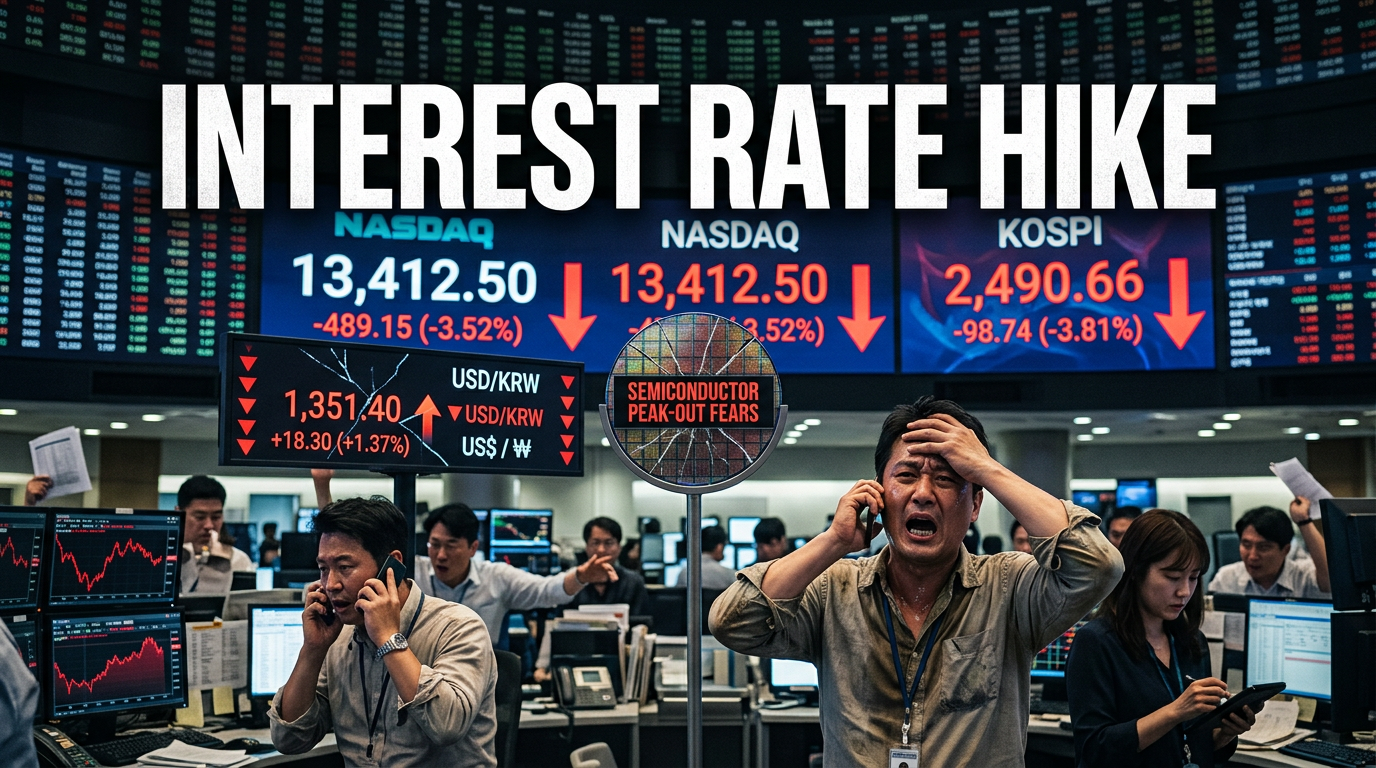
● Rate Hike Shock
Nasdaq·KOSPI “additional crash” checklist: the 2 factors (interest rates·semiconductors) and exchange-rate variables that will shake next week’s market
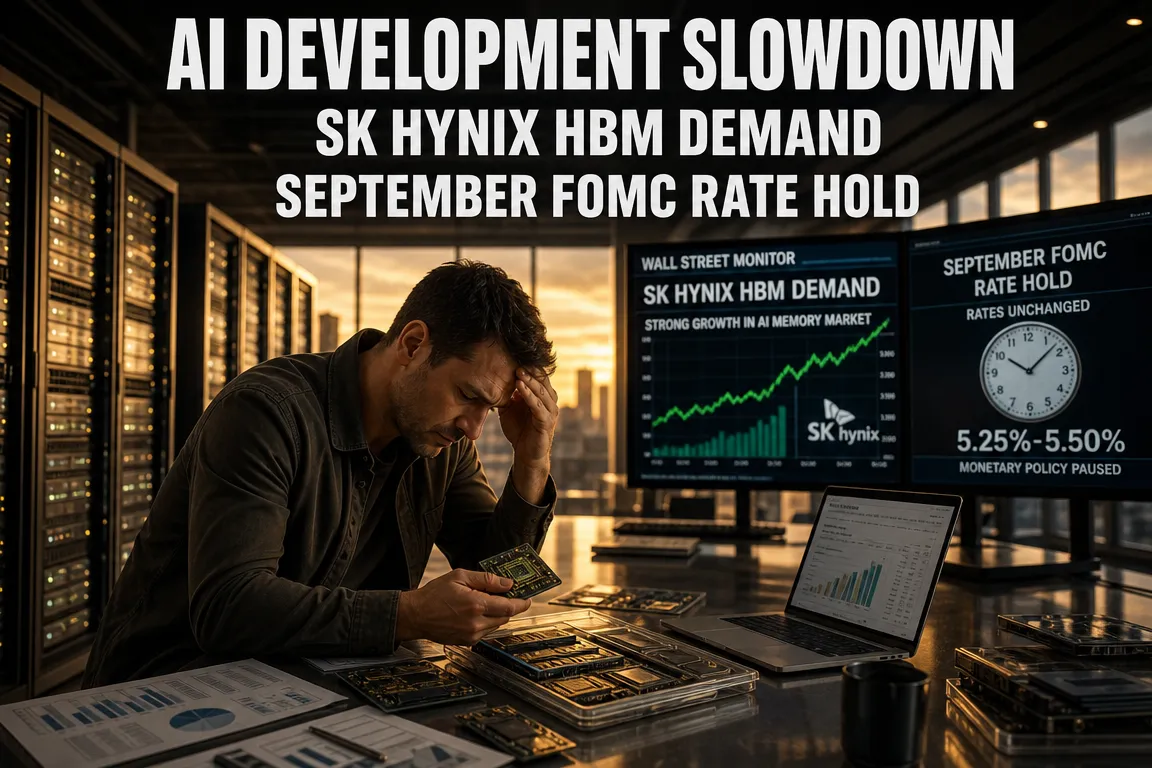
First of all, what people are most curious about right now: “Why did it suddenly drop like this?”
The core of what was shared was that while the U.S. market swung sharply, the Nasdaq fell rapidly and the Philadelphia Semiconductor Index dropped even more steeply.
What’s important here is not the “drop itself,” but what the triggers (the breaking points) that can create additional declines next week are.
The key points included in this piece can be summarized into exactly three.
- First, as employment data came out too well, concerns about rate hikes surged rapidly
- Second, the argument that semiconductors (especially memory) have ‘peaked out’ worsened market sentiment even further
- Third, when U.S. interest rates rise and flow through to Korea, the exchange rate (won weakness) can increase KOSPI volatility
And if we reinterpret this trend from an AI/tech investment perspective, it reads as a signal that the market is reacting first not to “growth,” but to uncertainty created by “interest rates and inflation (oil prices).”
Since this issue is a typical situation of re-pricing of global financial-market risk, it’s important to view the news as news, while checking it with the perspective of what the “real problem” for next week’s stocks is.
1) The #1 reason for the U.S. market’s sharp drop: employment is ‘too good’ → the probability of a rate hike skyrockets
The numbers mentioned in the original text were quite decisive.
- Nonfarm payrolls 170,000
- At about double versus the forecast of 85,000
- Upward revisions even to the March and April figures
The reason the market is so sensitive is that strong employment means consumption holds up, and if demand stays firm, inflation is not expected to cool easily.
Here, the points the Fed is worried about overlap.
- Even if oil prices fall, they are still expensive
- If oil prices stay high, product and service inflation can persist stubbornly
- If employment is strong as well, concerns about economic overheating grow
In other words, the market has entered a phase where it doesn’t interpret “good employment = good economy” only, but begins to read “good employment = higher for longer / a stronger rate policy.”
2) The bond market reaction was even scarier: the probability of a rate hike ‘surged’
Among the points mentioned in the original text, the most finance-market-like part is this.
- Existing probability of a rate hike of about 40% → rose to 77.5% on the day
- With the current interest rate at 3.5%, the possibility of 3.75% by year-end rose to nearly 50%
- Even the possibility of two rate hikes was mentioned as 27.5%
Stocks are ultimately sensitive to expected value (the discount rate), right?
Rising interest rates mean the discount rate for growth stocks (especially tech where valuations have risen due to AI investment) increases, so downside pressure can become even greater.
That’s why even “companies with good earnings” can be made to face another round of cold realism by the market.
That’s how the sense of “fear” spread here.
3) The #2 reason for the U.S. market’s sharp drop: the semiconductor (memory) ‘peaking out’ debate shakes sentiment
The point was that explaining this decline with “employment only” didn’t fit, because the memory-related drawdown was too large.
The flow shown in the original text has this structure.
- The Philadelphia Semiconductor Index plunged (roughly in the 10% range)
- Rumors spread that “the memory peak (turning point) could come earlier”
- A specific investment bank (BNP Paribas) mentioned the memory peak in mid-2026
- The author pushed back, saying it was “too hasty speculation”
What matters here is that the conclusion is not “memory is definitely okay,” but that
a stock group whose expectations were already built in too aggressively may be more vulnerable to ‘talk (noise)’.
In other words,
- if the stock has already risen a lot, or
- if expectations were already priced in during that period,
then once headlines like this ‘peaking out’ claim appear, selling can accelerate for the reason that “the estimates got shaken.”
4) “Even if oil prices fall, it’s still expensive” → the inflation path hasn’t been completely severed
Oil prices are mentioned in the original text.
- Oil prices fell and came down to the 90-dollar range
- But they are still expensive
- If oil prices remain high, inflation pressure for goods and services remains
The reason this part is important is that it makes it difficult for the market to conclude categorically that “inflation has been fixed.”
From the Fed’s point of view, the key is whether inflation is contained all the way through, and if the fuel pushing that inflation is oil prices, there’s room to judge that the “rate break” hasn’t been executed yet.
5) Transmission to the Korean market: rising U.S. interest rates → expanded KOSPI and FX volatility
The original text pointed out the most realistic part from the perspective of Korean investors.
- If U.S. interest rates rise, Korea also gets pressured
- There was a mention that the KOSPI overnight futures fell by more than 9%
- The exchange-rate situation is “not looking normal”
Especially, it’s hard to treat the exchange rate independently from “stocks.”
6) The exchange-rate (won/dollar) core: why do the 1,560~1,600 won range shake the market?
According to the original text, the exchange rate shows June 6 at 160 won (the unit presentation is somewhat mixed, but the core message is that won weakness has become very significant).
Here, the principle is clear.
- In the past, the won per 1 dollar was lower (e.g., in the 1,000-won range)
- Now, the won per 1 dollar is much more expensive
- = the won’s value declines
- In the background, the interest-rate differential and expected inflation are at work
Put simply,
If U.S. interest rates are higher, investors’ preference for dollar assets can increase, and selling won to buy dollars may become more common.
If geopolitical instability also overlaps, safe-haven demand can strengthen, potentially making dollar strength even more pronounced.
7) However, it’s difficult to conclude that it will “definitely crash further”: observation points (staggered buying zones)
The original text presents the logic below.
- The current decline has proceeded to a certain range from the recent peak
- The probability of a much larger crash (e.g., on the level of 2022) seems low for now
- Core reason: this year’s earnings outlook is too good
As supporting evidence, the focus was on the improvement trend in EPS (earnings per share).
- EPS rose 25% in the prior quarter
- The original expectation was 12%, but the actual result was even better
- An interpretation that the expansion of big-tech infrastructure investment boosted the earnings of AI beneficiary stocks
- The nuance that the tech stocks’ EPS growth rates are being raised each cycle
And the conclusion of this logic is summarized in a statement like this.
If a major economic crisis does not come, stock prices eventually converge toward fundamentals.
So even if a short-term decline grows due to “interest-rate fear,” the view here is that after some time, earnings and cash flow can again take the center of the market.
8) Investment perspective conclusion (reinterpreting the original): the essence of the decline is the distinction between ‘fundamentals’ vs ‘noise’
The conclusion presented in the original text is quite practical.
- A rate hike itself is scary (the 2022 trauma)
- However, the scale of the hike hasn’t been confirmed as “runaway level,” and only the probability has increased
- The memory peaking out claim could be excessive in terms of the evidence needed to shake the market
- If it falls further, it may be ‘noise’ that has nothing to do with fundamentals
So the wrap-up is not “chase buys / panic sell,” but with a tone that timing for staged entry may open up.
For blog readers, there is one important check here.
Separating the question of “why it’s falling” into employment, inflation, and interest rates (macro) versus earnings (EPS, micro) makes the 대응 much clearer.
The single most important line that should be written separately in the blog
What made today’s decline happen wasn’t that “a company suddenly went bankrupt,” but that
employment came out strongly, the probability of a rate hike surged, and the shock from that discount rate was reflected in prices first by growth stocks (especially AI/semiconductors).
And if the exchange rate also gets shaken here, KOSPI’s short-term volatility can increase as well.
Summarize this issue using keywords from an SEO perspective
This news flow is very strongly connected to the economic keywords below.
- Rate hike expectations (*** rate hike expectations ***)
- U.S. employment indicators (*** U.S. employment indicators ***)
- Won/dollar exchange rate (*** won/dollar exchange rate ***)
- Semiconductor industry conditions (*** semiconductor industry conditions ***)
- AI semiconductor cycle (*** AI semiconductor cycle ***)
< Summary >
- The sharp U.S. market decline was largely driven by the sudden surge in rate-hike concerns due to strong employment data.
- In the bond market, the increased probability of a rate hike (77.5%) and the year-end rate (3.75%) raised the discount-rate burden for growth stocks.
- In the Philadelphia Semiconductor Index, the memory peaking-out (cycle peak) debate spurred sentiment and made the drawdown even larger.
- Even though oil prices fell, they are still expensive, so the market interprets that the inflation path hasn’t been completely cut off.
- Rising U.S. interest rates can transmit to Korea, and won weakness (declining won value) can increase KOSPI volatility.
- However, since the trend of improving earnings (EPS) this year is strong, the article also suggests that additional declines could be ‘noise’ given a possible convergence toward fundamentals.
[Related posts…]
- The core mechanism by which rate-hike expectations increase market volatility
- The impact of sharp won/dollar exchange-rate changes on KOSPI and key checkpoints
*Source: [ 월텍남 – 월스트리트 테크남 ]
– 다음주 나스닥, 코스피 추가 폭락?..”이것” 확인해야 합니다.