● Musk Power Grab,Tesla-SpaceX Merger Shock,2-to-1 Premium Battle
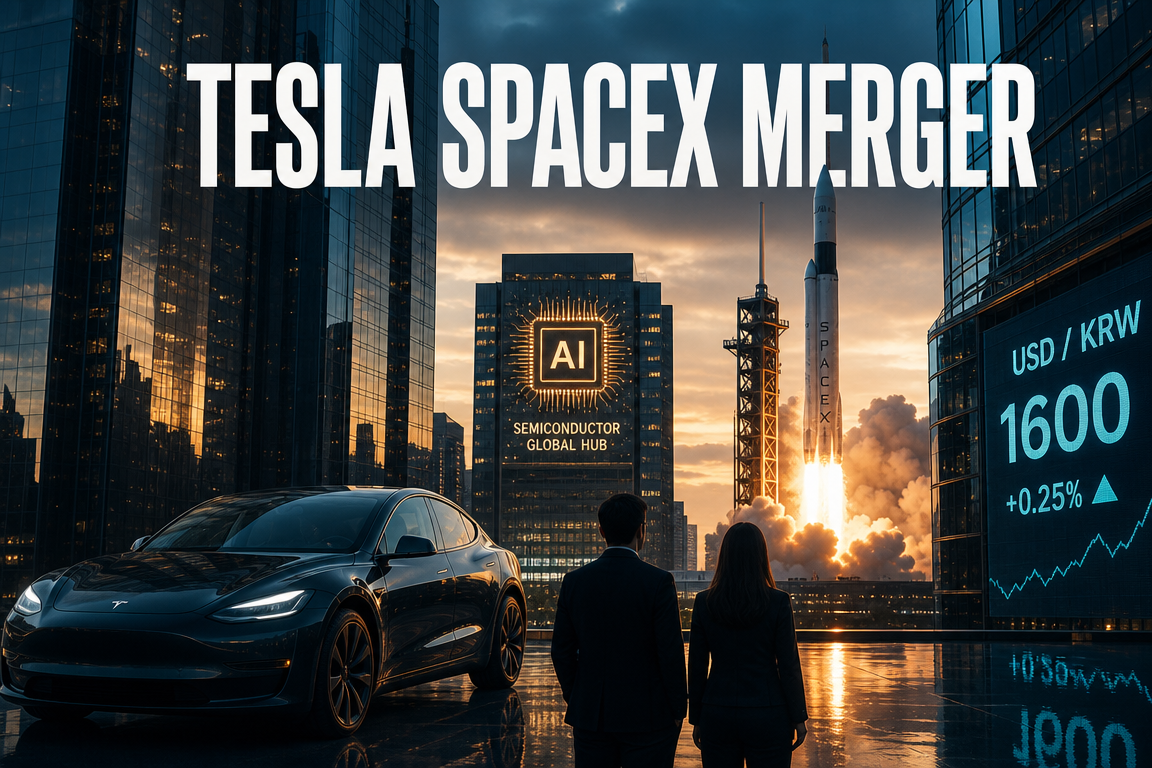
Tesla–SpaceX Merger Debate: The Core Issue Is Not a “2-to-1 Premium,” but a Reshaping of Musk’s Control
The most material issue in the market is not simply whether Tesla and SpaceX will merge.
The debate centers on three points:
1) Why Tesla shareholders view a market-cap-based merger as value-destructive.
2) Why the discussion escalated abruptly ahead of a potential SpaceX IPO.
3) Why the topic, while framed as a merger issue, is structurally linked to AI, semiconductors, robotics, autonomous driving, and Elon Musk’s governance/control objectives.
This report connects the issue to Tesla’s equity performance, U.S. equity market positioning, AI semiconductor dynamics, autonomous driving, and broader macro/industry trends, with particular emphasis on the possibility that the primary objective is governance control rather than incremental enterprise value.
1. Key Takeaways
Within the Tesla investor community, the view is spreading that any Tesla–SpaceX combination would require at least a “2-to-1” level premium.
This is not purely a price-demand narrative; it reflects the arithmetic that, at current market capitalizations, Tesla shareholders could become a near-minority cohort within a combined entity.
Interest intensified as a potential SpaceX IPO approached, while concurrent narratives around ASML, Musk’s public comments, large-scale semiconductor/compute initiatives, and expectations for xAI, FSD, Optimus, and robotaxi outcomes collectively amplified attention.
2. Why the “2-to-1 Premium” Narrative Emerged
2-1. Market-cap-based merger math implies Tesla shareholder disadvantage
Using the figures cited: SpaceX is referenced at approximately $1.75 trillion in value and Tesla at approximately $1.5 trillion.
A simple combination implies a consolidated value above $3 trillion.
The central issue is equity allocation. Under this framework, Tesla would represent below half, approximately 47%, implying SpaceX would hold the larger share.
As a result, Tesla shareholders may be asked to accept a reduced proportional claim on a platform positioned around EVs, energy, AI, and robotics relative to their current stand-alone exposure.
2-2. What “2-to-1” functionally represents
“2-to-1” is less a literal share exchange ratio and more a demand that Tesla’s valuation be recognized at a substantially higher premium than current trading levels.
In practice, the claim is that Tesla should reflect forward optionality across robotaxi, FSD licensing, Optimus, and AI infrastructure, implying a premium in the range of ~50% to ~100%.
This would be intended to preserve majority, or near-majority, influence for Tesla shareholders within the combined company.
2-3. Why current pricing may not fully reflect Tesla’s forward businesses
Tesla’s valuation embeds expectations beyond automotive operations, including autonomy, robotics, energy storage, supercomputing, and AI training infrastructure.
If a merger is priced primarily on current market capitalization, forward-value components not yet fully expressed in financial results could be transferred at a discounted implied price.
From the Tesla shareholder perspective, this creates a risk of monetizing long-duration upside prematurely and at insufficient valuation.
3. Why SpaceX Shareholders May Also Object
To secure Tesla shareholder approval, Tesla would likely require a high premium.
That premium would mechanically dilute SpaceX’s proportional ownership in the combined entity.
Accordingly, the transaction is structurally difficult to optimize for both shareholder bases, supporting the view that the concept is headline-attractive but negotiation-complex in practice.
4. Why the Merger Narrative Grew Despite an Approaching IPO Window
4-1. An IPO creates a public-market valuation anchor
Pre-IPO is a highly sensitive period for valuation recalibration.
A SpaceX IPO would shift pricing from private-market frameworks to a public-market clearing price, enabling more direct comparisons with Tesla.
As a result, investors will increasingly quantify relative advantage/disadvantage under combination scenarios regardless of whether a formal process exists.
4-2. Rising investor focus on the broader “Musk ecosystem”
In U.S. equities, platform ecosystems increasingly command premium valuation frameworks.
Analogous to Nvidia being valued across chips, software, and infrastructure, investors increasingly view Tesla, SpaceX, xAI, X, robotics, and satellite connectivity as a single AI infrastructure-adjacent complex.
Under this framing, merger speculation is treated less as rumor and more as a plausible strategic pathway.
5. ASML, Semiconductor Drawdowns, and the Implications of Musk’s Commentary
5-1. Why ASML is strategically central
ASML effectively dominates the supply of EUV lithography systems critical to leading-edge semiconductor manufacturing.
Samsung Electronics, TSMC, and Intel face structural constraints in advanced node progress without access to ASML systems.
ASML is therefore often treated not only as an equipment vendor but as a control point in the global advanced semiconductor supply chain.
5-2. Why Musk’s ASML reference may be non-trivial
Musk’s favorable reference to ASML is noteworthy in the context of potential surges in AI semiconductor demand driven by Tesla and SpaceX.
AI data centers, autonomy compute, robotics compute, and space-enabled communication/compute architectures could expand aggregate chip requirements materially, increasing dependence on advanced manufacturing capacity and tooling.
5-3. Semiconductor correction does not negate the long-duration theme
Recent corrections in semiconductor-related equities (e.g., Broadcom, ASML, Intel) do not necessarily indicate structural deterioration in AI-driven demand.
Market action may reflect repricing between near-term expectations and long-duration growth.
In such conditions, supply-chain leverage and capex trajectories can be more decision-relevant than near-term earnings variance.
6. Why Wall Street Views Diverge
6-1. Cautious view: collaboration is feasible without a merger
A core argument is that meaningful cooperation does not require corporate combination.
Compute sharing, connectivity collaboration, autonomy data processing, and xAI service integration can be structured via contracts and strategic partnerships.
This approach avoids complex equity exchange mechanics and reduces regulatory and disclosure friction.
6-2. Optimistic view: a high-probability long-term integration path
More aggressive views assign higher probability to Musk pursuing a single integrated platform spanning EVs, autonomy, robotics, satellite networks, launch services, AI models, and compute/semiconductor infrastructure.
The claim is that such an integrated system could create scale and defensibility difficult for competitors to replicate.
6-3. Opposition view: consolidation also consolidates weaknesses
Tesla faces operational pressures including slowing vehicle growth, intensifying competition in China, and European share pressure.
SpaceX, despite technical leadership, is capital-intensive with potentially variable profitability typical of aerospace programs.
Combination may aggregate risks alongside strengths, and could introduce incremental constraints around regulation and disclosure given SpaceX’s sensitive programs and Tesla’s public-company requirements.
7. Implications of Piper Sandler’s $500 Tesla Scenario
A notable element is that a $500 Tesla price target was presented without requiring a merger premise.
This indicates perceived capacity for Tesla to achieve substantial re-rating on a stand-alone basis.
There is also commentary that Optimus and parts of semiconductor-related initiatives may not be fully embedded in such valuation work.
For investors, this distinction matters: whether a merger is necessary to unlock the growth narrative, or whether it is an additive but non-essential catalyst. Current positioning appears closer to the latter.
8. Core Thesis: The Debate May Be About Control, Not Valuation
8-1. A commonly underweighted angle
While the discourse is framed as shareholder value and exchange ratios, the more consequential variable may be Musk’s governance leverage and voting control.
8-2. Why 25% voting power was highlighted
Musk has previously stated that advancing Tesla as a leader in AI and robotics would be operationally easier with at least ~25% voting control.
If ownership is below that threshold, long-duration, high-capex initiatives can face increased board and shareholder resistance, particularly when near-term profitability and longer-term investment priorities diverge.
8-3. A merger could materially increase Musk’s effective control
If Musk’s higher control position within SpaceX were combined with Tesla equity into a consolidated structure, his influence in the merged entity could rise materially, potentially exceeding 50% under certain constructions cited in market discussions.
Such an outcome would shift the balance of power from “largest shareholder” to de facto strategic control, directly affecting Tesla’s AI, robotics, and autonomy roadmap execution.
8-4. Governance framing as an explanation for execution pacing
Some investors question the pace of Optimus commercialization and robotaxi scaling.
Beyond technology and regulation, a governance-control constraint could also influence willingness to commit fully to long-duration bets.
Under this view, the binding constraint may be control architecture rather than engineering capability.
9. Macro and Industry Significance
9-1. A compressed case study of the ongoing industrial transition
The debate functions as a proxy for how value chains are converging across EVs, aerospace, AI semiconductors, data centers, robotics, autonomy, satellite connectivity, and energy infrastructure.
9-2. The boundary between manufacturing and digital platforms is eroding
Vehicles increasingly function as AI endpoints; robots as data-collection platforms; satellite networks as core connectivity infrastructure; semiconductors as foundational inputs across sectors.
Investment analysis therefore increasingly requires ecosystem-level frameworks rather than single-industry silos.
9-3. U.S. equity premium allocation is shifting
Markets increasingly reward potential control of future platform standards rather than only near-term revenue growth.
This structural preference helps explain persistent attention to merger narratives: narrative scale, network effects, and long-duration platform dominance are being capitalized more heavily.
10. Key Considerations for Investors
10-1. A merger could be supportive, but is not a guaranteed catalyst
Market reaction would depend on exchange ratios, tax and regulatory outcomes, litigation risk, shareholder approval dynamics, and post-transaction disclosure obligations.
10-2. Separate stand-alone Tesla value from merger synergy value
Tesla analysis should not rely solely on vehicle volume and margin trajectories, but merger speculation should also not be treated as a substitute for fundamentals.
A robust approach separates a stand-alone scenario from an incremental synergy scenario.
10-3. Governance can be as material as technology
Retail investors often emphasize product announcements and technical milestones.
In large-cap outcomes, ownership, voting rights, board structure, and legal protections can be equally decisive in determining strategic direction and capital allocation.
11. The Most Undercovered Point
The core question is not whether “Tesla acquires SpaceX” or “SpaceX absorbs Tesla.”
The central issue is where Musk consolidates AI, robotics, and autonomy-critical assets, and under what governance structure he can retain long-horizon control with minimal constraint.
Under this framing, a merger is less a financial engineering event and more a control-architecture redesign.
If successfully implemented, markets may increasingly value the platform as next-generation industrial infrastructure rather than a single-category automotive company.
12. Scenarios to Monitor
12-1. Scenario A: No merger; deeper operational collaboration
This is the base-case execution path: maximize business synergies while minimizing legal and regulatory complexity.
Near-term feasibility appears highest under this scenario.
12-2. Scenario B: IPO followed by phased integration discussions
Post-IPO public pricing could clarify exchange-ratio mechanics.
However, it could also sharpen shareholder conflicts as valuations become more transparent.
12-3. Scenario C: Governance cleanup followed by a large-scale consolidation move
This scenario carries the highest potential impact.
If control concerns are resolved and Musk proceeds to consolidate AI, robotics, space, and semiconductor/compute infrastructure, markets could apply a materially different valuation framework.
Conversely, failure could amplify regulatory exposure, litigation risk, and valuation compression simultaneously.
13. Conclusion
The Tesla–SpaceX merger debate is presented as an exchange-ratio and shareholder value discussion, but it is more accurately a multi-variable issue spanning Tesla’s equity narrative, U.S. market premium frameworks, AI semiconductor supply chains, autonomy commercialization, robotics execution cadence, and Musk’s governance control.
Understanding why Tesla shareholders cite a “2-to-1” premium requires focusing on how forward optionality is (or is not) reflected in current pricing.
At a deeper level, the debate centers on which corporate structure will control the key assets shaping the AI/robotics/autonomy cycle.
< Summary >
The central issue in the Tesla–SpaceX merger debate is not merely whether a merger occurs, but exchange-ratio mechanics, forward-value recognition, and Musk’s control objectives.
A market-cap-based merger could disadvantage Tesla shareholders, driving calls for at least a “2-to-1” premium.
That requirement would likely dilute SpaceX shareholders, making a mutually acceptable deal structurally difficult.
Wall Street is split between a “collaboration without merger” framework and a “platform integration” framework.
A critical, underweighted point is that the merger’s primary function may be governance/control restructuring rather than pure enterprise value maximization.
[Related Links…]
Tesla stock performance and autonomous driving outlook: key variables the market is reassessing
https://NextGenInsight.net?s=Tesla
AI semiconductors and the U.S. equity market: core themes for 2H big-tech positioning
https://NextGenInsight.net?s=AI
*Source: [ 오늘의 테슬라 뉴스 ]
– 테슬라·스페이스X 합병, 어느 쪽도 쉽지 않�� — IPO D-5, 2:1 프리미엄 없이는 테슬라 주주가 손해인 이유, $391 주주는?
● Won-Dollar Shock, Korea Crisis, 1600 Breakout
Will USD/KRW Reach 1,600: The Core Drivers of the Won’s Depreciation, Implications for Korea’s Economy, and Structural Policy Responses Investors Should Monitor
The current FX move cannot be explained solely by “a stronger dollar” without missing key drivers.
This report consolidates the underlying factors behind the USD/KRW dislocation; the linkages among declining FX reserves, the policy rate, money supply, fiscal sustainability, potential growth, and foreign capital flows; and why durable stabilization is more likely to come from structural reforms than from tactical FX-market measures.
It also addresses the divergence between the dollar index and KRW weakness, widening K-shaped polarization, the risk of a semiconductor-driven “boom” narrative, and how an AI and R&D hub strategy can function as a long-horizon FX stabilizer.
1. Why the current level matters: the numbers first
In the onshore Seoul FX market, USD/KRW rose intraday to 1,561.5 and closed around 1,559.
This is near levels seen during the Global Financial Crisis and represents a historically high and economically sensitive range.
More importantly, the quarterly average is also approaching post-Asian-crisis highs.
In cash exchange channels, USD buying quotes have already exceeded 1,600 at some locations.
Both market and consumer-facing exchange rates now reflect a phase of materially weaker KRW.
2. Why this move is riskier: “dollar strength” is insufficient as an explanation
USD/KRW typically rises alongside a stronger dollar index, reflecting broad USD appreciation.
Recent price action differs.
USD/KRW has continued to rise even in periods when the dollar index is not trending higher or is weakening.
This suggests KRW-specific depreciation rather than USD-driven appreciation.
If the USD is not the primary driver, domestic fundamentals become the central risk variable.
3. Macroeconomic impact: export champions may benefit, while the broader economy faces pressure
A weaker KRW is not uniformly negative.
Semiconductors, refining, and select large exporters may see reported earnings tailwinds because USD revenues translate into higher KRW.
At the economy-wide level, the distributional effects are adverse.
3-1. Rising costs for import-dependent SMEs
SMEs importing parts, raw materials, energy, and equipment face intensified cost pressure.
Firms embedded in large-exporter supply chains may experience cost shocks before any benefit from FX translation.
3-2. Higher consumer inflation and household burden
A weaker KRW lifts import prices.
This can transmit to energy, food, and consumer goods, increasing perceived inflation.
If wage growth lags, real disposable income declines.
3-3. Widening K-shaped polarization
Export conglomerates and some asset-owning cohorts may be relatively insulated.
Domestic-demand businesses, small merchants, SMEs, and lower-income households are more exposed.
Prolonged KRW weakness should therefore be assessed as a driver of inequality, not only an FX-market issue.
4. FX-reserve defense: clear limits
A gradual decline in FX reserves indicates that authorities may be responding to stabilize the market.
Verbal intervention, USD selling, and sentiment management can be useful tactically.
However, these measures are not structural solutions.
Using reserves to defend the currency primarily buys time.
If structural concerns persist, markets will continue to focus on a single question:
“Why is the KRW structurally weak?”
Absent a credible answer, interventions can become recurrent and market sensitivity may rise.
5. Structural driver (1): liquidity management risk—money growth can weaken the KRW
Liquidity conditions are a primary variable.
Rapid money supply growth tends to reduce the currency’s purchasing power.
If Korea’s money supply expands faster than that of the US, the KRW can weaken versus the USD even when the USD is not broadly strong.
5-1. Why M2 matters
M2 is a standard proxy for system-wide liquidity.
If Korea’s M2 growth exceeds US M2 growth, KRW supply is expanding relatively faster.
In such a setup, KRW weakness can persist even during USD softness.
5-2. The policy-rate channel
The policy rate is a core lever for liquidity and capital-flow conditions.
When FX pressure and inflation risks overlap, an overly cautious rate stance can be interpreted as limited commitment to currency defense.
Rate hikes carry clear costs given household leverage and growth headwinds.
However, continued liquidity accumulation without adjustment can increase FX risk premia.
6. Structural driver (2): fiscal sustainability—sovereign balance sheet matters to foreign investors
Foreign investors assess more than equity valuations.
Fiscal sustainability, policy credibility, and long-run growth capacity influence currency risk.
Persistent deficits and structural gaps between revenue and spending can weigh on KRW confidence.
6-1. Why persistent deficits are different
Temporary deficits to absorb shocks can be justified.
Deficits that become structural prompt questions about long-run solvency and policy space.
With demographic drag from low fertility and aging, these concerns intensify.
6-2. Fiscal credibility and FX are closely linked
Weaker fiscal credibility can pressure the sovereign bond market.
That can translate into foreign outflows and additional KRW depreciation pressure.
Fiscal conditions are therefore a material background variable for FX.
7. Structural driver (3): declining potential growth—the foundation of currency value
Potential growth is a core anchor.
It represents the economy’s long-run growth capacity without inflation instability.
A sustained decline signals weakening future economic capacity.
The KRW ultimately functions as a price tag on Korea’s growth outlook.
7-1. Why headline growth can be misleading
Upward revisions can reflect semiconductor price cycles, FX translation effects, and base effects.
Improving annual prints do not necessarily imply improved underlying capacity.
7-2. Concentration risk in semiconductors
Exports have been led by semiconductors.
Semiconductor export values are sensitive to price cycles and FX effects, not only volumes.
If pricing turns or FX tailwinds fade, growth momentum can soften quickly.
This structure limits confidence in sustainability.
8. Structural driver (4): capital-flow structure—outflows can dominate
In the short run, FX is influenced not only by the trade balance but also by the capital account.
If outward investment by corporates and investors exceeds inbound direct investment, KRW supply-demand dynamics deteriorate over time.
8-1. Why outward FDI matters
Offshoring production capacity and overseas investment creates persistent USD demand.
This can mechanically add to USD/KRW upward pressure.
8-2. Inbound flows are a healthier stabilizer
When global firms establish factories, R&D centers, and advanced-technology hubs domestically, USD inflows increase.
This is structurally more durable than reserve-based FX defense.
9. A practical structural response: positioning Korea as a global AI and R&D hub
AI-sector momentum links directly to macro stabilization.
Initiatives such as a proposed AI technology center by Nvidia should be interpreted as signals of hub potential rather than isolated corporate news.
Korea’s platform—semiconductors, AI infrastructure, manufacturing value chains, telecom networks, and skilled labor—supports a credible R&D hub thesis.
9-1. Why an AI-hub strategy can support FX stability
FX policy discussions often focus on the policy rate, FX reserves, and the Federal Reserve.
A broader solution is to structurally increase USD inflows.
Attracting global AI, semiconductor, robotics, EV, and frontier manufacturing investment into domestic R&D and production can:
increase inbound FDI, raise productivity, and improve potential growth.
Over time, this can strengthen the fundamental basis of the KRW.
9-2. Policy priorities
First, regulatory reform.
Create an operating environment where global firms can test and invest in AI, semiconductors, data, cloud, and robotics.
Second, active use of R&D zones and regulatory sandbox districts.
Develop regional testbeds for AI industry and advanced manufacturing innovation.
Third, a high-skill talent strategy.
Scale domestic training and improve conditions for global researchers and founders to work and build in Korea.
Fourth, connect semiconductors with physical AI.
Korea combines memory semiconductors, autos, consumer electronics, robotics, batteries, and telecom infrastructure.
Bundling these capabilities into a “real-economy AI implementation” positioning can improve investment competitiveness.
10. Key takeaways: what markets are likely focusing on
First.The USD/KRW spike may reflect KRW-specific weakness rather than broad USD strength.
Second.Reserve usage and verbal intervention are tactical tools, not structural solutions.
Third.If liquidity expansion outpaces the US, KRW depreciation pressure can rise.
Fourth.Fiscal slippage and declining potential growth are key variables for foreign outflows.
Fifth.A semiconductor-led rebound does not, by itself, demonstrate broader economic strengthening.
Sixth.An AI and R&D hub strategy that increases inbound FDI can serve as a long-horizon FX stabilizer.
11. The most important point often omitted: the issue is credibility of the growth model
Most coverage concentrates on “how high USD/KRW can go.”
The more material issue is why the KRW is weakening faster than the USD.
This is less about microstructure in the FX market and more about confidence in Korea’s growth model.
The core question is not whether 1,600 is reached, but whether Korea is perceived as a country that can increase future earning capacity rather than merely endure.
Accordingly, FX stabilization requires coordinated growth, industrial, fiscal, and monetary strategies.
An integrated investment-attraction strategy spanning AI and advanced manufacturing should be viewed not only as industrial policy but as macro and FX policy.
12. Monitoring checklist
Markets are likely to focus on:
the Federal Reserve’s rate path and broad USD conditions,the Bank of Korea’s policy stance,FX reserve trends,foreign equity and bond flow dynamics,the durability of the semiconductor cycle,and the government’s commitment to structural reform.
Near-term volatility may persist, while the medium-term direction depends on whether fundamentals improve.
13. Conclusion: durable FX stabilization is outside the FX market
The current USD/KRW surge should be treated as more than a tactical FX episode.
It reflects the interaction of liquidity management, policy-rate choices, fiscal sustainability, potential growth, industrial competitiveness, and inbound FDI.
Repeated reserve-based defense is unlikely to restore confidence on its own.
The durable solution is strengthening the economy’s underlying capacity.
If Korea effectively links AI, semiconductors, advanced manufacturing, and a global R&D hub strategy, it can pursue both FX stabilization and growth normalization.
Policy focus should remain on structural measures that rebuild the fundamental basis of the KRW rather than on headline-level FX fear narratives.
< Summary >
The USD/KRW surge appears to be driven more by KRW weakness than by broad USD strength.
Tactical measures such as reserve usage have clear limits; liquidity management, the policy rate, fiscal sustainability, and restoring potential growth must move together.
A semiconductor upswing alone is insufficient to validate a stronger underlying economy.
Over the long run, expanding inbound FDI through an AI and R&D hub strategy is positioned as the most important structural lever.
FX stabilization ultimately depends on upgrading Korea’s economic structure rather than on actions confined to the FX market.
[Related]
- Key Takeaways on the USD/KRW Surge and Korea’s Macro Outlook
- Analysis of AI Investment Expansion and Korea’s Growth Strategy
*Source: [ 경제 읽어주는 남자(김광석TV) ]
– 환율 1600원 가나? 본질적인 문제와 대응책은? [즉시분석]