● SpaceX IPO Shock,Starlink Cash Machine,xAI Power Play
SpaceX IPO: Generational Opportunity or Generational Volatility
Key investor brief covering the space economy, Starlink monetization, xAI capital intensity, and potential market-wide rebalancing
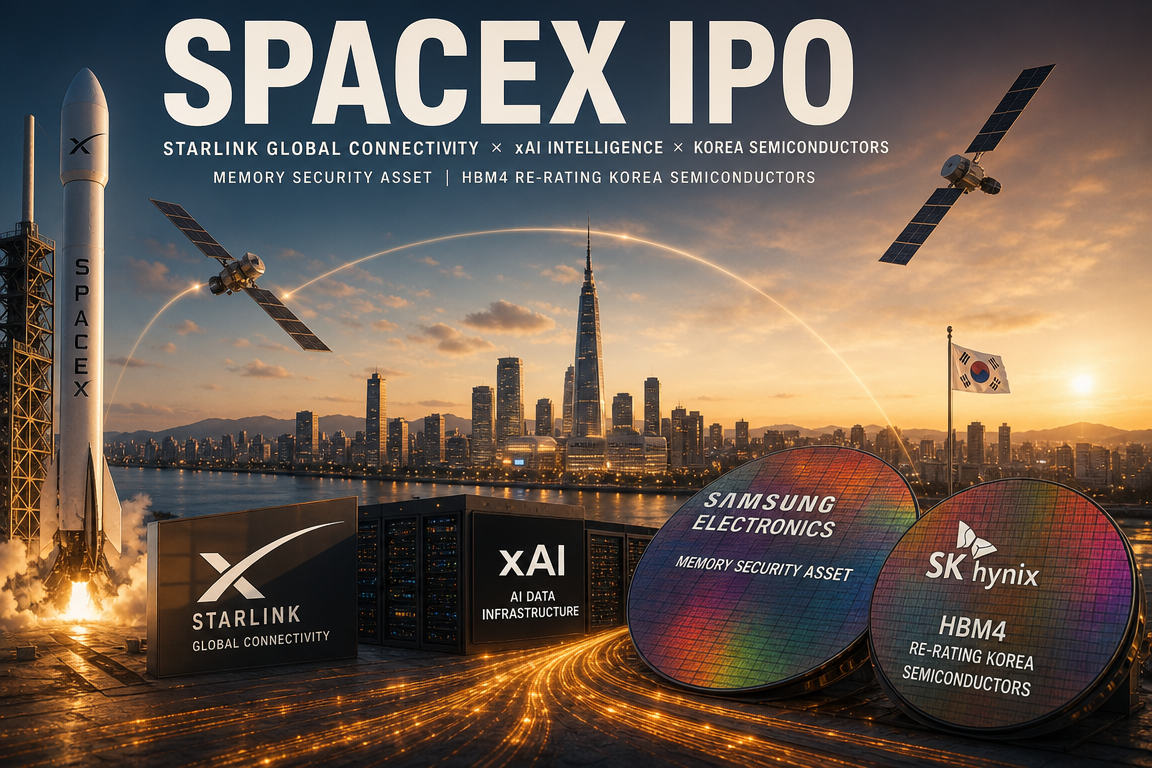
The potential SpaceX IPO is not a standard public listing. It consolidates multiple market-moving themes: the commercialization of the space economy, Starlink’s recurring cash-generation profile, xAI’s aggressive investment cycle, liquidity and allocation effects from a mega-IPO, and the potential repricing of growth and technology exposures.
Most coverage centers on “Elon Musk” and “IPO hype.” The primary investor considerations are:
1) SpaceX should be analyzed less as a launch provider and more as a space infrastructure platform.
2) Starlink is not only a consumer connectivity product; it is a network asset that can support AI, autonomy, defense, aviation, and maritime use cases with significant cash-flow implications.
3) The dominant variable may be capital-market rebalancing from a mega-IPO rather than the IPO event itself.
This report organizes: the structure of the space economy, SpaceX’s business model, the Starlink–xAI linkage, IPO market mechanics, post-listing volatility scenarios, and practical investor checkpoints.
1. News Brief: Why SpaceX Is Now a Market Focal Point
SpaceX is increasingly viewed as a company with realized revenue and demonstrated market power, rather than a purely long-duration “future story.”
SpaceX’s share of global launch cadence has risen to a level widely perceived as a controlling position. This is not simply “more launches”; it implies control over two core bottlenecks of the sector: launch cost and launch frequency.
Starlink also dominates satellite deployment volume. The debate has shifted from “will the market emerge?” to “who is already shaping and scaling the market?” with SpaceX at the center.
From a market-structure perspective, a SpaceX IPO could become a cross-asset capital-allocation event. A mega-IPO would likely drive rotation across large-cap growth, technology leaders, and benchmark-linked flows.
Accordingly, the topic should be treated as a macro-relevant volatility catalyst for Nasdaq- and S&P 500-adjacent risk, not merely as a single-equity listing.
2. The Space Economy: Why SpaceX Is Structurally Differentiated
2-1. The Space Economy Starts With Launch Cost Compression
Sector expansion requires materially lower costs to reach orbit. Satellite connectivity, space-based compute, lunar missions, and space logistics are constrained if launch economics remain prohibitive.
SpaceX’s primary disruption is the commercialization of reusability, altering the cost curve while increasing cadence. The industry is shifting from a one-off, project-based model toward repeatable, scaled operations.
As this model consolidates, governments, enterprises, telecom operators, defense contractors, and data-centric firms may rationally outsource to a dominant launch-and-deployment provider rather than build duplicative infrastructure.
2-2. SpaceX as “Space Delivery” Rather Than “Rocket Manufacturing”
Operationally, SpaceX is better framed as a “space delivery services” business: customers pay to move payloads into orbit using SpaceX’s transport system.
This resembles logistics-platform economics. Customers avoid building vehicles and operating launch infrastructure, and instead buy access to a more efficient distribution network.
A flywheel can form:
- Higher cadence reduces unit costs
- Lower unit costs expand demand
- Expanded demand increases scale advantages and strengthens market control
This network effect is a core driver of SpaceX’s strategic position in the space economy.
3. Strategic Integration: SpaceX, Starlink, and xAI as a Single System
SpaceX should not be assessed in isolation. The broader structure can be summarized across three pillars:
- Space launch and space infrastructure: SpaceX
- Satellite connectivity and global network: Starlink
- AI services and compute build-out: xAI
The system is mutually reinforcing:
- Lower launch costs enable faster Starlink scaling
- Starlink cash generation can fund future investments including xAI
- xAI growth increases demand for data, connectivity, and compute infrastructure, reinforcing satellite-network and data-center requirements
The integrated thesis is a “space–connectivity–AI” ecosystem.
4. Why Starlink Matters: Not Merely an Internet Product
4-1. Starlink as the Primary Cash-Flow Engine Within the System
Among SpaceX-linked activities, Starlink is the most direct monetization vector. Launch is strategically foundational, but recurring connectivity revenues can provide more immediate cash generation.
As subscriber counts expand, coverage improves, and enterprise/government accounts scale, Starlink can shift toward a recurring, subscription-driven revenue model favored by public markets.
4-2. The Larger Value Pool: B2B and B2G, Not Only B2C
Consumer broadband is relevant, but the larger profit pools are likely to come from enterprise and government:
- In-flight connectivity
- Maritime communications
- Military and disaster-response networks
- Remote industrial connectivity
- Rail and logistics networks
- Remote autonomy infrastructure (e.g., autonomous driving, drones)
In environments where terrestrial towers are impractical and mobility is inherent, low-Earth-orbit satellite connectivity can be structurally advantaged. Low latency and reliability are critical for autonomy, defense, and logistics networks.
4-3. Satellite Count Is Less Important Than Global Network Effects
The strategic asset is not the raw number of satellites but the integrated global network. Low Earth orbit supports lower latency; multi-layer architectures can expand coverage and resilience.
If fully scaled, connectivity becomes less dependent on national terrestrial infrastructure, with implications for telecom market structure and adjacent sectors including data security and defense.
5. Space-Based Data Center Scenario: Low Probability, High Optionality
A space-based data center concept appears speculative but warrants monitoring in an AI-driven infrastructure shortage environment.
5-1. Rationale for Space-Based Compute Infrastructure
AI scaling constraints increasingly center on power availability and cooling. As data centers expand, electricity demand and thermal management costs rise, creating a binding infrastructure bottleneck.
The space-based data center idea is positioned as an attempt to bypass constraints, citing:
- Potential solar energy utilization
- Different thermal conditions
- Reduced land and permitting constraints
- Long-term operating-cost optimization narratives
Technical feasibility, cost, and legal constraints remain substantial. The key signal is that AI infrastructure scarcity is driving exploration of non-traditional solutions.
5-2. Strategic Relevance Increases When Coupled With xAI
The concept becomes more meaningful when linked to xAI. Competitive positioning in AI depends not only on model quality but on compute capacity and the ability to scale infrastructure.
If launch capability, satellite connectivity, energy concepts, compute infrastructure, and AI services are pursued as a bundled vertical stack, this would represent a differentiated form of vertical integration versus incumbent technology platforms.
Even if near-term profitability is limited, markets may value the configuration as infrastructure preemption, subject to disclosure and execution risk.
6. Why xAI Matters Despite Near-Term Losses
A critical issue is that xAI’s cost growth may exceed revenue growth. This can be interpreted as investment risk, but it also signals priority allocation toward AI scale-up.
If Starlink cash flows effectively subsidize xAI, investors may frame the model as “recurring connectivity cash generation funding AI infrastructure build-out,” analogous to historical cases where a cash-flow business funded a later high-margin platform.
The key valuation variable is interpretation:
- Investment for durable future advantage, or
- Unbounded cost expansion without a clear path to returns
This interpretation may be a primary driver of post-IPO valuation dispersion.
7. IPO Mechanics and Why This One Is Potentially Market-Defining
An IPO is the initial public sale of equity, increasing disclosure and imposing public-market scrutiny on financials, risk factors, and segment economics.
Markets typically weigh simultaneously:
- Long-duration growth expectations
- Current financial performance and balance-sheet reality
Pre-IPO narratives can overemphasize growth. Post-listing, public disclosures often trigger a rapid reassessment.
This IPO is distinct due to potential scale. A mega-IPO can force meaningful positioning changes across active managers, passive benchmarks, and global growth allocations, affecting broader market liquidity and relative valuations.
8. Why a SpaceX IPO Could Increase Market Volatility
8-1. High Expectations Elevate Valuation-Compression Risk
Mega-IPOs often price with maximal narrative premium, especially when strategic themes (space + AI) and a high-profile founder converge.
After listing, the market tends to shift from narrative to metrics. Elevated valuation multiples (e.g., high revenue-based multiples) can become a focal point, particularly if parts of the business remain loss-making.
8-2. Capital May Rotate Rather Than Expand
A large offering often reallocates existing capital rather than attracting entirely new flows:
- Investors sell technology leaders or growth exposures to fund IPO demand
- Funds rebalance to meet allocation constraints
- Benchmark-linked vehicles adjust exposures
This can pressure existing market leaders regardless of the IPO’s initial performance. Both a strong IPO and a weak IPO can propagate volatility through positioning and sentiment channels.
8-3. Index Inclusion Can Amplify Mechanical Flows
If post-IPO market capitalization is sufficient, major index inclusion becomes a catalyst. Passive inflows can be large and mechanical, while index constituents face proportional reductions, creating additional cross-sectional volatility.
This is a portfolio-allocation event affecting ETFs, pensions, index funds, and global institutional rebalancing, not a single-stock phenomenon.
9. Post-IPO Price Paths: Why Outcomes Are Not Unidirectional
IPO trajectories vary materially:
- Initial surge followed by drawdown
- Early underperformance followed by rerating
- Long-duration compounding
- Range-bound trading
- Persistent decline
A strong company does not guarantee a strong stock if the entry valuation is excessive. Conversely, conservative pricing can enable later rerating.
For SpaceX, post-listing behavior will likely depend on: offering valuation, liquidity conditions, interest-rate regime, competing AI issuance, institutional demand, and the content of financial disclosures.
10. Practical Investor Checklist
10-1. Prioritize Segment Economics Over Narrative
Separate the model by segment:
- Launch: strategic asset vs. profit center
- Starlink: durability and quality of cash flows
- xAI: cost burden vs. embedded option value
10-2. Starlink ARPU and Enterprise/Government Mix Are Central
Subscriber growth alone is insufficient. If ARPU declines, unit economics and margins can deteriorate.
Key focus areas:
- Expansion into aviation, maritime, defense, government, and logistics
- Pricing power and churn
- Margin profile as capacity scales
10-3. Market Interpretation of xAI Losses Will Drive Valuation Dispersion
Losses must be assessed by the destination of spending:
- Controlled investment to build defensible infrastructure, or
- Uncontrolled burn with limited return visibility
10-4. The First Post-Listing Reassessment Phase Often Matters More Than Day 1
Direction is frequently set in the weeks and months after listing:
- Sell-side and buy-side research framing
- First public financial disclosures
- Passive-flow timing and magnitude
- Relative valuation versus large-cap technology and infrastructure peers
11. Under-Discussed Core Points
The SpaceX issue should not be reduced to “will it rise after listing?” Key points:
- SpaceX is structurally a space infrastructure platform, not merely a rocket company.
- Starlink is a global network asset linking AI, autonomy, defense, and logistics, not only consumer internet.
- xAI is primarily a bet on future infrastructure control rather than near-term profitability.
- The principal shock from a mega-IPO may be capital rotation out of existing technology and growth exposures.
- The event is best analyzed through global equity-market structure and asset-allocation effects.
In aggregate, the potential listing represents a collision of space commercialization, AI infrastructure build-out, global connectivity, and liquidity-driven rebalancing.
12. Conclusion: Opportunity and Volatility Can Coexist
SpaceX is positioned as a leading participant in the commercialization of the space economy, supported by reusability, Starlink network scaling, and optionality around AI infrastructure.
However, the IPO is a distinct catalyst with its own risk profile. Large narrative premiums can translate into high short-term volatility, and offering size can trigger market-wide reallocations.
Given potential overlap with other large AI-related issuance, investors should separate:
- Long-duration structural growth exposure, from
- Short-duration IPO-driven volatility and valuation risk
The required stance is structural analysis of segment economics and disciplined monitoring of capital flows.
< Summary >
The potential SpaceX IPO is a mega-event linking the space economy, Starlink, xAI, AI infrastructure, and broad equity-market reallocation dynamics.
SpaceX’s core identity is a space infrastructure platform rather than a rocket manufacturer.
Starlink’s larger value may lie in enterprise, government, defense, and logistics network use cases versus consumer broadband alone.
xAI should be evaluated as an infrastructure-control option rather than solely on current losses.
Post-IPO volatility risks include valuation compression, capital rotation, and index-related mechanical flows.
SpaceX may represent long-term opportunity, while also functioning as a major near-term volatility catalyst.
[Related Posts…]
- AI infrastructure capex expansion and equity-market reallocation watchpoints: https://NextGenInsight.net?s=AI
- Space economy mapping: how satellite connectivity and data centers may reshape industry structure: https://NextGenInsight.net?s=space-economy
*Source: [ 경제 읽어주는 남자(김광석TV) ]
– 일론 머스크가 구상한 우주경제. 스페이스X 상장은 역대급 기회인가? 역대급 변동성인가? [경읽남 248화]
● Semis Crash, Buy the Dip
Reasons to Revisit Samsung Electronics and SK hynix After a Sharp Sell-Off: Memory Should Be Viewed Not as a “Cycle,” but as a Strategic Security Asset
This report goes beyond “prices are down, so valuation looks cheap.” It consolidates:
- Why declines in Broadcom and Micron propagated into sharp losses in Samsung Electronics and SK hynix
- Why memory should no longer be treated as a conventional macro-cyclical sector
- How to differentiate Samsung Electronics vs. SK hynix in the HBM3/HBM4 transition
- Why the “PER 5x–8x” debate persists
- The central thesis: memory is evolving from AI infrastructure exposure into a security-relevant strategic asset
Key items often missed in mainstream coverage are also addressed:
- A structural shift in which customers share capital expenditure risk (not merely signing long-term contracts)
- The practical significance of Jensen Huang’s Korea visit: purchase orders, not photo opportunities
- Why the core of the “robotics” theme ultimately translates into accelerating memory demand
1. What Drove Today’s Sharp Decline in Semiconductor Stocks?
Broadcom/Micron weakness transmitted into Korean semiconductors
The immediate driver of the sell-off in Samsung Electronics and SK hynix was not company-specific negative news, but a broader U.S. semiconductor sector pullback.
- Broadcom declined materially.
- Micron fell by roughly 7%, pressuring the memory peer group.
The move is better characterized as sector-level de-risking after elevated expectations, rather than a new idiosyncratic issue at SK hynix.
The key issue is not deteriorating fundamentals, but elevated expectations
The critical question is whether fundamentals have been impaired. At present:
- It is difficult to argue that memory pricing or HBM demand has structurally collapsed.
- The market had embedded aggressive earnings assumptions; even strong results can fail to clear a raised bar and trigger a correction.
Korea-specific overhang: FX volatility
An additional factor for Korea is KRW/USD volatility.
- Elevated and unstable FX levels can weaken foreign flows and overall KOSPI risk sentiment.
Overall, the sell-off is best explained by: global semiconductor rotation + high earnings expectations + FX risk.
2. Is This an Opportunity or a Wait-and-See Moment?
If fundamentals are intact, pullbacks can be accumulation opportunities
The consistent conclusion is “buy on weakness,” contingent on one condition:
- Whether the cash-generation structure has changed (i.e., whether fundamentals are impaired)
Current indicators suggest the core memory upcycle is not broken:
- DRAM spot pricing corrected previously but has shown signs of rebounding.
- Supply-demand conditions across legacy memory and HBM remain constructive.
Is semiconductors still the market’s leadership sector?
Market breadth remains limited; relatively few sectors offer clear earnings growth. In such conditions, capital tends to concentrate in the most visible profit pools:
- AI semiconductors and memory remain primary leadership exposures.
- Samsung Electronics and SK hynix remain central index drivers in the KOSPI.
3. SK hynix vs. Samsung Electronics: Relative Positioning
SK hynix retains the HBM moat in the current cycle
HBM leadership is still widely viewed as SK hynix-led, particularly in HBM3:
- Technology execution
- Customer trust
- Supply stability
This has supported SK hynix’s positioning as a high-purity beneficiary of AI infrastructure capex.
Samsung Electronics may be re-rated in the HBM4 transition
The competitive landscape can shift at major node/product transitions. In HBM4:
- The market may assign optionality to a potential “new winner.”
- Samsung Electronics has scope for improvement in advanced packaging, testing, and customer engagement.
This allows for a scenario where SK hynix led earlier performance and Samsung Electronics closes the gap later during the transition.
Not necessarily a zero-sum outcome
Given the size of the expanding HBM market and Korea’s role in the AI infrastructure supply chain, a base case is:
- Both companies grow, with relative strength varying by phase rather than a single definitive winner.
4. Earnings Are Not Driven by HBM Alone
Legacy DRAM remains a meaningful earnings contributor
Market attention is heavily skewed toward HBM, but reported profitability is also strongly influenced by legacy DRAM.
- AI investment accelerates compute deployment, while memory supply expansion is slower, supporting DRAM pricing.
- Strong DRAM pricing can improve broader memory profitability, including NAND.
Memory pricing: consolidation with potential re-acceleration
After a period of demand resistance from high prices, a stabilizing/rebound pattern is notable:
- Price-sensitive demand exits.
- Essential demand remains, improving price support.
Memory is increasingly shifting from “nice-to-have” to “mission-critical.”
5. Memory: Still Cyclical, or Structurally Growing?
Past regime: short profit windows and long downcycles
Historically, memory was treated as highly cyclical, driven by:
- PC and smartphone replacement cycles
- Inventory swings
Valuation remained low due to the perception of transient earnings.
Current regime: data centers reshape the cycle
Demand is shifting from consumer devices toward data centers and AI infrastructure:
- Data center investment cycles are longer in duration.
- Initial deployments tend to be followed by expansions and ongoing maintenance capex.
This can produce longer and more durable profit periods than prior cycles.
Multi-year earnings durability is increasingly embedded in expectations
If consensus assumes profitability across multiple years, the valuation framework can change:
- Sustained earnings visibility supports multiple expansion.
- The market increasingly treats leading memory suppliers as long-duration AI infrastructure enablers rather than short-cycle trades.
6. PER Debate: Is 5x Reasonable, and How Far Can Re-Rating Go?
Low valuation reflects residual “cycle risk” skepticism
Despite earnings growth, PER remains constrained because the market has not fully discounted durability:
- Risk of future oversupply, including China capacity
- Concern that HBM tailwinds may be time-limited
Base re-rating range: ~7x–8x; upside case: 9x+
A reasonable reading of prevailing market debate is:
- Conservative re-rating: high-7x to ~8x
- More constructive scenarios: 9x+
A rapid move to software-like multiples (e.g., 20x–30x) is less likely given:
- Manufacturing-heavy business models
- Historical memory volatility
Condition for re-rating: proof of durable earnings
The primary catalyst for sustained multiple expansion is verification of:
- Not a one-year windfall, but stable, high earnings power over 3+ years
This would materially affect the market status of both companies within the KOSPI.
7. Core Thesis: Memory Is Becoming a Strategic Security Asset
Beyond “China supply” toward geopolitical supply-chain logic
If analyzed only through conventional cyclicality, China capacity additions imply renewed price-war risk. However, the current environment includes:
- U.S.-China technology competition
- Supply-chain reconfiguration
- Export controls
- Regional semiconductor “bloc” formation
In this context, the decision criterion shifts from lowest cost to trusted, controllable supply.
U.S. hyperscalers face constraints on sourcing China-made HBM
For high-performance, strategic AI infrastructure, substitution toward China-origin advanced memory is structurally constrained. The issue is strategic risk, not only price.
If this framing holds, Samsung Electronics and SK hynix may be valued less as cyclical equities and more as holders of strategic assets central to national AI competitiveness.
8. More Important Than Long-Term Contracts: Customers Sharing Capex Risk
Underappreciated structural change
Coverage often stops at “long-term supply contracts.” The more material shift is that some customers are increasingly:
- Sharing capital investment burden to secure supply stability
Implications:
- Reduced expansion risk for suppliers
- Lower volume-availability risk for customers
Contracts may trade some margin for stability
Long-term contracts can include pricing concessions, but they improve:
- Demand visibility
- Capacity planning certainty
- Earnings durability
This supports re-rating by shifting perception toward more predictable cash flows.
9. Jensen Huang’s Korea Visit: Orders Matter More Than Optics
Market impact depends on conversion to revenue and profit
Meetings and public commentary may affect near-term sentiment, but sustained valuation support depends on:
- Concrete purchase orders
- Contracted volumes
- Revenue and operating profit conversion within the NVIDIA ecosystem
The thematic focus: physical AI
Compared with prior supply-chain checks centered on memory, the current emphasis is expected to tilt toward:
- Physical AI and robotics ecosystem buildout
- Potential intersections with major Korea corporates
The market is increasingly focused on measurable deal flow rather than narrative momentum.
10. Robotics: The Ultimate Beneficiary May Be Memory
Robotics narrative, memory reality
Robotics and physical AI require extensive:
- Real-time sensing and inference
- Data buffering, retrieval, and high-throughput memory access
As physical AI scales, memory demand may rise across:
- Data centers (training and inference)
- Edge devices (on-device inference and logging)
Robots must replicate human-like perception loops
Key workloads include:
- Vision, audio, tactile data
- Localization and motion tracking
- Continuous state recording
- Environmental change detection
- Real-time inference
These are inherently memory- and bandwidth-intensive.
Commercial adoption may be slow; investment logic begins earlier
Even if consumer or enterprise robotics adoption is gradual due to regulation and social acceptance, infrastructure investment can begin ahead of mass adoption, supporting long-duration semiconductor demand.
11. Can SK hynix Surpass Samsung Electronics in Market Cap?
Theoretically possible; a dual-strength outcome is healthier
A scenario where SK hynix approaches or surpasses Samsung Electronics in market cap has been discussed due to:
- Higher memory concentration
- Higher AI exposure purity
- Stronger momentum
However, a more constructive macro outcome is both strengthening, with:
- Samsung Electronics recovering
- SK hynix potentially outperformingThis would improve the quality of KOSPI performance.
12. Key Risks and Practical Considerations
Chasing price increases increases drawdown risk
Absolute price levels can appear expensive after large moves. The more relevant question is whether:
- The earnings structure and competitive position remain durable
Focus on structural drivers, not daily headlines
Short-term variables include:
- Daily price action
- Media headlines
- Meeting optics
Structural drivers to monitor:
- Persistence of AI infrastructure demand
- Maintenance of memory supply advantage
- Customer commitment to long-term volume security
- Role of Samsung Electronics and SK hynix as core suppliers
If these remain intact, pullbacks become easier to contextualize.
Portfolio implication: leadership concentration
A practical framework discussed is:
- 65%–70% allocation toward leadership exposures
- Remaining allocation for rotation and thematic tradesThis reflects a market where concentrated earnings leadership dominates performance.
13. News-Style Key Takeaways
One-line summary of today’s move
Broadcom and Micron weakness, KRW/USD risk, and elevated earnings expectations drove a sharp decline in Samsung Electronics and SK hynix.
What matters fundamentally
Memory pricing has not structurally broken; Korea’s strategic role in AI infrastructure and supply-chain realignment remains intact.
Forward watch list
- HBM4 competitive positioning
- Sustainability of DRAM price re-acceleration
- Purchase orders from NVIDIA and major hyperscalers
- Expansion of long-term contracting and capex-sharing structures
- FX stability
14. Most Material Points Often Missing in Common Coverage
1) The key change is not price, but strategic status
Memory is shifting from a commoditized component to an asset tied to AI competitiveness and security-aligned supply chains.
2) Capex risk-sharing is more important than long-term contracts alone
This can underpin valuation re-rating by increasing cash-flow visibility and reducing expansion volatility.
3) The end beneficiary of robotics may be memory
Even if robotics and platform equities move first, sustained value accrual may concentrate in compute and memory demand growth.
4) Jensen Huang headlines are transient; contracted orders are durable
Optics drive sentiment; purchase orders drive earnings.
15. Conclusion
Samsung Electronics and SK hynix may remain volatile in the near term, particularly after strong runs. However, the central issue is whether memory continues to behave like a legacy cyclical industry.
If memory is increasingly positioned as AI infrastructure and a security-relevant strategic asset within a restructured global supply chain, both companies can be re-evaluated as core strategic holdings within the Korean equity market rather than purely cyclical semiconductor exposures.
- The sell-off in Samsung Electronics and SK hynix reflected U.S. semiconductor weakness, elevated earnings expectations, and FX instability more than company-specific deterioration.
- Memory pricing and AI infrastructure demand have not shown clear structural impairment.
- SK hynix leads in HBM today; Samsung Electronics has re-rating potential in the HBM4 transition.
- The most important shift is the market’s growing framing of memory as AI infrastructure and a strategic security asset.
- Jensen Huang’s Korea visit should be assessed by purchase orders and contract conversion, not optics.
- Despite near-term volatility, Korea’s memory leaders remain plausible KOSPI leadership exposures on a medium-term view.
[Related]
- https://NextGenInsight.net?s=semiconductors
- https://NextGenInsight.net?s=AI
*Source: [ Jun’s economy lab ]
– 그래도 삼성전자, SK하이닉스 사야합니다.(빈센트 하나증권 애널리스트 1부)