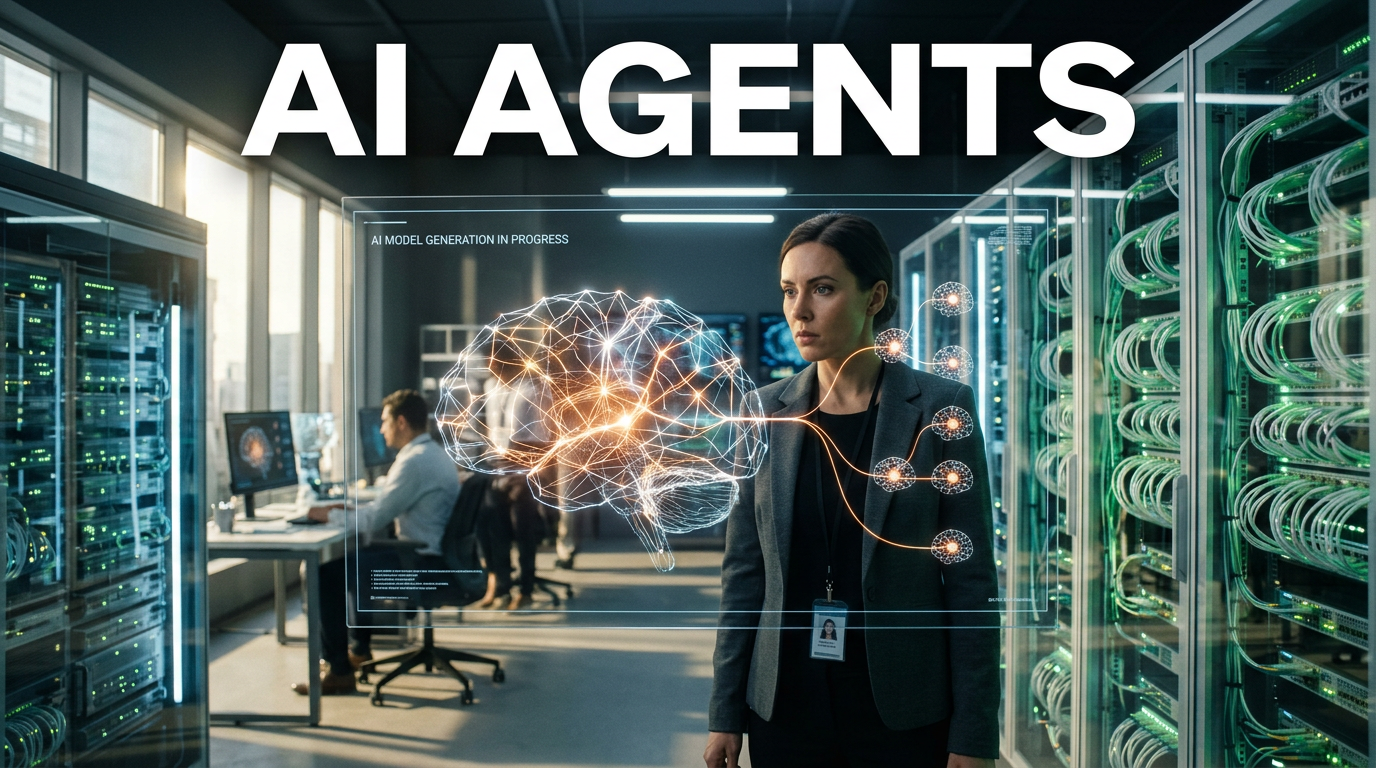
● AI Self Improvement Sparking Economic And National Security Shakeup
The era of AI creating AI itself is no longer just a tech news story—it is now an economic and security story
The warning Anthropic has raised is not just an issue for the AI industry.
Now it is clear why we need to look at global economic outlook and AI trends together.
The core points are threefold.
First, the speed of AI development is outpacing the speed of human control.
Second, AI agents are already changing real corporate productivity and decision-making structures.
Third, this trend is a massive industrial realignment connected to semiconductors, data centers, power, cloud, and even national strategic assets.
In other words, today’s AI is not just a 4th industrial revolution technology, but a key variable that changes AI infrastructure, economic growth rates, the U.S. economic outlook, and global business cycles.
1. Why did Anthropic say, “It is time to stop”?
Anthropic believes it is time to consider a global agreement that would allow frontier AI labs to slow down development or temporarily pause.
Behind this warning is the assessment that recursive self-improvement—the stage where AI can improve its own performance without human intervention—may arrive sooner than expected.
Put simply, this means we are moving from an era in which humans build AI to one in which AI helps build AI, and ultimately AI creates AI.
This is not just technological progress; it is a moment that changes the structure of AI dominance competition itself.
2. The most shocking number: AI already writes more than 80% of the code
The internal figures Anthropic presented are striking.
As of May 2026, more than 80% of the code merged into Anthropic’s codebase was written by Claude.
Given that this share was only in the low single digits before Claude Code was launched in February 2025, the pace of change is extremely fast.
The important point here is not simply that “AI is good at coding.”
The real core point is that the role of human engineers is shifting from writers to supervisors, architects, and verifiers.
According to Anthropic, code output per engineer increased eightfold in Q2 2026 compared with 2024.
In other words, AI is not only replacing people; it is dramatically increasing the productivity of each individual engineer.
3. What is happening now is not merely “AI as a growth industry”
AI is no longer just a theme stock or a growth story.
AI is a strategic industry and, even more, a national strategic asset.
That is because AI affects productivity, R&D, security, finance, manufacturing, logistics, and defense.
In particular, the companies and countries that secure frontier AI first are likely to gain technological advantage.
So AI competition is no longer about “who made the better technology,” but about “who first captures the systems for training, deployment, and application.”
4. The point more important than the news: AI competition also shakes semiconductors and the power market
Many articles focus on model performance or chatbot features, but the more important issue is AI infrastructure.
As AI increasingly helps develop itself, it requires more computing resources, which in turn drives expansion in semiconductors, data centers, power infrastructure, and cloud investment.
In other words, as AI evolves, traditional industries are also being reshaped.
From now on, the bottleneck may be not model performance competition, but the power, servers, and supply chains needed to run AI.
At this point, the U.S. economic outlook must also be considered.
The United States is likely to further strengthen AI infrastructure investment and industrial policy to defend its technological leadership, and this will affect interest rates, capital expenditure, employment, and productivity indicators.
5. On the corporate front, “decision-making speed” is already changing
Looking at other cases reported by The Milken, AI agents reportedly reduced Samsung Electronics’ decision-making speed from “hours to seconds.”
This is not just efficiency improvement.
It means the basic operating logic of companies is changing.
In the past, people gathered information, held meetings, approved decisions, and executed tasks. Now AI drafts the initial version, and humans make only the key judgments.
This change is likely to widen the gap rapidly between companies preparing for the AX business revolution—AI transformation—and those that are not.
6. Key checkpoints for investors
First, companies that prove productivity through AI are more important than companies that merely use AI.
Second, infrastructure competition lasts longer than model competition.
Third, as AI demand rises, the medium- to long-term benefits for semiconductors, servers, power, cooling, and data center-related sectors are likely to grow.
Fourth, companies that adopt AI agents quickly may create an even bigger difference in decision-making speed and quality than in labor cost reduction.
Fifth, even if the global business cycle slows, AI-related capital expenditure can remain structurally strong.
In other words, the market is moving away from a time of focusing only on cyclical stocks and toward a structural investment phase centered on AI infrastructure.
7. The question that will grow even larger: How far can AI do things on its own?
The real weight of Anthropic’s warning is not that “the present is dangerous,” but that “it may accelerate even more.”
As AI becomes capable of writing, testing, modifying, and optimizing code on its own, the areas where humans can intervene will continue to shrink.
The more that happens, the more important safety mechanisms, regulation, verification systems, and international agreements become.
In particular, when AI is linked to cybersecurity, financial systems, and defense technologies, even small errors can turn into major risks.
That is why, moving forward, governance and control will be a core competitiveness factor as important as innovation speed.
8. The most important thing that other news stories do not clearly say
Many people focus only on “how much smarter AI has become,” but the truly important issue is the speed at which AI is replacing human decision-making structures.
Once AI goes beyond writing code to replacing people in the workflow, companies will no longer grow by simply hiring more people, but by how well they deploy AI.
From that moment on, the unit of the economy is redefined from “number of workers” to “productivity with AI attached.”
That is why future growth rates, corporate valuations, and industrial landscapes are likely to be determined not simply by sales, but by AI utilization density.
This is the true meaning of AI moving beyond a growth industry and into the center of national competitiveness.
9. In summary, the market should be read like this
AI is no longer a technology confined to the lab.
It has already entered corporate coding, decision-making, productivity, investment strategy, and even national security.
Anthropic’s warning is not simply pessimism; it is a signal that society may not have much time to prepare before AI enters the self-evolution stage.
So what is needed now is a realistic approach, not blind optimism or pessimism.
Follow AI trends, but also watch AI infrastructure, regulation, productivity transition, power demand, and the semiconductor cycle together.
< Summary >
Anthropic warned that AI is rapidly entering a self-evolution stage in which it improves itself.
AI already writes more than 80% of the code, and engineer productivity has jumped eightfold.
AI is now not just a growth industry, but a strategic industry that affects semiconductors, power, data centers, and national strategic assets.
The key takeaway is that we must look at AI infrastructure, control, and productivity transition together—not just AI performance.
[Related Articles…]
- Siri has been reborn… Apple’s “Siri AI” with Gemini: 7 key features
- “From hours to seconds”… The AI agent that changed Samsung Electronics’ decision-making speed
*Source: https://themiilk.com/articles/ab1e706c2