● SpaceX-IPO-AI-Data-Center-Shock
SpaceX IPO: The Core Thesis Is Not Rockets, but AI Data Centers
This is not simply an IPO narrative.
The central issue is why SpaceX is increasingly framed as an AI infrastructure company, why Starlink is more than satellite broadband and is positioned as a connective layer across data centers, autonomy, robotics, defense, and communications, and why this intersects with semiconductor outlooks, equity positioning, and global macro constraints.
Most coverage focuses on valuation headlines or subscriber counts. The higher-impact question is whether SpaceX is building toward space-based AI compute and data-center infrastructure, and how this connects to legacy semiconductors, LEO satellite networks, power constraints, and data-center permitting bottlenecks.
1. Executive summary: SpaceX is evolving from a rocket company into a space-based AI infrastructure platform
Conventional framing:
- SpaceX = launch services company
- Starlink = satellite internet provider
- Elon Musk = space exploration / Mars narrative
Investment-relevant framing:
- Launch is an enabling layer, not the endpoint.
- Starlink is a cash-flow and demand-generation engine.
- The long-term objective is to extend AI-era power, connectivity, and compute infrastructure into space.
In this model, SpaceX is building logistics, communications, and ultimately compute capacity in orbit. Valuation frameworks may therefore extend beyond aerospace multiples toward a blended profile spanning communications, AI infrastructure, defense, data centers, and semiconductor supply chains.
2. Three-part business architecture: Space, connectivity, AI infrastructure
2-1. Launch services
SpaceX’s foundation remains launch, led by Falcon 9, Falcon Heavy, and potentially Starship.
The key differentiator is cost reduction through reusability and scale. Historically, launch markets lacked sufficient cadence for durable economies of scale. SpaceX partially solved this by internalizing demand:
- If external payload demand is insufficient,
- build proprietary satellites,
- launch them repeatedly on in-house vehicles,
- and drive down average launch cost through utilization and learning effects.
This directly links launch economics to Starlink deployment.
2-2. Starlink-led connectivity
Starlink functions as more than an ISP; it structurally internalizes launch demand and creates recurring revenue. The flywheel:
- launch demand is internalized,
- recurring revenue expands,
- higher cadence reduces per-launch cost,
- enabling further constellation expansion.
Starlink is structurally advantaged where terrestrial buildout is uneconomic:
- rural and remote regions in the U.S.
- Brazil, Argentina, Indonesia
- large, low-density geographies such as Australia
- aviation, maritime, and operational defense environments
The competitive axis is not pricing versus terrestrial carriers alone, but the cost structure of dense ground infrastructure in low-density regions.
2-3. AI data centers and space compute
This is the central long-duration option value:
- launch = transport infrastructure
- Starlink = connectivity infrastructure
- space data centers = compute infrastructure
If integrated, SpaceX’s profile shifts toward a large-scale AI infrastructure operator.
3. Why Starlink may be structurally larger than a broadband product
3-1. Near-term internet; longer-term expansion toward broader communications
Starlink currently focuses on broadband. If direct-to-device satellite connectivity scales, services could expand to messaging, voice, and smartphone connectivity.
A key dependency is mobile modem integration (e.g., vendors such as Qualcomm), since handset-level satellite connectivity requires compatible modem capability.
Potential implications:
- partial substitution or supplementation of terrestrial mobile networks
- hybrid terrestrial-satellite architectures
- disproportionate impact in large-area countries where terrestrial densification is costly
Dense markets with strong terrestrial coverage remain less structurally exposed, but large geographies may see meaningful adoption.
3-2. Continuous connectivity as an industrial prerequisite in the AI era
As AI expands beyond devices into physical systems, coverage and reliability become enabling infrastructure for:
- autonomous vehicles
- robots
- drones
- industrial sensors
- edge devices
In networked autonomy, shared situational awareness can improve system-level performance (e.g., hazard, weather, and obstruction data sharing). This positions Starlink closer to a backbone for distributed physical AI than a standalone consumer broadband service.
4. Why space-based data centers are being discussed: permitting and power, not only technology
4-1. Data-center expansion is encountering “social license” constraints
Post-AI acceleration has increased data-center buildout, but several constraints are tightening:
- high electricity demand
- substantial cooling-water requirements
- limited local perceived benefits
- lower long-term employment intensity post-construction
Local burdens often include:
- electricity pricing pressure
- water stress
- land-use conflict
- transmission and distribution expansion costs
AI scaling is therefore constrained not only by chips, but by power availability, siting, cooling, and permitting.
4-2. Space deployment as a potential workaround to terrestrial constraints
If permitting, grid capacity, water availability, and environmental constraints become binding, space-based compute is framed as an alternative pathway.
For such a pathway to be credible at scale, four conditions are required:
- low-cost access to orbit
- large-scale satellite networking
- high-throughput interconnectivity
- repeatable launch cadence for deployment and replenishment
Few organizations possess all four simultaneously, which supports the view that SpaceX is strategically positioned if this category progresses beyond concept stage.
5. Key technical constraints: thermal management and radiation
5-1. Thermal management: space is cold, but not inherently easy to cool
In vacuum, conventional convection-based cooling is limited. Water-based cooling is not directly analogous to terrestrial implementations. Radiative heat rejection and specialized thermal design become critical. This is solvable in principle, but engineering complexity and cost are material.
5-2. Radiation: semiconductor error rates and durability risk
Radiation can induce soft errors (bit flips) and degrade electronics, which is non-trivial for AI compute reliability.
A relevant implication is that leading-edge nodes are not always optimal for orbital environments. Larger-node, more durable, lower-cost components may be favored in early deployments due to:
- robustness
- cost
- serviceability and replacement economics
- radiation tolerance strategies
This introduces a potential demand vector for legacy semiconductors and memory in specific space-compute applications.
6. Linkage to Nvidia, HBM, SK hynix, and Samsung Electronics
Although framed as a SpaceX topic, the implications extend across the AI semiconductor stack.
6-1. Primary market: sustained demand for advanced AI compute
Near-term AI scaling on Earth continues to prioritize:
- high-performance GPUs
- HBM memory
- high-density servers
- power-efficient components
SK hynix and Samsung Electronics remain central to HBM and broader memory supply.
6-2. Secondary market: potential re-rating of legacy semiconductors
If space data centers advance, early-stage deployments may prioritize durability and economics over peak performance:
- robustness
- cost competitiveness
- replacement logistics
- radiation mitigation
This can create incremental use-cases for older DRAM, CPUs, GPUs, and general-purpose compute assets.
6-3. Tertiary market: AI PCs, edge devices, robotics, and communications
As compute distribution broadens into endpoints, connectivity becomes a binding layer. Satellite networks could function as a backbone bridging cloud and edge, with spillovers into:
- communications equipment
- modem chipsets
- automotive electronics
- robotics software stacks
- defense electronics
7. Space-industry perspective: cadence as competitive advantage
7-1. Launch frequency compounds advantage
Higher cadence drives:
- lower costs
- faster iteration and failure learning
- supply-chain refinement
- higher customer trust
This resembles platform-like network effects: volume reinforces competitiveness.
7-2. Strategic-industry dynamics sustain competition
Space is a strategic domain tied to security, reconnaissance, communications, and navigation. Major economies are unlikely to fully outsource sovereign launch and satellite capabilities. Therefore:
- commercial launch may concentrate,
- while national programs continue to invest in parallel capabilities.
8. IPO lens: avoid valuing SpaceX as a pure aerospace company
If an IPO progresses, the key analytical risk is misclassification.
8-1. Near-term fundamentals likely anchored by Starlink
Key drivers:
- subscriber growth
- aviation and maritime adoption
- enterprise and government contracts
- possible expansion toward direct-to-device services
8-2. Valuation premium likely tied to AI infrastructure optionality
Market premium, if applied, is more plausibly linked to whether SpaceX becomes an AI-era infrastructure operator than to incremental launch volume alone. Core diligence questions:
- scalability of Starlink as a global network
- feasibility and timeline of space-based data-center commercialization
- integration with autonomy, robotics, and defense networks
- durability of launch-cost and cadence advantage
8-3. Material risks
- Starship commercialization delays
- regulatory and spectrum risks
- geopolitical constraints
- technical failure risk for space-based compute
- orbital congestion and debris externalities
- intensifying connectivity competition
Space-based data centers remain a long-duration option rather than a near-term earnings driver; separating current cash flows from long-term optionality is essential.
9. News-style key points
9-1. SpaceX shifting from launch services toward AI infrastructure expansion
SpaceX is extending beyond launch into Starlink and potential space-based compute infrastructure.
9-2. Starlink as the demand internalization and cash-flow engine
Starlink supports launch economics, recurring revenue, and network scale.
9-3. AI bottlenecks extend beyond semiconductors to power and permitting
Power availability, land, water, cooling, and permitting are tightening constraints on AI infrastructure expansion.
9-4. Space-based data centers framed as a bottleneck-avoidance strategy
Orbital compute is positioned as a potential alternative pathway if terrestrial constraints become binding; SpaceX is structurally advantaged.
9-5. Semiconductor implication: potential incremental demand for durable, lower-node components
Radiation and serviceability may favor legacy and durable components in early orbital compute implementations.
10. Under-discussed investment takeaways
10-1. SpaceX as a bottleneck-removal company
Repeatedly observed pattern:
- high launch cost -> reusability and scale
- insufficient external demand -> internal demand via Starlink
- inefficient terrestrial expansion -> LEO satellite network
- constrained data-center siting -> space-based compute concept
10-2. Beneficiaries may include more than leading-edge chips
If space compute progresses, early demand may extend to legacy and radiation-aware components, not solely top-tier GPUs and HBM.
10-3. Starlink’s primary competitor is terrestrial buildout economics
The structural competition is against the cost and feasibility of dense ground infrastructure in low-density geographies.
10-4. AI economy winners may skew toward infrastructure bottleneck solvers
Long-run value creation may favor operators who solve:
- power
- connectivity
- compute deployment
- logistics and launch
- semiconductor supply-chain constraints
SpaceX is positioned across multiple bottleneck layers.
11. Macro relevance post-2026: AI advantage may shift from model capability to deployment scale
Macro sensitivity may increasingly focus on:
- where incremental electricity is sourced
- where data centers can be sited and permitted
- who controls wide-area connectivity
- what networks autonomy and robotics run on
- how demand splits between leading-edge and general-purpose semiconductors
SpaceX spans these categories more directly than most peers, implying that classification as an AI infrastructure platform may be more informative than narrow sector labels.
< Summary >
SpaceX’s strategic trajectory can be framed as a shift from launch services toward space-enabled AI infrastructure.
Launch is an enabling layer, Starlink supports recurring revenue and connectivity scale, and space-based data centers represent a long-duration option that could influence valuation if commercialization becomes credible.
AI bottlenecks increasingly include power, cooling, siting, and permitting, not only semiconductors. If orbital compute advances, incremental demand may extend beyond leading-edge GPUs toward more durable and cost-effective legacy components in early deployments.
An IPO, if pursued, should be analyzed through a combined lens spanning AI infrastructure, data centers, communications, defense, and semiconductor ecosystems, rather than as a pure aerospace listing.
*Source: [ 경제 읽어주는 남자(김광석TV) ]
– 스페이스X, 이제 로켓 회사가 아닙니다. AI 데이터센터까지 삼키는 진짜 그림 | 경읽남과 토론합시다 | 강정수 박사님 [2편]
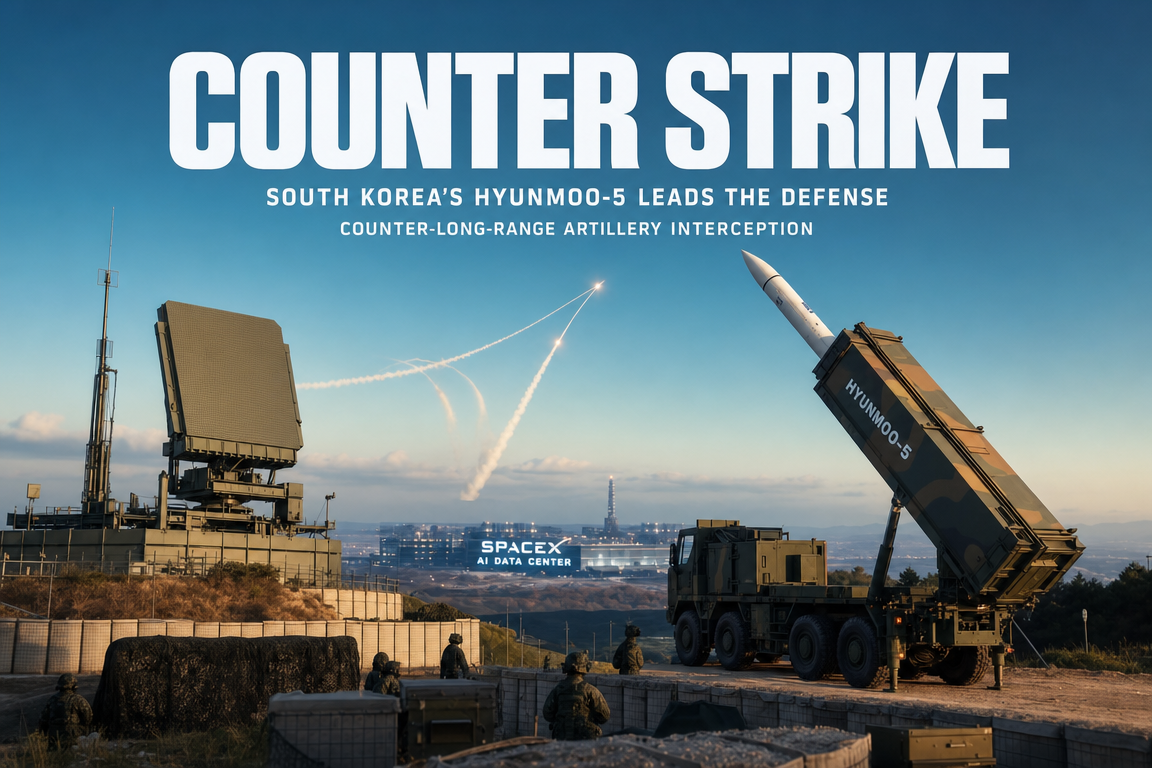
● Missile Shock, North Korea On Edge
1. Key Development: Why Hyunmoo-5 and Counter-Artillery Capabilities Create Credible Pressure on North Korea
- North Korea is assessed to calibrate provocation levels with awareness that South Korea possesses high-yield conventional strike assets such as Hyunmoo-5.
- The key deterrence mechanism is not mere possession, but the requirement for North Korea to factor in rapid, mission-kill risks to leadership nodes and critical military infrastructure in the event of escalation.
- The weapon concept emphasizes high-speed, steep-angle terminal flight and underground-target defeat effects, potentially disrupting hardened command bunkers and strategic facilities through shock and structural vibration.
2. Why the Phrase “More Frightening Than Nuclear” Emerges in Public Discourse
2-1. Strategic Coercion via Conventional Precision Strike
- Nuclear and conventional systems differ fundamentally in yield and consequences.
- The argument underlying the phrase is that high-yield conventional precision strike can credibly threaten decisive military functions without radioactive fallout, potentially lowering the perceived political threshold for employment relative to nuclear use.
2-2. Pressure on Underground Basing Strategies
- North Korea has long relied on underground hardening for survivability of leadership, missile, and nuclear-related assets.
- Large-penetrator conventional systems challenge the assumption that depth alone ensures safety, altering survivability calculations.
2-3. Beyond “Decapitation” Framing
- The operational relevance extends beyond leadership targeting:
- Potential degradation of command-and-control continuity
- Disruption of nuclear release and transmission pathways
- Neutralization of missile launch infrastructure
- Reduction of early-war decision bandwidth
- Pre-crisis deterrent effects through changed risk perceptions
- The strategic value is primarily in shaping adversary behavior before launch rather than post-strike effects.
3. Second Key Theme: Significance of Long-Range Artillery Interception
- Development and fielding of a counter-long-range-artillery interception system is highlighted as a major structural shift in defensive posture.
- The most immediate mass-casualty risk to the Seoul metropolitan area has historically been long-range artillery and multiple rocket systems, not only nuclear forces.
- Effective interception could reduce the leverage of early, large-volume fires as a coercive option.
3-1. Threat Profile: Not Limited to Nuclear Forces
- Public attention often concentrates on nuclear and ICBM narratives.
- From a civil-defense and escalation-management perspective, conventional massed fires represent a near-term, high-probability scenario in initial conflict phases.
3-2. Deterrence Requires Both Strike and Defense
- High-end strike assets provide retaliatory and suppression capability.
- Interception capability provides damage-limitation and continuity-of-society benefits.
- Combined effects reduce the adversary’s expected utility:
- Strong strike alone may still allow an adversary to assume it can impose significant initial damage.
- Strong defense alone may not sufficiently threaten adversary critical nodes to remove incentives for coercion.
- Integrated strike-plus-defense compresses perceived benefits of escalation.
4. What “Qualitative Superiority” Means in Operational Terms
4-1. Precision and Kill-Chain Differentiation
- Modern conflict outcomes depend on the speed and accuracy of:
- Detection
- Identification
- Precision engagement
- Post-strike assessment and re-tasking
- Areas of comparative advantage emphasized:
- Precision-guided munitions employment
- ISR-linked strike integration
- Intelligence fusion supported by alliance frameworks
- Accumulated domestic capability in missiles, artillery, and air defense
- Digitized command-and-control modernization
4-2. Systems Integration Over Platform Counts
- Deterrence effectiveness is driven less by platform inventories and more by end-to-end integration across sensor-to-shooter cycles.
- Adoption of networked sensors, near-real-time data fusion, and AI-enabled target analysis is positioned as a key differentiator.
5. Economic Framing: Defense Capability as Industrial Competitiveness
- Defense is characterized as a strategic industry with increasing relevance to national credibility amid supply-chain realignment and heightened geopolitical risk.
- Defense R&D and production pull demand from advanced industrial sectors, not limited to metals or energetics.
5-1. Technology Spillovers to the Civil Economy
- Capability development requires and reinforces:
- Semiconductors
- Batteries
- Communications
- Software
- AI algorithms
- Satellites
- Advanced composites
- Defense competitiveness is linked to manufacturing upskilling, digital transformation, and strengthening of high-value component ecosystems.
5-2. Implications for Capital Flows and Export Markets
- Market dynamics increasingly favor countries with strong technology depth and security credibility.
- Improving defense-industrial capacity may support:
- Expansion of defense exports
- Growth of component and materials suppliers
- Higher-skill engineering employment
- Increased R&D intensity
- Enhanced national brand value
6. AI Trend Lens: Software-Led Shifts in Military Effectiveness
6-1. AI as a Primary Driver of Operational Advantage
- The decisive change is positioned as AI-enabled decision cycles rather than individual missile specifications.
- Relevant application areas:
- Near-real-time tracking of artillery positions
- Early detection of launch indicators
- Trajectory prediction and interceptor prioritization
- Automated classification of multiple targets
- Scenario recommendation based on dynamic battlespace states
- The core value proposition shifts to how fast and reliably weapons are cued, tasked, and re-tasked based on fused data.
6-2. Potential National Strength Areas
- Existing strengths in semiconductors, communications, display ecosystems, industrial automation, and software integration are viewed as enabling inputs for defense AI.
- Noted opportunity domains:
- Defense edge computing
- Integration with drones and unmanned systems
- Real-time ISR analytics
- Intelligent interception systems
- Digital-twin-based battlespace simulation
7. Underemphasized Points in Common Media Coverage
7-1. The Primary Shift Is Adversary Decision Calculus
- Strategic value is framed as altering North Korean cost-benefit calculations, particularly leadership survivability assumptions, rather than maximizing physical destruction.
7-2. Interception Could Weaken a Core Coercion Tool
- If counter-long-range-artillery interception reaches operational maturity, the effectiveness of early mass-fire coercion against the capital region may decline, with second-order implications for negotiation leverage.
7-3. Defense Industry Growth as a Structural Economic Driver
- Defense technology is positioned as a contributor to export competitiveness and advanced manufacturing upgrading, with potential spillovers to broader investment sentiment.
8. Investor and Industry Monitoring Checklist
- Second-order beneficiaries beyond prime contractors (components, materials, sensors, communications)
- Growth potential of AI-enabled defense software vendors
- Expansion of satellite, drone, and ISR ecosystems
- Evidence that higher defense R&D translates into civilian innovation and commercialization
- Whether export contracts translate into domestic production scaling and employment
9. One-Sentence Consolidation
- Hyunmoo-5 and counter-long-range-artillery interception represent a structural shift that may raise deterrence credibility through integrated strike-and-defense, while also reinforcing defense exports, AI-enabled systems integration, and advanced manufacturing competitiveness.
10. Conclusion
- Deterrence is framed as evolving from platform-centric capability to integrated precision strike, layered defense, intelligence fusion, and AI-enabled command systems.
- The implications extend beyond security into exports, industrial policy momentum, supply-chain positioning, and broader perceptions of resilience in the national economy.
News-Style Key Takeaways
- Hyunmoo-5 is assessed as a high-impact conventional strategic asset designed to threaten hardened underground leadership and critical facilities.
- North Korea is expected to account for these capabilities in escalation planning.
- Fielding of counter-long-range-artillery interception could materially alter capital-region defense assumptions.
- Operational advantage is attributed to precision, intelligence fusion, and systems integration rather than quantity.
- Capability modernization is linked to defense exports, AI adoption, and advanced manufacturing development.
Additional High-Importance Points
- The central effect is disruption of adversary decision-making and survivability assumptions, not headline yield.
- Counter-artillery interception could reduce the credibility of massed conventional coercion.
- Defense-technology growth may influence economic competitiveness and investment attractiveness.
- Future competition is likely to emphasize AI-enabled detection, analysis, and interception systems over missile counts.
- Hyunmoo-5 is framed as a strategic conventional capability that pressures underground leadership and facilities, reshaping deterrence calculations.
- Combined with counter-long-range-artillery interception, deterrence is strengthened through both offensive denial and defensive damage limitation.
- The broader relevance includes defense exports, AI-driven systems integration, advanced manufacturing upgrading, and associated implications for investment sentiment and economic resilience.
*Source: [ 달란트투자 ]
– 한국 현무 핵보다 무섭다. 단 1발에 평양 초토화된다|정창욱 교수 3부