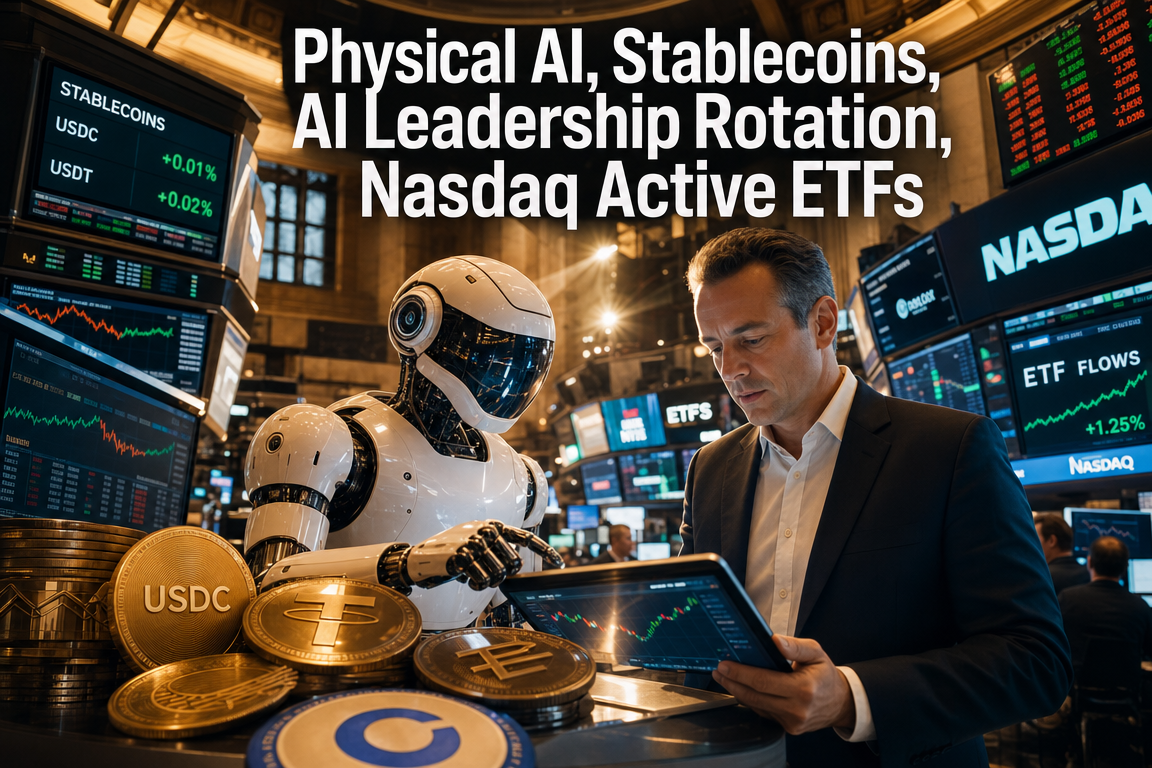
● Nasdaq Shock, AI Rotates Fast, ETF Shift
In a U.S. equity market characterized by sharp swings, the key for Nasdaq ETF investing is no longer the index itself, but the speed of leadership rotation
The core message is straightforward.
For Nasdaq investing, the more important question is not whether the index will continue to rise over the long term, but which companies will become the next leaders within it.
The original text highlights the flexibility offered by the KoAct U.S. Nasdaq Growth Companies Active ETF and the KoAct U.S. Nasdaq Bond Mix 50 Active ETF as a way to approach Nasdaq ETF investing more dynamically.
In particular, the analysis that AI investment leadership is shifting from GPUs to memory, CPUs, AI agents, and eventually physical AI is a more practical framework than a general market outlook on U.S. equities.
When combined with interest rates, the possibility of a change in the Fed chair, geopolitical risk, oil prices, large IPOs, and retirement-account safe-asset rules, it becomes clearer why active ETFs can function not only as aggressive products, but also as risk management tools.
This report summarizes the differences between passive and active ETFs in a volatile Nasdaq market, the shift in AI leadership, the outlook for U.S. equities in the second half, and the use of these products in retirement accounts.
1. News Summary: The 기준 for Nasdaq investing is changing
Until now, many investors viewed a Nasdaq 100 ETF as the standard vehicle for U.S. growth exposure.
This is because it provides broad exposure to companies such as Nvidia, Apple, Microsoft, Alphabet, Amazon, and Meta.
The issue raised in the original text is this.
The Nasdaq 100 is fundamentally a market-cap-weighted passive index.
In other words, companies with the largest market capitalization carry the highest weights.
The problem is that leadership within the AI industry is changing too quickly.
When generative AI emerged in late 2022, GPUs were the key bottleneck, and Nvidia became the dominant leader.
As AI infrastructure expanded, new leaders emerged in areas such as memory semiconductors, data centers, power, cooling, networking, and storage.
More recently, as AI agents have gained attention, the importance of CPUs, memory layering, API calls, database processing, and code execution has increased.
In other words, AI investing has shifted from a market centered on Nvidia alone to one that requires rapid identification of emerging bottlenecks.
In this environment, active ETFs that adjust weights according to market changes may have an advantage over passive ETFs that simply track market-cap rankings.
2. Strengths and limitations of passive Nasdaq ETFs
The main advantage of a passive Nasdaq ETF is simplicity.
Investors can gain diversified exposure to U.S. innovation companies without selecting individual stocks.
For investors who believe in the long-term growth of U.S. equities and technological innovation, it remains a strong option.
However, in a period of rapid AI industry change, its limitations are also clear.
For example, the Nasdaq 100 has heavy weights in established large-cap technology firms such as Nvidia, Apple, Alphabet, and Microsoft.
Yet these companies do not all benefit from AI at the same pace.
Some companies may face margin pressure in the short term as AI infrastructure spending rises.
Others may underperform expectations if they fall behind in AI service competition.
Apple is cited in the original text as an example of a company whose AI competitiveness has been questioned.
Although Apple remains one of the world’s most important technology companies, it has been seen as less aligned with the market’s expectations in generative AI and AI agents.
A passive index cannot reflect such judgments immediately.
If Apple remains a top-market-cap company, its weight stays elevated.
By contrast, an active ETF can increase exposure when AI competitiveness improves and reduce exposure when it weakens.
3. The core value of active ETFs: not aggression, but response speed
Many investors mistakenly view active ETFs as more aggressive products.
However, the central point in the original text is that an active ETF is not simply designed to rise more sharply.
Its objective is to generate excess returns relative to the Nasdaq index.
In rising markets, it aims to hold stronger leadership names; in declining markets, it seeks to fall less than the index.
That is the essence of an active ETF.
For example, when events such as trade tensions, AI bubble concerns, risks surrounding OpenAI’s circular investment structure, war in the Middle East, oil spikes, higher rates, or Fed uncertainty occur, the portfolio can be adjusted defensively.
The original text notes that when market uncertainty rises, defensive positions can be built using staples, utilities, and energy companies.
Such a strategy is difficult for individual investors to implement in real time.
For salaried investors, tracking semiconductors, AI models, the Fed, rates, oil, and geopolitical risk simultaneously on a daily basis is not realistic.
The practical value of an active ETF is that portfolio adjustments can be made in response to market changes without requiring the investor to rebalance manually.
4. AI leadership rotation: from GPU to memory, CPU, and AI agents
The most important investment insight in the original text is that AI leadership is not fixed.
When generative AI first emerged, the market focused on GPUs.
Nvidia GPUs became the core bottleneck because large-scale parallel computation is essential for LLM training and inference.
As models advanced and services expanded, new bottlenecks emerged.
The first is memory.
As AI services scale, larger volumes of data must be retrieved and processed quickly.
High-performance memory, storage, and data transfer speed have therefore become increasingly important.
The original text cites a case in which memory-related exposure was significantly increased when memory prices began rising sharply in September of last year.
By the time many investors confirm such changes through the news, a substantial portion of the move may already be reflected in prices.
The second is the CPU.
With the rise of AI agents, parallel computation alone is no longer sufficient.
When AI writes code, executes code, calls APIs, queries databases, and performs search tasks, the role of CPUs becomes more important.
Accordingly, the original text states that exposure to CPU-related companies such as AMD, Intel, and ARM was increased.
The third is AI agents.
AI agents are not merely chatbots that answer questions, but systems that execute tasks step by step.
For enterprises, if AI agents improve productivity, the rationale for paying for them becomes much stronger.
This is the key point that challenges concerns about AI monetization.
Individual consumers may hesitate to pay monthly subscription fees, but corporations can justify much larger spending if productivity improves materially.
5. Large-cap technology is not always the best beneficiary
When investors think of AI investing, they usually think first of Microsoft, Alphabet, Meta, and Amazon.
However, the original text presents a more critical view of this assumption.
Large-cap technology companies are both beneficiaries of the AI era and firms that must absorb massive capital expenditures.
They need to build data centers, purchase GPUs, secure power supply, and expand cloud infrastructure.
In other words, large-cap technology companies also play the role of infrastructure providers for AI-native firms.
By analogy to the early internet era, this may resemble the position of telecom carriers that built the network layer.
By contrast, the companies that captured the strongest profit growth later were internet service firms such as Google, Facebook, Amazon, and Netflix.
A similar pattern could emerge in the AI era.
Infrastructure companies may lead initially, while AI service companies could become the next leaders later.
If private companies such as OpenAI and Anthropic eventually go public, the center of the AI service cycle could shift.
In that case, passive Nasdaq ETFs may react more slowly because of their existing weight structure.
Active ETFs, by contrast, may be able to reflect new listings and emerging leadership more quickly.
6. Why large IPOs are becoming a key variable in second-half Nasdaq ETF strategy
The original text identifies large IPOs as a major reason why active strategies may become more important in the second half of the year.
In particular, possible listings by companies such as SpaceX, Anthropic, and OpenAI are presented as important market variables.
However, actual listing schedules and index inclusion rules may change, so investors should verify the latest filings and exchange announcements before making decisions.
The logic is as follows.
If a newly listed company is added to the Nasdaq 100 quickly, passive ETFs must buy the stock according to index rules.
Before that inclusion occurs, an active ETF may take a position in advance and seek to benefit from early supply-demand imbalances.
In large IPOs with limited free float, institutional demand can create strong near-term price support when supply is constrained.
This is an important point that is often missing from standard U.S. equity outlook commentary.
The key issue is not merely that “a good company is listing,” but how supply and demand may evolve before and after index inclusion.
7. Macro outlook: rates, the Fed, and liquidity may be more favorable to AI companies
The original text evaluates the outlook for U.S. equities through three lenses: macro conditions, industry trends, and corporate earnings.
On the macro side, rates and the Fed are the main factors.
If AI raises productivity, economic growth could improve while inflationary pressure remains contained.
This argument is linked to the PC and internet innovation cycle of the 1990s.
At that time, productivity gains supported a long expansion cycle in the U.S. economy.
If AI similarly improves corporate productivity, the Fed may have less justification for aggressive tightening.
The text also mentions the possibility of expansionary fiscal policy from a political standpoint.
Measures such as tariff rebates, subsidies, or tax incentives could affect market liquidity.
The key question is where liquidity flows when it enters the market.
The original text argues that the gap between AI and non-AI companies is widening.
Cars, smartphones, and traditional consumer sectors lack strong growth momentum, while AI-related companies are seeing faster upward revisions in revenue and earnings expectations.
In this environment, additional liquidity may continue to flow toward AI companies with stronger earnings visibility.
8. The AI bubble debate: excessive spending or supply shortage
One of the most common questions in AI investing is whether this is a bubble.
The scale of investment in data centers, GPUs, power infrastructure, and cloud capacity appears very large.
However, the original text does not interpret the situation as speculative excess.
Instead, it suggests that demand is extremely strong and supply remains insufficient.
In practice, AI service providers sometimes limit usage or adjust features because of compute shortages.
Enterprise customers are already seeing productivity gains as they introduce AI agents into their workflows.
If employees can write code faster and automate tasks more efficiently, companies are likely to treat AI token costs as an investment rather than an expense.
That is how AI evolves beyond consumer subscriptions into a B2B productivity market.
Individual consumers may question a monthly fee of even a modest amount, but corporations can justify far higher costs if productivity rises by 2x, 5x, or 8x.
For that reason, AI agents may represent not just a technology trend, but a turning point in AI monetization.
9. Even so, stock prices can eventually reverse: response matters more than prediction
Even if AI infrastructure investment continues, related stocks will not rise indefinitely.
The original text explicitly emphasizes this point.
During the dot-com bubble, internet adoption and corporate earnings continued to improve afterward.
Yet stock prices peaked earlier and then corrected sharply.
In other words, long-term industry growth and short-term stock cycles are not the same.
The same applies to AI infrastructure companies.
Revenue and earnings may continue to improve, but if expectations become too elevated, share prices may still correct.
That is why it is more important to respond to leadership changes, valuation, sentiment, and macro risk than to try to time the exact top.
This is also why active ETFs are emphasized.
It is difficult for individual investors to identify every inflection point correctly, whereas an actively managed portfolio can adjust through a professional investment process.
10. South Korea versus U.S. Nasdaq: which is more favorable?
The original text also takes a constructive view on the South Korean market.
In particular, memory semiconductors are seen as a major beneficiary of AI performance improvement, which could benefit Korean companies significantly.
Samsung Electronics and SK hynix occupy important positions in the AI infrastructure cycle.
Where Taiwan benefited heavily through TSMC in AI semiconductors, Korea may be entering the AI cycle later through memory leadership.
However, over the long term, AI service leadership is still likely to remain centered in the U.S.
OpenAI, Anthropic, Google DeepMind, Microsoft, and Meta are all concentrated in the U.S. ecosystem.
Accordingly, Korean equities and East Asian semiconductors may outperform in the near term, but U.S. Nasdaq ETFs still retain strong structural appeal for long-term retirement investing.
In practical terms, Korean semiconductors and U.S. AI services are better viewed as rotating cycle leaders rather than direct substitutes.
11. KoAct Nasdaq ETF strategy for retirement and individual pension accounts
The original text introduces two products.
The first is the KoAct U.S. Nasdaq Growth Companies Active ETF.
This product invests in U.S. Nasdaq growth companies while adjusting the portfolio according to market changes.
Its strategy adapts exposure across AI infrastructure, semiconductors, software, cloud, AI agents, and physical AI as growth sectors evolve.
The second is the KoAct U.S. Nasdaq Bond Mix 50 Active ETF.
This product combines the Nasdaq growth strategy with bonds.
The original text presents it as a way to use the 30% safe-asset requirement in retirement accounts.
Because retirement accounts often impose limits on risky assets, investors cannot always allocate 100% of their assets to equity ETFs.
In general, the structure must satisfy a 70% risky-asset and 30% safe-asset allocation.
In that case, an investor could allocate 70% to the KoAct U.S. Nasdaq Growth Companies Active ETF and 30% to the KoAct U.S. Nasdaq Bond Mix 50 Active ETF to increase Nasdaq active exposure within the account.
For example, if the bond-mix ETF has a 50% equity and 50% bond structure, a 30% allocation would add 15% equity exposure.
As a result, the overall account would have approximately 85% exposure to Nasdaq growth companies and about 15% exposure to bonds.
This approach may be useful for investors who want to maximize U.S. growth exposure while remaining within retirement-account rules.
12. An additional advantage of active ETFs: daily PDF disclosures can support investment research
Another benefit of active ETFs is that portfolio composition PDFs are disclosed daily.
For portfolio managers, this creates a burden.
Investors can see which names have been increased or reduced.
For investors, however, this is an advantage.
Portfolio changes can reveal which industries and companies are attracting new attention in the market.
For example, if the weight of CPU-related companies increases sharply, investors can begin asking why CPUs have become more important.
In an era of information overload, deciding what to study is itself difficult.
In this context, the portfolio changes of a professional manager can serve as a research signal.
Even investors who do not buy the ETF directly may find the PDFs useful for understanding AI investment trends and U.S. equity market leadership.
13. The most important point that is often overlooked in other media
The most important point in the original text is not simply that AI leadership changes over time.
The real issue is that leadership changes because technological bottlenecks move.
The market does not merely follow popular stocks.
As AI models evolve, bottlenecks move from GPUs to memory, from memory to CPUs, from CPUs to networking and power, and then to AI services and agents.
Capital flows to companies that solve those bottlenecks.
Therefore, the key issue is not whether Nvidia is strong, Apple is weak, or Micron is rising.
The more important question is what resource is currently most constrained in the AI industry.
The company that solves the constrained resource is the one most likely to become the next leader.
Another important point is that even if large-cap technology companies remain the eventual winners of the AI era, they may not deliver the best stock returns in every phase.
While large-cap technology firms build data centers and provide cloud capacity, the strongest earnings momentum may appear in memory, semiconductor equipment, CPUs, power infrastructure, and AI software companies.
Finally, the value of an active ETF is not only that it can outperform in rising markets.
Its real advantage may be the ability to reposition defensively during sharp selloffs, interest-rate uncertainty, geopolitical risk, and AI bubble debates.
This is the aspect most often omitted in standard ETF commentary.
14. Risks investors should monitor
First, an active ETF does not always outperform a passive ETF.
The manager may make incorrect calls, or may rotate leadership too early or too late.
Second, long-term AI industry growth and short-term stock prices can move differently.
Even when earnings improve, stock prices can correct if expectations are too high.
Third, investors should verify the latest information on large IPO schedules and index inclusion rules.
Building a strategy based only on a possible listing can lead to different outcomes if the timing changes.
Fourth, in retirement and individual pension accounts, investors should confirm product risk ratings, eligibility, fees, and currency effects.
Fifth, foreign exchange movements can have a significant impact on U.S. equity returns for Korean investors.
Changes in the won-dollar exchange rate can materially affect KRW-based performance.
15. Conclusion: Nasdaq investing is no longer just about buying U.S. growth; it is about participating in the rotation of AI leadership
The current Nasdaq investment framework cannot be explained simply as a long-term bet on large-cap U.S. technology.
AI continues to expand, but the segments attracting capital are changing quickly.
The market that was led by GPUs has expanded into memory, CPUs, AI agents, data center infrastructure, power, and eventually physical AI.
In such a market, investors need to understand both the stability of passive ETFs and the responsiveness of active ETFs.
Long-term investors may maintain exposure to Nasdaq as a structural theme while also considering active ETFs during periods of rapid leadership rotation.
For retirement investors in particular, the combination of the KoAct U.S. Nasdaq Growth Companies Active ETF and the KoAct U.S. Nasdaq Bond Mix 50 Active ETF may help increase exposure to U.S. AI growth while staying within risk-asset limits.
That said, all investment decisions should reflect the investor’s time horizon, risk tolerance, retirement-account structure, exchange-rate outlook, and fees.
The key is not to predict perfectly, but to build a structure that can respond when change occurs.
< Summary >
The core of Nasdaq ETF investing is now less about simple index tracking and more about how quickly investors can respond to AI leadership rotation.
The AI industry is expanding from GPUs into memory, CPUs, AI agents, data center infrastructure, and physical AI.
Passive Nasdaq ETFs offer simplicity and long-term exposure, but they may react slowly to concentration risk and leadership rotation.
Active ETFs are differentiated not only by upside capture, but also by their ability to manage risk and rebalance during downturns.
The KoAct U.S. Nasdaq Growth Companies Active ETF is presented as a vehicle for responding to changes in AI growth leadership.
The KoAct U.S. Nasdaq Bond Mix 50 Active ETF may be used to increase Nasdaq growth exposure while meeting the 30% safe-asset requirement in retirement accounts.
The most important lens is to identify which resource is currently most constrained in the AI industry.
The companies that solve that bottleneck are the ones most likely to become the next leaders.
[Related Articles…]
AI Cycle and Global Leadership Rotation Analysis
Key Outlook on Nasdaq ETFs and U.S. Equities
*Source: [ 소수몽키 ]
– 급등 급락 반복하는 증시, 혼란 속에서도 주도주 흐름 놓치지 않는 투자법
● Physical-AI,Stablecoins,Nvidia,HBM,Korea,Revolution
Why Stablecoins Are Disrupting Traditional Finance in the Physical AI Era: Key Takeaways on Nvidia, Korean Manufacturing, and the AI Payments Ecosystem
The core of this shift is not simply that AI has become more advanced.
AI is moving into real-world devices such as smartphones, PCs, refrigerators, robots, automobiles, and kiosks.
In this process, Nvidia views Korea’s semiconductor, manufacturing, telecommunications, and power infrastructure sectors as important partners.
As AI systems begin to place orders and make payments autonomously, stablecoins are likely to either replace or place significant pressure on existing card, remittance, and banking payment networks.
This article connects physical AI, on-device AI, AI PCs, humanoid robots, HBM, GPUs, AI infrastructure, stablecoin payments, and AI literacy in one framework.
1. The Physical AI Era Has Begun: When AI Moves Beyond the Screen
Until now, AI has primarily operated in digital environments such as apps, chatbots, search, document writing, and image generation.
The next major phase is physical AI.
Physical AI refers to AI that acts in the physical world.
Examples include humanoid robots moving goods in warehouses, robots assisting with assembly lines in automotive plants, AI appliances making independent decisions at home, and AI kiosks recognizing customers and processing payments in stores.
A key point emphasized in the discussion is that physical AI is no longer a distant possibility.
In some industries, deployment has already begun.
For example, Figure AI, a humanoid robot company, has introduced robots that perform warehouse tasks in ways similar to human workers.
In publicly released demonstrations, the robots were described as reaching a level where they could compete with skilled labor in handling parcel boxes.
Boston Dynamics Atlas, acquired by Hyundai Motor, is another important case.
Automotive manufacturing requires highly precise joint movement and strong environmental awareness, and Atlas is already regarded as having reached a substantial level of motion flexibility.
The remaining challenge is no longer whether robots can move, but whether they can understand the work environment and execute tasks accurately.
2. Why Nvidia Is Looking at Korea: GPUs Alone Cannot Complete Physical AI
Nvidia is the dominant player in the GPU market.
It provides the core computing infrastructure required for AI training and inference.
However, GPU leadership alone is not sufficient to dominate the physical AI market.
Physical AI requires three elements:
-
First, high-performance semiconductor infrastructure such as GPUs and HBM.
-
Second, real-world manufacturing data and operational know-how.
-
Third, an industrial ecosystem connected to robots, automobiles, home appliances, telecommunications, and power infrastructure.
This is where Korea’s strategic value increases.
Samsung Electronics and SK Hynix are key suppliers of HBM.
HBM is essential for GPUs to deliver performance at scale.
For Nvidia, Samsung Electronics and SK Hynix are therefore not just customers, but strategic supply-chain partners.
At the same time, Samsung Electronics has smartphones, PCs, and home appliances across its portfolio.
As on-device AI expands into smartphones, notebooks, refrigerators, televisions, washing machines, and air conditioners, Samsung becomes both a customer and an implementation partner for Nvidia.
LG Electronics is similar.
LG has strong positions in home appliances and PCs.
As AI refrigerators, AI washing machines, AI air conditioners, and AI televisions gain traction, LG will also become an important part of the physical AI ecosystem.
Hyundai Motor has both automobiles and robots.
Automobiles are likely to evolve into moving AI devices.
Robots are one of the primary use cases for physical AI.
Unless Nvidia enters automobile and robotics manufacturing directly, it will need partners such as Hyundai Motor.
3. Why Korea Is Uniquely Positioned in the Physical AI Value Chain
One of the most notable views in the discussion is that Korea already holds a substantial part of the physical AI value chain, excluding GPUs.
Korea has semiconductors, smartphones, home appliances, automobiles, robots, telecommunications, power, energy, and digital platform companies.
-
Samsung Electronics: HBM, smartphones, PCs, home appliances, on-device AI devices
-
SK Hynix: Core HBM supplier
-
Hyundai Motor: Automobiles, robots, Boston Dynamics
-
LG Electronics: AI home appliances, AI PCs, AI kiosks
-
Naver: Digital twins, AI platforms, data-driven services
-
Doosan Robotics: Collaborative and industrial robots
-
Doosan Enerbility: Power infrastructure and energy equipment
-
SK Telecom: Telecommunications infrastructure, AI data centers, networks
-
SK Energy: Energy supply chain and industrial infrastructure
For physical AI to scale, power infrastructure and telecommunications infrastructure are as important as AI infrastructure.
Robots, autonomous vehicles, AI appliances, and AI kiosks require stable networks for real-time data processing.
As AI data centers and high-performance computing systems expand, power demand will increase accordingly.
Physical AI is therefore not only a semiconductor issue, but a broader industrial trend linking manufacturing, energy, telecommunications, and platforms.
4. Nvidia’s Real Objective: Creating the Next Wave of GPU Demand
From Nvidia’s perspective, the existing generative AI market alone may not fully explain the next stage of growth.
Chatbots, search, document generation, and image creation remain important, but they may not sustain the same pace of GPU demand expansion indefinitely.
That is why Nvidia is focusing on physical AI as the next market.
If robots, automobiles, smart factories, AI appliances, AI PCs, and AI kiosks all require AI computation, GPU and AI semiconductor demand could move to a new level.
The key point is that Nvidia does not possess manufacturing data from production environments.
Physical AI is not only about building better models.
It also requires understanding factory operations, automotive assembly sequences, warehouse variables, and household appliance usage patterns.
Nvidia cannot generate this data alone.
That is why partnerships with Korean companies matter.
Korea is one of the few countries that combines manufacturing environments, consumer devices, telecommunications networks, and power infrastructure.
Nvidia’s repeated engagement with Korea should be seen not as symbolic activity, but as a strategic move to build the physical AI market jointly.
5. Why Stablecoins May Become the Payment Infrastructure of the Physical AI Era
As physical AI expands, AI will move beyond information delivery and take on decision-making and execution.
At that point, payment infrastructure becomes essential.
For example, an AI kiosk recognizes a customer and recommends an order.
When the customer approves, payment is processed automatically.
Traditional card networks could handle this, but stablecoins may prove to be a more efficient option.
The same applies to AI refrigerators.
A refrigerator can detect that eggs are running low, analyze the household’s consumption pattern, and place an automatic order.
It can also process payment.
An AI printer can reorder toner when supply is low.
An AI robot can purchase parts or consumables automatically.
As AI agents begin making frequent small-value payments on behalf of users, the burden on traditional financial systems will increase.
Card fees, cross-border transfer fees, foreign exchange costs, settlement delays, and intermediary expenses all become relevant.
Stablecoins offer advantages in speed and lower transaction costs.
This is especially important for global AI services, where cross-border payments are frequent.
A Korean user may use a U.S.-based AI service, a Japanese robot may order Korean parts, and a European AI agent may pay for cloud services in Asia.
In this environment, dollar-based stablecoins could emerge as a standard digital payment layer.
6. Stablecoins May Become the Operating Layer of the AI Economy, Not Just a Crypto Asset
Many still view stablecoins only as crypto investment products.
In the physical AI era, that view becomes incomplete.
Stablecoins may function less as speculative assets and more as digital financial infrastructure for AI agent payments, settlement, remittances, and value transfer.
A key term in the discussion is the “flow of value in services.”
If AI provides services, payment must follow.
When AI systems exchange data, invoke services, use APIs, consume cloud compute, or place parts orders through robots, value transfer occurs.
If these transactions are processed only through banks or card networks, speed and cost constraints emerge.
Stablecoins may serve as the payment layer that solves these constraints.
Accordingly, AI technological progress and stablecoin market growth should be viewed as interconnected economic trends rather than separate themes.
7. Stablecoins Still Depend on Regulation and the International Monetary Order
Technically, AI and stablecoins are likely to converge.
However, finance is not determined by technology alone.
Law, regulation, monetary policy, the international financial order, central bank positions, and anti-money-laundering standards all matter.
For stablecoins to replace traditional finance at scale, three conditions are required:
-
First, a regulatory framework that governments can recognize.
-
Second, a transparent reserve structure that businesses and consumers can trust.
-
Third, authentication, security, and liability standards suitable for AI agent payments.
In particular, once AI begins to make payments autonomously, the issue of liability becomes critical.
If an AI refrigerator makes an incorrect order, responsibility must be clearly assigned to the user, manufacturer, or AI service provider.
Without a clear framework, adoption may remain limited even if stablecoin payments are technically feasible.
8. AI Kiosks and AI Appliances Are Likely to Become Practical Use Cases for Stablecoin Payments
The proposal that LG Electronics should enter the AI kiosk market is noteworthy.
Traditional kiosks require users to select items and complete payment manually.
By contrast, AI kiosks can recognize users, remember preferences, recommend orders, and automate payment.
For example, when a regular customer enters a store, an AI kiosk could ask whether they would like the usual warm Americano.
If the customer agrees, the order and payment can be completed immediately.
If stablecoins are used, transaction costs can be reduced and the same payment experience can be extended globally.
AI refrigerators analyze food consumption patterns.
AI printers predict when consumables need replacement.
AI PCs can call paid AI services in line with workflow needs.
AI robots can pay for services required during operations.
In the physical AI era, the number of payments processed by AI may exceed the number of payments initiated directly by people.
This could materially change the financial sector and the broader digital transformation landscape.
9. The Most Important Point Not Fully Addressed in Other Media
The key issue is not simply the spread of AI devices, but the payment authority granted to those devices.
Most coverage focuses on Nvidia, GPUs, HBM, robots, and humanoid technology.
The real economic impact begins when AI starts spending money on behalf of users.
Once AI has payment authority, the subject of consumption shifts.
The structure moves from a model in which people compare and order directly to one in which AI agents evaluate conditions and execute transactions automatically.
At that point, payment networks become core infrastructure for the AI economy, rather than only financial services.
In other words, the central competition ahead is not only about who builds the smartest AI.
It is also about which AI can transact through which payment network, under whose authorization, and up to what limit.
Another important point is Korea’s opportunity.
Korea does not control GPUs directly, but it does possess the devices and environments where physical AI will be deployed.
Few countries combine semiconductors, home appliances, automobiles, robots, telecommunications, power, and platforms in a single industrial base.
If Korea can integrate AI infrastructure, manufacturing data, stablecoin payment standards, and power and telecommunications infrastructure, it could become both a testbed for physical AI and a global supply-chain hub.
Conversely, if this connection is missed, Korean companies may remain only as customers of Nvidia.
The real opportunity is not merely buying GPUs, but combining Korean industrial data with payment infrastructure to build a new AI economy ecosystem.
10. How Individuals Should Adapt in the AI Era: AI Literacy Is a Competitive Advantage
The latter part of the discussion addressed how individuals should respond in the AI era.
Professor Kim Sang-yoon explained that the process of accepting AI resembles the five psychological stages of accepting death.
-
Denial: Believing that AI will not replace one’s work.
-
Anger: Feeling that one’s job and capabilities should not be threatened.
-
Bargaining: Concluding that AI can still be useful for some tasks.
-
Depression: Being confronted by how well AI performs many tasks.
-
Acceptance: Treating AI as a tool and redefining one’s role.
The important point is that rejecting AI will not stop the transformation.
Generative AI has already been in the market for several years, and the gap between individuals and organizations that use it effectively is widening quickly.
Those who use AI well can raise productivity, while those who do not may lose competitiveness despite spending the same amount of time.
To remain ahead, individuals must move beyond rejecting AI and learn to use it actively.
They must recognize which parts of their work AI performs better.
They must learn how to delegate those tasks effectively to AI.
Prompt design, validation of AI outputs, and workflow redesign will become essential capabilities.
The example of music generation illustrates this well.
AI can produce music in 30 seconds that creates strong emotional impact.
Its influence now extends to creative work, planning, analysis, coding, design, marketing, and financial research.
The key question is no longer whether AI will take jobs, but how far individuals can use AI to elevate their own work to a higher level.
11. Key Changes Investors and Companies Should Watch
This trend should not be viewed only as a short-term thematic trade.
Physical AI and stablecoins are changes that can reshape both industrial structure and financial structure.
Investors should look beyond semiconductors and consider the entire AI infrastructure stack.
HBM, GPUs, data centers, power equipment, telecommunications networks, robots, automobiles, AI appliances, and digital payments should be assessed together.
Companies should not stop at adopting AI chatbots.
They should evaluate whether their products can evolve into on-device AI, whether AI agent payments can be integrated into their services, and how customer and manufacturing data can be used.
Governments and regulators should not treat AI industrial policy and financial regulation separately.
Stablecoins, digital payments, AI agent liability standards, data security, and power infrastructure investment should be designed together.
One of the key variables in the 2026 economic outlook is how deeply AI enters industrial operations.
Another is how that AI pays and settles transactions.
The intersection of these two trends is likely to generate new company valuations and industrial restructuring.
< Summary >
Physical AI refers to the movement of AI into real devices such as robots, automobiles, home appliances, kiosks, and PCs.
Nvidia cannot complete physical AI with GPUs alone, which makes cooperation with Korea’s semiconductor, manufacturing, telecommunications, and power companies strategically important.
Samsung Electronics, SK Hynix, Hyundai Motor, LG Electronics, Naver, Doosan Robotics, and SK Telecom may become key partners in the physical AI value chain.
If AI systems begin to place orders and make payments autonomously, stablecoins could pressure traditional financial systems through lower fees and faster settlement.
The central issue is not AI capability alone, but the moment AI is granted payment authority, at which point digital payment infrastructure becomes central to the AI economy.
Individuals and companies should use AI directly, redesign workflows, and build AI literacy to maintain competitiveness.
[Related Articles…]
*Source: [ 경제 읽어주는 남자(김광석TV) ]
– 피지컬AI 시대, 스테이블코인이 기존 금융을 대체한다 | 경읽남과 토론합시다 | 김상윤 교수 [3편]