● K-AI Goes GDPR First
K-AI Startup Level Seen at VivaTech 2026 in Paris: Core Technologies of Six AI Companies That Caught Europe’s Attention
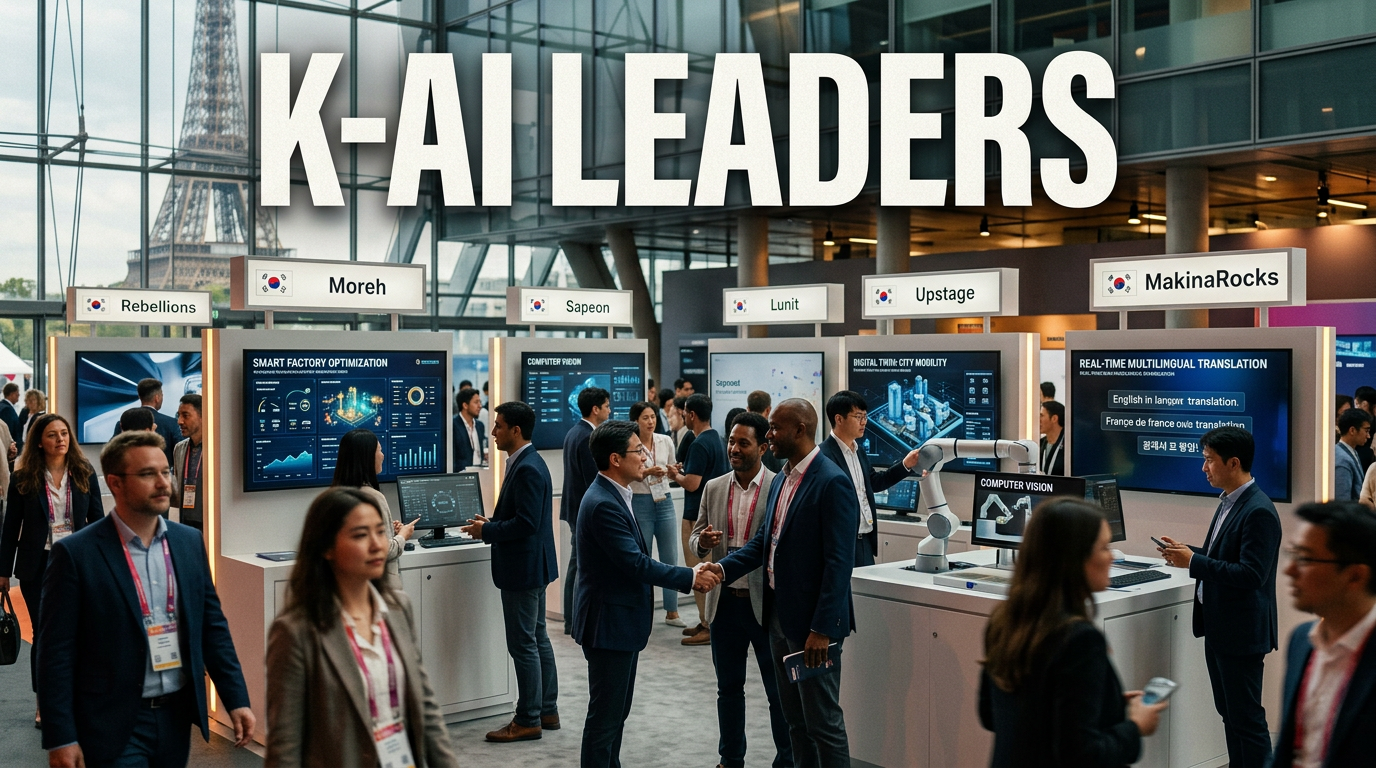
The most eye-catching point at this year’s VivaTech 2026 K-Startup integrated pavilion was not simple demo AI, but the appearance of a large number of B2B artificial intelligence solutions that can be used immediately in real enterprise settings.
In particular, the six domestic AI startups unveiled in Paris, France targeted a wide range of industries, from generative AI, manufacturing automation, digital twins, beauty tech, scent recommendation AI, to real-time interpretation AI.
This case is a good signal showing how Korean AI startups are entering the European market amid global economic outlook trends.
On the surface, it may seem like nothing more than “K-AI went to an overseas exhibition,” but in reality, much more important competitiveness is hidden beneath the surface, such as data security, on-premises deployment, GDPR compliance, connection to industrial field data, and real-time inference speed.
Below, we will organize the technologies of the six companies that appeared at VivaTech 2026 in a news format, and also highlight the core points that are not well covered in other YouTube videos or general news.
1. Weasliy AI: An AI agent that connects internal enterprise data
Weasliy AI introduced an AI agent service that connects document data, ERP data, groupware data, and SaaS tool data held by manufacturing, logistics, and general companies into one.
The core technology is enterprise AI data integration based on RAG, or retrieval-augmented generation.
Internal employees do not need to search through scattered data directly; through the AI agent, they can explore, analyze, and generate the information they need.
For example, even if inventory data, logistics movement data, internal documents, approval materials, and customer response records of a manufacturing company are scattered across different systems, AI connects them so that practitioners can use them immediately.
A particularly important part in the European market is data security.
Weasliy AI emphasized that it meets the security conditions required by European companies, such as ISO certification and GDPR compliance.
This can be seen as meaning that it goes beyond simply “having good AI features” and has the basic qualifications to actually contract with European companies.
As generative AI enters enterprise work, the biggest problem is not hallucinations, but internal data leakage and access permission management.
Therefore, Weasliy AI’s direction is very close to a realistic B2B artificial intelligence strategy in the European market.
2. Inkle: An AI data platform for manufacturing sites
Inkle is a company developing an AI data platform for manufacturing sites.
It focuses on connecting various facilities and equipment for domestic manufacturing companies and solving problems that occur on-site with AI technology.
At VivaTech 2026, it demonstrated collecting data from robots and then issuing commands back to those robots to pick up a specific object and place it in the desired basket.
The core of this technology is not simple robot control, but collecting and analyzing data from the manufacturing site in real time and then connecting that to the actions of physical equipment.
In other words, it is a manufacturing automation structure that proceeds from data collection → AI analysis → robot command → on-site execution.
This kind of technology is directly connected to smart factories, logistics automation, predictive maintenance, quality control, and industrial robot control.
Today’s global manufacturing industry is simultaneously facing rising labor costs, a shortage of skilled workers, supply chain restructuring, and productivity pressure.
In this environment, technologies that make existing equipment smarter through AI data platforms are becoming very important.
Inkle’s approach is not to completely replace an entire factory, but rather to connect existing manufacturing equipment with AI to boost productivity.
3. Greeneter: Technology that lightens massive digital twin data
Greeneter is a company that solves the large-scale data problem that arises during the reprocessing of digital twin data into 3D.
A digital twin is a technology that copies and manages real buildings, facilities, factories, and energy infrastructure as 3D data.
The problem is that the more precise the 3D data, the larger the file size becomes.
When data is heavy, costs arise in transmission, storage, analysis, visualization, and collaboration.
Greeneter introduced technology that can compress or optimize data up to 99.6% without loss.
Its representative product, Optimizer 2.0, was mentioned.
This product was originally developed in SaaS form, but it is now also offered as an on-premises version or a Windows installable version, and appears to be in a testing stage for B2B customers.
The important point here is Europe’s energy infrastructure.
Europe has many old energy facilities, and some facilities lack accurate blueprints or have insufficient maintenance data.
Turning these facilities into 3D data improves management efficiency, but it also creates data size and precision issues at the same time.
Greeneter’s technology can play an important role in the digital transformation process of such aging infrastructure.
In particular, it has strong potential for use in power grids, power plants, plants, airports, ports, large buildings, and urban infrastructure management.
4. Scentpedia and ScentID: AI recommendation services that learned perfume and fragrance data
AI technology has also appeared in the fragrance sector.
At the event, services called Scentpedia and ScentID were introduced.
These services recommend personalized scents based on perfume and fragrance data in order to solve customer pain points.
The company’s AI learns various perfume and fragrance data it holds, and searches for and recommends scents that match the user’s desired preferences or conditions.
Fragrance is an area that is much harder to quantify than text or images.
Preferences differ from person to person, perceptions of scent differ by culture, and selection criteria also vary depending on the season and situation.
Therefore, fragrance recommendation AI can be seen not just as a simple search service, but as a personalized AI service that connects emotional data with product data.
This technology can be connected to perfume brands, cosmetics companies, spatial fragrance marketing, hotels, retail stores, and the wellness industry.
As AI becomes more sophisticated at analyzing fragrance combinations and consumer preferences, it can shorten perfume development cycles and speed up the launch of customized products.
5. K-beauty AI service: Connecting skin diagnosis and product scanning
Another company introduced a service that allows users to check whether a K-beauty product is suitable for them by photographing or scanning it.
Users can identify their skin condition through a skin diagnosis device, and then scan cosmetics products to see whether the product is suitable for them.
This service connects product ingredients, skin condition, and usage methods to easily tell users how they should use the product.
It can be especially useful for foreign users.
K-beauty products are highly popular in the global market, but from the perspective of overseas consumers, it is often difficult to understand Korean product descriptions, ingredient information, usage order, and skin-type suitability.
If AI translates and analyzes this and explains it according to an individual’s skin condition, it can increase purchase conversion rates.
This technology is not just a beauty app, but a combination of global commerce and AI personalized recommendations.
Going forward, if K-beauty brands want to grow in the European and North American markets, personalized digital experiences are likely to become as important as product competitiveness.
6. Spawn AI: AI that provides real-time interpretation within 1.2 seconds
Spawn AI introduced real-time interpretation AI technology that provides interpretation within 1.2 seconds from the moment a person begins speaking.
The service name mentioned was Spawn Chat.
Spawn AI’s strength lies not only in its speed, but also in its ability to grasp context.
Typical interpretation services can translate at the word level, but in professional conversations or technical contexts, the meaning often becomes distorted.
Spawn AI highlighted its strength in providing fast and accurate interpretation even in technical and specialized conversations.
In fact, a case was mentioned in which it was able to interpret remarks by global leaders such as Jensen Huang at the 2025 APEC event.
This is a very important technology in global business settings.
Real-time interpretation AI can greatly reduce language barriers in international conferences, investment meetings, technology seminars, global sales, medical consultations, legal consultations, and remote education.
In particular, a latency of 1.2 seconds is close to a level that does not interrupt the flow of conversation, making it highly usable in actual meetings and negotiations.
Common traits of K-AI startups revealed at VivaTech 2026
The six companies unveiled this time belong to different industrial sectors, but they clearly share common traits.
First, all are focused on solving problems in real industrial settings.
Rather than simply building chatbots or showing image generation functions, they targeted specific markets such as manufacturing, logistics, energy, beauty, fragrance, and interpretation.
Second, they are strongly conscious of the B2B market.
Internal enterprise data, manufacturing equipment, digital twins, on-premises installation, and GDPR compliance are all factors more important to enterprise customers than to consumer apps.
Third, they are considering European regulations.
In particular, data security and privacy protection are the most important standards for entering Europe.
European companies carefully check data handling methods, security certifications, server locations, access permissions, and regulatory compliance just as much as AI performance.
Fourth, they are combining AI with industries in which Korea is strong.
Manufacturing, beauty, IT services, and interpretation technology are fields where Korean companies already have strengths.
There is a clear strategy to attach AI to these strengths and expand into the global market.
The most important point that other news outlets do not talk about enough
The core point of VivaTech 2026 is not simply that “Korean AI startups received attention overseas.”
The truly important point is that Korean AI startups are increasingly moving toward “regulation-friendly B2B AI.”
Recently, the global AI market has been looking more for safe AI solutions that real companies can use than for flashy generative AI demos.
In Europe in particular, GDPR, the AI Act, industrial data protection, and security certifications are core conditions that determine business success or failure.
That is why in the European market, the first question is not “How smart is the AI?” but “Can we safely entrust our company’s data to it?”
Weasliy AI’s GDPR response, Greeneter’s shift to on-premises and installable versions, manufacturing-site data platforms, and real-time specialized interpretation, all of which emphasize on-site applicability, align exactly with this trend.
Another important point is that the revenue model of AI startups is increasingly expanding from SaaS subscription models to hybrid deployment models.
In particular, European manufacturing, energy, and public infrastructure companies are reluctant to put sensitive data on external clouds.
Therefore, AI companies that offer on-premises, private cloud, installable versions, and security certifications together are likely to earn greater trust.
This is also important from an investment perspective.
When looking at AI startups, you should not just look at model performance or demo videos, but also check whether they have the security structure and deployment method that real customers are willing to pay for.
K-AI opportunities from the perspective of the global economic outlook
Looking at the current global economic outlook, companies are being asked to reduce costs and improve productivity at the same time.
As interest rate burdens, labor cost increases, supply chain instability, and rising energy costs continue, companies must do more work with fewer people.
In this situation, AI startups can be evaluated not simply as technology companies, but as productivity infrastructure companies.
Weasliy AI can reduce data search costs for office workers and operations teams.
Inkle can help automate manufacturing sites and improve equipment efficiency.
Greeneter can lower digital twin data management costs.
Beauty AI and fragrance recommendation AI can raise personalized commerce conversion rates.
Spawn AI can reduce global business communication costs.
In the end, the value these companies provide is not “AI is fascinating,” but “AI reduces corporate costs and expands revenue opportunities.”
This is the most realistic reason why K-AI startups are attracting attention in the European market.
Key points of the six K-AI startups organized by industry
Enterprise AI agent field: Weasliy AI increases the use of internal corporate data by connecting ERP, documents, groupware, and SaaS data based on RAG.
Manufacturing AI field: Inkle provides a data platform that connects manufacturing equipment and robot data to solve on-site problems with AI.
Digital twin field: Greeneter can be used for managing energy facilities and industrial infrastructure by optimizing large-scale 3D data without loss.
Fragrance AI field: Scentpedia and ScentID learn perfume and fragrance data to provide personalized scent recommendations.
K-beauty AI field: By connecting skin diagnosis and product scanning, it helps foreign consumers easily choose products suited to their skin.
Real-time interpretation AI field: Spawn AI lowers barriers to global business conversations based on interpretation within 1.2 seconds and contextual understanding.
Checkpoints to consider from an investment and business perspective
First, you need to see whether the technology is connected to the customer’s actual budget items.
The reasons companies spend money on AI are productivity improvement, cost reduction, risk management, and revenue expansion.
Most of these six companies fit this standard relatively well.
Second, you must check whether they can respond to European regulations.
GDPR, ISO certification, and whether on-premises deployment is available are very important entry conditions in the European B2B market.
Third, data connectivity is more important than the AI model itself.
In enterprise settings, AI performance is not determined by the model alone.
How stably it connects to how many internal systems determines actual results.
Fourth, industry expertise is necessary.
Manufacturing AI must understand manufacturing sites, beauty AI must understand skin and ingredient data, and interpretation AI must understand specialized terminology and context.
Industry-specific AI is more likely to generate revenue faster than general-purpose AI.
K-AI trends to watch going forward
Going forward, K-AI startups are more likely to grow faster with industry-specific AI solutions than with competition in general-purpose chatbots.
In particular, in the European market, enterprise AI with data security and regulatory compliance is expected to create strong demand.
Manufacturing automation, digital transformation, real-time interpretation, personalized commerce, and digital twin optimization are all areas with strong growth potential over the next 3 to 5 years.
For Korean startups to compete in the global market, they need to prepare not only technology but also local regulations, customer industry structure, security requirements, and partnership strategies.
The direction of the K-AI companies seen at VivaTech 2026 is getting fairly close to these conditions.
< Summary >
At the K-Startup integrated pavilion at VivaTech 2026 in Paris, six domestic AI startups showcased technologies that can be applied in real industrial settings.
Weasliy AI unveiled an RAG-based AI agent that connects internal enterprise data, and Inkle introduced an AI data platform that connects manufacturing-site equipment and robots.
Greeneter introduced technology that optimizes large-scale digital twin data, while fragrance AI services provide personalized recommendations based on perfume and fragrance data.
The K-beauty AI service helps overseas consumers easily find products suited to them by connecting skin diagnosis and product scanning.
Spawn AI highlighted its strengths in real-time interpretation within 1.2 seconds and contextual understanding.
The most important trend is that K-AI startups are moving away from simple demo-style AI and toward B2B artificial intelligence centered on solving industry-specific problems, on-premises deployment, GDPR compliance, and data security demanded by the European market.
[Related Articles…]
Global expansion strategies for AI startups
Manufacturing automation and digital transformation trends
*Source: [ 티타임즈TV ]
– 프랑스 파리에 뜬 K-인공지능 기업 수준 (비바테크2026 K-스타트업 통합관)