● China Shock, Korea at Risk
Why Korean Semiconductors May Be More Exposed Than China
The key issue is not simply that the United States is weakening and China is strengthening.
The more important point is where South Korea may be pushed as the United States and China each seek to complete their own semiconductor supply chains, resource supply chains, and technology ecosystems.
Even if U.S.-China tensions appear to ease temporarily, pressures from dollar hegemony, tariff disputes, decoupling, China’s economic slowdown debate, and the direction of the global outlook are likely to continue affecting the Korean economy directly.
On the surface, there may be summit meetings, tariff relief, and a relatively calm phase.
However, beneath that, a long-term competition over semiconductors, AI, rare earths, defense technology, digital currency, and manufacturing competitiveness is already underway.
This report summarizes why South Korea’s economy and semiconductor industry may be entering a particularly vulnerable phase, based on a Chinese think tank’s scenario for U.S. decline.
1. U.S.-China relations may enter a “decent peace” phase in late 2026
Current U.S.-China relations are moving through cycles of sharp confrontation and temporary easing.
The source material suggests a possible “decent peace” period in the second half of 2026.
A potential U.S. presidential visit to China and a possible visit by Xi Jinping to the United States could coincide with a short-term reduction in tariff conflict and direct economic confrontation.
However, this would not represent structural reconciliation.
It would more likely be a pause for managing tensions ahead of the next round of competition.
In other words, the conflict would not be ending, but temporarily slowing.
Accordingly, the global outlook should be interpreted not as a resolution of U.S.-China tensions, but as a managed phase of rivalry.
2. The world is moving from a U.S.-led unipolar order to a G2 parallel order
The core claim is clear.
The world is no longer in a unipolar era dominated by the United States, but in a parallel era in which the United States and China compete side by side.
In the past, the United States was the dominant G1 power, while Japan briefly rose as a G2 before losing momentum after the Plaza Accord.
China is different.
It already matches or exceeds the United States in manufacturing, trade, resource supply chains, rare earths, digital infrastructure, consumer markets, and defense technology in some areas.
The reference to “Thucydides’ trap” in front of the U.S. president is symbolically important.
It reflects China’s view of itself not as a subordinate partner, but as a structural peer competitor to the United States.
3. Areas where China has already surpassed the United States
China has already overtaken, or is rapidly catching up in, a broad range of areas:
- Manufacturing scale
- Total exports of goods and services
- Largest trading partner status for major countries
- Middle-class purchasing power
- Annual sales of automobiles and smartphones
- Number of internet users
- B2C e-commerce market size
- Number of students in science and engineering
- Size of domestic consumer market
- Energy and resource consumption
- Number of Fortune Global 500 companies
- Hypersonic missiles and unmanned systems
- High-speed rail technology
- 5G telecommunications technology
- Digital currency technology
China also holds a dominant position in the rare earth value chain.
Its control is especially strong in refining, processing, and permanent magnet production, not just mining.
Given that AI, electric vehicles, batteries, robotics, and defense technologies are all linked to rare earths, China’s resource position is not merely a raw materials issue.
It is becoming a structural lever over future technology industries.
4. Areas where the United States remains ahead
The United States still leads in many critical areas:
- GDP
- Number of big tech firms
- Market capitalization
- B2B internet market
- Number of unicorns
- AI research papers and technical capability
- Top-tier universities
- PhD-level talent
- International patent counts
- Public and private R&D spending
- Federal fiscal spending
- Military spending
- Total naval tonnage
- Aircraft carriers and stealth fighters
- Satellite navigation systems
However, the key point is that China is generally second in many of these areas.
The gap between the two and the rest of the world is still substantial.
This is why the term “G2 parallel era” is increasingly relevant.
5. China may catch up with U.S. GDP by 2035
Not only Chinese think tanks, but also institutions such as the IMF, OECD, and World Bank have discussed the possibility that China could catch up with U.S. GDP around 2035.
This is a forecast, not a certainty.
But the important point is that such projections are not driven solely by pro-China or anti-U.S. sentiment.
International institutions based in Washington also recognize China’s scale and growth potential in quantitative terms.
The global outlook should therefore be framed not around a single U.S.-led order, but around two large economic ecosystems existing in parallel.
Currency, manufacturing, resources, technology, defense, and digital platforms are increasingly separating into two systems.
6. The key challenge for South Korea is strategic positioning
As the United States and China build their own supply chains, the choices for third countries become more difficult.
South Korea once balanced this with a “security with the United States, economy with China” approach.
That model is no longer functioning effectively.
The United States is directly managing semiconductor supply chains.
China is also building its own semiconductor ecosystem.
The same bifurcation is occurring in batteries, electric vehicles, AI, cloud services, rare earths, and digital currency.
In this environment, treating the issue as a simple choice between sides could impose significant industrial costs on South Korea.
Korea must prioritize industrial survival strategy over diplomatic balance alone.
7. The core of the U.S. decline scenario is Wall Street and dollar hegemony
A notable point in the Chinese think tank’s U.S. decline scenario is Wall Street.
U.S.-China conflict is usually discussed in terms of tariffs, military issues, Taiwan, semiconductors, and technology sanctions.
This report argues that America’s financial system, especially Wall Street, has weakened the United States from within.
The United States was once a manufacturing nation.
There was a time when the success of GM was effectively seen as the success of the United States.
Since the 1980s, however, the dominant logic has shifted to “what is good for Wall Street is good for America.”
Finance has displaced manufacturing, and capital markets have grown larger than the real economy.
8. Three ways Wall Street shapes the United States
The report identifies three main mechanisms by which Wall Street influences U.S. politics and the economy.
First, political financing.
Wall Street exerts strong influence through campaign financing and lobbying.
Policy may increasingly reflect the interests of financial capital rather than the broader public interest.
Second, talent penetration.
Individuals from Wall Street move into key government roles, blurring the boundary between finance and public administration.
This creates tight links between the Federal Reserve, Treasury, the White House, and major economic agencies.
Third, a hostage structure.
When financial institutions take excessive leverage and risks, the government and central bank step in during crises.
The 2008 financial crisis and the subsequent liquidity injections and quantitative easing are key examples.
Losses are socialized, while gains are retained by financial institutions.
9. The gap between capital markets and the real economy continues to widen
A useful distinction in understanding the U.S. economy is the gap between Wall Street and Main Street.
Wall Street refers to financial markets.
Main Street refers to real businesses, workers, consumers, small business owners, and manufacturing activity.
The key issue is that stock markets can rise even when the real economy is under pressure.
Even during the pandemic, wars, financial stress, or recession fears, asset prices can recover if central banks and governments inject liquidity.
This dynamic is tied to dollar hegemony and money supply growth.
As the dollar supply expands and liquidity rises, the value of money declines.
In contrast, asset prices such as equities, gold, real estate, and bitcoin tend to face long-term upward pressure.
Temporary corrections may occur during periods of fear.
Major triggers include conflict in the Middle East, inflation, rate hikes, recession concerns, and financial instability.
But when liquidity returns after each shock, capital markets recover, and the cycle of bubbles and busts repeats.
10. The China debt crisis debate: is debt really the main risk?
The debate over China’s economic crisis has persisted for years.
Local government debt, shadow banking, property weakness, deflation, youth unemployment, and weak consumption are real risks.
However, the Chinese think tank argues that Western commentary often exaggerates China’s debt problem.
Its main argument is that debt denominated in domestic currency is fundamentally different from external foreign-currency debt.
South Korea’s past foreign exchange crisis was driven largely by foreign-currency liabilities, especially short-term external debt.
By contrast, domestic-currency sovereign debt and internal liabilities are easier for the central government and central bank to manage.
From China’s perspective, the more important question is not simply how much debt exists, but how that debt is used.
11. GDP-based debt ratios alone are not sufficient
The think tank argues that judging national risk solely by debt-to-GDP ratios is limited.
GDP is a flow variable.
Debt is a stock variable.
Using a simple ratio between the two to assess a country’s risk may be overly reductive.
Debt-to-GDP remains useful for cross-country and historical comparison.
But concluding that China is about to collapse based on this metric alone may be an example of single-cause reasoning.
The same applies to exchange rates.
Exchange rates are not determined only by interest rate differentials between Korea and the United States.
They are influenced by trade balances, capital flows, geopolitical risk, dollar strength, central bank policy, and investor sentiment.
China’s economic risks also cannot be reduced to debt alone.
12. China is using debt to fund future industries
China remains important because it is deploying debt not only for consumption, but also for future industries.
Semiconductor self-sufficiency is central.
China is developing memory semiconductor firms such as CXMT.
Government funding, local government funds, state capital, and private technology capital are all contributing to semiconductor ecosystem development.
The more the United States sanctions Chinese semiconductors, the stronger China’s self-reliance incentive becomes.
This creates a direct threat to South Korea’s semiconductor industry.
Korea should remember how China rapidly caught up with or surpassed Korea in shipbuilding, steel, petrochemicals, displays, batteries, and electric vehicles.
There is no guarantee that semiconductors will remain immune.
13. Why Korean semiconductors are exposed
Semiconductors are effectively the last major growth engine of the Korean economy.
Samsung Electronics and SK hynix remain highly competitive in global memory semiconductors.
In particular, SK hynix has emerged as a key supplier in Nvidia’s HBM supply chain.
Samsung is also moving quickly to secure HBM supply relationships with Nvidia.
Micron is also advancing rapidly.
The issue is that the competition is no longer limited to Korean firms.
The United States is strengthening domestic semiconductor supply chains.
China is pushing semiconductor self-sufficiency as a national strategy.
Nvidia, AMD, Intel, TSMC, Micron, CXMT, and SMIC are all building their own ecosystems.
In this environment, it is risky for Korea to assume that its memory leadership alone will protect it.
If both the United States and China seek semiconductor self-reliance, Korea’s bargaining power may weaken over time.
14. In R&D, total scale matters more than ratios
South Korea and Israel rank among the world’s highest in R&D spending as a share of GDP.
The source refers to both countries at around 4.25% of GDP.
China’s ratio is around 2.1%, which is lower on a percentage basis.
But the picture changes when looking at absolute spending.
Because the United States and China are so large, their total R&D outlays are far greater.
A lower ratio does not mean smaller practical scale.
R&D investment is like planting an apple tree rather than buying fruit for immediate consumption.
If the United States and China are planting large numbers of trees through massive spending, while Korea uses excess tax revenue or corporate profits mainly for short-term spending and redistribution, the future growth gap may widen.
15. Three foundations behind China’s technology rise
China’s rapid growth in electric vehicles, batteries, AI, robotics, telecom equipment, drones, smartphones, and digital platforms is not accidental.
First, capital became available.
After joining the WTO, China became the world’s factory and accumulated large trade surpluses.
Those resources were redirected into future industries and industrial policy.
Second, the domestic market expanded.
China’s population is about 1.3 billion.
Its middle class alone is comparable in scale to the total population of the United States or larger.
This allows electric vehicles, smartphones, AI services, fintech, and e-commerce to scale quickly within China.
Third, the government built the infrastructure.
The state has created markets, infrastructure, and scientific foundations for emerging industries.
This is not just private competition, but a system in which industrial policy and corporate strategy are closely aligned.
16. The most important point often missed in mainstream coverage
The key issue is not whether China collapses or whether the United States declines.
The real point is that both countries are trying to complete self-contained industrial ecosystems.
The United States is reorganizing its camp through dollar hegemony, big tech, AI semiconductors, financial markets, and military power.
China is building its own camp through manufacturing, rare earths, domestic demand, state-led R&D, and semiconductor self-sufficiency.
South Korea, positioned between them, may become a pressured middle country rather than a simple beneficiary.
Korean semiconductors are strong today, but if U.S. localization and Chinese self-reliance proceed simultaneously, Korea could lose both market access and customer leverage over time.
SK hynix’s leadership in HBM, Samsung’s strength in memory, and Korea’s position as a semiconductor exporter are real.
But if both major powers invest enormous resources in the same areas, Korea will need a far more aggressive strategy than before.
The question is no longer whether China’s economy will collapse.
It is whether China is investing heavily in future industries while Korea is preparing adequately.
17. Policy and corporate priorities for South Korea
First, semiconductors must be redefined as a national survival industry.
Semiconductors are not only a corporate issue, but also a core element of Korea’s economic security.
Tax, labor, power, water, land, equipment, materials, and R&D policies must be addressed as a package.
Second, Korea must prepare for AI semiconductors and what comes after HBM.
If HBM is the key technology today, the next phase includes on-device AI, neuromorphic semiconductors, CXL memory, advanced packaging, and energy efficiency for AI data centers.
Third, China should not be underestimated.
The perception of Chinese products as low-end is outdated.
China has both price competitiveness and technical capability in electric vehicles, batteries, drones, solar, and telecom equipment.
Fourth, relying only on the United States is also risky.
The United States may pressure allies through investment demands, tariff measures, and supply-chain relocation requests.
Korea must retain access to the U.S. market while securing its own technological sovereignty.
Fifth, fiscal priorities should shift toward future industries.
Short-term stimulus may still be necessary, but long-term priority should be given to R&D, talent development, and advanced manufacturing infrastructure.
18. Asset market signals from an investor perspective
If the dollar continues to be supplied over the long term, asset markets are likely to retain upward pressure.
However, periods of fear will continue to occur.
Potential correction triggers include renewed inflation, rate-hike concerns, renewed U.S.-China tensions, Middle East risk, financial weakness, and China’s property risks.
Accordingly, equity markets and the real economy should not be interpreted on the same timeline.
Stocks can rise even if the real economy slows, provided liquidity is injected.
Conversely, even strong corporate earnings can be offset by geopolitical risk and higher rates.
The key is not to treat the repeated cycle of bubbles and busts as abnormal.
It is a structural feature of the modern dollar-based capitalist system.
19. Conclusion
Concerns about China are valid.
China’s debt, property weakness, deflation, and local government risks are real.
But the more important point is that China continues to invest heavily in future industries despite these risks.
The United States is doing the same through dollar hegemony, big tech, AI, semiconductors, military power, and financial markets.
Ultimately, the core of the U.S.-China rivalry is which side can secure more industrial ecosystems within its own system.
South Korean semiconductors are at the center of that contest.
The priority for Korea is not to consume collapse narratives about China, but to build a survival strategy for its semiconductor and AI industries over the next decade.
Summary
U.S.-China relations may temporarily ease in the second half of 2026, but the strategic rivalry remains long term.
China leads the United States in areas such as manufacturing, rare earths, consumer markets, 5G, and digital currency.
The United States remains stronger in GDP, big tech, AI, military power, and financial markets.
The more important issue than China’s economic risks is China’s continued large-scale investment in semiconductors and future industries.
As both the United States and China pursue semiconductor self-reliance, strategic risk to Korea’s semiconductor supply chain is increasing.
South Korea should respond with more aggressive investment in R&D, AI semiconductors, post-HBM technologies, and advanced manufacturing infrastructure.
The central issue is not concern about China, but concern about Korea’s industrial competitiveness.
[Related Articles…]
- Semiconductor Supply Chain and HBM Competition Outlook
- Dollar Hegemony and Global Asset Market Shifts
*Source: [ 경제 읽어주는 남자(김광석TV) ]
– [풀버전] 중국 걱정할 때가 아닙니다, 한국 반도체가 위험합니다 | 김광석의 북리뷰 | 중국이 분석한 미국 침몰 시나리오
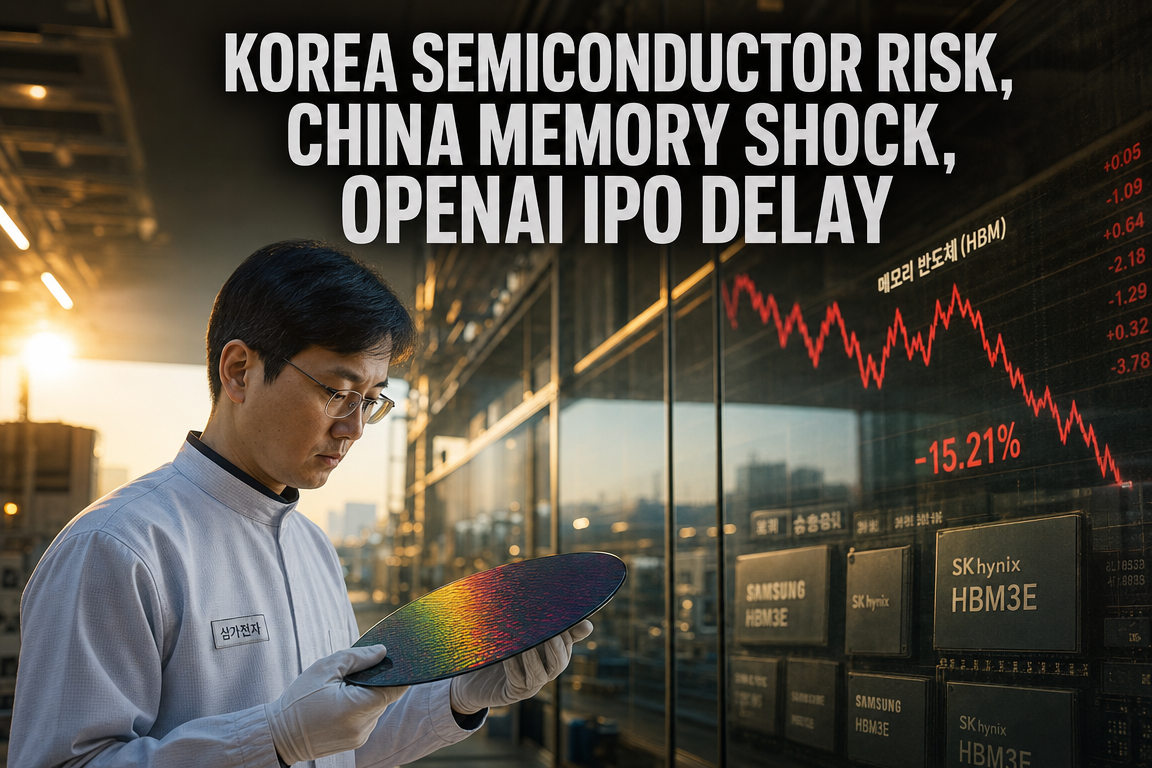
● Oil Shock, China Memory Shock, OpenAI Delay, Markets Jolt
Oil Surge, China Memory Variable, and OpenAI IPO Delay Speculation: The Real Reasons Behind the Market Shakeout
This development is not simply a case of “oil prices rising due to Middle East tensions.”
The key issues are threefold.
First, the agreement between the United States and Iran appears to have limited legal enforceability, which has revived risks around the Strait of Hormuz.
Second, Apple’s reported request for approval to use Chinese memory chips has introduced a new variable into the memory semiconductor price cycle centered on Samsung Electronics and SK Hynix.
Third, speculation that OpenAI may delay an IPO suggests that the AI investment boom is beginning to be judged not only by growth potential, but by profitability.
These three factors are linked to international oil prices, the KOSPI, the Nasdaq, foreign exchange, interest rates, and data center investment trends tied to AI.
1. Middle East Risk Re-Emerges: Why the Strait of Hormuz and Oil Prices Matter Again
The market was first shaken by rising military tensions between the United States and Iran over the weekend.
The original report notes that while the two sides reached an agreement aimed at easing tensions, the deal lacks strong practical enforceability.
In particular, a memorandum of understanding generally has limited legal force.
In corporate transactions as well, an MOU is often closer to a statement of intent than a binding contract with detailed enforcement provisions.
The same is true in intergovernmental agreements, which can remain fragile and reversible if interests diverge.
- Potential attacks on commercial vessels passing through the Strait of Hormuz
- Potential strikes on U.S. radar, drone, and missile facilities
- Expanded geopolitical risk due to hardline rhetoric
- Concerns over higher oil prices and renewed inflationary pressure
The Strait of Hormuz is one of the most critical chokepoints in global crude oil transportation.
Any military conflict in the area would not remain a regional issue; it would affect global energy prices.
Higher oil prices can reaccelerate inflation, and higher inflation may reduce expectations for central bank rate cuts.
Ultimately, Middle East risk affects not only crude prices, but also U.S. interest rates, the dollar, exchange rates, and equity market valuations.
2. The Key Market Point: Higher Oil Prices Hit Equities Twice
Rising oil prices first pressure corporate costs.
Transportation, raw materials, and power expenses rise, which can weigh on operating margins.
That is not the end of the impact.
If higher oil prices lift inflation again, central banks may become more cautious about cutting interest rates.
In other words, the first impact is on earnings, while the second is on rates and valuation multiples.
For that reason, rising oil prices should be viewed not as a short-term negative, but as a variable that can alter the global equity discount rate.
3. Apple’s Request to Use Chinese Memory Chips: More Than a Sourcing Issue
The second major issue is Apple.
The original report says Apple requested approval from the U.S. administration to purchase memory chips from a Chinese supplier.
This likely refers to CXMT, or ChangXin Memory Technologies.
The issue is that Chinese memory firms may be linked to U.S. defense-related restrictions or export control frameworks.
Even if a transaction is not fully prohibited, government approval may be required.
Apple has a clear rationale.
It can cite rising memory prices as one of the reasons for increasing prices on products such as the iPad and Mac.
In other words, Apple can argue that it needs access to Chinese memory to stabilize input costs.
At the same time, this can serve as leverage in negotiations.
4. Apple’s Real Intent: A Negotiating Tool to Pressure Memory Prices
The main issue is not whether Apple will actually use large volumes of Chinese memory.
What matters more is that Apple can use this option to weaken pricing leverage held by Samsung Electronics, SK Hynix, and Micron.
- Apple can challenge the existing supply structure dominated by the three major memory suppliers.
- Even the possibility of Chinese memory adoption can increase pricing pressure.
- If memory prices fall, Apple’s product margins may improve further.
- However, prices already raised for the iPad and Mac are unlikely to fall meaningfully.
Prices that have already increased tend not to come back down easily.
Even when input costs decline, companies often retain the benefit as margin expansion rather than passing it directly to consumers.
The reference to noodle prices in the original text reflects this dynamic.
Just as noodle prices do not easily decline even if flour becomes cheaper, Apple’s product prices are also unlikely to revert quickly if memory costs later decline.
5. What This Means for Samsung Electronics and SK Hynix
For Korean investors, this is the most important point.
The KOSPI is heavily influenced by the share performance of Samsung Electronics and SK Hynix.
Both companies are highly sensitive to the memory semiconductor pricing cycle.
Accordingly, Apple’s request to use Chinese memory is not merely an Apple-related headline; it is also relevant to the direction of the KOSPI.
That said, near-term disruption to the memory industry may be limited.
Current memory supply conditions remain tight due to demand from AI servers, HBM, and data center investment.
Unlike in the past, Apple is no longer in a position to broadly pressure suppliers simply by implying large orders.
Memory makers now have stronger bargaining power because demand from AI semiconductors and servers extends well beyond Apple.
However, the longer-term picture is different.
If Chinese memory firms improve quality and yield, and if U.S. regulatory barriers ease or are bypassed, the market could shift from a three-player structure to a four-player competitive environment.
That would create a long-term headwind for memory pricing cycles.
6. The Chinese Memory Risk That Should Not Be Ignored
The strongest warning in the original report is that Chinese memory technology should not be underestimated.
Korea has strong confidence in its semiconductor leadership.
It is true that Samsung Electronics and SK Hynix have led the global memory market.
But confidence can become complacency.
Chinese firms are narrowing the technology gap through large-scale state support, a large domestic market, and long-term investment strategies.
Even if they do not pose an immediate threat, the situation could change within five years.
In particular, price competition may emerge first in commodity DRAM, NAND flash, and some mobile memory segments.
Korean firms need to widen their lead in HBM, high-performance server memory, packaging, and the AI semiconductor ecosystem.
7. OpenAI IPO Delay Speculation: Market Sentiment Around AI Is Changing
The third issue is speculation that OpenAI may delay its IPO.
The original report notes that OpenAI may find it difficult to justify a $1 trillion valuation, which could lead it to postpone listing.
By contrast, Anthropic is cited as potentially receiving a higher valuation due to stronger growth and revenue metrics than OpenAI.
The key point is not simply that OpenAI may delay an IPO.
The more important issue is that the AI investment market is moving from broad expectations to performance validation.
- How quickly AI service revenue is growing
- Whether data center and GPU costs are sustainable
- Whether corporate users are realizing actual cost savings or revenue gains from AI adoption
- Whether AI investment returns, or ROI, are clearly demonstrated
Until now, investment has been driven largely by the fear of falling behind without AI.
Going forward, markets are likely to ask whether every $100 invested in AI generates $150 or $200 of measurable value.
This is a significant shift.
AI-related costs are beginning to appear as a meaningful expense item for companies.
8. Why OpenAI May Be Delaying Its IPO
The original report suggests that the reason for delaying an IPO may lie more in the background than in the headline explanation.
That view is reasonable.
In the current AI boom, conditions may seem ideal for going public.
Yet if a listing is still being delayed, valuation alone may not be the only issue.
Possible reasons include the following.
- Governance complexity involving nonprofit and for-profit structures
- Contractual and revenue-sharing arrangements with Microsoft
- Heavy computing costs and long-term data center investment obligations
- Insufficient visibility into profitability relative to model training costs
- Legal risks related to regulation, copyright, and data usage
- Disclosure burdens required in the IPO review process
Once a company goes public, it must disclose the numbers.
The market will examine not only revenue growth, but also operating losses, cash flow, customer retention, computing costs, and contractual obligations.
AI companies are now entering a stage where their growth narrative must be supported by financial statements.
9. The Next Stage of the AI Investment Boom: From Growth to Profitability
The AI market is not over.
Rather, the real selection process is only beginning.
In the early phase, most AI companies received high valuations.
Going forward, however, only companies that generate revenue, retain customers, and recover investment costs are likely to be rewarded.
This shift will also affect the Nasdaq.
AI software companies, cloud firms, semiconductor companies, data center REITs, and power infrastructure firms are all connected to the AI investment cycle.
If companies begin reducing AI spending, growth rates for some software firms may slow.
On the other hand, companies that can demonstrate actual productivity gains may command even higher premiums.
10. The Most Important Point Other Media Are Missing
The key issue is that these three developments are not isolated; they are linked through a single market flow.
① Middle East Risk Is Again an Inflation Risk
Uncertainty around the Strait of Hormuz could push oil prices higher.
Higher oil prices can feed inflation.
If inflation rises again, expectations for rate cuts weaken, which puts pressure on growth stock valuations.
② Apple’s China Memory Card Is Likely a Pricing Negotiation Tool
The important issue is less whether Apple will actually use Chinese memory in large volumes, and more that it now has a tool to pressure suppliers.
This could affect the long-term bargaining power of Samsung Electronics, SK Hynix, and Micron.
For the Korean market, this is directly tied to sentiment around the KOSPI.
③ OpenAI IPO Delay Speculation May Mark the Start of the AI Bubble Debate
This does not mean AI is disappearing.
It means the market is no longer satisfied with the statement that AI is transformative.
Going forward, ROI, cash flow, customer willingness to pay, and cost structure will become the main criteria.
④ The Common Thread Across All Three Issues Is Cost Pressure
Middle East risk raises energy costs.
The memory issue affects IT hardware costs and corporate margins.
The AI issue highlights the burden of data centers, GPUs, power, and cloud usage fees.
In short, the market is becoming more sensitive to cost pressure than to growth expectations.
11. Key Variables Investors Should Watch
- Whether oil prices are experiencing a temporary spike or a structural rise
- Whether military conflict near the Strait of Hormuz turns into actual supply disruption
- Whether Apple receives approval to use Chinese memory chips
- The pace of technology and yield improvement among Chinese memory firms
- HBM demand and the pricing trends of commodity memory for Samsung Electronics and SK Hynix
- Comparative revenue growth, losses, and enterprise customer trends at OpenAI and Anthropic
- Whether U.S. corporate AI investment budgets are increasing or being revised downward
- Whether rising oil prices push back expectations for rate cuts
12. Key Takeaway for Korean Investors
The Korean equity market has a high dependence on semiconductors.
For that reason, Apple’s request to use Chinese memory is highly relevant for Korean investors.
Even if AI memory demand remains strong in the short term for Samsung Electronics and SK Hynix, the long-term challenge from Chinese memory must be monitored.
AI investment sentiment is also important.
HBM demand for SK Hynix, Samsung Electronics’ high-bandwidth memory competition, power infrastructure, and data center investment are all tied to the AI cycle.
If global companies begin evaluating AI investment on ROI, indiscriminate gains in AI-related equities may become harder to sustain.
On the other hand, companies that can prove real earnings power may attract stronger capital flows.
In short, the market is moving from “all AI names go up” to “only companies that monetize AI will be rewarded.”
< Summary >
The main market headwinds are Middle East risk, Apple’s request to use Chinese memory, and speculation that OpenAI may delay its IPO.
Instability around the Strait of Hormuz could affect oil prices, inflation, and expectations for rate cuts.
Apple’s China memory card is a variable that may weaken pricing leverage in the Samsung Electronics and SK Hynix-centered memory market.
OpenAI IPO delay speculation suggests that the AI investment market is beginning to focus on profitability and ROI rather than growth alone.
Korean investors should monitor the KOSPI, semiconductors, AI data centers, foreign exchange, and interest rate trends together.
[Related Articles…]
- Semiconductor Cycle and AI Memory Investment Strategy
- AI Investment ROI and Data Center Growth Outlook
*Source: [ Jun’s economy lab ]
– 유가는 다시 치솟고, 메모리는 공격받고, 오픈AI는 상장 미루고