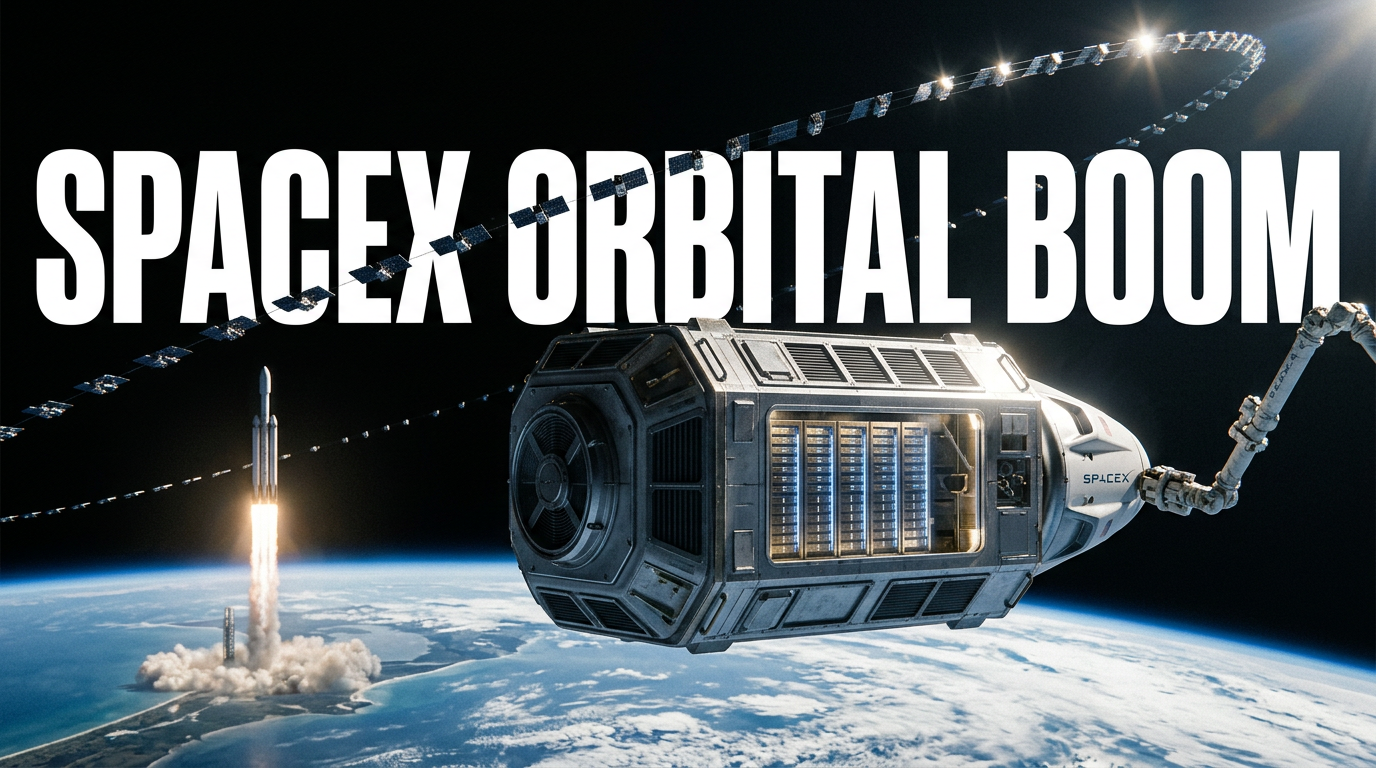
● SpaceX Starlink Space Data Centers Reshape Global Economies
How SpaceX, Starlink, and Space Data Centers Are Reshaping the Global Economic Outlook: Why You Should Study the Space Industry Now
The space industry is no longer a story about “going to Mars someday”; it is becoming a real industry connected to satellite communications, AI data centers, defense security, semiconductor testing, and even lunar base construction.
In particular, the changes driven by SpaceX and Starlink are not just about launching rockets well; the core point is that they are pushing space industry investment to become the next major pillar after semiconductors, artificial intelligence, and cloud infrastructure in the global economic outlook.
In this article, we will cover why New Space is surging, who uses Starlink, what SpaceX’s revenue structure looks like, whether space data centers are really possible, and who the Artemis project’s major competitors are.
And at the end, we will also highlight the truly important point that is relatively undercovered in other news and YouTube content.
1. Why the space industry is suddenly surging: the core point is a “cost revolution”
The biggest reason the space industry is getting attention is that SpaceX has drastically reduced launch costs.
In the past, space development was an area where governments poured massive budgets into one-off projects.
It was a structure like the Apollo project, where you launched once, explored once, and that alone became a symbol of national technological power.
But SpaceX changed the game by commercializing reusable rockets.
Instead of using a rocket once and throwing it away, it can now be recovered and reused repeatedly, greatly lowering the cost of accessing space.
This change is the starting point of the private-sector-led space industry, namely the New Space era.
When costs go down, the market opens up.
More satellites can be launched, communication networks can be built, Earth observation data can be sold, and lunar and Mars exploration become far more realistic businesses.
In the end, the space industry is now becoming a huge industrial platform where data centers, satellite communications, AI semiconductors, defense security, and cloud infrastructure all converge.
2. The difference between Old Space and New Space
To understand the space industry, you first need to distinguish between Old Space and New Space.
You need to understand this difference to see why SpaceX is valued so highly in the market.
Old Space is state-led space development.
NASA, the U.S. government, defense budgets, and traditional aerospace and defense companies such as Boeing and Lockheed Martin were at the center.
Its characteristics are reliance on national budgets, high costs, long development periods, and one-off projects.
New Space is private-sector-led space development.
Companies such as SpaceX, Blue Origin, and Rocket Lab are representative examples.
Its characteristics are reusable rockets, mass production, cost reduction, rapid experimentation, and commercialization of services.
In the past, space was “a place for exploration.”
Now space is becoming “income-generating infrastructure.”
This difference is the most important factor from an investment perspective in the space industry.
3. Why Starlink matters: satellite communications fill the last gap in internet infrastructure
Starlink is a service that provides internet using low-Earth-orbit satellites.
Traditional internet is based on fiber optic cables and ground stations.
But in mountainous regions, islands, oceans, aircraft, and war zones, ground infrastructure is weak or nonexistent.
Starlink targets this gap.
If you can see the sky, you can connect to satellites and get internet service.
That is why Starlink drew attention as an important communication tool during the war in Ukraine.
Even if ground stations are destroyed, satellite communications can continue.
The core point of Starlink is that it deploys a large number of low-Earth-orbit satellites.
Traditional satellite internet relied mainly on geostationary satellites, which meant long latency and poor service quality.
By contrast, Starlink places many satellites in lower orbits to reduce latency and improve speed.
Based on the original text, Starlink is described as expanding service to more than 166 countries and rapidly increasing paying customers.
However, for actual investment or business decisions, subscriber numbers, service countries, and revenue scale must always be reconfirmed using official materials and the latest disclosures.
4. Who uses Starlink: the key customer groups are four
The first customer group is users in rural, mountainous, and island regions.
In areas where it is difficult to install fiber optic cables, Starlink becomes a practical alternative.
Korea has extremely dense wired internet infrastructure, but the situation is different in overseas developing countries or countries with many islands.
In Indonesia, the Philippines, South Pacific island regions, and parts of Africa, the demand for satellite communications is much greater.
The second customer group is governments and public institutions.
In disaster response, wartime situations, wildfire and flood sites, border regions, and remote development projects, satellite communications become a strategic asset.
Internet connectivity is no longer just a convenience; it becomes national security and disaster-response infrastructure.
The third customer group is airlines.
Demand for internet access during long-haul flights keeps increasing.
That is because more passengers want to work, send messages, and consume content onboard.
This is why global airlines such as Emirates, Lufthansa, and American Airlines are expanding satellite internet adoption.
The fourth customer group is shipping, vessels, and special mobility sectors.
Large ships, deep-sea fishing vessels, yachts, offshore plants, and energy companies need stable communications even at sea.
This segment has higher unit prices than the consumer market and is centered on enterprise customers, so profitability is likely to be stronger.
5. Starlink’s limitations: it does not replace all internet services
Starlink is indeed a powerful service, but it cannot immediately replace fiber optic internet in cities.
It is relatively expensive, and connectivity quality can drop when the sky is blocked.
Buildings, trees, terrain, heavy rain, and clouds can also affect performance.
In addition, satellite communications are weak in underground spaces or deep inside buildings.
In other words, the essence of Starlink is not “a service that replaces all internet,” but rather “a premium infrastructure that connects places where existing internet does not reach.”
This part is important.
Starlink’s market is more likely to grow first in special high-value segments such as remote areas, aviation, shipping, defense, and disaster response, rather than in the entire urban home internet market.
6. SpaceX’s revenue structure: you should view it not as a rocket company, but as a communications and AI infrastructure company
Many people think of SpaceX as a rocket company.
But the perspective presented in the original text is different.
SpaceX’s core revenue source is increasingly shifting toward the Starlink satellite communications business.
Launch services are important, but launch alone cannot explain the company’s valuation.
Instead, rocket launches function more like internal infrastructure for continuously deploying Starlink satellites.
This structure is similar to Amazon first building internal server infrastructure and then growing it into the massive cloud business AWS.
In other words, SpaceX’s real strength is vertical integration: it builds rockets itself, makes satellites itself, launches them itself, and sells communications services itself.
Because one company controls the value chain, it gains competitiveness in cost control and speed of expansion.
The original text mentions the possibility that SpaceX will take a large share of satellite communications revenue and connect it to future AI businesses and even space data centers.
However, whether it is listed, the exact financial figures, and the subsidiary structure all require verification based on actual official materials.
From a blog reader’s perspective, it is more important to understand the big direction: “SpaceX is being revalued not as a rocket company, but as a space-based communications and AI infrastructure company.”
7. The SpaceX valuation debate: expensive by numbers, explainable by dreams
The original text discusses SpaceX valuation debates based on a scenario in which it goes public and enters the top tier of global market capitalization.
The core point is that if you look only at current revenue and profit, it is difficult to justify a valuation comparable to Big Tech.
Companies like Microsoft, Amazon, Apple, and Nvidia are already generating enormous revenue and operating profit.
By contrast, SpaceX is a company whose valuation heavily reflects future growth potential.
That is why standard PER or PSR metrics do not explain it well.
In such cases, the market jokingly uses the term PDR.
Price to Dream Ratio, meaning the multiplier of dreams.
It means the company’s valuation changes depending on how much the market believes in Elon Musk’s vision of the future.
The problem is that Elon Musk’s promises have not always been kept on time.
There have been many cases of delays or cutbacks, such as autonomous driving, robotaxis, Mars migration, and Hyperloop.
On the other hand, there have also been cases that truly changed the world, such as reusable rockets, Starlink, and the mass adoption of electric vehicles.
So from an investment standpoint, the most realistic conclusion is that “Elon Musk’s words cannot be completely ignored, but they are also hard to believe at face value.”
A conservative approach needs to assume that Musk’s timelines and targets may be exaggerated by about 2x to 5x.
8. Space data centers: the idea of solving AI-era power and cooling problems in space
As the AI industry grows, the biggest bottleneck is data centers.
AI model training and inference require enormous computing power, and that drives power and cooling costs sharply higher.
As a result, the global data center market is facing issues related to power grids, land, cooling water, and environmental regulations.
The idea behind space data centers is to solve this problem in space.
In space, solar power efficiency is high, land regulations are irrelevant, and in theory cooling may also be advantageous.
In particular, for data centers used for AI computation, space infrastructure experiments may be more suitable than terrestrial cloud storage.
However, you should not simplify it to “space is cold, so you can just put servers there.”
Space is a vacuum, so unlike on Earth, convection cooling using air or water is difficult.
Ultimately, the system must rely on radiative cooling, which releases heat in the form of electromagnetic radiation.
Large heat sinks and thermal management design become core technologies.
Another problem is radiation.
Semiconductors and memory can be vulnerable to radiation in space.
That is why cases where Korean semiconductor products such as Samsung Electronics memory and SK hynix memory are used in space environment testing are highly significant.
This is not just an experiment; it can become a point connected to future space data centers and AI semiconductor supply chains.
Finally, the biggest risk is maintenance.
If a server fails in a terrestrial data center, a person can go and replace it.
But in a space data center, repair is nearly impossible or far too expensive.
In the end, faulty equipment may have to be discarded, which could significantly undermine economic viability.
9. Conditions needed for space data centers to succeed
For space data centers to become a real industry, several conditions must be met.
First, launch costs need to fall further than they are now.
Large reusable rockets such as Starship must be operated stably.
Second, the reliability of space-grade AI chips and memory must be verified.
Semiconductors that can withstand radiation, temperature changes, vibration, and launch shocks are needed.
This is where opportunities for Korean semiconductor companies may arise.
Third, thermal management technology must be proven.
AI servers consume a lot of power, but they also generate enormous heat.
The key point is whether large server racks can be operated stably using radiative cooling alone.
Fourth, the cost and latency of data transfer between Earth and space must become low enough.
If satellite networks like Starlink are connected to space data centers, then in theory they become one space cloud infrastructure.
But for it to become a real commercial service, stability, security, speed, and cost all need to line up.
10. The Artemis project: lunar exploration is a “Mars outpost” strategy
The Artemis project is a crewed lunar exploration project led by NASA in the United States.
It can be seen as a project to send humans back to the Moon for the first time in half a century since Apollo.
But the goals of Apollo and Artemis are different.
Apollo was a competition of national technological power during the Cold War.
The symbolism of going to the Moon was huge.
By contrast, Artemis is a long-term strategy to use the Moon as an outpost for Mars exploration.
It includes lunar orbit, lunar landers, lunar bases, rovers, resource utilization, and long-duration stay technologies.
In other words, Artemis is not just an exploration project; it is a project to build the foundation of the space economy.
It also contains a competition for space dominance between the Western bloc led by the United States and the bloc centered on China and Russia.
Korea is participating in the U.S.-led Artemis coalition, so medium- to long-term opportunities may also open up in the domestic space industry.
11. Major Artemis participants: Old Space and New Space moving together
The Artemis project includes both traditional aerospace companies and New Space companies.
If you understand this structure, you can see the shift in power in the space industry.
Lockheed Martin is responsible for the Orion spacecraft.
Orion is the capsule astronauts ride in for transport.
Simply put, it is a long-distance transportation vehicle that can take people near the Moon.
Boeing plays a core role in the space launch system, or SLS.
As a representative company in the traditional aerospace industry, it still holds an important position in major national projects.
Northrop Grumman is responsible for Orion-related emergency escape systems and auxiliary equipment.
These companies also belong to the typical Old Space camp.
By contrast, SpaceX and Blue Origin compete in the lunar lander segment.
This is the stage where New Space companies begin to expand their role in earnest.
12. The difference between SpaceX and Blue Origin: they use different ways to go to the Moon
SpaceX’s Starship aims for a much larger payload capacity.
Its advantage is that it can send more equipment, robots, cargo, and infrastructure to the Moon.
However, because it uses a refueling and transfer method that involves staging near Earth before heading to the Moon, the operational difficulty is high.
If successful, the impact will be enormous, but the technical challenge is also very large.
Blue Origin’s Blue Moon is relatively closer to a transfer-from-lunar-orbit approach.
Its payload capacity may be smaller than SpaceX’s method, but the mission structure could be more stable.
From NASA’s perspective, rather than relying on just one company, a strategy of growing Blue Origin as well to reduce supply chain risk makes sense.
In the end, Artemis is not simply about who reaches the Moon first.
It is a long-term infrastructure competition that will extend to lunar logistics, lunar base construction, space resource utilization, and Mars exploration.
13. The possibility of a Tesla and SpaceX merger: big technological synergies, but also major real-world barriers
The original text also discusses the possibility of a Tesla and SpaceX merger.
If the two companies were combined, Elon Musk’s vast technological empire could be completed.
Technologically, there are many synergies.
Tesla’s batteries, energy storage systems, AI computing, and autonomous driving technologies could connect with SpaceX’s satellite network, space data centers, robots, and space base infrastructure.
It is also possible to imagine Starlink connecting with Tesla vehicles, and Tesla’s Megapacks being used in space and terrestrial energy infrastructure.
But in reality, it would not be easy.
Tesla has a large share of business in China, and SpaceX is deeply connected to U.S. defense and space security.
If the two companies were merged, U.S. government regulation, China risk, shareholder backlash, and conflict-of-interest issues could all grow significantly.
In particular, Tesla shareholders may resist being absorbed into a SpaceX-centered structure.
You also have to ask whether strengthening Elon Musk’s control is good for all shareholders.
So while a merger is not impossible, there is a major wall of politics, regulation, and shareholder approval before it could actually happen.
14. The truly important points that other news coverage mentions less
First, SpaceX’s core is not rockets but a “closed space platform.”
SpaceX is vertically integrating rockets, satellites, launches, communication networks, ground gateways, and customer touchpoints.
This structure can create lock-in effects like the Apple ecosystem or Amazon AWS.
The real money in the space industry is likely to come not from single rocket launch revenue, but from recurring communications, data, and AI infrastructure revenue.
Second, Starlink’s B2B market may be more important.
Compared with ordinary household subscribers, customers in aviation, shipping, defense, disaster response, and energy can provide higher margins.
If you look at Starlink only as consumer internet, you may underestimate the market.
Third, space data centers could become a new testbed for Korean semiconductor companies.
Memory, AI accelerators, power semiconductors, and packaging technologies that work reliably in space may become a premium market in the future.
If Samsung Electronics and SK hynix expand beyond memory for terrestrial data centers into semiconductors for the space environment, new opportunities will emerge in the AI semiconductor supply chain.
Fourth, the space industry is a security industry.
After the war in Ukraine, satellite communications became a core infrastructure for military, diplomatic, and disaster response operations.
That is also why countries view private services like Starlink strategically.
Space industry investment is not just growth stock investing; it is also tied to geopolitical risk.
Fifth, Artemis is not about lunar tourism; it is a supply chain restructuring project.
It connects lunar landers, rovers, spacesuits, communications, energy, semiconductors, materials, robots, and 3D printing.
In the space industry, you need to look at the entire value chain, not just one rocket company.
15. Checkpoints to watch from an investment perspective
The first thing to look at in space industry investment is launch costs.
Launch costs need to keep falling for satellite communications, space data centers, and lunar logistics businesses to grow.
The second is the growth in Starlink subscribers and the share of enterprise customers.
What matters is whether aviation, shipping, government, and defense customers increase more than consumer users.
The third is the stability of Starship.
Large reusable rockets must operate reliably for mass satellite launches and space data center plans to become reality.
The fourth is demand for AI data centers.
As investment in AI infrastructure keeps growing, capital may also flow into bold alternatives such as space data centers.
The fifth is regulation and geopolitics.
Space is a private industry, but it is also military and security infrastructure.
You must always look at the competition among countries such as the United States, China, Russia, Europe, and India.
< Summary >
The space industry is moving into the New Space era led by the private sector as reusable rockets lower costs.
Starlink is a key satellite communications infrastructure connecting remote areas, aviation, shipping, defense, and disaster response.
SpaceX should be viewed not merely as a rocket company, but as a space platform company expanding into communications, AI, and data centers.
Space data centers are an idea that could solve the power and cooling problems of the AI era, but major technical challenges remain in heat dissipation, radiation, and repair costs.
The Artemis project is a long-term project that goes beyond lunar exploration to build a Mars outpost and a space supply chain.
From an investment perspective, you need to look at launch costs, Starlink enterprise customers, Starship stability, AI data center demand, and geopolitical risk together.
[Related Articles…]
SpaceX Growth Strategy and Valuation Outlook
AI Data Centers and Global Infrastructure Investment Trends
*Source: [ 티타임즈TV ]
– 아르테미스, 위성 통신, 우주 데이터센터…’우주산업’을 당장 공부해야 하는 이유