● AI Hub Race, HBM, K-Data
Why Global Big Tech Covets Korean Data: K-Data, HBM, and AI Infrastructure Create a New Economic Outlook
The core point of this discussion is not simply that “Korea should also build its own AI models.”
Rather, the more important question is whether “global AI winners can be made to pass through Korea no matter what.”
Instead of burning through massive capital like the U.S. and China to build general-purpose foundation models from scratch, it is a far more realistic strategy for Korea to leverage its already strong HBM, semiconductor manufacturing data, medical data, shipbuilding manufacturing data, and AI infrastructure to become a global AI hub.
In particular, the next bottlenecks in the AI industry are more likely to emerge in power, memory, data alignment, cloud transition, and vertical AI by industry than in the model itself.
In this article, we will summarize the AI bubble debate, SMR and energy investment, the Claude blocking issue, the limits of sovereign AI, and K-data monetization strategies all at once.
1. Is the AI industry currently in a bubble or a supercycle?
One of the hottest debates in the global economic outlook right now is whether AI is in a bubble.
As companies like Nvidia, OpenAI, Anthropic, Microsoft, Amazon, and Google continue making enormous AI infrastructure investments, some have pointed out that “money may just be circulating among them without final demand.”
-
The core point of the criticism
The structure in which Nvidia invests in OpenAI, and OpenAI then buys Nvidia chips again, appears like circular trading.
The concern is that capital expenditures on AI data centers and GPUs are so large that if actual revenue does not follow, it could become a bubble.
-
The core point of the rebuttal
OpenAI and Anthropic together are already generating about $80 billion in annualized revenue, roughly 100 trillion won.
Of course, this is still small compared with the scale of AI-related CAPEX, but it is already hard to say that there is “no demand” when substantial enterprise and developer demand already exists.
-
The more important point
The hyperscalers are not financing AI investments recklessly with corporate bonds; they are investing using operating cash flow generated in the existing cloud market.
Companies are moving their data to the cloud faster in preparation for the AI era, and in the process, the cash flow of AWS, Microsoft Azure, and Google Cloud is strengthening.
In other words, AI investment is moving not as mere speculation, but on top of real demand for cloud transition, data alignment, workflow automation, and improved enterprise productivity.
The AI bubble debate will continue, but at least for now, the interpretation that we are closer to the “beginning of an AI supercycle” than the “end of a bubble” is plausible.
2. AI benefits are still visible only in short industry cycles
The areas where AI is showing the clearest productivity gains right now are industries with short outcome-verification cycles, such as coding, software development, and retail product placement.
Developers can use AI coding tools to check results within minutes.
Software can be built and tested in a day or two.
Convenience stores and commerce companies can change product placement and recommendation algorithms with AI and see sales response within a week.
But the truly major impact has not arrived yet.
-
Drug development
For AI-discovered drug candidates to pass Phase 2 and Phase 3 clinical trials and actually reach the market, it takes years.
If the economics of AI-based drug development are proven, the case for AI investment could become much stronger.
-
Manufacturing optimization
Manufacturing industries such as semiconductors, shipbuilding, automobiles, and batteries depend on data quality and process optimization.
If AI improves process yields, equipment maintenance, and design automation, it can directly affect corporate profit margins.
-
Overall enterprise operations
Many large Korean corporations still have not fully integrated external LLMs into their workflows because of concerns over data leakage.
If security issues and data governance are resolved, demand for enterprise AI could grow far more than it is now.
In the end, the AI revenue visible now may be only a portion of the total potential.
Just as PCs evolved beyond forecasts of “one per household” into an era of multiple devices per person, agentic AI is still before widespread adoption.
3. The next bottlenecks in AI infrastructure are power, memory, cooling, and data
When looking at the AI industry, focusing only on model companies narrows the view.
The real investment opportunities are likely to come from the bottlenecks that models must inevitably pass through as they grow.
-
Memory bottleneck
High-performance memory is essential for AI training and inference.
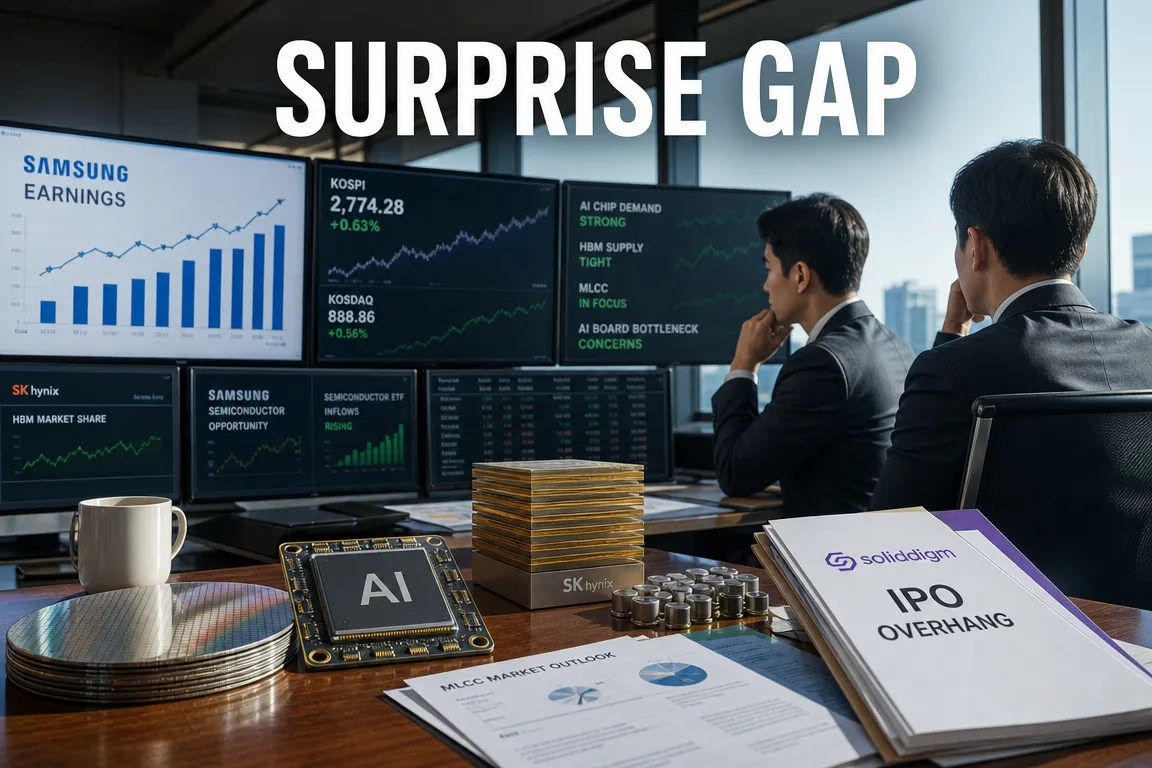
This is why SK hynix and Samsung Electronics are so important in the HBM market.
As global AI infrastructure investment expands, semiconductor investment flows will continue to draw attention.
-
Power bottleneck
AI data centers require enormous amounts of electricity.
That is why SMR, or small modular reactors, are being discussed as a leading candidate.
Companies such as NuScale Power, Oklo, and X-energy are commonly mentioned.
-
Energy substitution potential
However, we should not conclude that SMR must necessarily be the final winner.
If a combination of solar power, wind power, and ESS can create a cheaper and more stable structure, the energy solution for AI data centers could change.
-
Cooling bottleneck
Data centers packed with high-performance GPUs face serious heat problems.
Immersion cooling, water-cooling systems, and data center thermal management companies could emerge as a new value chain.
-
Data bottleneck
In the AI era, labeled and aligned data matters more than simply having a lot of data.
Korea’s greatest advantage is precisely this sophisticated data ecosystem.
In short, the winners of the AI industry will not be only “the smartest model,” but possibly “the companies that control the infrastructure and data that make the model run.”
4. Why a global AI hub strategy is more realistic than building a proprietary foundation model
Korea may find it attractive to directly build a general-purpose foundation model at the level of the U.S. and China.
But in reality, the scale economy, GPU acquisition, power, and capital all present major limitations.
The perspective of CEO Jooyoung Yoon and partner Yonggwon Lee is clear.
Rather than forcing a “K-OpenAI” or “K-Anthropic,” it is more powerful to create a structure that makes global AI companies inevitably come to Korea to train and collaborate.
-
Foundation models are already in an ultra-large-scale competitive landscape
OpenAI, Anthropic, Google DeepMind, Meta, xAI, and major Chinese AI companies are pouring in massive capital and computing power.
Competing in the same way may be comparable to trying to recreate the World Wide Web or ASML from scratch.
-
Korea’s strength lies more in essential infrastructure than in the model itself
Korea has strengths in HBM, semiconductor manufacturing capability, advanced manufacturing data, medical data, and shipbuilding data.
These are assets that global frontier AI companies cannot help but covet.
-
A similar approach to Taiwan’s TSMC strategy
Rather than focusing on building a sovereign AI model of its own, Taiwan has grown TSMC and the semiconductor manufacturing ecosystem into a national strategic asset.
Korea would also be more realistic in treating HBM, advanced manufacturing, and data infrastructure as strategic assets.
In conclusion, Korea should think not as a “late mover in model competition,” but as an “AI infrastructure hub that model winners must pass through.”
5. The real value of K-data that global Big Tech is eyeing
Korea’s most underrated asset is data.
In particular, data in the medical, manufacturing, semiconductor, and shipbuilding sectors can have very high training value from the perspective of global AI companies.
-
National Health Insurance data
Through the National Health Insurance system, Korea has relatively systematically accumulated medical records over people’s life cycles.
The fact that disease, prescription, treatment, and screening data have been accumulated over the long term gives it enormous value for drug development, disease prediction, and medical AI model training.
-
Comparison with the UK Biobank
The UK Biobank is a core asset used by global pharmaceutical companies and research institutions based on long-term longitudinal data from hundreds of thousands of people.
Korea’s medical data may have even greater potential in terms of scale and sophistication.
-
Semiconductor manufacturing data
Semiconductor process data is directly tied to yield improvement, defect prediction, and equipment optimization.
If AI is to improve actual industrial productivity, this kind of high-quality manufacturing data is necessary.
-
Shipyard manufacturing data
Korea’s shipbuilding industry has accumulated data on design, welding, process management, and supply chain optimization.
It is extremely good industrial data for building vertical AI.
The problem is not handing this data over to foreign companies, but monetizing it while preserving data sovereignty.
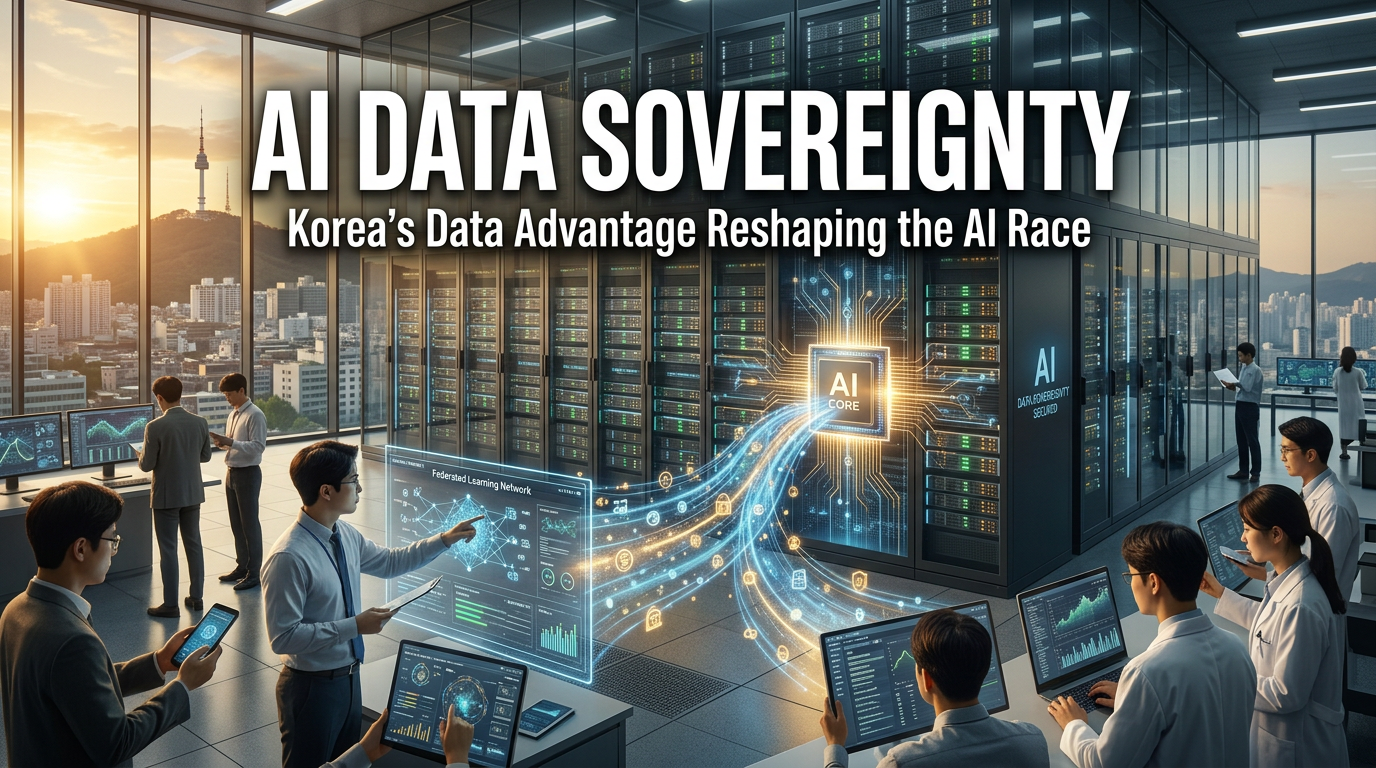
Here, the core point is federated learning.
6. Data should not be handed over; the model should come to Korea to train
Many people worry that “once data is given away, it is over.”
That is correct.
If raw data is handed over wholesale, data sovereignty can be lost.
That is why the necessary approach is federated learning.
-
Existing method
Data is sent to where the model is located.
In this case, the risk of raw data leakage is high.
-
Federated learning method
The model enters the environment where Korea’s data resides.
The model is trained inside domestic companies or public institutions, and only the training results are taken out, not the raw data.
-
Korea’s strategic opportunity
Korea can platformize its data.
It can make foreign AI companies come to Korea to train, and Korea can secure data usage fees and platform revenue.
If this structure is built, Korea can become not just a data provider, but a hub for global AI training.
It is a structure that can protect data sovereignty while also bringing in the economic gains of the AI industry.
7. The sovereign AI debate: necessary, but not something to concentrate all resources on
After the Claude blocking issue, the argument that “Korea also needs sovereign AI” has grown stronger.
From a national security or strategic technology perspective, the claim that a country needs AI models it can control is certainly valid.
But there are also aspects that must be viewed realistically.
-
The performance gap problem
Even if Korea builds its own model, simply reaching 95%, 98%, or 99% of a global top-tier model may not be enough.
That is because companies and users tend to want to use the best-performing model in the end.
-
Dependence on open-source models
Even if models are built domestically, there is a possibility they will be based on Chinese or foreign open-source models.
In that case, geopolitical risks and security issues must be considered together.
-
The issue of resource allocation
Korea’s capital, talent, GPUs, and power are not infinite.
If all capabilities are concentrated on general-purpose foundation models, investments in HBM, manufacturing data, medical data, and vertical AI, which Korea can do well, may instead be weakened.
Sovereign AI may be necessary, but it should not become the entirety of a national AI strategy.
Korea may have a bigger opportunity in vertical AI, data alignment companies, and industry-specific AI platforms that solve industrial problems rather than in general-purpose models.
8. How should we view the Claude blocking issue?
The issue in which some Anthropic Claude functions were restricted at the U.S. government level should not simply be interpreted as “the U.S. will not let AI out.”
-
National security technology issue
If a particular AI model is judged to have advanced in hacking capability, it can be classified as a national security technology.
In that case, it is not strange for the U.S. government to temporarily restrict access.
-
The entire performance was not blocked
In some benchmarks, there are evaluations that performance outside the hacking domain actually got worse.
In other words, this was likely a restriction on certain risky functions, not on all AI functions.
-
Political relations are also a variable
There is also analysis that Anthropic had friction with the U.S. administration over defense procurement and human rights issues.
Therefore, it is not necessary to immediately generalize this incident into “Korea will not be able to use external LLMs.”
The possibility that the U.S. will completely block all AI models from allied countries is low.
Just as the internet, YouTube, Gmail, and cloud services operate within the global economic system, AI models are also likely to open gradually within an economic framework of interdependence.
9. K-Anthropic is less important than K-Scale AI, K-Optum, and K-Tempus
The most important message in this discussion is not “let’s make K-Anthropic,” but “let’s build data infrastructure companies like K-Scale AI.”
-
Scale AI-type companies
These are companies that align, label, and manage the quality of data needed for AI model training.
As the AI industry grows, the importance of such data infrastructure companies will inevitably grow as well.
-
Optum-type companies
This is a company model that provides insurance, hospital, pharmaceutical, and healthcare analytics services based on medical data.
Combined with Korea’s National Health Insurance data, it has enormous industrial potential.
-
Tempus-type companies
This is a company model that supports precision medicine and drug development by using cancer diagnostics, genomics, and clinical data.
It is a representative direction in which Korea’s medical data ecosystem and AI technology can combine.
Bloomberg also tried to build its own LLM using proprietary financial data, but eventually moved toward a strategy of combining data licensing with model competition rather than competing on model performance alone.
Walmart is also cited as a case where it attempted to develop its own LLM but changed direction after recognizing the difficulty of competing in general-purpose models.
The core point is not to build a 90-point in-house model.
It is to combine a 100-point global model with Korea’s high-quality data to solve industry-specific problems.
10. Policy direction should also shift from blacklist to whitelist
In the AI era, data regulation determines industrial competitiveness.
Korea still tends to rely heavily on blacklist-style regulation, where “this is not allowed and that is not allowed.”
-
Blacklist policy
There are many prohibited items in data use, making it difficult for companies to even try.
If regulatory uncertainty is high, both startups and large corporations become hesitant to actively commercialize AI.
-
Whitelist policy
This approach first opens up the range of possible uses and then makes post hoc adjustments if problems arise.
Japan has recently drawn attention for data openness and AI utilization, and that is also related to this policy shift.
To grow the K-data industry, institutional infrastructure is needed so that public and private data can be used safely.
Federated learning, data clean rooms, anonymization, security audits, and usage fee systems must all be designed together.
11. AI value chain checkpoints to consider from an investment perspective
From the perspective of individual investors, rather than choosing a specific stock right away, it is important to study where AI bottlenecks occur.
In particular, Korean investors often focus on Samsung Electronics and SK hynix, but if you go one step deeper, a broader range of opportunities appears.
-
First, look at the sectors where bottlenecks emerge.
You need to see what becomes scarce as AI models grow.
Typical examples include GPU, HBM, power, cooling, network, data, security, and cloud costs.
-
Second, look at acquisitions and partnerships by large corporations.
You should check which startups Nvidia, Microsoft, Amazon, Google, and major cooling equipment companies acquire or strategically partner with.
This is one of the fastest ways to verify whether a technology is real.
-
Third, look at the possibility of mass production.
Even if a technology looks good, if it cannot be mass-produced, it is hard to change an industry.
In particular, in power, cooling, and semiconductor materials, components, and equipment, mass producibility and supply chain stability are key.
-
Fourth, look at total cost of ownership.
Lower adoption cost alone does not make a technology good.
Total cost of ownership, including operating costs, maintenance costs, electricity costs, and replacement costs, determines economic viability.
-
Fifth, merger and acquisition potential also matters.
Companies with technologies that can dominate the next standard may not only grow independently but could also be acquired by Big Tech at a high price.
Just as Google paid a high price to acquire YouTube, which later generated enormous revenue, Big Tech acquisitions can instead become a catalyst for service expansion.
What matters from an investment perspective is not only “the most famous AI company right now.”
It is the ability to see which companies are hidden in which bottleneck segments today but may be on the finish line of the AI industry 4 or 5 years from now.
12. The most important points that other news does not clearly explain
Many news stories focus on Korean AI models, sovereign AI, Nvidia stock prices, and HBM supply competition.
But the truly important points are a little different.
-
First, Korean data is not crude oil but a refined industrial asset.
The core point is not simply that there is a lot of data, but that it is sophisticated data connected to real industries such as medical care, manufacturing, semiconductors, and shipbuilding.
-
Second, data sovereignty and monetization must be possible at the same time.
If the model comes to Korea to train without raw data being handed over, security and monetization can both be achieved.
-
Third, Korea can become not a late mover in AI models, but an AI training hub.
Global frontier models can be made to come in to train on Korea’s medical data, semiconductor manufacturing data, and shipbuilding data.
-
Fourth, the decisive battleground in AI policy is the regulatory approach.
If blacklist-style regulation is maintained, it will be difficult for K-data companies to emerge.
A whitelist-style data utilization policy with safeguards is needed.
-
Fifth, the goal of Korean AI should not be a general chatbot but the solving of industrial problems.
Building sharp vertical AI in the manufacturing, medical, shipbuilding, semiconductor, and financial sectors that Korea knows well is more advantageous in terms of global scalability.
In the end, Korea’s AI strategy should be closer to “not let’s build our own OpenAI,” but rather “let’s make OpenAI, Anthropic, and Google have no choice but to come train in Korea.”
13. The AI industry strategy Korea should pursue going forward
-
Strengthen HBM and semiconductor infrastructure
The core of AI infrastructure is high-performance memory.
Samsung Electronics and SK hynix’s next-generation HBM roadmap, packaging technology, and supply chain strategy will remain important observation points.
-
Build a medical data platform
A research and commercialization platform is needed to safely utilize National Health Insurance data and hospital data.
It can expand into drug development, precision medicine, insurance risk analysis, and disease prediction AI.
-
Monetize manufacturing data
Semiconductor, shipbuilding, battery, and automobile manufacturing data are assets that global AI companies cannot easily obtain.
A strategy to transform this into industry-specific AI platforms is necessary.
-
Secure data sovereignty based on federated learning
The model should come into Korea rather than data being sent overseas.
This structure can turn Korea into a global AI data hub.
-
Cultivate K-Scale AI-type companies
Companies that build data labeling, alignment, quality management, and industry-specific datasets should be nurtured.
This could become a broader and more sustainable revenue opportunity than model competition.
< Summary >
The AI industry is still closer to the beginning of a supercycle than the end of a bubble.
AI benefits are currently appearing first in areas with short verification cycles, such as coding and software.
As AI performance is confirmed in long-cycle industries such as drug development, manufacturing, medical care, and shipbuilding, demand could grow further.
It may be inefficient for Korea to directly build general-purpose foundation models like the U.S. and China.
Instead, a strategy that leverages HBM, semiconductor manufacturing data, medical data, shipbuilding data, and AI infrastructure to become a global AI hub is more realistic.
The core point is not to hand over data, but to make global models come to Korea to train.
Sovereign AI is necessary, but it should not become the entirety of national strategy.
Korea should nurture data infrastructure companies like K-Scale AI, K-Optum, and K-Tempus rather than K-Anthropic.
From an AI investment perspective, do not look only at model companies; also look at power, memory, cooling, cloud, and data bottlenecks.
[Related Articles…]
- AI Infrastructure Supercycle and Global Big Tech Investment Trends
- Why a Korean AI Hub Strategy Matters in the Data Sovereignty Era
*Source: [ 티타임즈TV ]
– 글로벌 빅테크가 눈독 들이는 K-데이터의 위력 (조용민 언바운드랩스 대표, 이용권 고릴라PE 파트너)