● Tesla, Crash, Selloff, Robotaxi, FSD, AI, Breakout
The Real Reason Tesla Shares Fell 7%: More Important Than the Semi Accident Is Robotaxi, FSD, and the July 7 Announcement Scenario
The key issue in this Tesla story is not simply why the stock fell.
The Miami robotaxi launch, Austin Cybercab road testing, expectations for FSD version 15, the Q2 delivery surprise, and the possible July 7 announcement are all connected.
Some interpretations attribute Tesla’s share decline to the Semi truck accident, but that explanation is weak when the timing and nature of the incident are examined.
The market had already priced in the delivery upside, and the more likely trigger was profit-taking after the announcement.
More importantly, Tesla is in a transition from an automaker to an AI company built around autonomous driving.
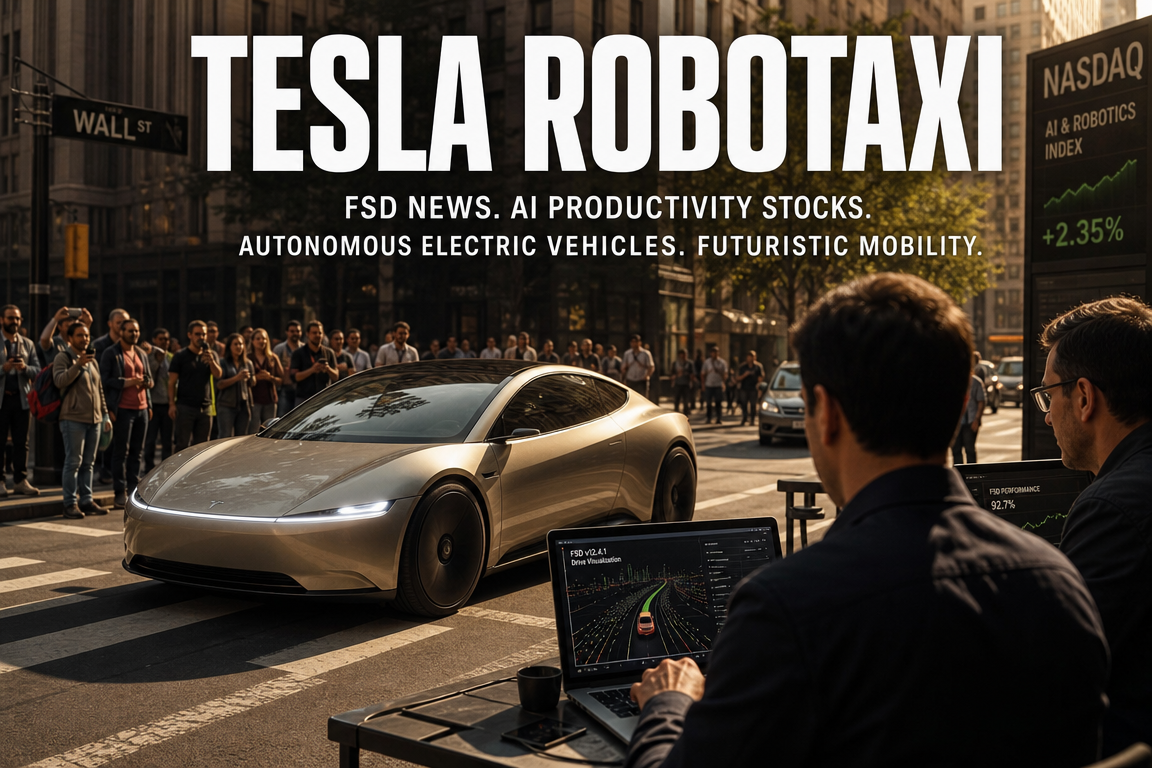
1. Miami Robotaxi Launch: A Key Signal of Tesla’s Autonomous Driving Expansion
Tesla’s official robotaxi account announced Miami service with the message, “What’s up, Miami?”
The significance of the Miami robotaxi launch is not simply the addition of one more city.
It indicates that Tesla is expanding autonomous driving services beyond its Texas-centered testing phase into major U.S. metropolitan areas.
Published ride videos show vehicles operating in downtown traffic without anyone in the driver’s seat or passenger seat.
This suggests that Tesla’s FSD technology is moving closer to commercial deployment.
The current service area is reported to be about 20 square miles.
That area covers a substantial portion of Miami’s key commercial districts and transportation hubs.
It is more than a limited test zone and appears capable of covering meaningful urban mobility demand.
Even if Miami International Airport is included in the service area, curbside pickup and drop-off at the terminal are still not legally permitted, according to reports.
In other words, access near the airport is possible, but terminal service still faces regulatory constraints.
2. Why Miami Matters: Robotaxi Expansion Is About Validation, Not Just Speed
Some investors view Tesla’s robotaxi expansion as too slow.
However, Tesla’s priority is not simply adding cities, but validating FSD across diverse road environments.
Miami combines tourist traffic, dense urban driving, commercial districts, and airport-related mobility demand.
Operating robotaxis in this environment can significantly improve the quality of Tesla’s autonomous driving data.
Austin remains the core location for Cybercab testing.
The fact that a steering wheel- and pedal-free Cybercab is already being tested on public roads suggests Tesla is moving from Model Y-based robotaxi service toward a dedicated robotaxi platform.
Tesla’s strategy appears to be to expand robotaxi service coverage first with Model Y vehicles, then introduce Cybercab in areas where road validation is complete.
If so, the Miami launch may be less about a single new service and more about preparing infrastructure for broader Cybercab deployment.
3. Phoenix and Nevada: Tesla’s Robotaxi Network Is Expanding
Tesla has also indicated expansion plans for Phoenix, Arizona.
Nevada regulators are reportedly considering a permit request for 5,000 robotaxi vehicles.
Investors should track this closely.
Robotaxi is not a one-time vehicle sales business, but a platform model in which one vehicle can generate repeated revenue.
Traditional auto businesses recognize revenue once when a vehicle is sold.
By contrast, robotaxi operations can generate mobility service fees, operating data, AI training value, and fleet management revenue.
If this model becomes established, Tesla’s valuation will be difficult to explain using EV market share alone.
Ultimately, Tesla’s long-term stock performance will depend not only on vehicle deliveries, but on how quickly autonomous service revenue becomes visible.
4. Was the Semi Truck Accident Really the Cause of Tesla’s Share Drop?
Recent commentary linked Tesla’s stock decline to the Semi truck accident.
However, the date and circumstances suggest caution in making that connection.
According to reports, the accident occurred on June 28, U.S. time.
The vehicle struck a stopped car from behind, and two occupants were killed.
Some accounts suggested possible driver fatigue.
Importantly, Tesla’s Semi does not yet have FSD installed.
That means the crash should not be treated as an FSD-related incident, but rather as a case involving human driving.
It has not been officially confirmed whether automatic emergency braking was activated.
Tesla shares fell more than 7% after the Q2 delivery report.
There was roughly a four-day gap between the accident and the stock decline.
For that reason, the Semi accident alone is not a sufficient explanation for the share drop.
5. Gene Munster’s View: “The Market Already Knew the Good Number”
Gene Munster of Deepwater Asset Management explained Tesla’s post-earnings decline on CNBC.
His interpretation is straightforward.
Tesla’s Q2 deliveries were better than expected.
Yet the stock fell after the announcement.
This is consistent with a “buy the rumor, sell the news” pattern.
Munster noted that Tesla stock had already risen about 12% over the prior week before the release.
By comparison, the Nasdaq gained about 4% over the same period, meaning Tesla had already moved sharply ahead of the announcement.
This was likely driven by unofficial expectations that Q2 deliveries would grow by about 22%.
In other words, the positive surprise had already been priced in, and short-term investors likely took profits after the release.
From this perspective, the decline looks more like a correction after anticipation rather than a deterioration in fundamentals.
6. Has the EV Downturn Ended? The Real Meaning of the Delivery Surprise
Munster said the EV market has gone through a difficult two-year period.
Based on the original text, sales were down 1% in 2024 and 8% in 2025.
That backdrop had reinforced concerns about weakening EV demand.
However, Tesla’s stronger-than-expected deliveries this quarter suggested that some suppressed demand may be returning.
Higher U.S. gasoline prices also appear to have supported EV demand.
When gasoline prices rise, the economic case for EVs becomes more attractive for consumers.
Still, Munster emphasized that Tesla’s growth rate should be assessed even apart from gasoline price effects.
The key question is whether this delivery improvement is a one-off or the beginning of a broader demand recovery.
If the market viewed the number as durable growth, the stock would likely have continued higher.
The sharp decline instead suggests that investors still see the improvement as potentially temporary.
That makes Q3 deliveries and margin trends especially important.
7. Is Tesla an Automaker or an AI Company?
Elon Musk has repeatedly said Tesla is no longer just a car company.
Many Tesla investors broadly agree.
However, that does not mean the automotive business is unimportant.
Tesla vehicles function as physical AI systems that collect data on public roads.
Millions of Tesla vehicles worldwide continue to generate training data for FSD.
That data can also extend to robotaxi services, Optimus humanoid robots, logistics automation, and energy management systems.
For that reason, Tesla’s delivery volume still matters.
The more vehicles on the road, the more data is generated, and the faster autonomous AI performance can improve.
From an AI investment perspective, Tesla vehicle sales should be viewed not only as revenue, but also as expansion of AI infrastructure.
8. July 7 Announcement: Will Cybercab Mass Production Be Discussed?
Tesla’s community has been closely watching a possible July 7 announcement.
The backdrop is a remark by Tesla Vice President Lars Moravy that he would discuss production scaling.
That has led the market to speculate that Cybercab mass production could be announced.
If Tesla were to disclose a mass production plan for Cybercab, it would be highly significant.
Cybercab is a dedicated robotaxi vehicle without a steering wheel or pedals.
Mass production of such a vehicle would imply strong confidence in unsupervised autonomous driving commercialization.
Nothing is confirmed yet.
Still, the recent sequence of events suggests Tesla may be sending a series of signals ahead of a larger announcement.
The Model YL launch, Miami robotaxi rollout, Austin Cybercab road testing, and the FSD version 14 light release all appeared around the same period.
Individually, these may look like separate events, but together they suggest Tesla’s autonomous driving commercialization roadmap is becoming more concrete.
9. The Key Point Few Reports Emphasize: The Real Variable Is Not Deliveries, But Trust Re-Establishment
The most important point in this Tesla case is not the headline numbers.
The market already had some awareness that Q2 deliveries would be solid.
That is why the post-announcement decline was not surprising.
The real issue is whether investors begin to trust Tesla’s growth narrative again.
The market is currently viewing Tesla through two lenses.
The first is the automaker lens, focused on slowing EV demand and rising competition.
The second is the AI platform lens, centered on FSD, robotaxi, Cybercab, and Optimus.
For Tesla shares to move decisively higher, the second view must be supported by real numbers.
That means expanded robotaxi service areas, actual paid usage, validated safety performance, regulatory approvals, and a clearer Cybercab production schedule.
The market wants data, not just narrative.
As a result, robotaxi operating metrics may matter more than Q3 deliveries.
Key metrics to watch include miles driven, intervention frequency, paid rides, service-area expansion speed, and revenue per vehicle.
Once those figures begin to appear, Tesla’s valuation could be recalibrated materially.
10. What Tesla Shareholders Should Watch Now
First, the July 7 announcement.
Investors should determine whether the discussion centers on Cybercab mass production, production scaling, FSD improvements, or robotaxi deployment plans.
Second, the timing of FSD version 15.
Tesla has suggested that broader robotaxi expansion may accelerate after FSD version 15, making this update an important inflection point.
Third, operational stability in Miami robotaxi service.
Performance in a complex environment involving downtown traffic, commercial areas, and airport proximity is critical.
Fourth, the status of Nevada’s 5,000-vehicle permit request.
If approved, Tesla’s robotaxi program could move from testing toward scale economics.
Fifth, Q3 deliveries and margins.
The Q2 surprise will be judged by whether the next quarter confirms it.
Sixth, U.S. risk appetite in equity markets.
Tesla remains sensitive to rates, Nasdaq performance, and AI-related sentiment.
11. Tesla’s Current Position from an Investment Perspective
Tesla is currently positioned between an EV company and an AI company.
That transition naturally creates volatility.
Strong vehicle deliveries can lift the stock in the short term.
But if the market doubts sustainability, profit-taking can quickly follow.
By contrast, if Tesla delivers clear commercialization metrics in robotaxi and FSD, its valuation could move beyond the framework used for traditional automakers.
In that sense, the key issue is not EV sales recovery, but the proof of an autonomous revenue model.
If Tesla can mass-produce Cybercab and expand the robotaxi network across multiple cities, the market may once again value the company as an AI infrastructure business.
If the announcement is weaker than expected, or if regulatory and safety issues persist, the stock may continue to trade like an automaker.
For shareholders around $393, the more important question is not daily price movement, but which metrics Tesla uses to demonstrate its AI transition.
< Summary >
Tesla’s sharp share decline is difficult to attribute to the Semi truck accident.
The accident was not directly related to FSD, and the stock drop occurred after the Q2 delivery release.
Gene Munster argued that the delivery upside had already been priced in and that the post-release move reflected profit-taking.
The Miami robotaxi launch is an important signal that Tesla’s FSD and autonomous driving services are expanding into major cities.
Austin Cybercab testing, the Phoenix plan, and Nevada’s 5,000-vehicle permit request all point to potential growth in Tesla’s robotaxi network.
If the July 7 announcement includes Cybercab mass production or production scaling, expectations for Tesla’s AI transition could strengthen further.
The main items to watch are Q3 deliveries, FSD version 15, robotaxi operating data, and the pace of regulatory approvals.
[Related Articles…]
- Tesla Robotaxi Expansion and Stock Outlook: Key Analysis
- AI Investment Trends and U.S. Growth Stock Strategy
*Source: [ 오늘의 테슬라 뉴스 ]
– 세미 사고 때문에 주가 떨어졌다고요? 진 먼스터 “이 숫자, 시장은 이미 알고 있었다” — $393 테슬라 주주가 알아야 할 진실
● War-Driven Liquidity Surge
The Real Reason Stocks Rose Despite the Middle East War: Debt-Driven Liquidity Stronger Than War Risk
Why did global equities rise instead of collapse after the Middle East war erupted?
The key driver was not simply that markets ignored the war.
Rising defense spending, postwar reconstruction costs, energy infrastructure investment, supply-chain realignment, and higher government debt together created new liquidity.
In particular, this market priced in the expectation that fiscal policy could translate into corporate revenue, even amid uncertain interest-rate forecasts.
Ultimately, the postwar equity rally was driven less by risk appetite than by a structure in which governments borrowed and spent, and that spending became revenue for selected industries.
1. The Main Factors Behind Equity Gains Despite the Middle East War
War typically unsettles markets.
Oil prices rise, inflation pressure increases, safe-haven demand strengthens, and equity markets often weaken.
This time, however, the pattern was different.
The war created near-term shocks, but it also gave governments a stronger rationale to increase spending.
- Defense budgets began to rise.
- Demand for rebuilding damaged infrastructure in the Middle East increased.
- Investment needs for energy security expanded.
- Nuclear power, SMRs, renewables, refining capacity, and energy storage infrastructure attracted attention.
- Markets began to price in the possibility that fiscal spending would flow into corporate revenue.
In short, war is a risk to markets, but it also provides a powerful justification for higher public spending.
That is the most important point for understanding the recent equity rally.
2. What Debt-Led Liquidity Means for Equities
The recent move can be summarized as: debt-created liquidity supported asset prices.
Governments need funding to expand defense budgets, support reconstruction, and build energy infrastructure.
That funding is difficult to secure through taxes alone.
As a result, governments issue bonds and expand debt.
The transmission mechanism is straightforward.
- Governments issue sovereign debt.
- The proceeds are spent on defense, construction, energy, and infrastructure.
- That spending becomes orders and revenue for related companies.
- Investors price in potential earnings improvement.
- Equities can rise even in a war-risk environment.
Government debt is therefore not only a burden.
From the market perspective, it can function as fiscal liquidity that supports earnings.
That is the core reason equities rose despite the war.
3. The Impact of Defense Spending Increases on Equities
After the Middle East war, countries have become more willing to expand defense budgets.
War provides one of the strongest political justifications for higher defense spending.
When security risks rise, voters are often more willing to accept such increases.
The likely beneficiaries are relatively clear.
- Defense contractors
- Aerospace companies
- Drone and unmanned systems firms
- Cybersecurity companies
- Satellite communications and surveillance firms
- Military logistics and defense component suppliers
Higher defense spending is not only a cost increase.
For companies, it can mean long-term contracts and more stable revenue visibility.
That is why defense stocks often outperform when geopolitical risk rises.
4. The Additional Investment Cycle Created by Postwar Reconstruction
Destroyed infrastructure in the Middle East will eventually need to be rebuilt.
The scope is broad, including roads, ports, power grids, telecom networks, refining facilities, hospitals, and residential infrastructure.
This requires substantial funding.
Governments, international organizations, and private financiers may provide capital, while global companies compete for project awards.
- Construction and plant engineering firms
- Power infrastructure companies
- Telecom equipment firms
- Refining and petrochemical equipment suppliers
- Logistics and port operators
- Engineering and project management firms
Investors are often looking ahead to the reconstruction cycle rather than the conflict itself.
For some sectors, war-related disruption shifts into expectations for new contract demand.
5. Why Energy Transition May Accelerate Further
The war has once again highlighted the importance of energy security.
It has strengthened the question of how long countries can remain dependent on a limited number of oil and gas suppliers.
That concern translates into energy transition investment.
The following areas are drawing attention:
- Nuclear power
- SMRs
- Renewable energy
- Power grid investment
- Energy storage systems
- LNG infrastructure
- Refining capacity for greater imports of U.S. light crude
As instability in the Middle East increases, importing countries seek to diversify supply.
For example, importing more U.S. crude requires refining systems suited to that grade.
Upgrading refineries, expanding ports, and building storage capacity require substantial capital.
That spending is also financed through public budgets and private investment.
As a result, war can accelerate efforts to reduce fossil-fuel dependence and invest in energy infrastructure.
6. Why U.S. Treasury Yields Cannot Easily Fall
The problem is that higher government spending requires more bond issuance.
When Treasury supply rises, bond prices fall and yields rise if demand is insufficient.
This is one of the main reasons U.S. Treasury yields have remained elevated.
- Defense spending needs are increasing.
- Postwar reconstruction and foreign support require funding.
- Energy security investment is expanding.
- Supply-chain restructuring requires capital.
- Interest costs on existing government debt are also rising.
All of these pressures increase bond issuance.
When supply grows faster than demand, yields move higher.
In that sense, war is not only a geopolitical risk but also a fiscal event that affects rates.
7. Why Safe-Haven Demand Is Less Powerful Than Before
In the past, wars and financial crises often drove investors into U.S. Treasuries.
Today, however, safe-haven demand is less dominant.
One reason is the rapid expansion of U.S. government debt.
Investors no longer rely solely on the traditional view that U.S. Treasuries are always safe.
They also evaluate fiscal deficits, bond issuance volumes, interest burdens, and the durability of dollar dominance.
This shift matters.
Even during war, Treasury yields can remain stable or move higher.
When yields stay elevated, global financial markets remain under pressure.
8. The End of the Low-Rate Era and the Middle-Rate Environment
This trend also reflects the end of the low-rate era.
In the past, central banks could quickly cut rates and inject liquidity in response to shocks.
That is no longer the case.
Inflation has not fully normalized, government debt is high, and geopolitical risks are rising.
In such an environment, policy rates are unlikely to return to zero levels.
The global economy is therefore moving into a middle-rate regime.
Capital is more expensive, and borrowing costs are higher for companies, households, and governments.
Even so, equities can rise because fiscal expectations are stronger than interest-rate pressure in selected sectors.
9. Why the Fed and the FOMC Cannot Cut Rates Easily
The Federal Reserve and the FOMC face a difficult policy environment.
War and rising oil prices can reignite inflation.
Expanded government spending can also support demand.
Higher Treasury yields can add stress to financial markets.
If rates are cut too quickly, inflation could reaccelerate.
If rates stay high for too long, recession risk and financial stress could increase.
As a result, markets are no longer focused only on when rate cuts will begin.
They are also considering whether the neutral rate is structurally higher, how long elevated rates will last, and how much fiscal policy will constrain monetary policy.
10. U.S.-China Rivalry and De-Globalization Increase Costs
The Middle East war should not be viewed in isolation.
The global economy is already shaped by U.S.-China rivalry, de-globalization, geopolitical fragmentation, and supply-chain reconfiguration.
Companies can no longer rely only on the lowest-cost production base and the most efficient transport route.
They must also account for security, politics, sanctions, tariffs, and supply-chain resilience.
That raises costs.
- Relocating production facilities requires capital.
- Critical components must increasingly be sourced from domestic or allied suppliers.
- Logistics networks need diversification.
- Energy supply must be diversified.
- Government subsidies for strategic sectors are expanding.
De-globalization is therefore creating a higher-cost environment.
In that environment, the role of government becomes larger, and fiscal policy has greater influence.
That fiscal activity, in turn, increases bond issuance pressure and supports higher yields.
11. AI Productivity as a Second Supporting Factor
AI should also be considered in this context.
In an era of higher rates, higher costs, and geopolitical risk, corporate productivity becomes more important.
AI-supported efficiency is one of the main reasons markets remain constructive.
Companies that use AI to reduce labor, operating, logistics, and data-analysis costs can defend margins more effectively.
In particular, adoption may accelerate in defense, energy, financial services, manufacturing, logistics, and cybersecurity.
- In defense, autonomous systems and surveillance AI are gaining importance.
- In energy, grid optimization and demand forecasting AI are increasingly needed.
- In financial services, AI is being used for risk management and Treasury market analysis.
- In manufacturing, supply-chain restructuring and automation are expanding.
- In cybersecurity, automated threat detection and response are becoming essential.
AI is therefore more than a thematic trade.
It is a productivity tool that helps companies adapt to a higher-cost environment.
Any economic outlook should therefore consider rates, war, fiscal policy, and AI productivity together.
12. The Most Important Point Missing From Most Coverage
The key point is that war is both a risk event and a justification for budget execution.
Most coverage explains the Middle East war through oil, currencies, defense stocks, and geopolitical risk.
But the deeper market driver is fiscal spending and government debt.
When war breaks out, governments spend more.
That spending is financed by bond issuance.
Bond issuance pressures rates.
At the same time, that fiscal spending becomes corporate revenue.
This contradiction is the core of the current market environment.
In simple terms:
- It is a burden for the bond market.
- It can be positive for selected equity sectors.
- It gives governments a rationale to pursue both security and industrial policy.
- Investors must watch rate risk and fiscal beneficiaries at the same time.
That is why the current rally is not a broad-based market. It is a selective one, led by sectors that benefit from government spending, energy transition, and AI-driven productivity.
13. Key Variables Investors Should Monitor
Looking ahead, investors should not focus only on whether the Middle East conflict escalates.
What matters more is how governments translate the conflict into budget allocations.
- The scale of defense spending increases in the United States and Europe
- Whether Middle East reconstruction projects are launched
- The path of oil prices and the risk of renewed inflation
- Additional upside in U.S. Treasury yields
- Changes in the timing of Federal Reserve rate cuts
- The pace of investment in nuclear, SMR, and renewable energy
- The expansion of subsidies tied to supply-chain restructuring
- The speed at which AI productivity improves corporate earnings
Equity and Treasury markets rising at the same time is unlikely to persist for long.
Even if fiscal expectations support earnings, higher yields can still pressure valuations.
As a result, the market is in a phase that is neither fully optimistic nor fully defensive.
14. Which Sectors Are Likely to Attract Capital
The sectors most likely to benefit from this environment are relatively clear.
- Defense: Driven by budget expansion and long-term contract visibility.
- Energy infrastructure: Supported by supply diversification and refining investment.
- Nuclear and SMRs: Seen as solutions that support both energy security and decarbonization.
- Renewable energy: Connected to policy efforts to reduce fossil-fuel dependence.
- Construction and plant engineering: Supported by reconstruction and infrastructure rebuilding.
- Cybersecurity: As conflict expands into the digital domain.
- AI infrastructure: Increasingly important as a productivity tool in a higher-cost economy.
However, not all companies in these sectors will outperform.
Investors still need to assess contract visibility, balance-sheet strength, refinancing risk, cost inflation, and policy alignment.
15. Conclusion: Government Spending Expectations Were Stronger Than War Risk
The reason equities rose despite the Middle East war is not that markets dismissed the conflict.
Rather, investors concluded that higher defense spending, reconstruction demand, energy-transition investment, and supply-chain reconfiguration could translate into higher corporate revenue.
That process is supported by rising sovereign debt and fiscal expansion.
In that sense, the recent rally represents a new form of liquidity-driven market behavior.
In the past, central banks supplied liquidity through rate cuts.
Today, governments are creating liquidity through debt-financed fiscal spending.
That is the new market mechanism in a higher-rate environment.
The key to the economic outlook is no longer the policy rate alone.
Fiscal policy, Treasury yields, inflation, geopolitical risk, and AI productivity are now interacting to shape markets.
< Summary >
Equities rose despite the Middle East war because expectations for government spending outweighed war-related risk.
Governments are likely to increase defense budgets and expand investment in reconstruction and energy infrastructure.
That spending is funded through sovereign debt and can translate into revenue for related companies.
As a result, Treasury yields may rise, while defense, energy, construction, and AI productivity-related stocks may benefit.
The key point is that this is not a broad war rally, but a selective liquidity environment driven by fiscal policy.
[Related Articles…]
- Middle-Rate Era and Its Impact on Global Asset Markets
- How AI Productivity Is Reshaping 2026 Industry Trends
*Source: [ 경제 읽어주는 남자(김광석TV) ]
– 중동 전쟁에도 증시가 오른 진짜 이유 #경읽남 #경제읽어주는남자 #경제전망 #북리뷰 #머니쇼크