● Samsung, SK Hynix ETF Frenzy Shakes KOSPI
The real reason the KOSPI is fluctuating is capital concentration, not Samsung Electronics earnings
Today’s market focus is not simply whether Samsung Electronics rises or SK Hynix holds up.
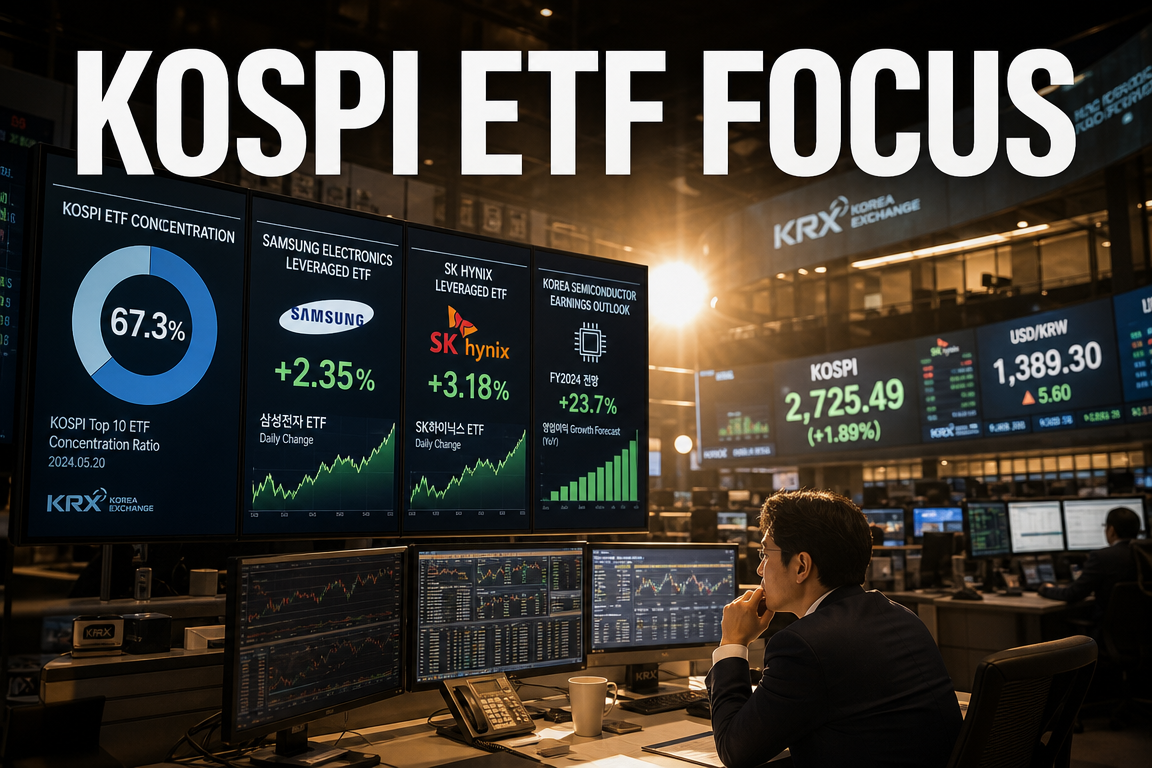
The key issue is that retail capital is flowing into leveraged ETFs concentrated on Samsung Electronics and SK Hynix, distorting liquidity across the broader KOSPI and KOSDAQ markets.
This is occurring alongside political efforts to delay National Pension Service rebalancing, possible regulatory measures on leveraged ETFs by the Bank of Korea and policymakers, and Samsung Electronics’ preliminary earnings release scheduled for tomorrow.
Although the market appears to be trading on semiconductor earnings expectations, the decisive factor is where capital is concentrating and where it is leaving.
1. The center of today’s market was Samsung Electronics and SK Hynix leveraged ETFs
The products attracting the strongest capital inflows in the domestic market are leveraged ETFs focused on Samsung Electronics and SK Hynix.
For retail investors, investing through leveraged exposure to the two leading semiconductor names is more straightforward than selecting individual stocks.
The problem is that as more capital enters these ETFs, other stocks are increasingly excluded from trading volume.
In other words, the KOSPI may appear supported by Samsung Electronics and SK Hynix, while the market internally becomes increasingly concentrated and uneven.
In this environment, the index may look stable, while individual portfolios remain under pressure.
The sharp decline in KOSDAQ trading value is not likely to be a temporary weakness.
It indicates that market participants are shifting away from growth, small-cap, biotech, secondary battery, and AI software names toward semiconductor leveraged ETFs.
2. Why KOSDAQ trading value is weakening
The KOSDAQ market is highly sensitive to liquidity.
Compared with large-cap stocks, institutional support is weaker and retail participation is dominant.
When retail capital moves into Samsung Electronics and SK Hynix leveraged ETFs, KOSDAQ is immediately affected.
Lower trading value reduces price responsiveness to positive news and makes the market more vulnerable to small-scale selling.
This is the main reason many investors feel that “only my stocks are not moving.”
The KOSPI is being supported by large semiconductor names, while KOSDAQ is losing momentum as capital circulation weakens.
The current market can therefore be described as both an earnings-driven semiconductor cycle and a liquidity divergence cycle.
3. Why the Bank of Korea and policymakers are focusing on leveraged ETFs
Recent concerns raised by the Bank of Korea and some policymakers stem from this concentration issue.
Leveraged ETFs offer amplified gains when the underlying asset rises, but losses can also accumulate quickly when it falls.
When capital becomes excessively concentrated in a small number of large-cap names, price discovery across the market may weaken.
Put simply, it becomes difficult to distinguish whether prices are rising because of fundamental strength or because ETF inflows continue.
This is why discussions have emerged around possible delisting, restrictions on new inflows, or stronger investor protection measures.
Whether these proposals become policy remains uncertain.
However, markets typically react to policy possibilities before they are confirmed.
As a result, such regulatory discussions may create short-term pressure on Samsung Electronics and SK Hynix flows.
4. Why possible ETF regulation could weigh on Samsung Electronics and SK Hynix in the short term
The fact that Samsung Electronics and SK Hynix are strong companies is separate from near-term supply and demand pressure.
When leveraged ETF inflows increase, fund managers must buy more of the underlying names to maintain exposure.
If new inflows slow or investor sentiment weakens, incremental buying pressure can fade.
If capital exits these ETFs, selling pressure on the underlying stocks can also increase.
For that reason, discussions on leveraged ETF regulation may weigh on Samsung Electronics and SK Hynix in the short term.
That said, in the medium to long term, tighter controls could help normalize overheated flows and improve overall market health.
The key issue is the scale and pace of any regulation.
5. Why the National Pension Service rebalancing delay helped reduce the KOSPI’s decline
One reason the KOSPI narrowed its losses after weakening earlier in the session was news that a delay in National Pension Service rebalancing is being considered.
The National Pension Service manages asset allocation across domestic equities, overseas equities, and bonds.
When domestic stocks rise sharply, it may need to sell part of its holdings to maintain target weights.
This is known as rebalancing.
If policymakers move to temporarily delay that process, the market may interpret it positively.
The reason is that mechanical selling pressure from the pension fund could decrease.
This is especially relevant after a strong rally in Samsung Electronics and SK Hynix, when investors are sensitive to potential pension-related selling.
Therefore, the rebalancing delay news may serve as a short-term supportive factor for the KOSPI.
6. Why Samsung Electronics was relatively stronger than SK Hynix
Today, Samsung Electronics showed relatively stronger performance than SK Hynix.
The main reason is expectations ahead of Samsung Electronics’ preliminary earnings release.
Investors are watching whether tomorrow’s results will confirm a recovery in the semiconductor cycle.
Samsung Electronics has a broader business mix than memory semiconductors alone, including smartphones, displays, and foundry operations.
Recently, reports suggesting possible monthly profitability in the foundry segment have supported sentiment.
Foundry has been a recurring drag on Samsung Electronics’ earnings.
If the foundry loss narrows or monthly profitability is confirmed, expectations for earnings improvement could strengthen further.
For that reason, Samsung Electronics has held up relatively well despite short-term supply and demand pressure.
7. Why tomorrow’s preliminary Samsung Electronics earnings release matters
Tomorrow’s preliminary earnings release is not merely a company-specific event.
The entire Korean equity market is currently relying on expectations for a semiconductor earnings recovery.
If Samsung Electronics meets or exceeds expectations, investors may view this as evidence that the semiconductor cycle recovery is being confirmed by actual numbers.
In that case, capital could extend beyond Samsung Electronics and SK Hynix into semiconductor equipment, materials, and component stocks.
If the results fall short, the market could react quickly and negatively.
This is especially important because capital has already been heavily concentrated in semiconductor large caps through leveraged ETFs.
In other words, the market is in a phase where positive news may lift prices modestly, while negative news can trigger outsized volatility.
Samsung Electronics’ preliminary earnings release is therefore a near-term turning point for the KOSPI.
8. How the market can be summarized in news format
First, capital in the domestic market is concentrating in Samsung Electronics and SK Hynix leveraged ETFs.
This supports large semiconductor names in the KOSPI, while KOSDAQ and small-cap stocks face liquidity pressure.
Second, the possibility of leveraged ETF regulation has emerged as a short-term supply and demand risk.
Concerns around investor protection and concentration are leading to policy discussion.
Third, news of a possible delay in National Pension Service rebalancing reduced the KOSPI’s losses.
Markets viewed this as easing the risk of mechanical pension-related selling.
Fourth, Samsung Electronics showed relative strength due to earnings expectations and foundry improvement news.
If results are strong, expectations for a semiconductor earnings recovery may expand further.
Fifth, tomorrow’s preliminary Samsung Electronics earnings release is likely to determine the near-term direction of the KOSPI.
Better-than-expected results could extend the semiconductor-led rally, while disappointment could expose the risks of concentrated flows.
9. The key point that is often missed in other coverage
The most important issue is market breadth, not just Samsung Electronics earnings.
The index may appear strong, but internal market breadth can still be weak.
If Samsung Electronics and SK Hynix rise while KOSDAQ trading value remains depressed and small caps are ignored, the market’s ability to sustain gains weakens.
In such a phase, a small number of stocks can create the illusion of a healthy market.
That is the key point investors often miss.
A rising KOSPI does not necessarily mean the entire market is healthy.
If money is concentrated in large semiconductor names while other sectors lose liquidity, volatility can increase at any time.
Leveraged ETFs are a powerful buying engine in a rising market, but they can also intensify selling pressure in a downturn.
For now, the crucial question is not Samsung Electronics’ daily price movement, but whether trading value begins to broaden again into KOSDAQ and small-cap names.
10. Key checkpoints for investors
First is Samsung Electronics’ preliminary revenue and operating profit.
Whether results exceed expectations and confirm a recovery in memory semiconductors is important.
Second is the improvement trend in foundry operations.
If monthly profitability is confirmed in actual results, it would support Samsung Electronics’ share price.
Third is the divergence in flows between Samsung Electronics and SK Hynix.
SK Hynix benefits from strong HBM expectations, while Samsung Electronics is supported by broader memory and foundry recovery expectations.
Fourth is whether leveraged ETF regulation becomes more concrete.
The key question is whether the issue remains a policy discussion or develops into restrictions on capital inflows or product structure changes.
Fifth is whether the National Pension Service rebalancing delay becomes reality.
If confirmed, it could help ease KOSPI supply pressure.
Sixth is whether KOSDAQ trading value recovers.
Without a recovery in trading value, broad-based market participation is likely to remain limited.
11. The current KOSPI environment in one sentence
The KOSPI is being supported by semiconductor earnings expectations, but internally it is also facing structural issues from leveraged ETF concentration and liquidity depletion in KOSDAQ.
In the short term, Samsung Electronics’ preliminary earnings release is the most important event.
Over the medium term, the key issue is whether capital spreads beyond semiconductor large caps into other sectors.
If Samsung Electronics delivers strong results, the market may gain further support.
However, if results fall short or leveraged ETF regulation concerns intensify, the KOSPI could weaken more quickly than expected.
At this stage, investors should focus not only on semiconductor strength, but also on how that strength is being financed and concentrated.
< Summary >
The main issue in today’s KOSPI market is capital concentration into Samsung Electronics and SK Hynix leveraged ETFs.
As retail capital flows into semiconductor large-cap ETFs, KOSDAQ trading value is weakening sharply.
The Bank of Korea and policymakers are discussing possible leveraged ETF regulation, which may create short-term pressure on Samsung Electronics and SK Hynix.
Meanwhile, news of a possible delay in National Pension Service rebalancing helped reduce the KOSPI’s losses.
Samsung Electronics’ preliminary earnings release tomorrow is a key event for confirming the semiconductor recovery.
The most important question is not Samsung Electronics’ share price alone, but whether capital concentrated in semiconductor large caps can broaden into other sectors and KOSDAQ.
[Related Articles…]
Samsung Electronics Earnings and Semiconductor Cycle Outlook
KOSPI Outlook and Domestic Market Flow Analysis
*Source: [ 내일은 투자왕 – 김단테 ]
– 결국 코스피의 문제는 ‘이것’ #삼성전자 #하이닉스 #코스피
● Semiconductor Boom, GDP Mirage, KOSPI Risk
Is the Korean Economy Truly in a Boom? The Semiconductor Effect Behind 17.1% GDP Growth and KOSPI Risk
The most important issue in the Korean economy is straightforward.
GDP growth, export growth, trade balance, and the KOSPI outlook all appear strong on the surface, yet the real economy remains noticeably weak in daily life.
This report examines the meaning of Korea’s 17.1% nominal GDP increase, the economic distortion created by surging semiconductor exports, the market concentration risk caused by Samsung Electronics and SK Hynix, the sustainability of the memory semiconductor cycle, and the indicators that matter most for the Korean economic outlook.
The key point often missing from other coverage is that Korea’s economy must be assessed separately from semiconductors.
At present, aggregate indicators imply strength, but excluding semiconductors suggests that underlying economic momentum may be weaker than headline figures indicate.
1. News Focus: Korea’s GDP Rose 17.1%, Which Appears Strong on the Surface
The first headline figure is 17.1% nominal GDP growth in the first quarter.
Real GDP also grew by 3.8% year over year, indicating solid momentum.
On the surface, the Korean economy appears to be performing well.
Growth is strong, exports are expanding, and the trade balance remains in surplus.
- Nominal GDP growth: 17.1%
- Real GDP growth: 3.8%
- Total export growth: 43.5%
- Semiconductor export growth: 154.6%
- Trade balance: record surplus trend
- Equity market: strength led by semiconductor large caps
However, many households and businesses do not feel this improvement in practice.
Wages have not risen materially, domestic demand remains soft, and small businesses and self-employed operators continue to face pressure.
This gap is driven by the semiconductor effect.
2. What the Semiconductor Effect Means: The Average Improves, but Most Sectors Do Not
The semiconductor effect refers to a situation in which one sector, semiconductors, lifts the entire economic picture and creates the appearance of broad-based strength.
The key figures are important.
In 2026, cumulative total exports rose 43.5%, while semiconductor exports increased 154.6%.
This means that overall export growth is real, but a disproportionate share of that growth comes from semiconductors.
It would be difficult to conclude that all industries improved at the same pace.
- Korea total export growth: 43.5%
- Semiconductor export growth: 154.6%
- Total manufacturing production growth: around 3%
- Manufacturing production excluding semiconductors: around 1.3%
The message is clear.
The Korean economy is not broadly overheating; rather, semiconductors are very strong while the rest of the economy remains moderate.
For that reason, Korea’s outlook should not be evaluated using aggregate export growth alone.
Semiconductor exports and non-semiconductor exports must be analyzed separately to assess the true business cycle.
3. Why the Real Economy Feels Weak: Samsung Electronics and SK Hynix Are Not the Entire Economy
Korea’s total employed population is about 29.3 million.
By contrast, Samsung Electronics and SK Hynix together employ roughly 170,000 people, based on the original source.
These two companies are highly important to the Korean economy.
However, stronger earnings at these firms do not automatically translate into higher income for 29 million workers and self-employed households.
This explains the gap between GDP growth and lived experience.
National aggregates can improve while household income and business sales remain unchanged.
In particular, semiconductor upturns may have limited employment spillover effects.
Semiconductors are high value-added industries, but they do not generate mass employment in the same way as traditional manufacturing sectors.
As the industry shifts toward AI semiconductors, HBM, and advanced memory, capital intensity and specialized labor become more important, while the transmission to the broader labor market becomes slower.
Accordingly, the question “Why does GDP look strong while my situation has not improved?” is not misplaced.
It is, in fact, one of the most accurate questions to ask about the Korean economy today.
4. KOSPI Outlook Risk: The Equity Market Also Reflects a Semiconductor Distortion
The same distortion applies to the KOSPI.
When Samsung Electronics and SK Hynix rise sharply, the broader index appears stronger even if many other companies do not participate.
Korea’s equity market is highly concentrated in semiconductor large caps.
Because Samsung Electronics and SK Hynix have large market capitalizations, the KOSPI is heavily influenced by their performance.
It is also important to note that stock prices do not move only on absolute earnings levels.
Markets focus not only on whether profits are strong, but also on whether earnings growth can continue at a high rate.
Second-quarter earnings for Samsung Electronics and SK Hynix may remain strong, and third- and fourth-quarter earnings may also stay elevated.
However, once the growth rate of operating profit begins to slow, the market may begin to price in peak-cycle concerns.
- Step 1: Share prices rise on semiconductor earnings expectations
- Step 2: Earnings are reported at strong levels
- Step 3: Signs of slowing growth emerge
- Step 4: The market prices in peak-cycle risk
- Step 5: KOSPI volatility increases
For KOSPI analysis, it is not enough to say that Samsung Electronics and SK Hynix are performing well.
The performance of the KOSPI excluding Samsung Electronics and SK Hynix must also be assessed.
If that measure remains weak, the market is likely being driven by a narrow set of large-cap names rather than a broad-based rally.
5. A 37.1% Semiconductor Share of Exports Requires Separate Tracking
One of the most important figures is that semiconductors account for 37.1% of Korea’s total exports.
In 2011, that share was around 9%.
When the share was 9%, it was still possible to interpret aggregate export data without separating semiconductors.
At 37.1%, that approach is no longer sufficient.
If one product accounts for more than one-third of total exports, aggregate export data alone is not enough to assess the Korean economy.
It is similar to a class average being lifted by one top student while the performance of the rest of the class is overlooked.
Going forward, Korea’s economic indicators should be broken down at least as follows.
- Total exports including semiconductors
- Total exports excluding semiconductors
- Memory semiconductor exports
- Non-memory semiconductor exports
- Manufacturing production excluding semiconductors
- KOSPI excluding Samsung Electronics and SK Hynix
Only with this framework can policymakers, companies, and investors make more accurate decisions.
6. How Long Can the Semiconductor Cycle Continue? Memory Prices Are the Key Variable
The current semiconductor upcycle in Korea is centered on memory chips.
Samsung Electronics and SK Hynix are particularly strong in DRAM, NAND, and HBM.
AI data center investment, generative AI adoption, and rising server spending by global technology companies have sharply increased demand for high-performance memory.
This is clearly positive for Korean semiconductor firms.
However, semiconductor cycles do not last indefinitely.
Memory semiconductors are highly cyclical.
When prices rise, profits can expand rapidly; when the price cycle peaks or weakens, earnings can slow just as quickly.
The original text notes that prices for DDR4, DDR5, and NAND Flash rose sharply from early 2025 through mid-2026.
That price increase was a major driver of first- and second-quarter 2026 earnings.
Whether the same pace can continue in the second half of 2026 remains uncertain.
If price indicators show signs of peaking, the market may quickly discount slower earnings growth.
- Whether memory price increases continue
- The pace of AI server investment
- Possible CAPEX adjustments by global technology firms
- Supply expansion by China and U.S. competitors
- Whether inventory adjustment begins
These are the main variables for judging the next phase of the semiconductor cycle.
7. Global Competition: Micron, CXMT, and Nanya Should Not Be Underestimated
Korean companies remain ahead in high-performance memory.
In particular, Korea continues to hold an advantage in HBM and advanced DRAM.
However, it would be risky to assume that competitors will remain behind indefinitely.
The original text notes rapid catch-up efforts by Micron in the U.S., CXMT in China, and Nanya in Taiwan.
The key issue is clear.
Korea may retain leadership in premium technologies, but competitors can still gain share in mid- and lower-end memory markets.
Korea has seen similar patterns in petrochemicals, steel, shipbuilding, batteries, and other industries.
At first, it was assumed that Chinese firms could not catch up, but over time they gained ground in lower-end segments.
Semiconductors should not be treated as an exception.
For that reason, the more important question is not whether Korea is strong today, but how long its current lead can be maintained.
8. Weakness in Non-Memory Semiconductors Remains the Structural Issue
Korea’s strength lies in memory semiconductors.
However, the global semiconductor market increasingly depends on non-memory chips, system semiconductors, and foundry capacity.
In the AI era, memory leadership alone is not sufficient.
GPU, NPU, ASIC, system semiconductors, advanced packaging, and foundry ecosystems all matter.
The strongest company in this area is TSMC in Taiwan.
TSMC holds an overwhelming share of the foundry market and is closely linked with global leaders such as Nvidia, AMD, and Apple.
If Korea relies only on the memory cycle, it may miss a larger share of value creation in the AI semiconductor industry.
- Memory semiconductors: Korea’s strength
- Non-memory semiconductors: Korea’s weakness
- Foundry: TSMC dominance
- AI accelerators: U.S. big tech and fabless companies lead
- Advanced packaging: a key competitive frontier
Korea must convert gains in memory into broader capabilities in non-memory chips, foundry operations, system semiconductors, and the AI semiconductor ecosystem.
Without that transition, the current upcycle may remain short-lived.
9. The Key Distinction Often Missed: Price-Driven Growth vs. Volume-Driven Growth
One of the most important but often overlooked issues is that the current semiconductor upcycle is largely driven by price increases.
Export value is determined by price multiplied by volume.
Therefore, rising export value does not necessarily mean shipment volumes have increased materially.
When semiconductor prices rise sharply, export value can increase even if unit volumes remain stable.
Failing to distinguish this can lead to an overly optimistic view of the economy.
Price-driven growth can fade quickly once the cycle turns.
By contrast, growth driven by volume gains and market-share expansion tends to last longer.
Accordingly, the key question is not simply whether semiconductor exports are rising.
- Are semiconductor shipment volumes actually increasing?
- Do exports remain strong after adjusting for price effects?
- Is the share of high-value products rising?
- Is Korea losing share in lower-end segments?
- Is the non-memory revenue mix expanding?
Without clear answers to these questions, claims of a Korean economic boom may be overstated.
10. Policy Implication: The Semiconductor Upswing Should Be Used as Investment Capital, Not a Celebration
The semiconductor upswing is a major opportunity for the Korean economy.
However, it should not be treated as a short-term celebration.
Profits, tax revenue, and investment capacity generated by semiconductors should be directed toward future industries.
To raise long-term growth, Korea must also improve the competitiveness of sectors beyond semiconductors.
- Strengthen export industries excluding semiconductors
- Expand investment in non-memory semiconductors and foundry capacity
- Develop AI semiconductor design talent
- Build advanced packaging and materials, parts, and equipment ecosystems
- Expand infrastructure for power, water, and land
- Support future industries such as space, quantum computing, robotics, biotech, and defense
- Broaden the cycle into SMEs and domestic demand sectors
The policy priority is not “the economy is strong because semiconductors are strong,” but rather “use the semiconductor upcycle to build the next growth engine”.
11. Investor View: This Is a Period for Verification, Not Enthusiasm
Investors do not need to view the market negatively.
AI investment and the memory semiconductor cycle remain strong themes.
Earnings improvement at Samsung Electronics and SK Hynix is real and material.
However, equity markets always discount the future.
A strong earnings headline can sometimes mark a short-term peak rather than a beginning.
The key question is not whether results are good, but how much more improvement remains relative to expectations.
Investors should monitor the following indicators.
- DRAM and NAND contract price trends
- HBM demand and supply agreements
- Operating profit growth at Samsung Electronics and SK Hynix
- Capacity expansion plans at Micron, CXMT, and other competitors
- Global AI CAPEX trends
- KOSPI performance excluding semiconductor large caps
- USD/KRW movements and rate-cut expectations
For KOSPI analysis, market breadth matters more than the headline index level.
A market driven only by semiconductor large caps is very different from one supported by autos, biotech, defense, shipbuilding, consumer stocks, and IT parts suppliers.
12. Conclusion: Not a Broad-Based Boom, but an Uneven Recovery Led by Semiconductors
The Korean economy can be summarized in one sentence.
This is not a broad-based economic boom; it is an uneven recovery in which a semiconductor upcycle is lifting headline indicators.
GDP growth, export growth, the trade balance, and the KOSPI all look strong.
However, excluding semiconductors, manufacturing production and real-economy momentum do not yet indicate a full recovery.
The correct response is not celebration.
It is accurate diagnosis.
The semiconductor upcycle is a valuable opportunity, but it does not by itself prove that Korea’s overall economic fundamentals have strengthened.
The priority is to move beyond the semiconductor effect and build growth in non-memory chips, AI semiconductors, and future industries.
Korea’s true competitiveness will not be determined when semiconductors are strong.
It will be determined by whether the economy can remain resilient when the semiconductor cycle turns down.
< Summary >
Korea’s 17.1% GDP increase appears consistent with a boom on the surface.
However, the main driver is the sharp rise in semiconductor exports.
Total exports rose 43.5%, while semiconductor exports increased 154.6%.
Manufacturing production excluding semiconductors remains around 1.3%, which does not indicate a broad recovery.
The KOSPI is also exposed to concentration risk because of its heavy dependence on Samsung Electronics and SK Hynix.
Future analysis should separate semiconductor-related indicators from the rest of the economy.
If memory price momentum slows, earnings and equity volatility may increase.
Korea should use the current semiconductor upcycle to expand into non-memory semiconductors, AI chips, and future industries.
[Related Articles…]
- Semiconductor Outlook: Key Indicators for Korea’s Export Cycle
- AI Memory Demand and the Next Phase of the HBM Cycle
*Source: [ 경제 읽어주는 남자(김광석TV) ]
– 한국 경제는 어디로 가는가? 반도체 호황에 파티할 때인가? [경읽남 252화]