● Tesla, RoboTaxi, Regulation, Merger, Shock
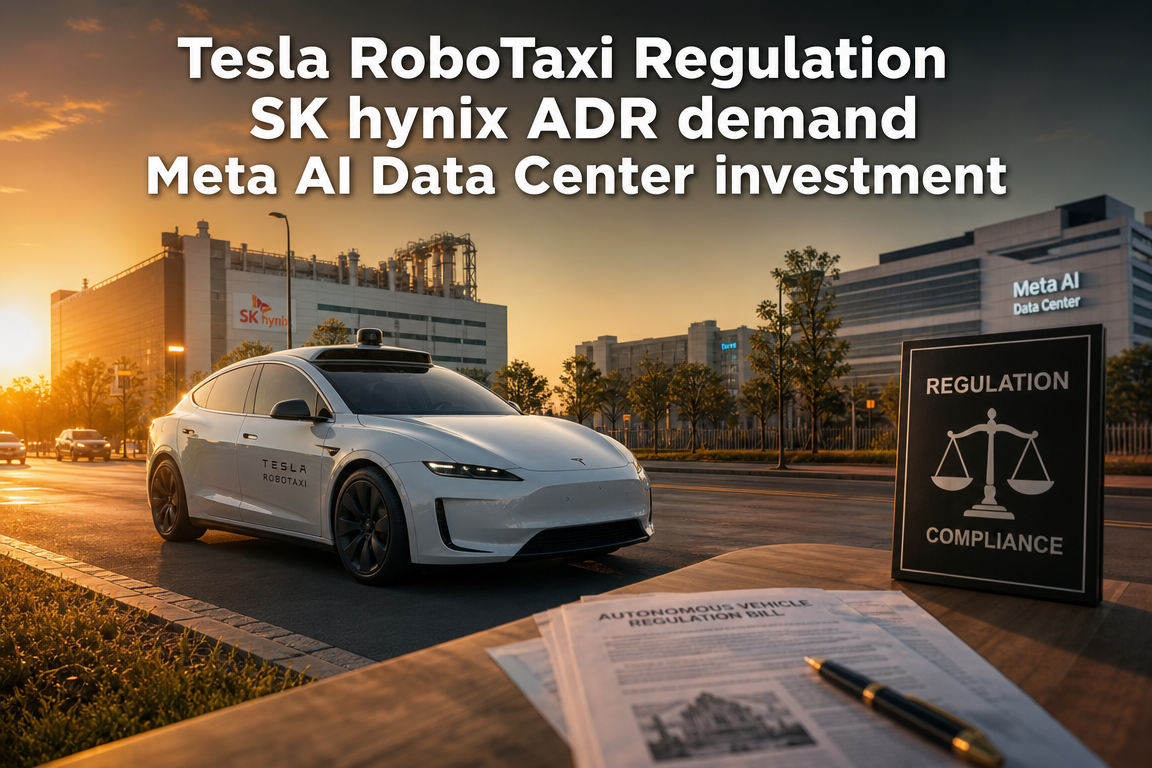
Tesla Robo-Taxi Regulation and the SpaceX Merger Speculation: The Real Drivers Behind Wall Street’s 500-USD Target
The key issue here is not simply that Tesla’s stock fell on the day.
A proposed New Jersey bill requiring autonomous-driving sensors is directly challenging Tesla’s camera-based FSD strategy, while Wall Street is now discussing a potential Tesla-SpaceX merger in official research reports.
At the same time, RBC raised its Tesla target price to 500 USD, citing a robotaxi market valued at 4.2 trillion USD. These developments are reshaping the framework through which Tesla is being evaluated.
There are three main points to consider.
First, geopolitical risk and uncertainty around the interest-rate outlook are weighing on U.S. equities.
Second, the New Jersey bill represents a regulatory risk that could alter the cost structure and scaling pace of Tesla’s robotaxi business.
Third, the Tesla-SpaceX merger scenario has moved beyond rumor and into strategic scenarios being modeled by Wall Street.
1. Market backdrop: More important than Tesla’s decline is the rise in uncertainty premium
According to the source, Tesla closed at 394.06 USD, down 2.19%.
SpaceX was cited at 148.3 USD, down 0.78%, but since SpaceX is not a publicly listed company, this figure is better interpreted as a private-market transaction or valuation estimate rather than an exchange-traded closing price.
The Dow fell 1.09%, while the Nasdaq showed modest resilience and finished slightly higher.
Overall, U.S. equities reacted more to Middle East geopolitical risk than to company-specific developments.
Reports of increased tensions between Iran and the U.S. triggered volatility in futures markets, while investors shifted back toward monitoring safe-haven assets and interest-rate expectations.
The June FOMC minutes were also released, but they offered limited guidance on the future policy path.
The market is currently facing simultaneous pressure from inflation, war risk, and expectations for rate cuts.
In this environment, high-valuation growth stocks such as Tesla can see outsized volatility from even relatively small regulatory headlines.
2. New Jersey autonomous-driving bill: A direct challenge to Tesla’s camera strategy
The most important development in this report is the autonomous-vehicle bill proposed in New Jersey.
The core provision would prohibit autonomous vehicles from operating with cameras alone and require additional sensors such as lidar or radar.
The bill is also reported to include a three-year pilot period and a requirement to collect more than 50,000 miles of supervised driving data during that time.
If enacted, this would become the first U.S. case effectively mandating multi-sensor equipment for autonomous vehicles.
The problem is that this standard directly conflicts with Tesla’s current strategy.
Elon Musk has long argued that autonomous driving can be achieved with a camera-based vision system alone.
By contrast, Waymo and other autonomous-driving companies use combinations of lidar, radar, and high-definition maps.
In other words, the bill is framed as a safety regulation, but its practical impact would disproportionately affect Tesla.
Tesla is currently trying to scale its robotaxi business using the Model Y and Cybercab, neither of which comes standard with lidar.
If the bill is passed, Tesla may need to revisit hardware design, vehicle cost, production planning, and its software-training architecture.
3. Why the bill matters: The precedent may be more important than immediate passage
It is still unclear whether the bill will pass in the near term.
A vote has not yet been scheduled, so any definitive conclusion would be premature.
However, markets are reacting less to the bill itself than to the precedent it could create.
If multi-sensor mandates begin in New Jersey, similar bills could emerge in California, New York, and Illinois.
California in particular could be a likely venue for similar debate, given the state has previously been politically and administratively tense with Tesla.
Because robotaxi operations depend heavily on state permits and city-level operating rules, regulatory developments in one state can become the starting point for broader national adoption.
The larger issue for Tesla is cost.
Adding lidar increases per-vehicle hardware expense.
Tesla’s robotaxi strategy depends on low-cost mass production and software monetization.
If sensor mandates spread, the economics of the lower-cost Cybercab could weaken.
As a result, robotaxi margins, payback periods, service pricing, and fleet operating costs would all need to be recalculated.
4. Robotaxi outlook: The market is large, but regulation can compress valuation
The source cited Morgan Stanley’s view that Tesla’s robotaxi service could expand beyond Austin into Phoenix, Orlando, Tampa, and Las Vegas.
By year-end, the fleet could rise to around 1,500 vehicles, with potential expansion to 30,000 vehicles by 2030.
These figures are highly relevant to Tesla’s valuation.
Tesla’s current premium is driven not only by EV sales, but by expectations for autonomy, robotaxis, and AI platform monetization.
If robotaxi deployment scales quickly, Tesla could be re-rated as a mobility platform rather than a car manufacturer.
Conversely, broader state-level regulation could reduce the implied size of the market.
RBC’s increase in Tesla’s target price from 475 USD to 500 USD is tied to this logic.
RBC estimates the robotaxi market at approximately 4.2 trillion USD and argues that Tesla should be valued not as an automaker, but as a platform combining AI, robotics, energy, and mobility.
At a current share price of 394 USD, the 500 USD target implies roughly 24% upside.
That outlook, however, depends on an important assumption.
Tesla must be able to operate robotaxis at scale using its current camera-based autonomy stack.
If New Jersey-style sensor mandates spread to other states, both RBC’s 4.2 trillion USD market estimate and Tesla’s assumed share of that market would likely need to be revised lower.
5. JPMorgan’s Tesla-SpaceX merger scenario: From rumor to formal analysis
The most notable part of the source is that JPMorgan reportedly included a Tesla-SpaceX merger scenario in an official research report.
JPMorgan is said to have characterized the scenario as strategically plausible.
The rationale is that Elon Musk holds key control over both companies, and that Tesla and SpaceX are closely linked in terms of technology, capital, and brand.
However, SpaceX is not listed on a public exchange.
As a result, any reference to a valuation being attached to SpaceX should be understood as reflecting private-market valuation, internal estimates, or secondary-market pricing rather than public-market listing status.
Failing to distinguish between these can materially distort an investment view.
For a merger to become feasible, a number of complex issues would need to be addressed, including how to value SpaceX, what exchange ratio Tesla shareholders would receive, whether the deal would be cash or stock-based, and how tax issues would be handled.
In other words, the fact that the merger idea appeared in a formal report is meaningful, but it does not imply near-term execution.
6. The positive merger case: Combining AI, satellites, robots, and energy
If Tesla and SpaceX were combined, the potential synergies would be clear to supporters of the idea.
Tesla has electric vehicles, batteries, autonomous driving, Optimus robots, and energy storage.
SpaceX has launch vehicles, Starlink satellite internet, U.S. government and defense contracts, and space infrastructure technology.
A combination of the two could create an integrated ecosystem spanning AI infrastructure, communications, robotics, energy, and mobility.
For example, Starlink could provide a global connectivity layer for autonomous vehicles and robots, while Tesla Energy could support power solutions for space and communications infrastructure.
Optimus could expand beyond factory automation into space operations, logistics, and defense support systems.
From this perspective, a merger would not simply be a corporate combination, but a restructuring of the broader Musk ecosystem into a single AI-driven industrial platform.
This is why Wall Street is no longer dismissing the concept outright and is beginning to model it.
7. The main merger risk: China’s exposure versus U.S. national-security contracts
The largest risk identified by JPMorgan is regulatory.
In particular, Tesla’s exposure to China could conflict with SpaceX’s government and defense relationships in the United States.
Tesla is deeply tied to China through Gigafactory Shanghai, which serves both production and sales.
SpaceX, by contrast, has close contractual relationships with the U.S. government, the Department of Defense, and NASA.
If the two companies were combined, regulators would likely view the transaction not as a normal merger, but as a national-security and technology-control issue.
From the U.S. perspective, it would be difficult to approve a structure in which a company with space-launch, satellite communications, and military contracts merges with a company that has significant China exposure.
China, meanwhile, could become more sensitive to Tesla’s local manufacturing, data, and supply-chain footprint.
Even if the merger makes strategic sense, the political, security, and regulatory hurdles are entirely separate issues.
8. Key items to watch in Tesla’s Q2 earnings report
According to the source, Tesla’s Q2 earnings release is scheduled for July 22.
The key items for investors to watch are not just revenue, but margins, robotaxi expansion, FSD adoption, and regulatory commentary.
First is automotive margin.
With EV price competition still intense, Tesla’s ability to defend profitability will matter.
Second is the robotaxi schedule.
Investors will focus on which cities come next after Austin, how many vehicles are actually deployed, and how safety drivers or remote supervision are managed.
Third is FSD monetization.
Subscription rates and software revenue must increase meaningfully for Tesla’s AI-platform thesis to gain support.
Fourth is Tesla’s response to the New Jersey bill.
If Tesla strongly rejects sensor mandates or calls for a unified federal framework for autonomous driving, the market is likely to interpret that as an important policy signal.
9. The next FSD differentiator: Understanding destinations in natural language
The source also cited comments from Ashok Elluswamy, Tesla’s AI software executive, on X.
The key point is that Tesla is developing FSD to understand natural-language instructions, such as a user describing a home by its gate color and asking to be dropped off at that exact location.
If implemented successfully, this could materially improve the robotaxi user experience.
One of the current limitations of autonomous driving services is that a destination can be selected on a map, but the system may not understand the fine-grained context of where a person actually wants to be dropped off.
For example, in practice the exact entrance matters: a hospital emergency entrance rather than the main door, a specific building in an apartment complex rather than the front gate, or a particular airport gate rather than the terminal in general.
If Tesla combines natural-language understanding with vision-based autonomy, it could move beyond lane-following autonomy toward a mobility AI that understands context more like a human driver.
That would be an important differentiator versus other autonomous-driving companies.
10. The most important point that is easy to miss
The most important issue is not the Tesla-SpaceX merger speculation, but who sets the regulatory standard for robotaxis.
Many investors are focused on the 500 USD target, merger possibility, and Elon Musk’s broader vision.
However, the variable that actually changes valuation is much more practical.
It is whether each state government requires a specific sensor configuration for autonomous vehicles.
If cameras alone are allowed, Tesla can scale quickly by leveraging low cost and large vehicle data sets.
If lidar and radar become mandatory, Tesla’s cost advantage, existing vehicle strategy, and Cybercab production plan could all be disrupted.
In that sense, the New Jersey bill is not just a local policy issue; it is a potential change in the discount rate applied to Tesla’s robotaxi valuation.
More important than whether the robotaxi market is worth 4.2 trillion USD is whether Tesla can enter that market at low cost and at speed.
If that assumption weakens, the logic behind the 500 USD target also weakens.
Another point that should not be overlooked is that the Tesla-SpaceX merger scenario is better understood as an option value than as a base case.
If it happens, the re-rating could be substantial, but the regulatory barriers are so high that it cannot currently be treated as the core justification for the stock.
Ultimately, Tesla’s investment case still depends on FSD, robotaxi expansion, AI monetization, and EV margins.
11. Investor checklist
There are four near-term variables investors should monitor when assessing Tesla.
First, the progress of the New Jersey autonomous-driving bill.
Whether it remains at the proposal stage, moves to a vote, or spreads to other states will matter.
Second, actual robotaxi operating data.
Cities served, fleet size, accident rates, intervention frequency, and customer experience will all shape the valuation case.
Third, management commentary on FSD and margins in the Q2 earnings release.
As EV sales face pressure, investors need to see whether software revenue can provide a meaningful offset.
Fourth, changes in Wall Street’s valuation framework for Tesla.
Whether the company is treated as an automaker or an AI platform will materially affect the implied multiple.
In the medium term, the more realistic point of analysis is not whether Tesla and SpaceX merge, but how closely the two companies can remain connected without a merger.
If Starlink, robotaxi, Optimus, and energy storage continue to scale independently while still creating ecosystem synergies, the market may assign Tesla a higher multiple even without a formal combination.
< Summary >
Tesla fell to 394.06 USD, but the real issue is not the one-day decline; it is the regulatory risk facing robotaxi deployment.
The New Jersey bill would require additional sensors such as lidar and radar for autonomous vehicles, directly challenging Tesla’s camera-based FSD strategy.
If similar rules spread to other states, Tesla’s robotaxi cost structure and expansion pace could be materially affected.
RBC raised its Tesla target to 500 USD and valued the robotaxi market at 4.2 trillion USD, but that outlook depends heavily on the regulatory environment.
JPMorgan examined a Tesla-SpaceX merger scenario, but the combination of China exposure and U.S. national-security contracts presents substantial regulatory hurdles.
Ultimately, Tesla’s core drivers remain FSD commercialization, robotaxi expansion, AI monetization, and regulatory execution.
[Related Articles…]
*Source: [ 오늘의 테슬라 뉴스 ]
– 월가가 동시에 짚은 테슬라 합병, $500 목표가의 진짜 근거는?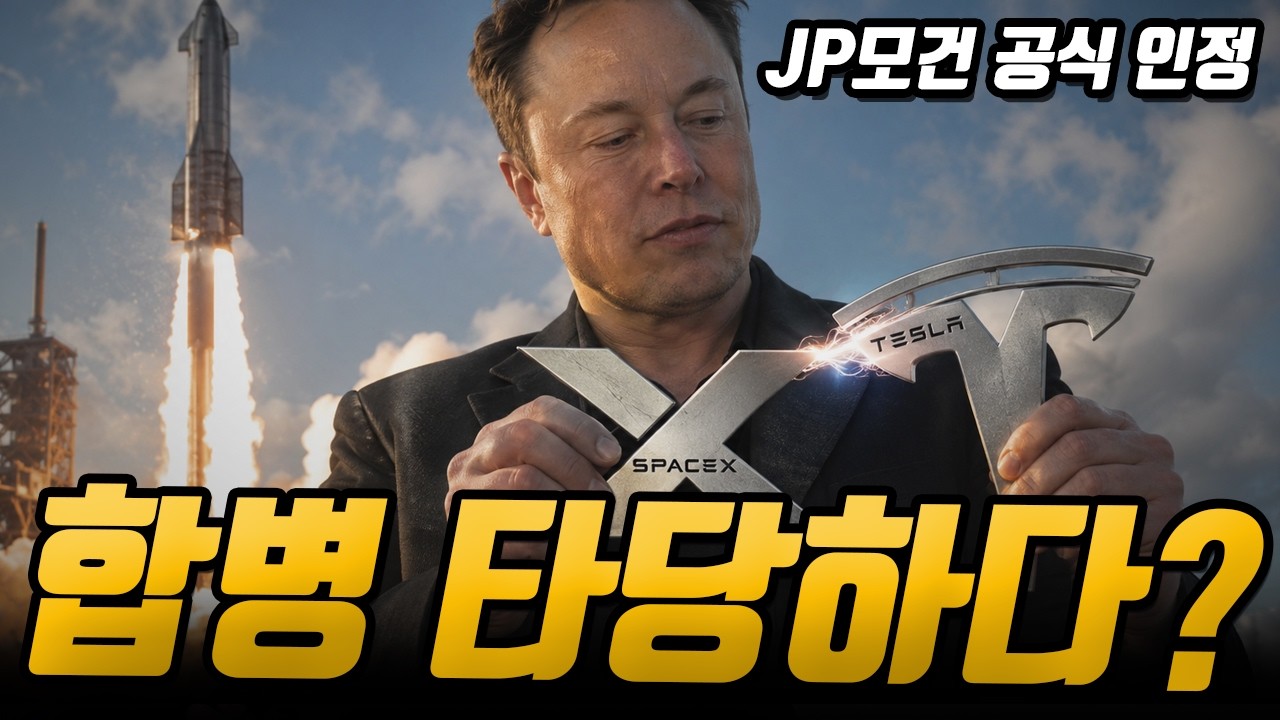
● KOSPI-Rally, SK-Hynix-ADR-Boost, Iran-Relief, Meta-AI-Spend
Three Reasons for the KOSPI Rebound: SK hynix ADR, Easing Geopolitical Risk, and Meta’s AI Data Center Investment
The main driver of the recent KOSPI rebound is not a simple technical recovery, but the simultaneous alignment of foreign flows, a revaluation of semiconductor stocks, and expectations for continued AI infrastructure investment.
In particular, the strong reception for the SK hynix ADR suggests that global investors remain highly attentive to Korean semiconductor equities.
Combined with signs of easing tension between the United States and Iran, as well as Meta’s large-scale data center investment, renewed support has emerged for the KOSPI outlook.
At first glance, this may appear to be just another rise in the KOSPI. In practice, however, the move reflects the interaction of the semiconductor cycle led by Samsung Electronics and SK hynix, the AI investment trend in U.S. equities, and improving expectations for global liquidity.
1. SK hynix ADR Demand: Foreign Investors Are Looking at Korean Semiconductors Again
The first reason for the rebound is news that the SK hynix ADR was oversubscribed more than seven times at the offering price.
An ADR, or American Depositary Receipt, is a security that allows overseas company shares to be traded in the U.S. market.
In practical terms, it gives U.S. investors access to SK hynix without purchasing Korean shares directly.
Strong demand for the SK hynix ADR indicates that U.S. institutional investors continue to assign high value to HBM, AI semiconductors, and the recovery in memory chip conditions.
SK hynix is especially recognized as a key supplier of HBM used in NVIDIA AI accelerators.
As a result, U.S. investors are increasingly treating SK hynix not as a conventional memory company, but as a semiconductor stock directly linked to AI infrastructure growth.
Why the SK hynix ADR Matters for the KOSPI
The key point is that the U.S. ADR and the Korean common share are not entirely separate assets.
If, as noted in the source material, conversion between the Korean common share and the ADR is possible at meaningful scale, the implications are different.
When the ADR price rises strongly in the U.S., it can create arbitrage-driven demand based on the price gap with the Korean common share.
In that case, U.S. buying interest can be transmitted into the Korean KOSPI market.
In other words, the strong showing in the SK hynix ADR is not only a sign of overseas popularity. It also suggests that a channel for foreign capital to return to the Korean market may be reopening.
This is the first key factor behind the KOSPI rebound.
2. Expectations of Easing U.S.-Iran Tensions: Lower Geopolitical Risk Supports Risk Assets
The second factor is the expectation that geopolitical risks related to the United States and Iran may ease.
The source material refers to comments by Trump indicating a desire for negotiations with Iran.
Markets generally react negatively to geopolitical tension.
Rising Middle East risk can lift oil prices, increase inflation pressure, and weaken expectations for U.S. rate cuts.
By contrast, signals that tensions may ease tend to support risk assets immediately.
In such cases, U.S. equities, emerging markets, and the Korean KOSPI can all stage a short-term relief rally.
Why the KOSPI Is Sensitive to Geopolitical News
Korea is a highly export-oriented market with significant reliance on energy imports.
As a result, rising Middle East risk can simultaneously affect oil prices, the exchange rate, and foreign investor flows.
When the won weakens sharply against the dollar, foreign investors often shift away from Korean equities toward dollar assets.
Conversely, if geopolitical risk declines, pressure on the won may ease and foreign investor sentiment may recover.
The recent KOSPI rebound can be seen as a move that reflects partial relief from these macroeconomic concerns.
Ultimately, expectations of easing U.S.-Iran tensions helped reduce the risk premium that had been weighing on the KOSPI outlook.
3. Meta’s Data Center Investment: AI Infrastructure Demand Has Not Peaked
The third factor is Meta’s data center investment.
In recent months, the market has questioned whether AI investment has become excessive or whether capital spending by major technology companies has peaked.
Concerns also emerged that if Meta could use excess computing capacity for cloud services, demand for AI servers may slow.
However, the key point highlighted in the source material is this:
If computing capacity were truly abundant, Meta would not continue building more data centers.
This suggests that legacy computing resources and next-generation AI computing resources serve different purposes.
Legacy computing can support cloud services and general-purpose workloads.
But training and inference for advanced AI models require new AI data centers that combine high-performance GPUs, HBM, high-speed networking, and power infrastructure.
What Meta’s Investment Means for Samsung Electronics and SK hynix
Meta’s continued AI data center investment implies that demand for NVIDIA GPUs, HBM, and server DRAM may remain firm.
This is especially positive for SK hynix.
SK hynix holds a strong position in the HBM market.
Samsung Electronics could also re-emerge as a key driver of the KOSPI rebound if HBM competitiveness improves, server memory conditions recover, and foundry expectations stabilize.
In short, Meta’s data center spending is not merely a big tech headline.
For the Korean equity market, it signals that AI infrastructure spending has not ended and that expectations for a semiconductor super-cycle remain intact.
Summary of the Current KOSPI Rebound
- Flow-related news: SK hynix ADR demand exceeded seven times the offering size, confirming U.S. investor interest in Korean semiconductors.
- Market structure: The possibility of arbitrage between the ADR and the Korean common share created a channel through which U.S. buying interest may affect domestic prices.
- Geopolitical factor: Expectations of easing U.S.-Iran tensions helped stabilize oil, the won, and risk-off sentiment.
- AI investment: Meta’s continued data center spending eased concerns that demand for AI infrastructure may be slowing.
- Market impact: Expectations for a KOSPI rebound strengthened, led by major semiconductor stocks such as SK hynix and Samsung Electronics.
The Core Point Often Missed in Other Coverage: AI Investment Peak-Out Concerns Are Weakening
The most important issue in this rebound is not simply that SK hynix is attracting attention or that Meta is building more data centers.
The real point is that the market’s concern about an AI investment peak-out is weakening again.
Global equities have recently been shaped by the view that major technology companies may be spending too much on AI.
If AI data center investment slows, the impact would extend beyond U.S. semiconductor companies such as NVIDIA, AMD, and Broadcom to SK hynix and Samsung Electronics as well.
Meta’s renewed data center investment directly challenges that concern.
Even if legacy computing capacity is available, next-generation infrastructure capable of supporting advanced AI models remains constrained.
That distinction is central to understanding the quality of the KOSPI rebound.
The market is reacting not to a single short-term catalyst, but to the possibility that the AI infrastructure investment cycle may last longer than expected.
Five Points Investors Should Monitor
1) Whether foreign buying actually continues
It is important to determine whether the demand seen in the SK hynix ADR translates into buying of the Korean common share.
For the KOSPI to extend gains meaningfully, foreign and institutional net buying matters more than retail participation.
2) Whether Samsung Electronics joins the rally
A rally limited to SK hynix alone may constrain the broader semiconductor uptrend.
Samsung Electronics needs to participate for the overall KOSPI to gain stronger upward momentum.
3) Whether the KRW-USD exchange rate stabilizes
A sharp rise in the exchange rate could weaken foreign capital inflows.
When assessing the KOSPI outlook, the currency trend is as important as semiconductor news.
4) Whether other major technology firms also increase AI investment
Capital expenditure plans from Microsoft, Google, Amazon, and Oracle should also be monitored.
The key question is whether AI infrastructure investment is an industry-wide trend rather than a single-company issue.
5) Whether HBM pricing and server DRAM demand remain firm
The foundation of semiconductor equity performance remains earnings.
HBM supply tightness, pricing strength, and recovering server memory demand must continue for the equity case for SK hynix and Samsung Electronics to remain intact.
KOSPI Rebound Scenario: Can the Prior High Be Recovered?
For the KOSPI to recover its previous high, three conditions are required.
First, semiconductor leaders such as SK hynix and Samsung Electronics must remain strong.
Second, AI-related stocks in the U.S. market must avoid a sharp reversal and maintain an upward trend.
Third, geopolitical risk and exchange-rate pressure must not re-accelerate.
Based on current conditions, the rationale for a KOSPI rebound is clear.
However, short-term profit-taking may emerge after a sharp move, so follow-through in flows and earnings remains important before adding risk.
Because the KOSPI has a high semiconductor weighting, continued strength in the AI semiconductor cycle could support further upside.
Conversely, renewed concerns about a slowdown in AI investment or weaker expectations for U.S. rate cuts could increase volatility.
The Current Situation in One Sentence
Strong demand for the SK hynix ADR created a catalyst for foreign flows, easing U.S.-Iran tensions reduced macro headwinds, and Meta’s data center investment confirmed that AI infrastructure demand remains resilient.
Accordingly, the recent KOSPI rebound is better viewed not as a simple relief rally, but as a revaluation of growth stocks centered on semiconductors and AI.
Markets can change direction at any time.
Even so, the key themes in the Korean market remain SK hynix, Samsung Electronics, AI infrastructure, U.S. equities, and the KOSPI outlook.
When these factors move in the same direction, the probability of a return toward the prior high increases.
< Summary >
The first reason for the KOSPI rebound is the strong demand for the SK hynix ADR.
This confirmed U.S. investor interest in Korean semiconductor equities and raised expectations for foreign inflows.
The second reason is the possibility of easing U.S.-Iran tensions.
Lower geopolitical risk can ease pressure on oil and the won and improve risk appetite.
The third reason is Meta’s data center investment.
This is a sign that demand for AI infrastructure remains firm and is positive for SK hynix and Samsung Electronics.
The most important takeaway is that concerns about an AI investment peak-out are weakening.
For the KOSPI to recover its prior high, semiconductor leadership, foreign flows, and exchange-rate stability must all be confirmed.
[Related Articles…]
- KOSPI Rebound Signals and Semiconductor Rally Review
- AI Infrastructure Investment and Data Center Demand Analysis
*Source: [ 내일은 투자왕 – 김단테 ]
– 코스피 반등하는 3가지 이유 #하이닉스 #삼성전자 #코스피