● KOSPI-Slides-Suddenly
Three Reasons the KOSPI Lost Momentum: Rates, Leveraged ETF Regulation, and “Break-even Selling” Weighed on the Market
The key driver of the recent KOSPI decline was not simply weakness in Samsung Electronics and SK hynix.
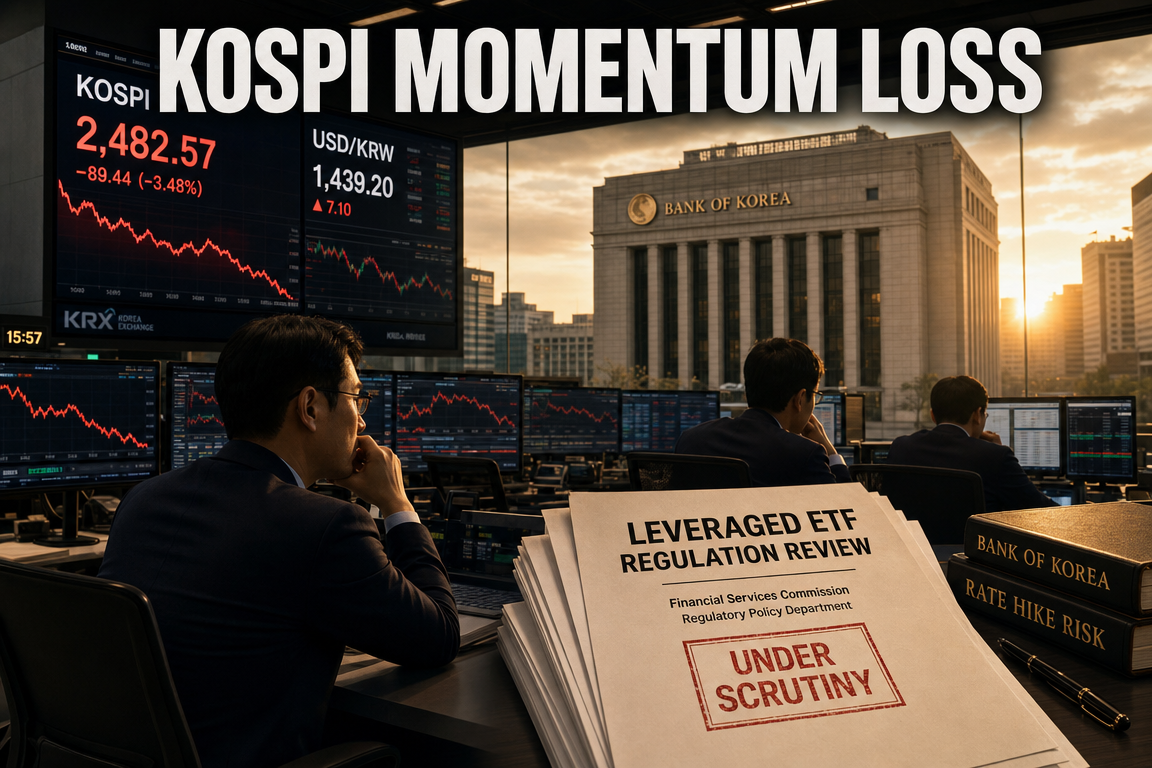
The market initially showed signs of recovery in semiconductor names during the morning session, but by afternoon, concerns over a possible policy rate hike, speculation about leveraged ETF restrictions, and heightened investor risk aversion combined to quickly weaken demand.
More importantly, Korean equities appear to be shifting into a market where positive catalysts fail to sustain gains for long.
This report summarizes why the KOSPI suddenly lost momentum, how the move may affect supply and demand for Samsung Electronics and SK hynix, and the key factors investors should monitor going forward.
1. Morning sentiment was stable: semiconductor expectations supported the KOSPI
At the open, the KOSPI showed relatively stable conditions.
In particular, foreign demand related to SK hynix and expectations surrounding ADR performance helped support sentiment across semiconductor equities.
Because Samsung Electronics and SK hynix are central to index direction, the market had room to speculate that semiconductors could again stabilize the KOSPI.
In the current Korean market, semiconductors are not just a sector; they are effectively the market’s underlying support base.
Foreign flows, institutional trading, and retail sentiment are all heavily influenced by Samsung Electronics and SK hynix.
However, the positive tone did not last.
Morning optimism faded quickly in the afternoon, and the market shifted back toward selling pressure.
2. First reason for the KOSPI’s weakness: signals of possible rate hikes from the Bank of Korea
The first factor that unsettled the market was comments related to the Bank of Korea’s policy rate outlook.
As inflation pressures and foreign exchange concerns persisted, the central bank’s message was interpreted as leaving room for additional tightening, prompting an immediate market reaction.
From the equity market’s perspective, interest rates remain one of the strongest headwinds.
When rates rise, the appeal of deposits and bonds increases, while the relative attractiveness of risk assets such as stocks declines.
Growth stocks and semiconductor names, which are priced heavily on future earnings expectations, are especially sensitive to higher rates.
In practical terms, interest rates force a revaluation of all asset prices.
As discount rates rise when valuing future corporate earnings, fair value estimates for stocks can decline even if earnings forecasts remain unchanged.
For that reason, tightening risk from the Bank of Korea directly weighed on the KOSPI outlook.
Why rate hike concerns weigh more heavily on Korean equities
Korean equities are highly sensitive to the exchange rate.
When the KRW/USD exchange rate becomes unstable, foreign investors are less willing to buy Korean stocks aggressively due to currency loss risk.
The Bank of Korea must also consider inflation and the exchange rate simultaneously, which limits expectations for policy easing.
The market problem is that it had already been pricing some probability of rate cuts.
Once the possibility of rate hikes enters the discussion, investors begin to assume that tightening may remain in place longer than expected.
That shift quickly translates into selling pressure.
3. Second reason for the KOSPI’s weakness: speculation about leveraged ETF restrictions
The second factor was speculation around possible regulation of leveraged ETFs.
Market chatter suggested that margin requirements could be raised or investment amounts limited for leveraged ETF products.
Although these were not confirmed measures and remained speculative, markets often react strongly to such rumors.
This is because leveraged ETFs have a meaningful impact on short-term liquidity flows.
In particular, when retail investors use KOSPI 200 leveraged ETFs, semiconductor leveraged ETFs, or 2nd battery leveraged products to take aggressive positions, the index can move sharply in the short term.
If restrictions are introduced, funds that would otherwise flow into Samsung Electronics and SK hynix may decline in the near term.
Semiconductor stocks are not being directly regulated, but the capital that enters through semiconductor-tracking ETFs and leveraged products could slow materially.
Actual market impact of leveraged ETF regulation
Leveraged ETFs tend to amplify gains in rising markets and intensify selling pressure in declining markets.
When retail investors buy aggressively through these products, they can increase upside momentum in the KOSPI.
Conversely, when regulation is discussed, the market tends to price in weaker aggressive buying activity ahead.
Markets often react to the possibility of regulation before any actual policy is implemented.
This time as well, leveraged ETF regulation talk increased concerns over short-term liquidity in the KOSPI.
4. Third reason for the KOSPI’s weakness: the market has not fully exited risk aversion
The third factor is investor sentiment.
At present, the market is not responding to positive news with follow-through buying.
Instead, many investors appear to be using rallies as opportunities to sell.
The dominant mindset is to exit once prices recover to break-even levels.
This is fundamentally different from a bull market.
In a rising market, positive news typically leads investors to buy more on the expectation of further upside.
But in a market still affected by fear, a price increase often triggers selling as investors seek to reduce risk.
That break-even selling behavior is the key psychological feature of the current market.
When this mindset dominates, even favorable news has limited ability to sustain a lasting rally.
Positive catalysts are viewed as exit opportunities rather than the start of a broader move higher.
5. Why Samsung Electronics and SK hynix matter even more now
Samsung Electronics and SK hynix remain central to KOSPI direction.
When these two stocks are strong, foreign inflows typically improve and overall market sentiment stabilizes.
When they weaken, the index is vulnerable to broad declines.
SK hynix continues to attract global investor attention due to AI semiconductors, HBM demand, and data center investment trends.
For Samsung Electronics, the key variables remain the memory cycle and the pace of improvement in foundry competitiveness.
However, even with favorable industry outlooks, prices can fall in the short term if rates, exchange rates, regulation, and sentiment deteriorate at the same time.
In other words, improving semiconductor fundamentals do not automatically translate into daily stock price gains.
6. Why this move should not be treated as a simple correction
This KOSPI weakness should not be dismissed as a one-day correction.
Three pressures appeared at the same time.
-
First, possible rate hikes reduce valuation multiples.
-
Second, leveraged ETF regulation may slow short-term capital inflows.
-
Third, investor fear turns positive news into selling opportunities.
When these three factors align, the market finds it difficult to recover quickly.
Because Korean equities are highly sensitive to foreign flows and the exchange rate, investors must also monitor U.S. rates and KRW/USD movements.
The current KOSPI environment should not be viewed simply as a “semiconductor-led rally” story.
Liquidity conditions are more important than sector fundamentals at this stage.
7. The most important point often missed in other coverage
The core issue is not individual negative headlines, but the simultaneous narrowing of liquidity channels.
Many reports discuss Bank of Korea comments, leveraged ETF regulation, and investor sentiment separately.
In practice, however, these factors are connected.
Rate hike concerns shift capital away from risk assets.
Leveraged ETF restrictions reduce aggressive short-term buying power.
Investor fear weakens the remaining demand.
The KOSPI is losing momentum not because of too many adverse headlines, but because the market’s ability to absorb those headlines has weakened.
Stock prices move on liquidity before they move on news.
Even favorable news cannot sustain a rally if there is not enough capital willing to buy it.
The KOSPI is currently in that type of market phase.
8. Key indicators to monitor in the KOSPI outlook
Investors should track more than the index level itself.
The following four points are important:
-
Bank of Korea communication: whether rate hike language continues or shifts toward a more accommodative tone as inflation stabilizes.
-
KRW/USD trend: a stable exchange rate may support foreign inflows, while renewed volatility would pressure the KOSPI.
-
Confirmation of leveraged ETF rules: whether actual restrictions are introduced or the discussion remains speculative.
-
Foreign trading in Samsung Electronics and SK hynix: whether foreign buying in semiconductors is sustained remains central to market direction.
At this stage, it is more important to see whether the index can hold gains after an advance than whether it rises on a given day.
If gains fade quickly, selling pressure remains strong.
If declines are limited despite negative headlines and trading value improves, market conditions may be stabilizing.
9. Investor response strategy
In the current market, risk management should take priority over aggressive chasing.
Leveraged ETFs can offer strong gains when the direction is correct, but losses can accumulate quickly as volatility rises.
When rates and exchange rate conditions remain unstable, maintaining some cash exposure is appropriate.
Even large-cap semiconductor stocks such as Samsung Electronics and SK hynix may face profit-taking during sharp short-term rallies.
Accordingly, phased buying and phased selling are more relevant than all-at-once positioning.
When many investors intend to sell once they return to break-even, supply tends to build near specific price levels.
In such a market, investors should focus on identifying where the stock repeatedly stalls.
From a short-term trading perspective, a rebound supported by rising trading value is more credible than a rally on declining volume.
10. Conclusion: the KOSPI must be viewed through liquidity, not only semiconductors
The recent KOSPI weakness was not caused solely by a loss of semiconductor momentum.
It resulted from the combined effect of rate hike concerns, leveraged ETF regulation speculation, and risk-averse investor behavior.
Samsung Electronics and SK hynix remain important, but semiconductor optimism alone is not sufficient to drive the broader market higher in the current environment.
For the KOSPI to strengthen again, rate pressure must ease, the exchange rate must stabilize, and uncertainty around leveraged ETFs must diminish.
Most importantly, investor psychology must shift from selling into strength to buying on weakness.
Until then, any rebound is likely to remain short-lived and volatile.
Ultimately, the current KOSPI environment is driven more by liquidity than earnings, more by capital flows than fundamentals, and more by sentiment than headlines.
< Summary >
The KOSPI lost momentum for three reasons.
First, comments suggesting possible rate hikes from the Bank of Korea increased valuation pressure on equities.
Second, speculation about leveraged ETF regulation created concern over slower short-term capital inflows.
Third, persistent investor fear led to selling when prices moved higher.
Semiconductor optimism around Samsung Electronics and SK hynix remains in place, but the KOSPI is currently more sensitive to rates, exchange rates, liquidity, and investor sentiment than to sector-specific catalysts.
Going forward, investors should focus less on whether the index rises and more on whether it can hold those gains, whether foreign flows continue into semiconductors, and whether the Bank of Korea and the exchange rate become more stable.
[Related Articles…]
- How Policy Rates Affect the KOSPI and Global Equities
- AI Semiconductor Cycle and Investment Strategy for Samsung Electronics and SK hynix
*Source: [ 내일은 투자왕 – 김단테 ]
– 코스피 힘빠진 이유 3가지 #코스피 #하이닉스 #삼성전자
● AI,Stock,Trap
Can Investors Trust AI-Picked Stocks? The Real Reason Retail Investors Face the Highest Risk
The central issue is not simply that AI stock picks should be treated with caution.
The more important point is that AI can strengthen investor judgment as a decision-support tool, but it can also amplify conviction, reinforce confirmation bias, and increase trading frequency, thereby raising the probability of losses.
This is especially relevant where AI investing, robo-advisors, stock investing, retail investors, and investment strategy intersect. The market appears to be at an important inflection point.
This report explains why buying AI-recommended stocks without independent review is risky, why the gap between institutional and retail AI usage is widening, and what investment approach is likely to remain viable in the AI era.
1. Core Issue: AI Stock Picks Are Not Answers, but Plausible Answers
Retail investors are increasingly exposed to phrases such as “AI-recommended stocks,” “AI-picked stocks,” and “AI-based promising names.”
The problem is that many investors treat AI responses as more objective and accurate than human opinions.
The key message is clear.
AI does not provide definitive answers; it generates the most plausible response based on the question asked and the data it was trained on.
In other words, a positive AI view on a stock does not mean the stock is necessarily a sound investment.
If the user already intends to buy a particular name, AI may simply reinforce that intention.
That is the main risk for retail investors.
2. Why AI Stock Picks Are Risky: The Three C’s
The risks of AI-based stock selection can be summarized in three areas.
2-1. First Risk: Conviction Inflation
When AI says something, it tends to sound more credible.
If a person says, “This stock looks attractive,” investors may remain skeptical.
But if AI says, “This stock has favorable earnings momentum, industry growth potential, and valuation support,” credibility rises.
This is conviction inflation.
AI appears emotionless, unbiased, and data-driven.
That creates the impression that “if AI analyzed it, it must be right.”
However, AI does not bear responsibility for losses.
If an AI-recommended stock declines, AI does not experience the loss.
The investor absorbs the full downside.
In that sense, AI stock recommendations resemble earlier stock-picking chat rooms.
The medium has changed from human to machine, but the underlying risk is similar.
Delegating judgment to an external source is risky in both cases.
2-2. Second Risk: Confirmation Bias
The most common question to AI is: “What do you think about this company?”
That question already contains the user’s interest and expectation.
Most investors are not asking, “Why should I avoid this stock?”
They are usually seeking validation for a name they already favor.
AI can detect that intent.
As a result, it may provide a well-structured bullish case aligned with the user’s expectation.
Even weak companies can be presented in a favorable light if the user asks for reasons to invest.
This is both a strength and a weakness.
AI responses vary depending on how the question is framed.
Therefore, when using AI for stock analysis, investors should always ask the opposite question as well.
Examples include:
“List five reasons not to buy this stock.”
“Outline scenarios in which this company’s earnings could deteriorate.”
“What expectations are already priced into the current share price?”
“Why might an institutional investor sell this stock?”
Only then can AI be used as a risk-review tool rather than a confirmation tool.
2-3. Third Risk: Speed of Diffusion
Another major shift in the AI-driven market environment is the speed of information diffusion.
Previously, investors had to search news, reports, videos, community posts, and disclosures manually before deciding whether to buy or sell.
The time required to collect information naturally created a period for reflection.
Now AI can summarize key information in seconds.
It can quickly process news flow, financial statements, industry outlooks, peer comparisons, and risk factors.
Although convenient, faster information gathering also leads to faster trading decisions.
Investors buy faster, sell faster, and rotate faster.
As a result, turnover increases.
In general, higher turnover tends to reduce retail investor returns because of fees, taxes, slippage, and emotional decision-making.
Information overload creates behavioral overload, and behavioral overload creates losses.
AI may appear to save time, but it can also act as a catalyst for excessive trading.
3. AI Can Become a New Form of Stock-Picking Room
One of the strongest observations from the discussion was that AI can function as a different version of a stock-picking room.
The structure is similar.
In a traditional stock-picking room, one person names a stock and investors follow.
AI recommendations work in much the same way.
The only difference is whether the source is human or algorithmic.
If investors do not have the ability to analyze companies, understand industries, and absorb risk independently, AI recommendations become another form of dependency.
The belief that “AI picked it, so it must be safer” is especially dangerous.
AI does not manage portfolio losses.
AI does not decide when to cut a position.
AI does not endure market panic on behalf of the investor.
Ultimately, the responsibility for investment decisions remains with the individual.
4. Why Retail Investors Face Greater Risk: Institutional AI and Retail AI Start from Different Positions
AI may appear to level the playing field between retail and institutional investors.
In practice, the situation is different.
Retail users generally rely on public AI platforms.
Institutional investors, by contrast, combine proprietary data, high-performance algorithms, real-time market data, professional research, and quantitative models.
The difference is material in data quality, speed, and infrastructure.
That means when a retail investor asks AI whether a stock is attractive, institutional systems may already have analyzed the same information and executed trades earlier.
Using AI does not mean retail investors have the same tools as institutions.
In many cases, retail AI only summarizes the market trail left after institutional decisions have already been made.
The comparison is not equal.
5. Why Different AI Systems Give Different Answers
Another frequently overlooked issue is that different AI systems can produce different answers to the same question.
One model may place greater weight on specific news articles or reports.
Another may rely more heavily on a different dataset or training emphasis.
As a result, the same stock may be described as positive, neutral, or negative depending on the platform.
So which answer is correct?
There is no single correct answer.
AI does not generate truth independently; it produces responses based on the material it has learned from.
For that reason, investors should not rely solely on the conclusion. They should examine the basis for that conclusion.
In stock investing, that means checking the source of the data, the reference date, earnings assumptions, market consensus, interest rates, exchange rates, and liquidity conditions.
6. The Paradox of Robo-Advisors and AI Investing: Diversification Does Not Always Win
The discussion also included an interesting point about robo-advisors, asset managers, and investment advisory firms.
In the cited 2026 first-half example, some individual investors recorded strong returns by concentrating exposure in large-cap semiconductor names such as Samsung Electronics and SK hynix.
By contrast, some asset managers and robo-advisory firms delivered weaker performance.
The reason is straightforward.
Professional managers handle other people’s money and cannot concentrate heavily in a single stock or sector.
They must diversify across sectors for risk management purposes.
Robo-advisors are also built around diversification.
They typically combine multiple asset classes, sectors, and ETF-based strategies to pursue stability.
However, in certain market regimes, only a small number of stocks drive most of the returns.
For example, in a semiconductor-led market, a few large-cap names may lift the broader index.
In that environment, a diversified portfolio may underperform a concentrated retail position.
This does not mean diversification is ineffective.
Over the long term, diversification reduces volatility and improves survival probability.
However, on a short-term basis, AI-driven diversified strategies do not always outperform concentrated retail bets.
7. Human Advantage Comes from Hesitation
One of the more notable observations was that human competitiveness in investing often comes from hesitation.
In investing, hesitation is usually seen as a weakness.
But in the AI and robo-advisor era, hesitation can be a strength.
Robo-advisors buy and sell mechanically once preset conditions are met.
They exit when prices break a threshold and enter when conditions are satisfied.
Humans, however, hesitate.
When prices rise, they wonder whether to sell.
When prices fall, they question whether to cut losses or hold.
This hesitation is not always beneficial.
But in some cases, it prevents premature decisions and supports stronger outcomes.
For example, a stock such as SK hynix may have looked weak in earlier periods before rebounding sharply later.
A mechanical rule might have led to an early exit.
A human investor, despite concern, may choose to hold through the volatility.
That ability to pause is difficult for AI to replicate.
That said, blind holding is also risky.
The key is to distinguish between informed concern and unfounded stubbornness.
8. Core Conclusion: Do Not Delegate to AI; Decide with AI
The central message is co-intelligence.
Co-intelligence does not mean delegating judgment to AI. It means combining human and AI capabilities to make better decisions.
AI is strong at organizing data, comparing information, and summarizing quickly.
Humans should handle context, accountability, experience-based skepticism, and final decision-making.
Investors who ignore AI may fall behind in the future.
But investors who hand over all decisions to AI may face greater risk.
The right strategy is not “buy the stock AI selected,” but rather “use AI to ask better questions and examine more risks.”
9. A Practical AI Checklist for Investors
Rather than asking AI to recommend stocks, investors should use it in the following ways:
First, ask AI about risk, not just upside.
Focus on why a stock could fall before asking why it could rise.
Second, verify the source of AI’s response.
Check whether the earnings figures, news flow, and industry outlook are current.
Third, compare multiple AI outputs.
Relying on one model can lead to a narrow view.
Fourth, consider the macroeconomic backdrop.
Interest rates, exchange rates, liquidity, the business cycle, and the economic outlook all affect stock performance.
Fifth, reduce trading frequency.
Faster information does not require faster trading.
Sixth, separate ideas from execution.
An AI-generated idea is a candidate for review, not an immediate buy signal.
Seventh, develop the opposing case.
For attractive names, investors should ask what would prove them wrong.
10. The Most Important Point Often Missing from Other Coverage
Many discussions stop at saying that AI can help investors or that AI stock picks should be treated carefully.
The more important issue is different.
AI can improve an investor’s capabilities while also accelerating the investor’s mistakes.
In the past, forming strong conviction required time.
Investors had to read reports, review news, ask others, and think through the case.
Now AI can produce an investment rationale in 10 seconds.
That speed creates the illusion of thorough analysis.
In reality, the investor may simply be consuming a generated narrative.
Another critical issue is that AI can turn emotional judgment into polished rational language.
What begins as “I think this will go up” can be converted into a structured explanation involving industry growth, earnings improvement, global demand, and valuation support.
At that point, emotion may be mistaken for analysis.
That is the main risk for retail investors in the AI era.
The danger is not that AI is wrong.
The danger is that AI sounds too plausible.
11. Why Co-Intelligence Matters: The Difference Between AI Users and Those Replaced by AI
The discussion then moved beyond investing to AI-era competitiveness more broadly.
The key concept is co-intelligence.
In the pre-AI era, it was more important not only to know facts, but to connect them into insight.
For example, many people understood macro indicators, interest rates, exchange rates, corporate earnings, and industry trends individually.
Far fewer could connect them into a coherent view of how markets might move.
AI now performs part of that connective work.
If the question is well framed, AI can organize multiple pieces of information into a clear summary.
This can be seen as the democratization of intelligence.
But differences emerge at the next stage.
People who accept AI output passively may remain average.
People who add experience, context, skepticism, and counterarguments can produce superior outcomes.
That is co-intelligence.
Going forward, the advantage may belong less to those who use AI more often and more to those who know how to think with AI.
12. Why Co-Intelligence Also Matters for Hiring and Career Competitiveness
The discussion also addressed employment in the AI era.
Many companies are reducing entry-level hiring and favoring experienced candidates.
At first glance, younger workers may appear better positioned because they often use AI more frequently and more naturally.
However, employers are not looking only for AI usage skills.
They want the ability to judge whether AI output is accurate, realistic, and contextually appropriate.
Experienced workers can say, “This does not fit the market,” “The customer will not accept this,” or “This figure is inconsistent with operating conditions.”
Less experienced workers may simply submit AI-generated output without sufficient review.
That difference may become a competitive gap.
Ultimately, the distinction between those replaced by AI and those who benefit from it may come down to co-intelligence.
13. A Practical Way for Retail Investors to Use AI
The message is not to avoid AI entirely.
AI should be used.
What matters is how it is used.
Asking AI “What should I buy?” is where the risk begins.
Instead, investors should use prompts such as:
“Summarize this company’s revenue and operating profit trends over the last three years.”
“Separate the growth drivers and headwinds for this industry.”
“Compare the balance sheets of this company and its main competitor.”
“Provide arguments for why the stock is expensive and why it may be cheap.”
“Assess the impact of rate cuts versus rate holds on this sector.”
“Identify the weaknesses in my investment thesis.”
Used this way, AI becomes a decision-support tool rather than a stock-picking tool.
Retail investors should use AI to examine the economic outlook, industry shifts, earnings trends, valuation, and market sentiment together.
14. Final Message: Avoid AI Stock Picks, but Use AI Analysis
Buying stocks solely because AI selected them should be avoided.
The same applies to stocks selected by people.
The key issue is not who made the recommendation, but whether the investor can make an informed decision independently.
AI is a powerful tool.
It is not a substitute for investment responsibility.
In the AI era, retail investors are likely to split into two groups.
One group will follow AI outputs directly and become overconfident.
The other will use AI to think more critically, compare more broadly, and make more disciplined decisions.
Over the long term, the second group is more likely to survive.
The point is not to distrust AI.
The point is not to overtrust it.
Do not delegate to AI; decide with AI.
< Summary >
Buying stocks solely because AI recommends them is highly risky.
AI does not provide definitive answers; it generates plausible responses based on the prompt and the data.
The main risks in AI-based investing are conviction inflation, confirmation bias, and faster information diffusion.
Retail investors are at a disadvantage relative to institutions in AI quality, data access, and execution speed.
Robo-advisors and AI investing are effective in diversified portfolios, but may lag concentrated retail bets during narrow leadership markets.
The key advantage in the AI era is not delegating judgment to AI, but practicing co-intelligence.
AI should be used for risk review, data organization, and testing the opposing case, not for stock picking alone.
[Related Articles…]
AI-Era Investment Strategy and Retail Survival
Global Asset Market Shifts and the 2026 Outlook
*Source: [ 경제 읽어주는 남자(김광석TV) ]
– AI가 찍어준 종목, 믿고 사도 될까? 개인투자자가 가장 위험한 이유 | 경읽남과 토론합시다 | 이시한 교수님 [2편]