● HBM Bottleneck Fuels Next Semiconductor Boom
Signal More Important Than SK hynix ADR Surge: The Next Phase of the Semiconductor Cycle Driven by HBM, KV Cache, and AI Infrastructure Bottlenecks
The real point to focus on in this issue is not simply that “SK hynix surged in the U.S. stock market.”
The core point is how far the ADR premium can push the Korean-listed share price, whether the memory semiconductor upcycle can continue beyond 2027, and why the AI agent era is causing HBM and DRAM demand to explode again.
In particular, the most important takeaway from the original text is not the SK hynix ADR listing event, but the fact that memory content is surging in Nvidia’s next-generation chip architecture.
This is not just a semiconductor boom story; it can be seen as a signal that the profit structure of the AI semiconductor market is shifting from “general DRAM price increases” to “HBM-centered high-value-added growth.”
With neoclouds, power infrastructure, and data center investment also coming into play, AI infrastructure investment remains the strongest growth axis even in the broader global economic outlook.
1. SK hynix ADR surge: why did the market cheer?
According to the original text, the SK hynix ADR listing event drew major attention in the U.S. stock market on Friday.
As the Taegeukgi flag was displayed in front of JPMorgan’s headquarters on Wall Street and the Nasdaq opening bell was rung, the global standing of Korea’s semiconductor company was once again highlighted.
The original text explains that SK hynix raised more than about 40 trillion won through the ADR listing.
That said, from an investor’s perspective, it is essential to check the actual disclosure, issuance structure, whether new shares were issued, whether existing shares were sold, and the ADR ratio.
An ADR listing is meaningful not merely as a news event, but because it broadens foreign investors’ access to Korean stocks.
In particular, U.S. investors face issues such as currency exchange, time difference, account opening, taxes, and liquidity when investing directly in the Korean market.
Because ADRs reduce these inconveniences, they improve accessibility for U.S. institutional and retail investors.
That is why a premium can be attached to being a Korean flagship AI semiconductor company listed on the U.S. market.
2. What the IPO price of $149, opening price of $170, and closing price of $168 mean
Based on the original text, the IPO price of SK hynix’s ADR was $149.
The opening price was set at $170, and it rose to around $175 intraday, marking a gain of about 19%.
However, the stock later pulled back, closing at $168, for a gain of about 12%.
On the surface, that is not a bad result.
Double-digit gains versus the IPO price are clearly a positive market reaction.
But as pointed out in the original text, it is hard to call it an “explosive hit.”
That is because this ADR listing event was expected to be a powerful catalyst that could reignite recently weakened investment sentiment toward memory semiconductors.
In other words, what the market expected was not just a rise, but a trend reversal.
However, the fact that the stock closed below the opening price suggests considerable short-term profit-taking pressure.
3. The 15% ADR premium: why the Korean-listed share does not automatically rise in lockstep
Many investors are most curious about this part.
“If the ADR price converted into won is more expensive than the Korean-listed share, won’t the Korean stock just rise to that level once the Korean market opens?”
In theory, the law of one price should apply.
If shares of the same company with the same economic value exist, their prices should be similar whether in Korea or the U.S.
But in reality, that is often not the case.
Because ADRs trade in the U.S. market, U.S. investors can buy and sell them more easily.
This accessibility can create a premium on ADRs.
The original text estimated this premium at around 15%.
TSMC, in fact, has historically traded at an ADR premium as well.
The key point is that if conversion between the ADR and the Korean-listed share is not freely available, risk-free arbitrage does not work perfectly.
For example, if you could buy the Korean share cheaply, convert it into the U.S. ADR, and sell it at a higher price, the gap would disappear quickly.
But if conversion involves procedures, costs, restrictions, time, and liquidity issues, the price gap can persist for quite a long time.
So just because the ADR is 15% more expensive does not mean the Korean-listed share must immediately rise by 15%.
That is the first reason to be cautious about this event.
4. Short-term stock perspective: the ADR event was a catalyst, but not as powerful as expected
The original text viewed the July 10 ADR listing event and the late-July Big Tech earnings announcements as two important events for investing in memory semiconductors.
The first event, the ADR listing, was positive but ambiguous.
It rose, but pulled back from the intraday high, and the premium was not strong enough to be seen as a powerful re-rating signal far beyond TSMC’s level.
In a situation where sentiment toward memory semiconductors had weakened somewhat recently, a strong rebound required a factor that exceeded market expectations.
However, based on this ADR reaction alone, one can interpret that the supply-demand signal was not strong enough to push the Korean-listed share sharply higher all at once.
Still, it is not over yet.
If U.S. institutional investors gradually revalue SK hynix from the perspective of Micron, TSMC, and Nvidia’s value chain, additional premium could follow.
In particular, if the logic that “it has better profitability than Micron, but its valuation is cheaper” resonates in the U.S. stock market, the possibility of closing the Korea discount could grow.
5. Chairman Choi Tae-won’s core message: the semiconductor cycle is not over, but the supply-demand gap is large
One of the most important statements in the original text is Chairman Choi Tae-won’s message.
The gist is: “AI is driving structural change, but the semiconductor cycle has not disappeared entirely.”
This is a very realistic assessment.
Semiconductors remain a cyclical industry in which prices move according to supply and demand.
What matters now, however, is that within that cycle, demand is significantly outpacing supply.
Chairman Choi mentioned plans to double production capacity within five years.
But customers are reportedly saying even that would not be enough.
This is not just optimistic rhetoric.
Semiconductor production capacity is difficult to expand quickly.
Fab construction, equipment installation, yield stabilization, and customer qualification all take a long time.
In other words, even if demand explodes right now, supply cannot keep up immediately.
This structure is the core background supporting memory semiconductor prices and HBM shortages.
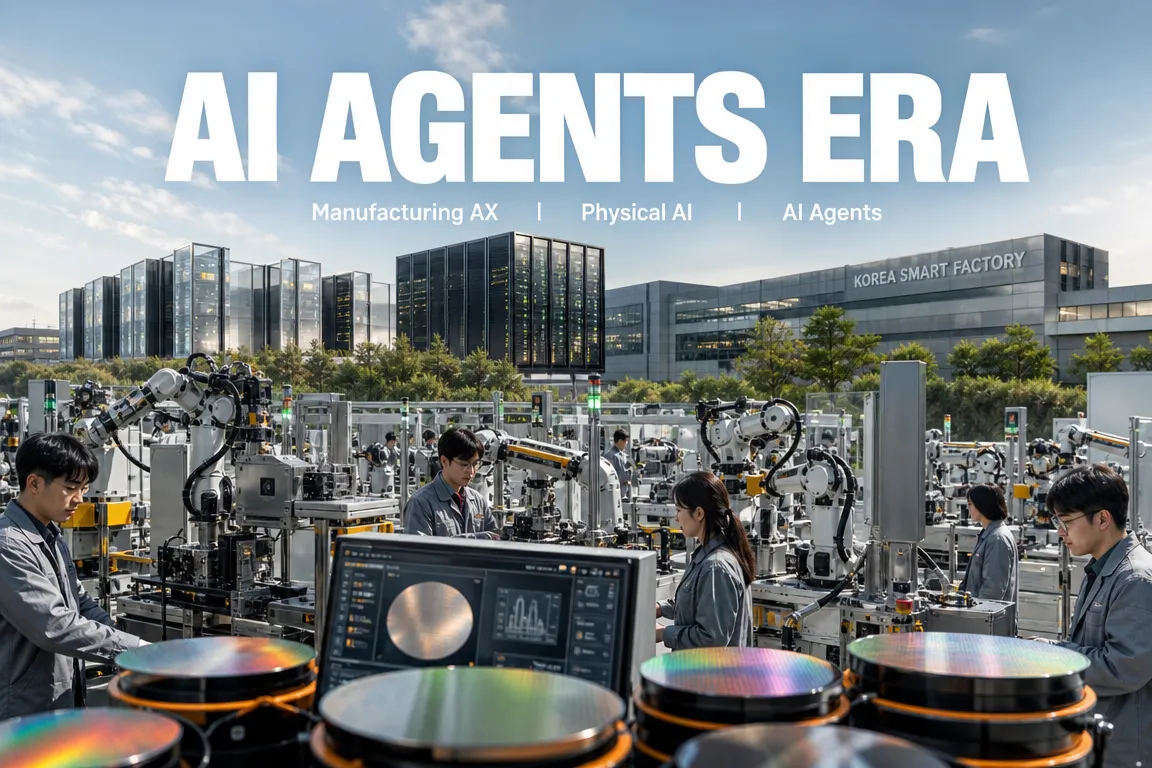
6. The core bottleneck in the AI agent era: KV cache is exploding memory demand
Another important keyword in the original text is KV cache.
KV cache is easiest to understand as temporary memory stored so AI can remember conversational context.
For an AI model to remember a user’s question and prior conversation and produce a response, it must continuously store Key and Value information internally.
The issue is that as AI agents perform longer and more complex tasks, this KV cache grows rapidly.
A simple chatbot only needs to handle short conversations, but AI agents read emails, analyze documents, write code, and work across multiple apps.
Because they must maintain long contexts throughout that process, memory usage surges.
If KV cache is not managed efficiently, computational burden can grow exponentially.
That is why Big Tech companies such as Google are researching KV cache compression, quantization, and offloading technologies.
But even if compression technology advances, if AI usage grows even faster, memory demand will continue to increase fundamentally.
Ultimately, in the AI agent era, not only GPU compute performance but the entire memory hierarchy, including DRAM, HBM, and NAND, becomes important.
7. What Nvidia’s next-generation chip architecture tells us: watch memory growth, not just GPUs
The original text mentioned the Vera Rubin line of chips as Nvidia’s next-generation semiconductor architecture.
The key point is that a large amount of LPDDR5X-based memory is added around the CPU, and HBM4 capacity increases significantly around the GPU.
Based on the original text, the Vera CPU area was said to have about a 3x increase in DRAM content compared with before.
The Rubin GPU was also said to use 288GB of HBM4, which could lead to a larger HBM footprint than before.
What investors should focus on here is not simply the news that Nvidia is making better chips.
More important is the fact that the total amount of memory required per next-generation AI server keeps increasing.
GPU is at the center of the AI semiconductor market, but as GPUs get stronger, surrounding memory bottlenecks also grow.
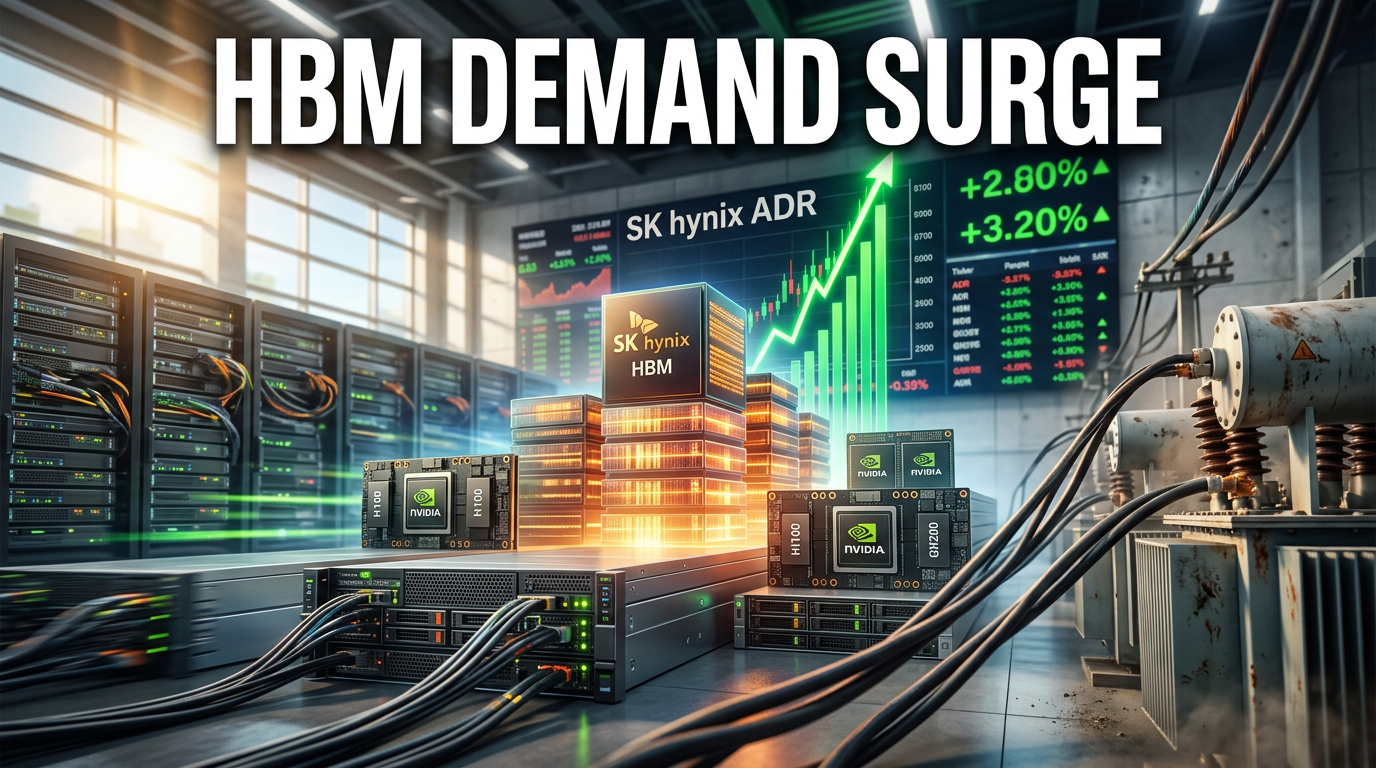
Ultimately, HBM shortages are more likely to be a structural phenomenon arising from changes in AI data center design than a short-term theme.
8. The memory cycle after 2027: watch the HBM transition rather than DRAM peak-out
The original text introduced a bearish view that DRAM’s upward momentum could slow around Q2 2027 or sometime in 2028.
This is a very realistic concern.
As new fabs come online and supply increases, the pace of general DRAM price gains may slow.
In fact, the big driver of memory stock gains so far has been the rise in DRAM prices.
When prices rise, revenue and profit increase sharply even if the volume sold is the same.
But starting after 2027, the center of growth may change.
The original text suggested that HBM could become a structure that lifts both P and Q at the same time.
Here, P means price and Q means quantity.
So while the past was heavily driven by higher prices due to shortages, the future could see both volume and price rise together through increased HBM content and a shift toward higher-value products.
This is growth with better profit quality.
That is because it is growth driven not just by price spikes, but by stronger customer demand and product mix improvement as well.
9. Why HBM4 matters: a structure that can create a 3x revenue growth scenario
The original text presented a calculation showing that if HBM prices rise by about 50% and volume increases by about 100%, total revenue could rise by more than roughly 3x.
In simple terms, if price becomes 1.5x and volume becomes 2x, revenue becomes 3x.
Of course, actual company performance depends on yield, costs, customer mix, long-term supply contracts, exchange rates, and depreciation.
But the direction is clear.
As the industry moves to HBM4, unit prices rise, and the HBM capacity required per GPU also increases.
HBM also has higher technical barriers and stricter customer qualification requirements than general DRAM.
As a result, there are fewer suppliers, and the leading companies can gain relatively stronger bargaining power.
This is a key medium- to long-term variable for SK hynix’s stock price.
10. The decisive difference between general DRAM and HBM: from commodity to customized component
General DRAM is, as the name suggests, a general-purpose product.
Anyone can manufacture it to certain specifications, and customers can buy from multiple suppliers.
Products like this tend to become price-competitive like raw materials over time.
HBM is different.
HBM is tied to GPU and packaging architecture, interfaces, power characteristics, thermal design, and customer qualification.
In particular, specifications can differ by AI accelerator, whether Nvidia, AMD, Google TPU, or Broadcom custom ASIC.
When that happens, memory companies become not just suppliers, but core partners in the AI semiconductor ecosystem.
From the customer’s perspective too, it is hard to switch away from a proven HBM supplier.
This is the lock-in effect.
If SK hynix and Samsung Electronics secure technological advantages in back-end packaging, TSV, bonding, and yield stabilization, they could build a much stronger moat than in the past general memory market.
11. What Leopold Aschenbrenner’s portfolio shows about the AI investment map
The original text introduces the AI-focused investment portfolio of Leopold Aschenbrenner, known as a former OpenAI insider.
The key point is that he is focusing more on AI computing infrastructure bottlenecks than on AI software companies.
In his portfolio, higher exposure was mentioned for neocloud companies such as Nebius, CoreWeave, Core Scientific, and Applied Digital.
Neoclouds are emerging cloud infrastructure companies that provide GPU clusters needed for AI training and inference.
Although Big Tech is building its own data centers, external GPU cloud demand is also growing as AI demand increases too quickly.
In addition, computing hardware and memory companies such as SanDisk, Micron, and TSMC were also mentioned as major investment targets.
What matters is that energy infrastructure companies like Bloom Energy were included as well.
In other words, the bottlenecks in AI investing are not the model itself, but compute, memory, power, and data centers.
This perspective also aligns with the current AI infrastructure investment trend in the U.S. stock market.
12. Morgan Stanley’s view: Nvidia remains the top pick, and memory shortages may last longer
The original text also mentioned a Morgan Stanley report.
The core message was that Nvidia remains the top pick and that memory shortages could last for several years.
Even though Nvidia is already generating enormous revenue, its growth rate is not slowing; in fact, it is accelerating.
Normally, as revenue scale grows, the growth rate naturally declines.
But because AI data center demand is so strong, Nvidia’s earnings slope remains high.
There is also analysis that Nvidia’s computing market share remains strong even if Broadcom and Big Tech develop custom AI chips.
In particular, if Nvidia’s share remains high even in the inference market, HBM demand is also likely to stay solid.
The more Nvidia sells, the more companies in the memory supply chain such as SK hynix, Micron, and Samsung Electronics can benefit as well.
13. Valuation perspective: possible re-rating for Nvidia, Micron, and SK hynix
The original text mentioned Nvidia’s forward P/E, EPS growth rate, and Micron’s low valuation.
Nvidia is already a mega-cap company, but because EPS growth is expected to be very high, the valuation burden may look lower than expected.
Micron may also look inexpensive on a forward P/E basis when the memory semiconductor recovery and HBM growth expectations are reflected.
From this perspective, SK hynix also has room to be re-evaluated by U.S. investors.
In particular, considering HBM market share, its position in Nvidia’s supply chain, DRAM profitability, and the impact of the won exchange rate, the Korea discount could narrow.
That said, in the short term, it is wise to be cautious about chasing the stock based only on the ADR premium.
The ADR premium may already be partly reflected, and the price gap between the Korean-listed share and the U.S. ADR may persist structurally.
14. The core point rarely explained in other news: SK hynix’s real variable is not ADR, but the “commoditization shift” in memory
The most important part of this issue is not whether the ADR listing was a hit.
The real core point is that memory semiconductors may no longer be tied only to a simple commodity cycle.
In the past, DRAM was a classic cyclical industry: when prices rose, everyone benefited; when supply increased, everyone suffered.
But HBM has a more customized nature and is deeply connected to the AI accelerator ecosystem.
That means earnings volatility for memory companies may become milder than in the past.
Also, as the share of high-value-added products increases, the market may assign a higher valuation to memory companies.
That is what re-rating means.
Ultimately, the key to SK hynix’s medium- to long-term stock performance is not the 15% ADR premium, but HBM4, back-end packaging, customer lock-in, and the spread of AI agents.
If these four factors come together, SK hynix can be evaluated not merely as a memory company, but as a core AI infrastructure company.
15. Key indicators investors should check now
First, check whether the ADR premium is being maintained.
Track how much premium the U.S. ADR price is getting relative to the Korean-listed share.
If the premium expands, it may signal strong demand from U.S. investors.
Conversely, if the premium narrows, it may indicate that short-term overheating is cooling.
Second, look at Big Tech’s AI data center investment plans in late July earnings.
Capital expenditure guidance from Microsoft, Amazon, Google, and Meta is directly tied to HBM demand.
If AI server investment continues to rise, that is positive for SK hynix and Micron.
Third, watch Nvidia’s next-generation GPU shipment schedule and the pace of HBM4 adoption.
The faster the transition to HBM4, the larger the share of high-value-added memory revenue can become.
Fourth, monitor DRAM price growth slowing and HBM revenue growth together.
If you only look at DRAM peak-out, the bearish view may seem right.
But if HBM revenue grows faster, overall results can keep improving.
Fifth, check the power infrastructure bottleneck.
AI data centers cannot run on GPUs alone.
They also need power, cooling, land, and transmission networks.
If power infrastructure shortages worsen, data center expansion may be limited even if demand for AI semiconductors is strong.
16. Conclusion: be cautious on the short-term spike, but the medium- to long-term structural shift remains strong
The SK hynix ADR listing event is certainly symbolic.
It is positive that Korea’s flagship semiconductor company is now more directly exposed to U.S. stock market investors.
But from a short-term stock perspective, you must consider the ADR premium, profit-taking, the price gap with the Korean-listed share, and the recent weakening in memory investment sentiment together.
So an approach like “the ADR rose, so the Korean-listed share will definitely surge too” is dangerous.
On the other hand, the medium- to long-term picture remains strong.
The spread of AI agents increases KV cache demand, and KV cache lifts demand for DRAM and HBM.
Nvidia’s next-generation chips need more memory, and HBM4 may see both price and volume increase simultaneously.
Ultimately, when looking at SK hynix, what matters more than a short-term event is how long the AI infrastructure investment cycle will last.
If you look at the U.S. stock market, global economic outlook, AI semiconductors, HBM, and memory semiconductor trends together, this issue is best interpreted not as a simple surge story, but as a midpoint in an industrial structural shift.
< Summary >
The SK hynix ADR listing is symbolically significant, but as a short-term stock catalyst, it was more ambiguous than expected.
Because ADRs carry an accessibility premium, it is hard to say that the Korean-listed share will simply follow the U.S. price exactly.
The semiconductor cycle has not disappeared, but right now AI demand is outpacing supply by a wide margin.
In the AI agent era, KV cache could structurally increase demand for DRAM, HBM, and NAND.
Even if DRAM price growth slows after 2027, HBM4 may continue to lift both price and volume.
The real core point is not the ADR surge, but that memory semiconductors are shifting from general commodities to core customized components for AI.
[Related Articles…]
HBM Market Outlook and AI Semiconductor Supply Chain Changes
Nvidia Earnings and the AI Data Center Investment Cycle Analysis
*Source: [ 월텍남 – 월스트리트 테크남 ]
– 하이닉스 +15%급등, 오히려 조심해야하는 이유..