● Tesla-Cracks-S, X-Lines, Bets-30T-on-Robots-AI
Tesla’s decision to remove the Model S and Model X lines | A 30 trillion won robotics bet, Optimus, and AI infrastructure investment, fully organized
The core issue this week is not simply that Tesla is investing in robots.
The key point is that Tesla plans to remove the production lines for its symbolic Model S and Model X during a period of EV market recovery and repurpose that capacity for Optimus and physical AI production systems.
In addition, the release of U.S. CPI, PPI, retail sales, labor data, and Tesla’s earnings may increase volatility in Tesla shares and global equity markets.
This report summarizes Elon Musk’s conflicts with the AI industry, Anthropic and xAI, OpenAI-related issues, changes at the Fremont factory, Cybercab production technology, and the main challenges facing Optimus.
1. Key macro indicators this week | CPI, PPI, retail sales, labor data
Global financial markets are likely to react sensitively to incoming data this week.
The calendar includes U.S. CPI, PPI, retail sales, the Philadelphia Fed manufacturing index, and initial jobless claims.
These data points are critical for assessing inflation trends, interest rate expectations, and the risk of economic slowdown.
Growth stocks such as Tesla are particularly sensitive to rate expectations.
If inflation comes in above expectations, rate-cut expectations may weaken and pressure Nasdaq and Tesla shares.
By contrast, stable inflation and resilient consumption could support both EV demand and AI infrastructure investment themes.
2. Key points ahead of Tesla’s Q2 earnings release
Tesla’s Q2 earnings release is scheduled for July 22.
Investors will focus less on revenue and more on margins, deliveries, FSD monetization potential, and the scale of Optimus investment.
According to the source material, Tesla’s Q2 deliveries were 481,260 units, above the market estimate of approximately 406,600 units.
This matters because Tesla is not shifting to robotics as an escape from weakness; it is reallocating capital toward robotics even as its EV business shows signs of recovery.
In other words, Tesla’s strategic shift appears to be a proactive reallocation of resources rather than a defensive move.
3. Why Elon Musk re-evaluated Anthropic
Elon Musk recently posted on social media that he was “obviously wrong” about Anthropic.
He had previously suggested that Anthropic would struggle in the AI competition, but now appears to view it as one of the strongest players in the industry.
The source links this change in tone to Anthropic’s compute agreement with the Memphis data center.
Anthropic is described as using compute resources worth $1.25 billion per month through May 2029.
When a competitor becomes a major customer, a change in tone is understandable.
This underscores that AI competition is not only about model quality but also about capital spending on data centers, power, GPUs, and cloud compute.
4. Why the OpenAI, Apple, and Elon Musk conflict matters
The dispute between Elon Musk and Sam Altman is again drawing attention.
OpenAI began in 2015 as a nonprofit research organization, and Musk was one of the co-founders.
After OpenAI shifted toward a for-profit structure, Musk argued that the company had abandoned its founding mission.
The dispute has led to litigation and remains a major political issue in the AI sector.
When Apple announced that ChatGPT would be integrated into iPhone operating systems, Musk responded that he might ban Apple devices at his companies.
His concern was that user data could be routed to OpenAI.
The source also mentions the possibility of a trade secret dispute between Apple and OpenAI.
If such legal conflicts escalate, they could affect OpenAI’s IPO prospects, AI regulation, and the structure of Big Tech partnerships.
5. Tesla robotaxi app update | FSD status display
Tesla’s robotaxi app is said to include a feature that shows whether a vehicle is currently driving itself under FSD.
The app reportedly displays autonomous driving status in blue text.
While this may appear to be a simple UI update, it is an important step in building trust in the robotaxi service.
Passengers need to know clearly whether the vehicle is being operated by a human or by FSD.
For autonomous mobility to scale, Tesla must secure not only technical performance but also user confidence.
6. Unmanned Cybercab rides begin at Gigafactory Texas
Unmanned employee rides in Cybercab have reportedly begun at Gigafactory Texas.
A person involved in Cybercab and robotaxi engineering reportedly took the vehicle more than 50 times over the past few days and described it as difficult to leave.
This suggests that Tesla is designing autonomous driving as a service experience, not just a vehicle feature.
Cybercab is intended to operate without a steering wheel or pedals, which requires a fundamentally different manufacturing and operations model from conventional EVs.
This is also why Tesla is pushing both robotaxi and Optimus: both are centered on physical AI, where AI systems make decisions and act in the physical world.
7. Fremont factory transition | The Model S and Model X lines disappeared in 46 days
The most important development took place at Tesla’s Fremont factory in California.
Tesla released footage showing the complete dismantling of the Model S and Model X assembly lines.
The process reportedly took about 46 days.
An automotive assembly line is a highly complex production system involving concrete floors, robotic arms, conveyor belts, electrical systems, and plumbing infrastructure.
Removing such a line in 46 days suggests that the next production system had already been prepared.
Tesla’s manufacturing account described the moment as the end of an era.
Model S, launched in 2012, and Model X, launched in 2015, were symbolic vehicles that shaped Tesla’s premium EV image.
Tesla is now stepping away from those symbols.
8. Why Model S and Model X now
The suspension of Model S and Model X production was not a sudden decision and appears to have been signaled in a prior earnings call.
According to the source, new orders were halted in April and the last vehicles were delivered in May.
New production has ended, but service and parts support for existing vehicles is likely to continue.
Model S and Model X were important for brand identity, but their sales have long been overshadowed by Model 3 and Model Y.
For Tesla, reallocating limited factory space from lower-volume flagship vehicles to higher-growth robotics production may be a more rational use of capacity.
9. Fremont first, Texas later
Elon Musk previously referred to a plan to build a robot production line in Fremont with capacity for roughly 1 million units.
A much larger Optimus dedicated production site is also reportedly being prepared in Texas.
Under this structure, Fremont would serve as a pilot manufacturing and process-validation site, while Texas would become the center of mass production.
This is similar to Tesla’s approach in automotive manufacturing.
Test at a small scale, improve quickly, then expand into large-scale production.
If applied to Optimus, this approach could materially change the pace of robot manufacturing.
10. Tesla’s 30 trillion won bet | More than $20 billion for factories and AI infrastructure
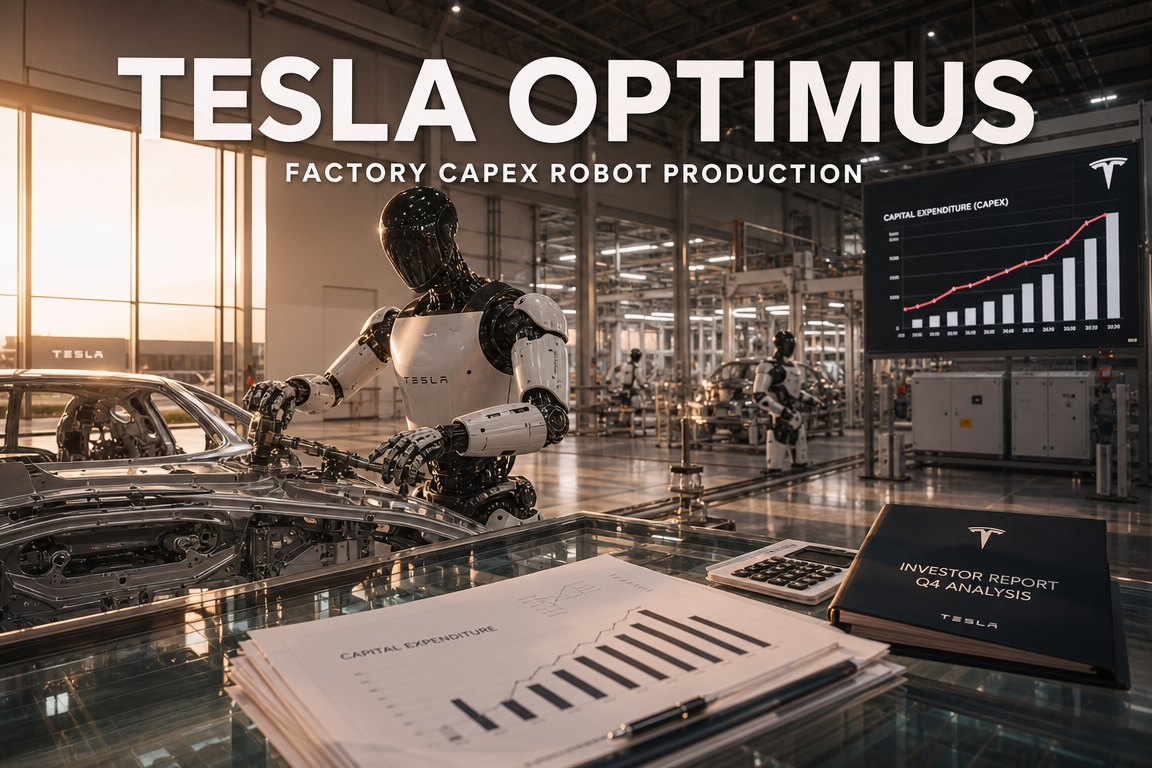
The source says Tesla is planning more than $20 billion in investment for factories and AI infrastructure.
That is close to 30 trillion won.
It is an amount large enough to acquire many mid-sized automotive brands.
The key point is that this capital is not only for buildings.
Tesla is simultaneously preparing AI training infrastructure, autonomous driving data processing, robot production facilities, and new manufacturing processes.
Tesla’s robotics strategy therefore looks less like a software company experiment and more like a manufacturing-based AI platform strategy.
11. Why Cybercab production technology connects to Optimus
Tesla has also introduced a new production technology for Cybercab.
The core process is reaction injection molding.
In simple terms, instead of painting a completed part, color is mixed into the material itself and molded directly.
This can reduce the coating process from hours to minutes.
It can also reduce manufacturing time, supply chain burden, and hazardous emissions.
An interesting point is the visual connection between Cybercab’s gold color and the color palette used in recent Optimus images.
If Tesla applies the same no-paint, integrated-color process to robots, Optimus production costs could decline materially.
Tesla appears to be transferring manufacturing-speed innovations from cars to robots.
12. This is not a move away from EVs because EVs are failing
One point should be clarified.
Tesla is not focusing on robots simply because its EV business has collapsed.
The source says Tesla recorded its first annual revenue decline in more than 20 years in 2025, along with lower net profit.
At the same time, it notes the possibility of higher oil prices and an EV demand recovery in 2026.
The International Energy Agency is said to expect global EV sales to approach 30% of total vehicle sales this year.
In other words, the EV market may be entering another recovery phase.
Even so, Tesla is moving space and capital from Model S and Model X production into robotics.
This is an offensive allocation of resources, not a defensive one.
13. What Tesla shareholders should focus on | From automaker to physical AI company
The key question for Tesla shareholders is straightforward.
Is Tesla still an EV company, or should it be valued as an AI robotics company?
Most of Tesla’s revenue still comes from automobiles.
However, the market assigns a premium valuation because of its future businesses, including autonomous driving, robotaxi, energy, and Optimus.
If Optimus can genuinely replace human labor, Tesla’s valuation could become difficult to compare with traditional automakers.
If Optimus remains at the demonstration stage, robotics expectations could become a source of pressure on Tesla’s share price.
Investors are therefore likely to place increasing emphasis on Optimus production, cost, task capability, and customer testing rather than vehicle sales alone.
14. The real challenge for Optimus is not walking, but hands
Many people focus on whether humanoid robots can walk.
The harder problem is the hand.
Most human work is completed through the hands.
Opening doors, using tools, lifting cups, connecting cables, and assembling parts all require highly precise hand movements.
The source also references a new robotic hand from the U.S. startup 1X Technologies.
It is described as having 25 degrees of freedom, tendon-driven motion, up to 45N of finger force, and a target positional accuracy of 0.2 mm.
Water resistance and durability beyond 2 million cycles are also highlighted.
These capabilities matter because robots must be able to use tools designed for human environments without modification.
15. Physical AI inflection point comes when robotic hands and AI brains converge
Even a highly capable robot hand is not enough without a strong AI system.
Conversely, even a strong AI system is limited if the hand is too crude to act in the physical world.
Optimus therefore depends on the integration of hardware and AI models.
Elon Musk has praised Anthropic while also suggesting that xAI’s Grok is quickly catching up to competing models.
If Tesla’s autonomous driving data, xAI’s language models, and Optimus’s physical action data are connected, the physical AI competition could enter a new phase.
This is where Tesla differs from other robotics startups.
Tesla combines AI models, vehicle data, factory automation, batteries, actuators, and mass-production experience.
16. The most important point rarely emphasized elsewhere
The main point is not simply that Tesla is spending 30 trillion won on robots.
The real issue is that Tesla is reusing automotive manufacturing assets as it converts car factories into robot factories.
Most robotics startups can produce compelling robot demonstrations, but they lack experience manufacturing hundreds of thousands or millions of units at consistent quality and low cost.
Tesla has a major advantage in this area.
The Fremont line teardown may be the first public signal of a transition from automotive manufacturing systems to humanoid robot production systems.
Another key point is that Optimus may be decided less by overall robot performance than by the quality of its hands.
Walking robots attract attention, but robots that generate revenue are the ones that can work with their hands.
The most important checkpoints for Optimus 3 will be finger dexterity, tactile sensing, repeat-task accuracy, failure rates, and tool-use capability.
Finally, Tesla is not moving into robotics because EVs are failing; it is moving while the EV market may still recover, in pursuit of a larger opportunity.
That distinction matters for understanding Tesla’s strategy.
17. Investor checklist | Seven items to monitor
First, monitor the hand structure and task demonstrations of Optimus 3.
Walking alone is not sufficient; assembly, tool use, and cable connection are more important.
Second, confirm the launch timing of the Fremont robot production line.
Tesla must show how many units it can actually produce.
Third, track the Texas Optimus dedicated production site.
Fremont may be a test environment, but Texas is the main event for mass production.
Fourth, verify whether Cybercab production processes are applied to Optimus.
If reaction injection molding and no-paint processes are used for robots, the cost structure could change materially.
Fifth, assess whether FSD and robotaxi data are connected to Optimus AI.
Tesla’s strength lies in collecting and training on large-scale real-world data.
Sixth, review Tesla’s CAPEX and AI infrastructure spending in the earnings release.
Capital allocation, not commentary, will show the real direction of strategy.
Seventh, watch whether Tesla’s share price becomes more sensitive to robotics progress than to auto delivery data.
At that point, the market may begin to value Tesla as an AI robotics platform rather than as a car company.
18. Conclusion | Is Tesla’s robotics bet reckless, or the next growth curve?
Tesla’s move is bold.
Model S and Model X were iconic vehicles that helped establish Tesla as a premium EV brand.
Yet Tesla is now leaving those symbols behind and shifting toward an Optimus- and robotaxi-centered production model.
This decision would be difficult to justify unless Tesla believed the robotics market could be much larger than the automotive market.
That conviction has not yet been fully validated by numbers.
Optimus shipment volume, task performance, hand dexterity, production cost, and customer adoption will all be needed.
Ultimately, Tesla’s 30 trillion won bet will succeed only if Optimus can do more than walk like a human; it must also use its hands like a human.
If that happens, Tesla could be re-rated as a leading company in the physical AI era rather than simply as an EV manufacturer.
< Summary >
Tesla is rapidly dismantling the Model S and Model X production lines and shifting toward robot production systems.
This decision appears to reflect a view that Optimus and the physical AI market represent a larger opportunity, not simply weakness in EV demand.
Tesla plans to invest more than $20 billion in factories and AI infrastructure, linking robotaxi, Cybercab, and Optimus into a single manufacturing ecosystem.
Key watch items are Optimus 3 hand performance, task capability, and the activation of production lines in Fremont and Texas.
Tesla shareholders should monitor not only vehicle deliveries but also robot ramp-up speed and AI infrastructure spending.
[Related Articles…]
- Optimus and the Humanoid Robotics Market Outlook
- Robotaxi and Autonomous Driving as Tesla’s Next Growth Strategy
*Source: [ 오늘의 테슬라 뉴스 ]
– 잘 팔리는데도… 테슬라, 로봇에 30조 베팅한 진짜 이유! 테슬라 주주는?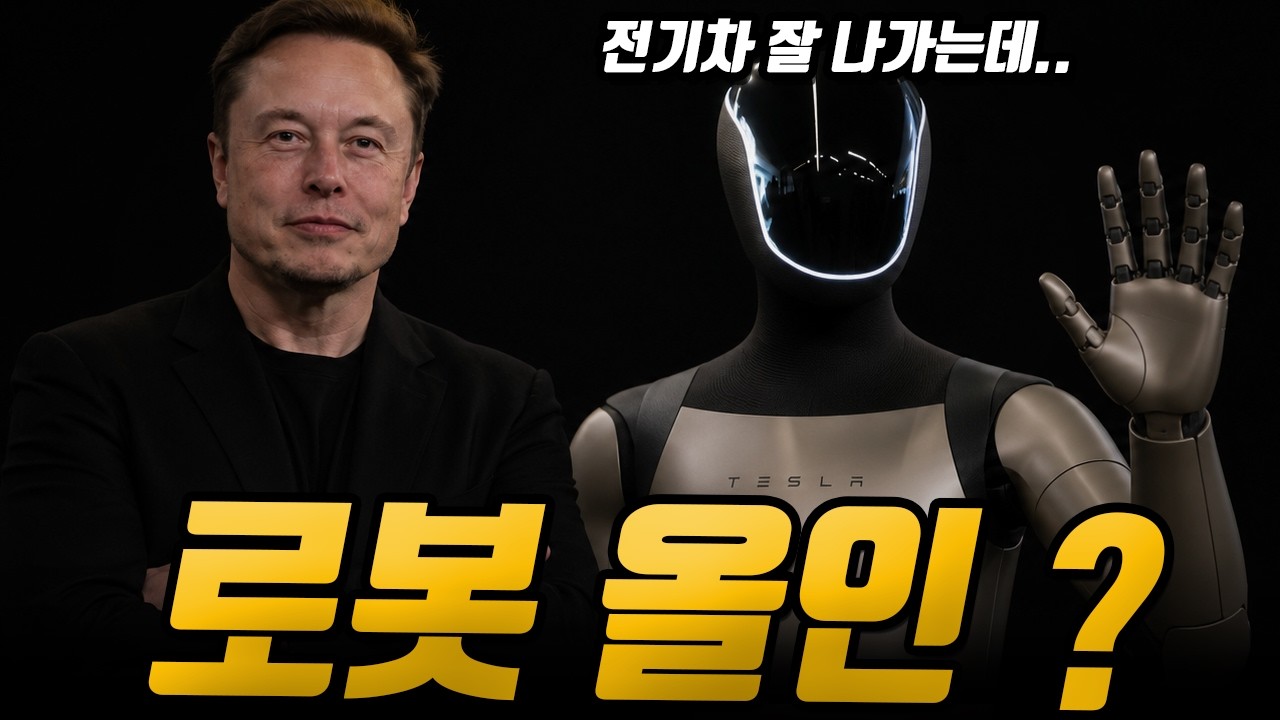
● AI,Investing,Trap,51-Rule
The Illusion That AI Can Predict the Future: The 51% Rule Investors Must Understand to Avoid Losses
When discussing AI investing, stock investing, robo-advisors, asset allocation, and economic outlooks, the most dangerous misconception today is the belief that AI can precisely predict the future.
The core point is not simply to be cautious about AI.
The principle is that humans must retain final judgment and responsibility under the “51% rule.”
This is especially important for individual investors who rely on AI stock picks, AI financial plans, or AI-based investment strategies without scrutiny, as the risk of loss rises materially in such cases.
1. Key Takeaway: The Greatest Misconception in the AI Era Is Future Predictability
Professor Lee Shihan identified the most dangerous misconception in the AI era as the belief that one can predict the future through AI.
Many people now ask AI about promising occupations, disappearing jobs, outperforming stocks, and 10-year asset plans.
The issue is that AI responses are generated from historical data and the current level of technological development.
In other words, AI can outline future possibilities based on current trends, but it cannot accurately foresee entirely new technologies or abrupt structural changes in society.
Three years ago, few expected generative AI to transform daily life and industry as it has today.
By the same logic, forecasts for the AI era three, five, or ten years ahead can easily prove inaccurate.
- AI is not a tool for confirming the future.
- AI is better understood as a tool for organizing possibilities based on current information.
- Investors should treat AI responses as hypotheses, not conclusions.
2. Paris Exposition Example: Past Forecasts Envisioned a “Flying Mail Carrier”
At the 1900 Paris Exposition, people imagined future occupations.
One representative concept was a “flying mail carrier” delivering letters using a one-person flying device.
At the time, people imagined personal airborne mobility.
However, they did not anticipate email, messaging, or smartphones as the core technologies of information exchange.
In this sense, the future was only partially anticipated, while the main direction proved incorrect.
This example remains relevant because the same pattern appears in the AI era.
People forecast future jobs and industries based on technologies that already exist.
In practice, however, the future may be shaped by technologies that are not yet visible.
3. Kodak’s Collapse: The Issue Was Not Technology, But the Speed of Transition
Kodak is often cited as a company that failed because it did not prepare for the digital camera era.
More accurately, Kodak already possessed digital camera technology.
The problem was that it failed to understand how the digital transition would spread.
Kodak assumed that film sales would decline gradually and that digital cameras would be adopted slowly.
It therefore built a transition strategy between its film business and digital camera business.
The market, however, did not evolve as expected.
When cameras were integrated into smartphones, the rules of the game changed completely.
The issue was not that digital cameras needed time to expand independently; instead, mobile phones already installed worldwide became cameras.
Kodak did not lack technology; it misread the combination and speed of technological diffusion.
- Owning technology and responding to the market are different matters.
- In forecasting, diffusion pathways matter more than the technology itself.
- In AI investing, “which technology will rise” is less important than “how it connects with industries.”
4. Quantum Computing and Financial Markets: One Technology Alone Cannot Define the Outcome
There are concerns that once quantum computers become commercially viable, existing financial networks, cryptographic systems, and Bitcoin security could be weakened.
Such a scenario cannot be ruled out entirely from a technical perspective.
However, quantum security technologies will likely advance alongside quantum computing.
In other words, it is risky to isolate one technology and conclude that existing systems will collapse once it emerges.
Technology ecosystems always move together with counter-technologies, regulation, security, and market behavior.
The same applies to economic outlooks and investment strategies.
If interest rates, equity markets, foreign exchange, and geopolitical risks are assessed through a single variable alone, the result is likely to diverge from actual market behavior.
5. The Risk of AI Finance: AI Is Effective at General Rules, Not at Understanding Individual Circumstances
AI can produce highly convincing financial plans.
For example, if asked to plan for a home purchase in three years, retirement assets in ten years, or an investment allocation based on salary, it can respond quickly.
The problem is that these answers are usually general-purpose.
AI can produce a plan suitable for an average person.
That does not mean the plan is appropriate for a specific individual.
A person may marry, have children, change jobs, start a business, or face health-related disruptions.
External variables such as war, oil shocks, presidential remarks, or policy rate changes can also occur unexpectedly.
AI cannot fully incorporate such personal contexts and unforeseen variables.
For that reason, an AI-generated financial plan should be treated as a provisional map that requires continual revision, not a fixed long-term plan.
6. The Limitation of Robo-Advisors: Algorithms Cannot Fully Capture Unpredictable Shocks
Robo-advisors automatically adjust asset allocation using algorithms.
They allocate among equities, bonds, cash, and commodities according to investor profiles and market indicators.
However, these systems have clear limitations.
Not every shock can be encoded in advance.
Sudden presidential remarks, conflicts in the Middle East, unexpected regulatory changes, and crisis-level financial events are difficult to model perfectly ahead of time.
Using a robo-advisor is reasonable, but treating it as an absolute decision authority is not.
AI investment systems are only one of several tools for interpreting markets.
Individual investors should review AI outputs and reassess them against their own investment principles and risk controls.
7. The 51% Rule: Even If AI Does 99% of the Work, Final Control Remains Human
The central concept in this discussion is the “51% rule.”
It means that even in the AI era, humans must retain the 51% of responsibility that cannot be delegated.
This should not be misunderstood as requiring humans to do 51% of the work themselves.
AI can handle 99% of the workload if needed.
Research, summarization, simulation, draft reports, and investment idea generation can all be assigned to AI.
However, the final human judgment determines the direction of the outcome.
This last layer of human intervention represents the decisive 51% share in the decision process.
- AI is strong at execution and organization.
- Humans must retain the roles of questioning, context-setting, and responsibility.
- Once AI-generated output is used as-is, accountability shifts to the human user.
8. The Substance of the 51%: Questions, Context, and Responsibility
The human share that must be preserved in the AI era can be divided into three parts.
First, questions.
Humans decide how to ask AI the right question.
Better questions generally produce better answers.
Conversely, imprecise questions lead to weaker or misdirected responses.
Second, context.
AI is effective at average answers.
However, my occupation, income, family situation, debt, investment horizon, and risk tolerance must be provided by me.
Without this context, AI-driven investment strategies may appear sound but fail in practice.
Third, responsibility.
AI does not bear responsibility for its outputs.
If an AI-recommended stock falls, AI does not absorb the loss.
If an AI-generated meeting summary contains errors, the human submitter remains accountable.
Ultimately, any output produced with AI must be verified by a human at the end of the process.
That verification and judgment process is the core of the 51% rule.
9. The Meeting Minutes Example: Why Verification Matters
AI can summarize meeting minutes quickly.
A two-hour meeting can be condensed in about 20 seconds.
From a productivity standpoint, this is a major improvement.
The problem is accuracy.
There are cases where statements from people who did not attend the meeting are included in the minutes.
In such cases, the issue is not only with the AI.
It also reflects the responsibility of the person who submitted the document without final review.
If AI reduces two hours of work to 20 seconds, a human should still spend at least two minutes reviewing it.
That two-minute verification is what preserves the human 51% share.
10. Practical AI Investment Principles for Individual Investors
Individual investors do not need to avoid AI in finance.
On the contrary, they should use it actively.
However, AI should be treated as a decision-support tool, not as an infallible source of truth.
- Do not buy a stock immediately just because AI recommended it; first review the rationale.
- Adjust AI-generated asset allocation plans to reflect your own cash flow and debt profile.
- Treat AI economic forecasts as one scenario among several.
- Independently check interest rates, exchange rates, employment data, and geopolitical risks.
- Review robo-advisor outputs regularly and set your own rebalancing rules.
In equity markets, AI can identify historically supported patterns with relatively high probability.
However, it cannot fully anticipate war, regulation, political remarks, corporate accounting issues, or liquidity shocks.
Therefore, the most important objective in AI-based investing is loss management rather than return prediction.
11. The Most Important Point Often Missed in Other Content
Many discussions emphasize that AI improves productivity, helps generate investment ideas, or identifies promising sectors.
However, the most important issue lies elsewhere.
The difference between those who use AI effectively and those who are led by AI lies in the update cycle.
Anyone who receives a 10-year plan from AI once and accepts it without revision is taking a significant risk.
By contrast, users who reapply AI weekly, monthly, or quarterly and incorporate changes in their own circumstances and the market become materially stronger.
In this sense, the real competitive advantage in the AI era is adaptability, not prediction.
AI is not a fixed future-telling device; it is a tool for responding quickly to change.
This is highly relevant to investing.
More important than finding stocks AI labels as winners is the ability to revise quickly when the market proves otherwise.
Equally important is the ability to limit losses and restore balance when AI-generated asset allocation becomes unstable.
Ultimately, the winners in the AI era are more likely to be those who continuously upgrade their own judgment frameworks using AI, not those who merely trust AI forecasts.
12. The Meaning of Collective Intelligence: AI Does Not Replace Humans; It Enhances Them
Professor Lee Shihan presents “collective intelligence” as a key concept for the AI era.
Collective intelligence refers to a framework in which humans and AI improve judgment together.
This is not an era in which AI replaces everything.
It is an era in which AI expands human intelligence and decision-making capacity.
The goal is not simply to delegate tasks to AI, but to build a structure for thinking with AI.
The core of collective intelligence is a self-directed upgrade process.
In the future, brain chips may enable automated cognitive enhancement.
For now, however, individuals must learn how to use AI, how to ask better questions, and how to verify outputs.
The direction of self-development in the AI era is clear.
The focus should be on increasing one’s own value.
The ability to use AI effectively, verify AI outputs, and interpret market and technology shifts will become critical competencies.
13. Investor Checklist: How to Review AI Responses
- Check whether AI’s conclusion is based on data or on general statements.
- Confirm whether your income, debt, family plans, investment horizon, and risk profile are reflected.
- Request at least three scenarios and compare optimistic, neutral, and pessimistic outcomes.
- Separately assess variables that AI may miss, including politics, war, interest rates, exchange rates, and regulation.
- Make final buy and sell decisions according to your own investment principles.
- Do not use AI once and stop; update the analysis regularly.
- Prioritize loss exposure and contingency planning before return expectations.
14. Conclusion: In the AI Era, the People Who Protect Capital Are Not the Predictors, But the Verifiers
AI is a powerful tool.
However, power does not mean certainty.
AI can rapidly provide average and general answers, but the context of one’s life and money remains the user’s responsibility.
The most dangerous attitude in AI investing and finance is, “AI said it, so it must be right.”
The safest attitude is, “AI said this, so I will verify it.”
The 51% rule is a survival principle for the AI era.
AI may perform 99% of the work.
But questions, context, judgment, and responsibility must remain with humans.
That final 1% is what ultimately protects capital and careers.
< Summary >
AI is a tool for organizing possibilities, not for accurately predicting the future.
Kodak failed not because it lacked technology, but because it misread the diffusion path of technological change.
AI-based finance and robo-advisors are useful, but they cannot fully capture individual circumstances or sudden shocks.
The 51% rule means humans must retain questions, context, judgment, and responsibility.
The key competitive advantage in the AI era is adaptability, not prediction.
Individual investors should use AI as a tool to verify investment strategy, not as an authority that replaces judgment.
[Related Articles…]
- AI Investing: Risk Controls Every Individual Investor Should Review
- Stablecoin Competition and the Key Points for the 2026 Global Outlook
*Source: [ 경제 읽어주는 남자(김광석TV) ]
– AI가 미래를 맞힌다는 착각? 돈 잃지 않으려면 반드시 알아야 할 51%의 법칙 | 경읽남과 토론합시다 | 이시한 교수님 [3편]