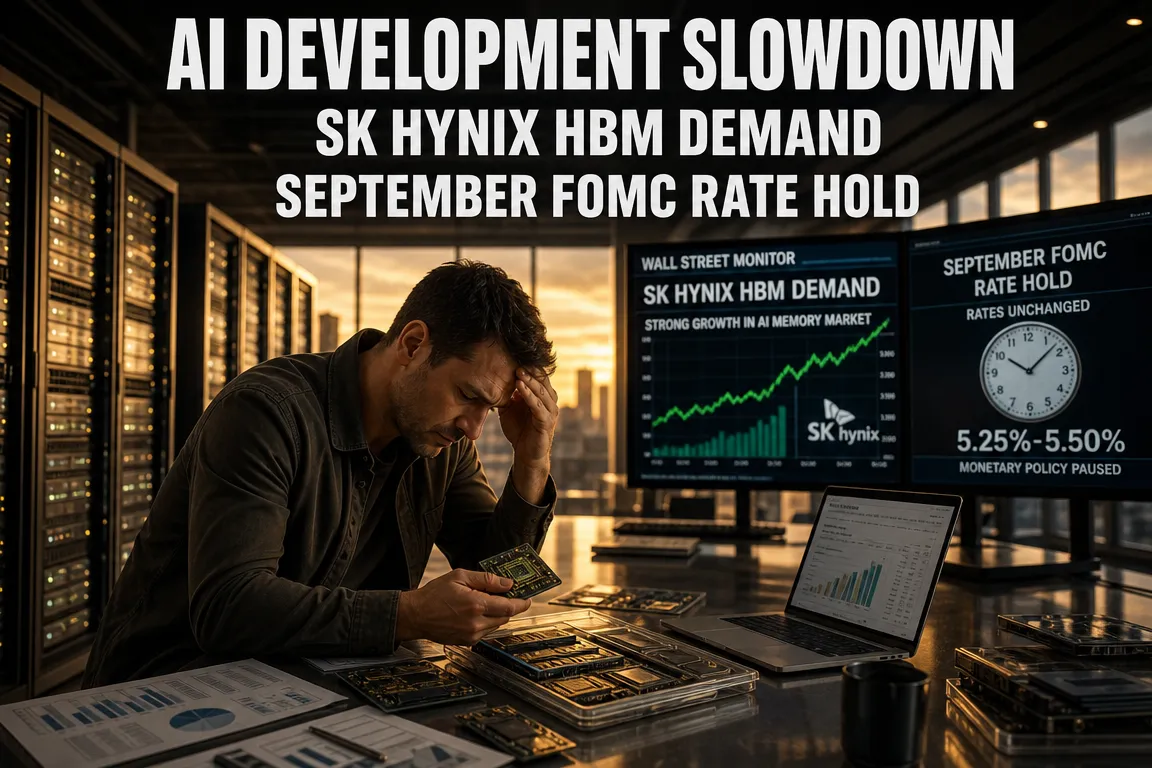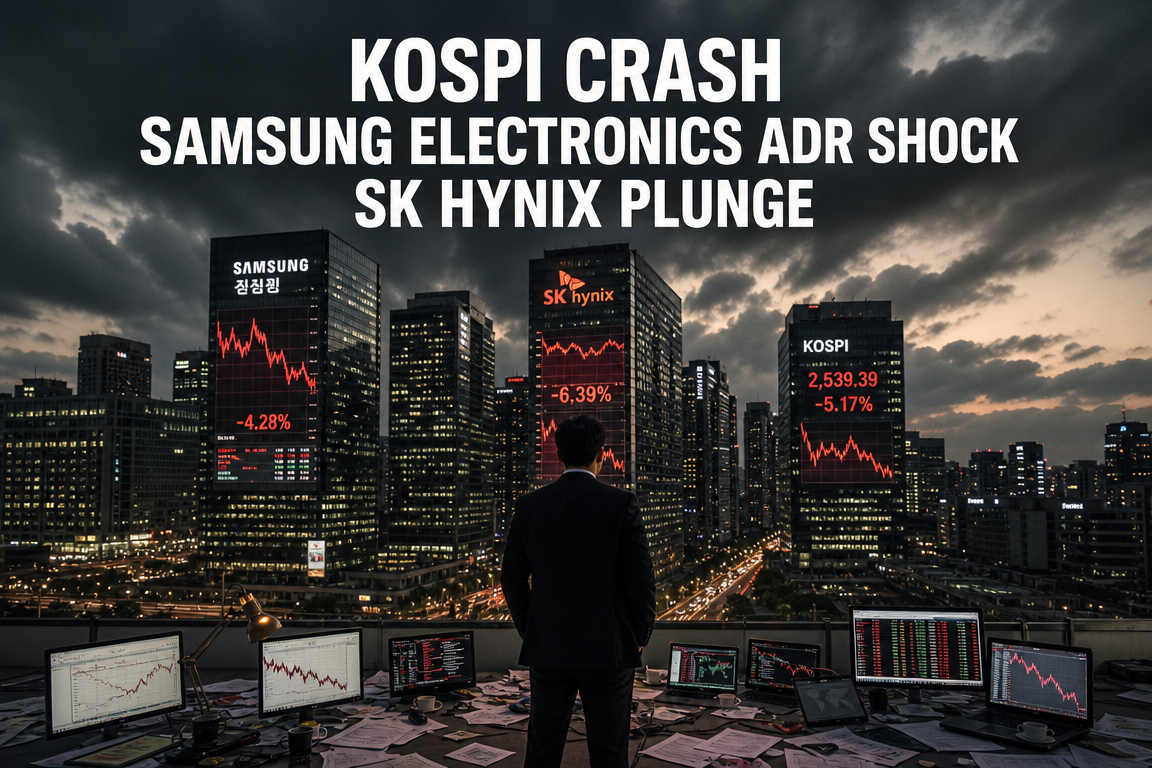
● KOSPI Crash, Samsung-SK Hynix Plunge, ADR Shock
KOSPI’s Worst Day: Sharp Declines in Samsung Electronics and SK Hynix, with the Real Driver Extending Beyond ADR Disappointment
Today’s key point was not simply the KOSPI selloff, Samsung Electronics decline, or SK Hynix plunge.
The main issue was that the Korean equity market is now pricing, at once, semiconductor earnings expectations, AI infrastructure investment, Big Tech CAPEX, leveraged ETF flows, and US ADR pricing, creating a much more volatile trading environment.
At face value, the session appeared to reflect fading expectations for SK Hynix’s ADR listing in the US. In reality, it was closer to a day when doubts about the durability of the memory semiconductor cycle began to be reflected more meaningfully in prices.
The session also underscored why the distinction between a good company and a good stock remains critical.
1. What happened in the KOSPI today
The KOSPI fell in a one-way downward move and posted a sharp decline intraday.
Sidecar and circuit breaker measures were triggered as volatility intensified.
A circuit breaker is a mechanism that temporarily halts trading during extreme market moves to give investors a cooling-off period.
Such measures are typically associated with major market shocks such as the dot-com bubble, the global financial crisis, or the COVID-19 pandemic.
More recently, however, this type of extreme volatility has appeared more frequently than in the past.
This suggests not only a one-day negative catalyst, but a market structure that has become significantly more sensitive.
2. Why Samsung Electronics and SK Hynix fell together
The most visible names in today’s selloff were Samsung Electronics and SK Hynix.
SK Hynix fell sharply intraday, while Samsung Electronics also declined materially.
Because both stocks carry large weights in the KOSPI, their declines quickly translated into broader index weakness.
This move is not easily explained as a simple correction after a strong run in semiconductor shares.
Multiple negative factors had accumulated in the market, and today’s move appears to have been a release of that pressure.
3. First factor: SK Hynix ADR expectations were weaker than anticipated
The most immediate trigger was the ADR-related development for SK Hynix.
SK Hynix ADRs began trading in the US and reportedly closed at a premium of around 15% to the Korean common share.
In general, a premium in the 15% range is not particularly weak for a global semiconductor name.
TSMC, for example, has often traded within a similar premium range.
The issue was that Korean investors had set a much higher bar.
Market expectations had been that a US listing effect would produce a stronger upside response.
When the outcome failed to exceed those expectations, selling emerged on disappointment.
In other words, the issue was not that the ADR was weak, but that expectations had been too high.
4. Second factor: a second-quarter earnings caution on SK Hynix
Additional pressure came from a brokerage report.
Samsung Securities indicated that SK Hynix’s second-quarter operating profit could come in below market expectations.
The exact figures in the original source appear distorted by transcription, but the key point is that the forecast was roughly 8% below consensus.
The target price was largely unchanged, but the market reacted more strongly to the statement that earnings may come in below expectations.
With semiconductor valuations heavily discounting future earnings, even a modest downgrade risk was enough to increase selling pressure.
5. Why a high HBM mix became a concern
SK Hynix has a strong position in the HBM market.
HBM demand tied to AI has been a core growth driver for the company.
However, the fact that HBM now accounts for a large share of the business was interpreted as a short-term concern.
The reason is that HBM is often sold under long-term supply agreements.
Unlike legacy DRAM, where price increases can be reflected relatively quickly, HBM volumes are often delivered under previously agreed pricing.
As a result, the market concluded that a high HBM mix may not translate into an immediate earnings surprise this quarter.
6. Third factor: leveraged ETFs amplified the decline
A major structural factor today was leveraged ETF flow.
Recently, both retail investors and short-term capital have increasingly favored leveraged ETFs over the underlying Samsung Electronics and SK Hynix shares.
This can reduce liquidity in the common shares themselves.
When underlying liquidity is thin, selling can push prices down more easily.
Once the underlying stock weakens, ETF managers may need to sell more of the common shares to rebalance positions.
That, in turn, can deepen ETF losses and trigger additional selling from ETF holders.
This creates a feedback loop in which weakness in the underlying shares drives ETF declines, which then lead to further selling in the underlying shares.
Today’s move was intensified less by a single headline than by this market structure.
7. Fourth factor: geopolitical risk from US-Iran tensions
Geopolitical risk also weighed on sentiment.
Renewed US-Iran military tension increased risk aversion across global markets.
In such environments, investors tend to reduce exposure first in high-beta assets such as growth stocks and semiconductors.
In already fragile markets, even a single geopolitical headline can sharply increase selling pressure.
Recent market behavior has been characterized by muted reactions to positive news and exaggerated responses to negative developments.
That pattern can continue to produce sharp selloffs when sentiment is weak.
8. The deeper issue: doubts about long-term supply agreements in memory semiconductors
More important than today’s move is the fact that the market has begun questioning long-term supply agreements in memory semiconductors.
Samsung Electronics and SK Hynix are fundamentally B2B companies.
Their major customers are cloud providers, hyperscalers, and large technology platforms.
These customers purchase large volumes of memory for AI servers and data centers.
Long-term supply agreements were previously viewed positively.
The assumption was that pre-secured volume would improve earnings visibility.
However, the market is now also considering the opposite scenario.
If the memory cycle turns or hyperscaler investment capacity weakens, long-term contracts could face renegotiation.
Similar situations have occurred in the past, including cases where analog semiconductor companies had to revisit long-term supply terms when customer conditions deteriorated.
The market is now drawing on that precedent again.
9. Why Big Tech CAPEX has become the key variable
The next major driver for semiconductor valuations is Big Tech CAPEX.
CAPEX refers to spending on long-lived assets such as data centers, servers, GPUs, and networking equipment.
Big Tech has accelerated AI infrastructure investment at a rapid pace.
The issue is that larger investment programs also place greater pressure on cash flow.
In the past, Big Tech bought servers and memory with excess cash.
Today, AI spending is large enough that some companies may need to consider debt financing or equity issuance.
Initially, the market did not treat this as a major concern.
Recently, however, caution has increased around whether AI investment has become excessive.
If Big Tech reinforces its commitment to expanding AI infrastructure, sentiment toward Samsung Electronics and SK Hynix should improve.
If management instead emphasizes efficiency and slower capital deployment, memory semiconductor stocks could remain under pressure.
10. Why late-July Big Tech earnings matter
The most important upcoming event is Big Tech earnings and conference calls.
The market is likely to focus more on management commentary than on reported numbers alone.
Investors are looking for answers to clear questions.
First, are AI and cloud revenues still growing strongly?
Second, is demand for data center investment still intact?
Third, is there any intention to slow AI infrastructure spending?
Fourth, is demand for memory and HBM being maintained?
If CEOs state that AI demand remains strong and investment will continue to rise, sentiment toward semiconductors could recover quickly.
By contrast, repeated references to efficiency, optimization, or CAPEX discipline could be interpreted as signals of slower investment.
11. Fears that the memory price upcycle may be maturing
Another important concern is the memory pricing cycle.
Recent earnings improvement at memory companies has been driven more by price increases than by shipment growth.
In other words, the cycle has been driven primarily by price rather than volume.
When memory prices rise quickly, revenue and operating profit improve sharply.
But once the pace of price increases slows, the market begins to worry immediately.
Even if prices are not falling, a slower rate of increase can still pressure share prices.
Equities assign higher valuations when future conditions are expected to improve further.
Once investors start questioning how much upside remains, profit-taking tends to follow.
12. Pressure from SK Hynix’s operating margin
SK Hynix’s strong operating margin is also becoming a double-edged factor.
A higher margin reflects stronger competitiveness.
At the same time, the market begins to ask how much further improvement is possible.
For a manufacturing-based semiconductor company, it is difficult to keep raising operating margins to 80% or 90% levels indefinitely.
As a result, much of the current profitability may already be reflected in the share price.
In that case, even strong earnings may not be enough to lift the stock further.
The market is now in a phase where results need to exceed already high expectations to move the share price.
13. The rise of Chinese AI models is another variable
Another emerging factor in the AI sector is the improving performance of Chinese AI models.
In the past, startups and developers often used top-tier models such as OpenAI and Anthropic without much concern for cost.
This can be described as a kind of token maximalism.
The preference was to use the best models at the highest possible volume.
However, as AI usage expands, cost pressure is increasing.
Some startups are now looking to use lower-cost Chinese models or open-source alternatives instead of expensive frontier models.
If this trend continues, it could slow the pace of high-end AI infrastructure investment.
That said, there is still no clear sign of deterioration in the annualized revenue growth of major AI companies such as OpenAI or Anthropic.
Going forward, revenue growth at AI model companies may become a leading indicator for memory demand.
14. US ADR pricing is now feeding back into Korean common shares
SK Hynix’s ADR listing has created a new channel of influence.
ADR prices in the US can now directly affect sentiment toward the Korean common share.
The mechanism is helpful when prices are rising, but it can also amplify declines in weak markets.
If the Korean common share falls sharply, the ADR may also weaken.
If the ADR then falls, Korean investors may sell the common share the following day.
That can push the Korean share lower again, which may in turn pressure the ADR.
This feedback loop can further increase volatility when sentiment is already weak.
Going forward, SK Hynix investors will need to monitor the ADR after the Korean market closes.
15. The key market lens: a good company is not always a good stock
Samsung Electronics and SK Hynix remain high-quality companies.
Both are central players in the global memory semiconductor market.
They are also direct beneficiaries of AI server, data center, HBM, DRAM, and NAND demand growth.
However, a good company is not always a good stock at any given point in time.
A good stock requires not only fundamentals, but also supportive expectations, valuation, positioning, and sentiment.
The current market appears to be saying that the companies remain strong, but the stocks are temporarily expensive or vulnerable.
In this phase, risk management is more important than aggressive bottom-fishing.
16. The most important points not emphasized elsewhere
First, today’s decline was driven more by market structure than by news alone.
ADR disappointment and earnings caution were real negatives, but the magnitude of the decline was amplified by leveraged ETFs and thin liquidity in the underlying shares.
Second, the market no longer views HBM as a one-sided positive.
A high HBM mix supports long-term growth, but in the short term it may limit the pass-through of higher prices because of contract structure.
The same HBM news can therefore be positive or negative depending on the market phase.
Third, Big Tech CAPEX is now the main driver of Korean semiconductor valuations.
Samsung Electronics and SK Hynix no longer trade solely on domestic supply-demand conditions.
Investment trends at Amazon, Google, Meta, and Microsoft now matter more for valuation.
Fourth, the feedback loop between US ADRs and Korean common shares is a new risk.
ADR listings improve global access to the stock, but they can also transmit volatility between the US and Korea.
Fifth, the semiconductor cycle should not yet be dismissed, but debate about peak expectations has clearly begun.
Fundamentals have not broken down.
However, share prices respond first to changes in expectations.
The market is now asking how much further the cycle can improve.
17. Key indicators investors should monitor
1) SK Hynix ADR closing trend
Investors should watch whether the ADR continues to weaken or begins to stabilize.
2) Trading value in Samsung Electronics and SK Hynix common shares
It is important to see whether liquidity in the underlying shares improves or whether ETF-driven distortions continue.
3) Big Tech earnings and CAPEX guidance
Key questions are whether companies continue to expand AI infrastructure spending or instead emphasize efficiency and cost control.
4) HBM pricing and commentary on long-term supply agreements
Investors should monitor how much of the price increase is flowing through to earnings and whether contract terms are changing.
5) Revenue growth at AI model companies
The annualized growth of OpenAI, Anthropic, and similar firms should remain under observation.
6) Global geopolitical risk
Events such as US-Iran tensions can affect oil prices, FX, and broader market sentiment.
18. What investors should focus on now
This is a market that calls for flexibility rather than conviction.
Instead of buying aggressively based only on a favorable semiconductor outlook, investors should identify which variables the market is most sensitive to.
Short-term investors should prioritize ADR trends, leveraged ETF flows, and foreign investor positioning.
Medium- to long-term investors should focus on Big Tech CAPEX, AI server demand, HBM contract structure, and the memory pricing cycle.
In a period of elevated KOSPI volatility, staged buying and cash allocation discipline are important.
A rebound is possible, but a rebound does not automatically mean a trend reversal.
At the same time, a sharp decline does not necessarily mean fundamentals have collapsed.
The key question is when the market will once again be willing to treat a good company as a good stock.
< Summary >
Today’s KOSPI decline was led by the sharp fall in semiconductor shares, especially Samsung Electronics and SK Hynix.
Direct catalysts included weaker-than-expected SK Hynix ADR expectations, a cautious second-quarter earnings outlook, and geopolitical risk tied to US-Iran tensions.
More importantly, the decline reflected leveraged ETF distortions, limits to HBM price pass-through, and concerns about slowing Big Tech CAPEX.
The fundamentals of the semiconductor sector have not yet broken down, but the market has started to question peak expectations.
Going forward, Big Tech earnings, AI infrastructure spending guidance, SK Hynix ADR performance, and memory price trends are likely to be the key variables.
At this stage, risk control and monitoring leading indicators matter more than aggressive buying.
[Related Articles…]
Semiconductor Cycle and AI Infrastructure Outlook
KOSPI Decline and Global Market Volatility Review
*Source: [ 내일은 투자왕 – 김단테 ]
– 코스피 최악의 날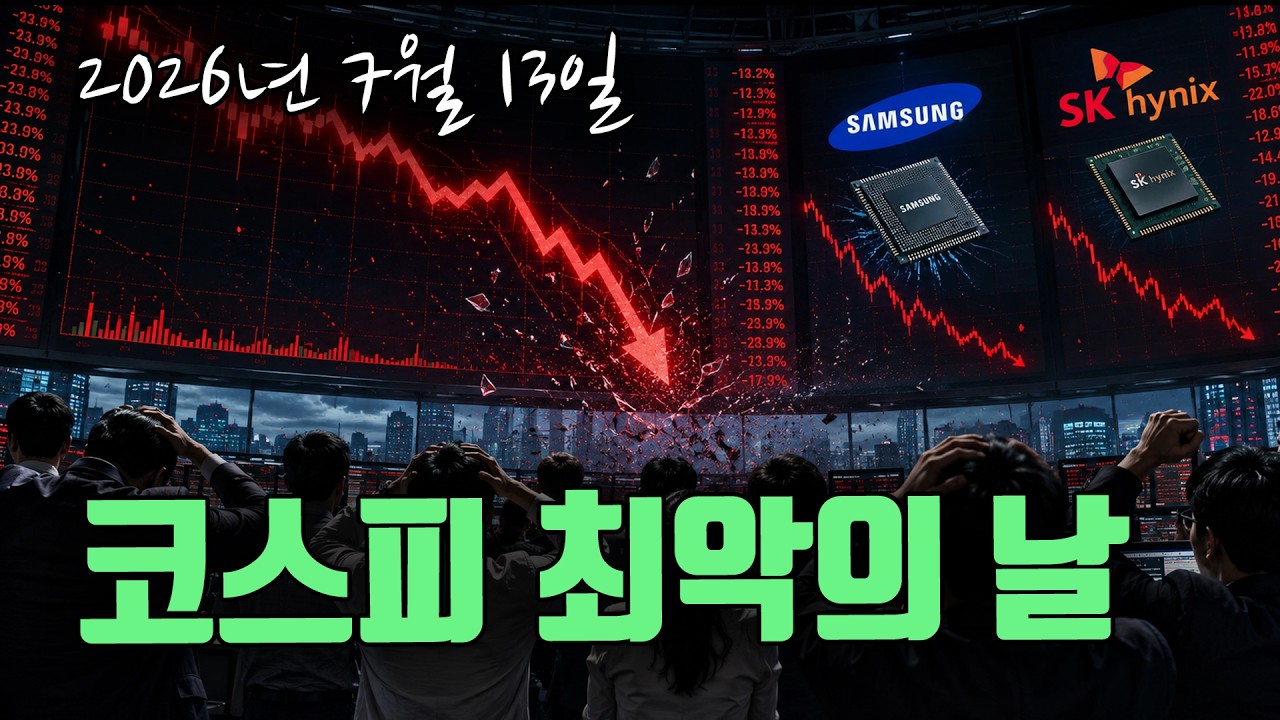
● KOSDAQ Shock, DS Active ETF, Big H2 Bet
Why KOSDAQ Deserves Reassessment in a Highly Volatile Market: Key Second-Half Themes Through the DS KOSDAQ Active ETF
What matters in today’s market is not whether KOSDAQ has risen or fallen.
The key issue is that entirely different stocks within KOSDAQ are already moving independently.
This report summarizes why the KOSDAQ market remains challenging, why it may still present opportunities in the second half, and why active ETFs are attracting more attention than plain index ETFs.
It also highlights issues that are often overlooked in other news coverage and videos, including the breakdown in intra-KOSDAQ correlation, institutional flow changes, and structural limits on active ETFs.
1. Key Takeaway: KOSPI Was Strong, but KOSDAQ Underperformed
In the first half of the year, the domestic equity market was relatively led by KOSPI.
Large-cap semiconductor names such as Samsung Electronics and SK hynix supported market sentiment and lifted the broader KOSPI benchmark.
By contrast, KOSDAQ remained weak on a headline index basis.
As a result, many retail investors may reasonably ask why KOSDAQ should matter now.
However, one point is critical.
A weak KOSDAQ index does not mean there were no opportunities within KOSDAQ.
KOSDAQ comprises roughly 1,800 listed companies.
Recent commentary has placed the three-year average correlation among KOSDAQ stocks at around 0.13, indicating that individual names often move independently.
In practical terms, KOSDAQ is a market where individual stocks can rise sharply even if the index is weak.
It is also a market where some names can fall sharply even when the index appears stable.
2. What Is the DS KOSDAQ Active ETF?
The product in focus is the DS KOSDAQ Active ETF.
It is the first ETF launched by DS Asset Management.
While less familiar to retail investors, DS Asset Management is known in the local market for its strength in equity management and private-market investing.
The firm has roughly 18 years of operating history and, as of late June, assets under management were cited at about 6 trillion won.
Historically, the firm focused mainly on private funds for high-net-worth individuals and institutional clients, with limited exposure to retail investors.
The core objective of this ETF is not to replicate the KOSDAQ index.
Instead, it seeks alpha by selecting stocks with stronger growth potential within KOSDAQ.
The manager also stressed an important caveat.
This is not a low-volatility product designed for passive investors.
KOSDAQ is inherently volatile, and active stock selection may increase return dispersion.
3. Three Reasons KOSDAQ Is Difficult to Invest In
KOSDAQ offers opportunity, but it is also structurally more difficult to invest in.
For retail investors selecting individual names, risk management is essential.
① A High Share of Loss-Making Companies
The share of KOSDAQ-listed companies that are loss-making has been cited at around 45%.
That means nearly half of the market still lacks a stable earnings base.
By comparison, the loss-making ratio for KOSPI companies has been cited in the 20% range.
Loss-making companies are not necessarily poor businesses.
In sectors such as biotech, robotics, aerospace, and secondary batteries, heavy early-stage investment often leads to accounting losses.
The key question is not whether a company is currently unprofitable, but whether those losses can translate into future growth.
② Elevated Distress and Penny-Stock Risk
KOSDAQ is a market where startups and small caps are expected to grow.
That means the market contains both promising companies and businesses that have failed to scale.
Some names can rise and fall sharply on themes, rumors, or trading flows rather than fundamentals.
Such stocks can become significant downside risks for retail portfolios.
In KOSDAQ, avoiding weak names is often as important as identifying strong ones.
③ Severe Information Asymmetry
One of the biggest issues in KOSDAQ is limited information coverage.
Large-cap stocks receive steady research coverage from brokers and frequent media attention.
Last year, large-cap coverage was cited at around 87%.
By contrast, research coverage for small and mid-cap companies with market capitalization below 100 billion won was cited at only about 1.6%.
In other words, most companies are traded with little formal analysis.
For retail investors, it is difficult to verify business models, order trends, technology progress, and financial stability directly.
This is one reason KOSDAQ active ETFs exist.
4. Why KOSDAQ May Still Deserve Attention in the Second Half
The positive case for KOSDAQ is not based on sentiment alone.
The interview emphasized structural changes.
In other words, the issue is not a short-term theme, but the possibility of a change in market quality.
① Potential Earnings Growth Among KOSDAQ Companies
The first structural change is earnings improvement.
For major KOSDAQ sectors, operating profit growth expectations remain strong.
The interview cited projected operating profit growth of about 55% this year and 33% next year.
The most notable area is semiconductor equipment, parts, and materials.
As capital expenditure expectations rise around Samsung Electronics and SK hynix, suppliers in the materials, components, and equipment space may benefit.
For these companies, order wins and earnings recognition may take time.
However, markets typically price in future developments in advance, so even the prospect of new orders can move share prices.
Other important KOSDAQ growth sectors include biotech, robotics, aerospace, and secondary batteries.
Historically, KOSDAQ leadership has centered on biotech, semiconductors, and secondary batteries, while robotics and aerospace have recently gained more attention.
② Policy Shift: Removing Weak Companies and Introducing a Promotion-Relegation Framework
The second change is policy-related.
The government is pursuing market reform through faster removal of distressed companies and broader structural cleanup.
One major direction is tighter delisting standards.
The aim is to remove weak companies that generate losses for retail investors without meaningful improvement.
Another important policy concept is a promotion-relegation system.
Similar to a first and second division in sports, the idea is to differentiate companies by quality and growth profile.
Japan has implemented similar mechanisms in its stock market.
Although the final domestic framework has yet to be confirmed, the direction is generally viewed as positive for market quality.
The significance is straightforward.
KOSDAQ could shift from a market where almost any name can experience sharp swings to one where better companies are valued more appropriately.
③ Institutional Flow Changes: Potential Capital Inflows of up to 30 Trillion Won
The third change is related to capital flows.
For stocks to rise, earnings and policy matter, but capital must also enter the market.
A key point is the possible reallocation from pension funds and large investment banks.
Historically, KOSDAQ’s weight in pension benchmarks has been very low.
Some estimates place it around 1%, while others suggest as much as 3%.
There is now discussion about raising that level to above 5%.
Market estimates suggest that this could result in approximately 16 trillion won of inflows.
In addition, a portion of capital raised by large investment banks is expected to be deployed into risk capital for KOSDAQ-related investment.
That amount has also been cited at around 15 trillion won.
Together, the total comes to roughly 30 trillion won.
Given that KOSDAQ’s total market capitalization is around 500 trillion won, 30 trillion won represents about 6% of the market.
While that may not appear large as a percentage, it could still have a meaningful impact on near-term flows.
5. Why Active ETFs May Be More Relevant Than KOSDAQ Index ETFs
Many investors may ask why they should not simply buy a KOSDAQ 150 ETF.
The answer lies in the extreme dispersion across sectors.
Based on the figures cited in the interview, the KOSDAQ 150 index gained about 23.92% over the past year.
However, the KOSDAQ 150 IT sector rose about 97.38%.
By contrast, KOSDAQ 150 healthcare returned only around 2.1%.
Industrials were cited at roughly 36%.
This means returns in KOSDAQ depend heavily on which sector is included.
In such a market, identifying leading sectors and leading stocks quickly can matter more than simply buying the index.
Passive ETFs move according to predetermined rebalancing schedules.
Active ETFs, by contrast, can respond more quickly to market changes.
In a market like KOSDAQ, where correlation is low and information asymmetry is high, active management can be more valuable.
6. Three Competitive Advantages Highlighted by DS Asset Management
① Experience in Private-Market Investing
DS Asset Management was presented as having a strong background in private-market investing.
Many KOSDAQ companies begin as private businesses before listing through IPOs.
As a result, experience in analyzing private companies can help in selecting KOSDAQ names.
Private-market analysis requires more than desk research.
It requires direct meetings with management, business-site checks, and supply-chain verification.
The interview noted that portfolio managers may conduct more than five company meetings per day.
Such field-based analysis can be an important advantage in a market where research coverage is sparse.
② Sector-Specialized Investment Personnel
The second advantage is team composition.
DS Asset Management emphasized a structure in which sector analysts and portfolio managers jointly build the portfolio.
For example, semiconductor industry veterans analyze semiconductor names, while biotech PhDs or industry specialists analyze biotech companies.
Technical understanding is essential in KOSDAQ.
Evaluating a semiconductor equipment supplier, a biotech company’s clinical prospects, or a robotics parts maker’s supply-chain position cannot be done through financial statements alone.
Industry experience is a meaningful differentiator in active ETF management.
③ Faster Response and Internal Systems
The third advantage is responsiveness.
Active ETFs can adjust portfolios as market conditions change.
DS Asset Management said it uses an internal system that incorporates flows, fundamentals, and supply-chain bottlenecks.
The interview referred to this as the “Argos system.”
The goal is to combine quantitative data with industrial analysis rather than rely solely on manager judgment.
7. Portfolio Characteristics: A Stronger Tilt Toward Mid and Small Caps
Specific holdings of the DS KOSDAQ Active ETF will be available on the official website after listing.
However, some portfolio direction was disclosed.
The KOSDAQ 150 index reportedly has roughly 86% exposure to large-cap companies with market capitalizations above 1 trillion won.
By contrast, the DS KOSDAQ Active ETF aims to maintain more than 50% exposure to mid and small caps below or near the 1 trillion won level.
In other words, it is intended to have a different profile from the KOSDAQ 150 ETF.
As of the current market environment, semiconductor equipment, parts, and materials may account for a relatively large share.
Exposure could reach nearly 50% in some cases.
However, the strategy is not limited to semiconductors.
The fund also seeks to select companies with growth visibility in secondary batteries, pharmaceuticals and biotech, robotics, and aerospace.
8. Key Risk: This Product Carries High Volatility
The most important risk is volatility.
KOSDAQ already carries higher volatility than KOSPI because it has more small and mid-cap names and larger price swings in individual stocks.
An active ETF that seeks excess returns through stock selection can therefore exhibit even greater volatility.
In addition, the process of cleaning up weak companies may temporarily unsettle the broader market.
Names in robotics, aerospace, and biotech that have rallied on expectations may face sharp corrections if earnings do not follow.
Accordingly, KOSDAQ investing is not only about what to buy, but also about what to avoid.
Retail investors often suffer losses not because they fail to buy the right winners, but because they mistakenly buy the wrong risk names.
For that reason, the core role of an active ETF is not only to identify upside names, but also to avoid companies that can damage portfolio performance.
9. Key Points Often Missed in Other News Coverage and Videos
① The Real Opportunity in KOSDAQ Lies in Dispersion, Not Just Index Direction
Most coverage asks whether KOSDAQ will rise or fall.
What matters more is that stocks within KOSDAQ are moving very differently from one another.
A correlation figure of 0.13 indicates that stock selection matters far more than index exposure in this market.
② Institutional Inflows May Concentrate on Select Mid-Cap Winners
Capital from pension funds and large investment banks will not lift every KOSDAQ stock evenly.
Instead, inflows are more likely to concentrate in higher-quality mid-cap names that meet policy and institutional criteria.
That could widen the gap between winners and losers within the market.
③ Even Active ETFs Cannot Fully Break Away from the Index
An active ETF is not free to ignore its benchmark entirely.
Under current rules, active ETFs must maintain a correlation coefficient of at least 0.7 with the benchmark index.
In other words, even if KOSDAQ falls sharply, an active ETF cannot move in a fully opposite direction.
Investors should understand this practical limitation.
④ In KOSDAQ, Alpha May Come More from Avoidance Than from Buying
In a strong market, identifying the biggest winners appears to be the main task.
In KOSDAQ, however, a single poor stock choice can distort overall returns.
This is because the market contains many names with limited information and significant distress risk.
Accordingly, the real advantage of a KOSDAQ active ETF may lie not only in finding upside names, but also in avoiding the stocks most likely to hurt performance.
10. Investor Approach by Profile
① Investors Seeking Short-Term High Returns
Caution is warranted.
The KOSDAQ Active ETF is better viewed as a product for growth exposure under volatility, not as a short-term momentum vehicle.
It may not be suitable for investors focused on daily or two-day performance.
② Investors Who Find Individual KOSDAQ Stock Selection Difficult
This group may want to consider it.
Individual KOSDAQ names are difficult to analyze because of weak information coverage and volatility.
If stock selection is difficult, an active ETF can provide access to professional management.
③ Investors Seeking Diversified Exposure to Semiconductor Equipment, Robotics, and Aerospace Growth Themes
Investors interested in these sectors should review the portfolio characteristics.
In particular, earnings improvement in semiconductor equipment, parts, and materials, along with policy support, may be a key second-half market variable.
That said, a higher sector concentration also increases sector-specific volatility.
④ Investors Looking at Long-Term KOSDAQ Structural Improvement
If one is assessing policy reform, institutional flows, and earnings improvement together, the market may merit long-term review.
Still, even if structural change emerges, volatility can remain high.
Phased buying and position sizing remain important.
11. Final View: KOSDAQ Is Not a Market to Avoid, but a Market to Select Carefully
KOSDAQ is a risky market.
However, risk alone does not mean it should be avoided entirely.
Because volatility is high and information asymmetry is substantial, the market can offer opportunities to investors capable of proper analysis.
The key themes for the second half are earnings growth, policy reform, institutional flows, semiconductor equipment, parts, and materials, and active ETFs.
If these five forces align, KOSDAQ could move beyond a simple theme-driven market and into a phase of structural re-rating.
However, not all stocks are likely to rise together.
The gap between strong and weak companies may widen further.
Accordingly, the core task in KOSDAQ investing is selection, not broad buying.
The DS KOSDAQ Active ETF is designed to select mid-cap growth names within this environment.
Investors should review holdings, sector weights, management style, and volatility before making any decision.
This report is not an investment recommendation, and all ETF investments carry principal loss risk.
< Summary >
KOSDAQ remains a market with significant stock-picking opportunities despite weak index performance.
However, high loss-making ratios, distressed-name risk, and information asymmetry make it difficult to invest.
In the second half, earnings improvement, policy reform, and institutional flow changes may drive a structural shift in KOSDAQ.
The DS KOSDAQ Active ETF is an active ETF that selects growth companies across semiconductor equipment, biotech, robotics, and aerospace.
The central issue is not only identifying winners, but also avoiding risky names.
KOSDAQ is not a market to avoid outright, but one that requires disciplined selection.
[Related Articles…]
- KOSDAQ Structural Repricing and Second-Half Strategy
- Active ETF Expansion and Retail Investor Response
*Source: [ 소수몽키 ]
– 어려워진 장에도 기회는 있다? 초고변동 장세 주목할 투자처