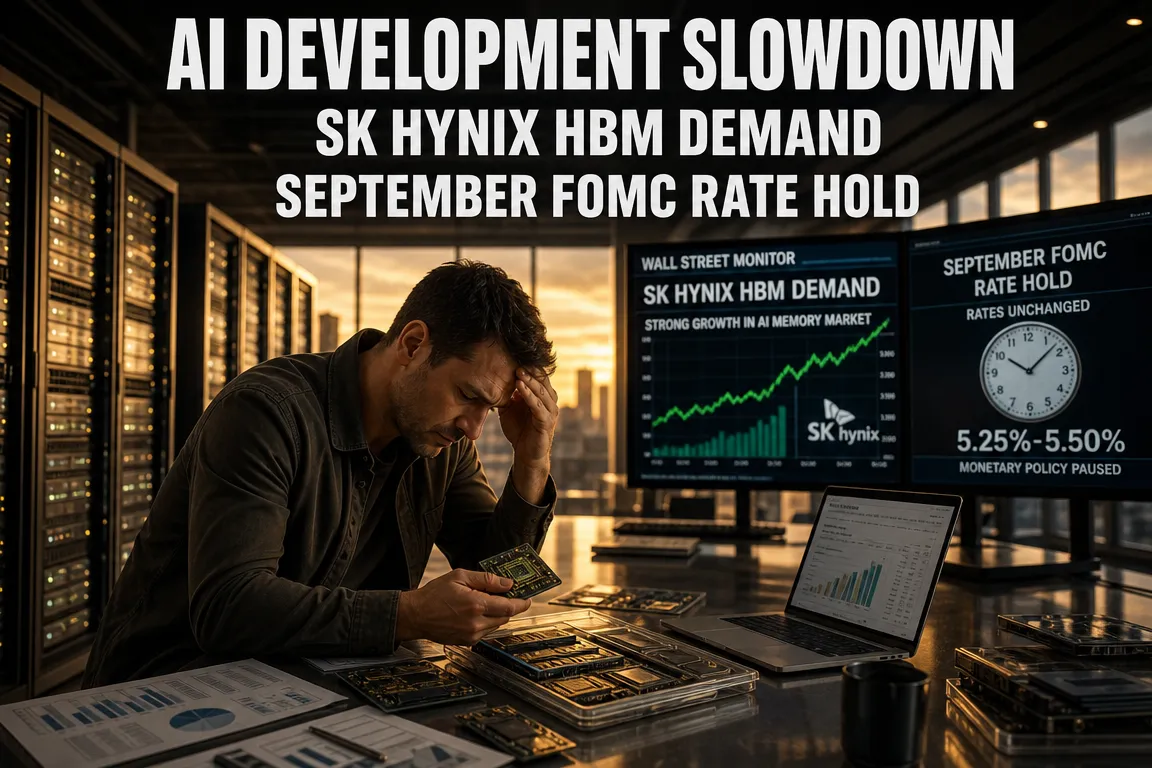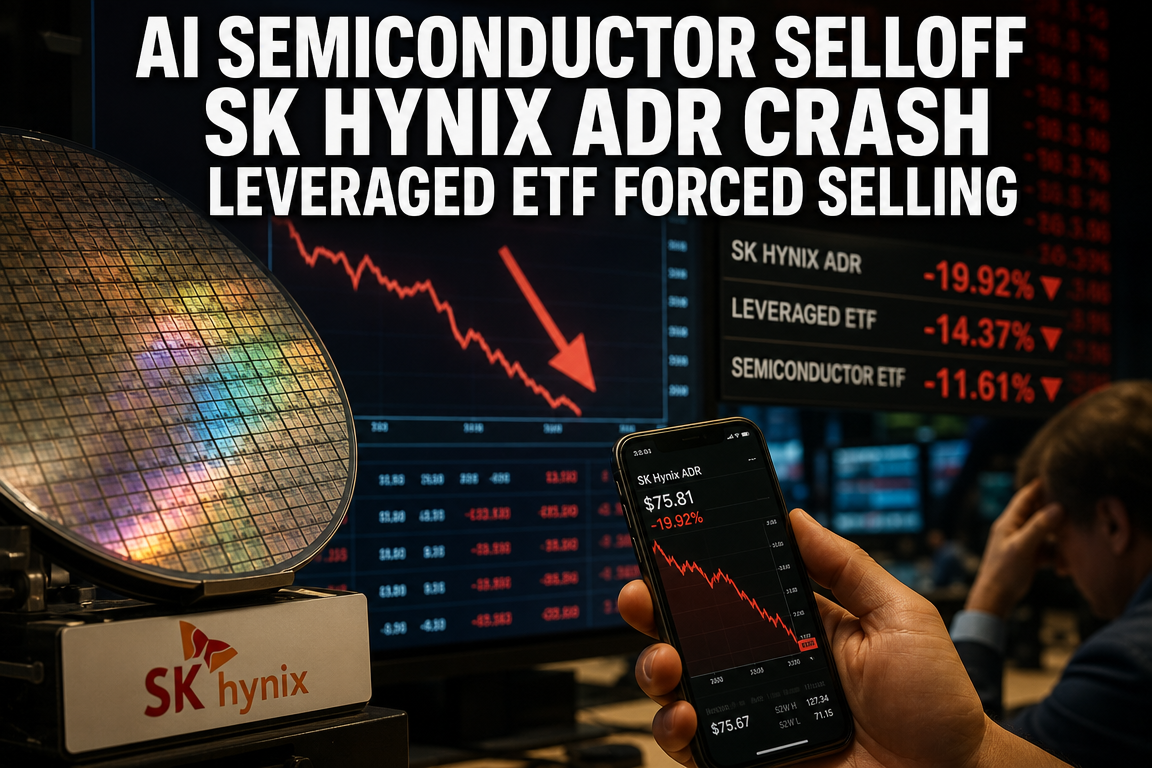
● Semiconductor Shock, SK Hynix ADR Crashes, TSMC Surges
TSMC earnings surprise, but semiconductors sell off: the real cause of the SK hynix ADR shock and key variables for U.S. equities
The key point in today’s market is not simply that semiconductors declined.
TSMC reported second-quarter revenue up 36% year over year, beating expectations, and June revenue surged 67.9%.
Yet on the same day, SK hynix ADR fell as much as nearly 9% in premarket trading, and semiconductor stocks including Micron, SanDisk, Marvell, AMD, and Intel also moved lower.
At first glance, this appears to signal a peak-out in the AI semiconductor rally, but the main issue is not a deterioration in fundamentals. It is closer to a supply-demand shock driven by ADR structure, forced selling in leveraged ETFs, and program trading.
With CPI and PPI, earnings from major U.S. financial institutions, international oil prices, and the Federal Reserve’s policy stance all due this week, a turning point is forming for the outlook for U.S. equities.
1. New York market overview: indices mixed, semiconductors under concentrated pressure
U.S. equities traded mixed overall.
The Nasdaq fell intraday by about 0.6% to 0.87%, reflecting weakness in technology stocks.
The S&P 500 declined by roughly 0.18% to 0.26%, with losses relatively contained.
The Dow Jones Industrial Average rose about 0.2%, supported by defensive flows.
- Nasdaq: lower on weakness in semiconductors and high-growth technology stocks.
- S&P 500: losses limited by support from selected large-cap names.
- Dow Jones: higher on energy and some defensive sectors.
The important point is that the broader market did not break down; selling was concentrated in semiconductors.
In other words, the decline reflects AI semiconductor position adjustments more than a broader risk-off move in U.S. equities.
2. Semiconductor selloff: Micron, SanDisk, Marvell, AMD all decline
The sharpest weakness was in semiconductors.
Micron fell by around 5%, while SanDisk declined 6% to 7%.
Marvell Technology dropped 5% to 6%, and Broadcom also fell more than 2%.
AMD and Intel each declined 3% to 4%, as selling spread across AI semiconductors, memory, and custom chip names.
- Micron: weaker on correlation with SK hynix and the memory cycle.
- SanDisk: short-term profit taking despite upbeat target price revisions.
- Marvell and Broadcom: consolidation after AI custom-chip optimism.
- AMD and Intel: correction amid CPU and data center competition.
- NVIDIA: attempted to break above $210, but remained capped near $209.
Semiconductor ETFs also weakened, with leveraged products showing far greater volatility.
In particular, mechanical selling in single-stock leveraged ETFs and semiconductor leveraged ETFs appears to have amplified the decline.
3. The real driver behind the SK hynix ADR drop: a structural supply-demand issue, not a deterioration in intrinsic value
SK hynix attracted strong attention after listing its ADR on Nasdaq.
On its first day, the ADR rose nearly 13% above the offering price, signaling a strong debut.
Converted into Korean won, the ADR traded at about KRW 2.35 million, compared with the domestic share price of roughly KRW 2.18 million, implying a premium of 7% to 8%.
Under normal circumstances, this should have triggered arbitrage.
Investors would buy the cheaper Korean shares and convert them into ADRs to sell at a higher price in the U.S. market.
That process would typically lift the domestic share price toward the ADR level.
This time, however, the mechanism did not function properly.
The process of converting Korean shares into newly issued ADRs was operationally difficult and effectively constrained by quota restrictions.
As a result, although a price gap existed, the arbitrage channel to narrow it was not sufficiently open.
This is the most important structural reason behind the recent decline in SK hynix.
The ADR traded at a premium in the U.S., but the capital flow needed to buy Korean shares and convert them into ADRs was restricted.
4. Global fund rotation: selling Korean shares, preferring Nasdaq ADRs
Another key factor was portfolio rotation among global funds.
From the perspective of overseas investors, Nasdaq ADRs denominated in dollars may be more convenient than Korean shares, which carry currency risk and relatively lower liquidity.
As a result, some global capital reduced exposure to SK hynix in the Korean market and shifted toward the U.S.-listed ADR.
Hedge fund strategies also played a role.
Some Wall Street capital appears to have used long-short trades, buying the ADR while shorting the relatively more vulnerable Korean shares.
This added downward pressure on the domestic listing.
In short, the decline was less about a sudden deterioration in SK hynix’s business and more about post-ADR listing dislocations in market structure.
5. Heavy selling in the Korean listing: institutions and foreign investors sold together
In the Korean market, institutions and foreign investors sold at the same time.
Institutions sold about 780,000 shares, while foreign investors sold about 700,000 shares, bringing total selling to nearly 1.5 million shares.
A research note from Korea Investment & Securities was also cited as a factor that weighed on sentiment.
The report suggested that quarterly operating profit at SK hynix could fall about 8% below market expectations.
The core argument centered on HBM pricing.
HBM, SK hynix’s key profit driver, is often tied to long-term supply agreements with major customers such as NVIDIA.
As a result, even if conventional memory prices rise sharply, HBM price gains may be relatively moderate.
This does not undermine the company’s long-term competitiveness.
However, in a market already debating AI excess, a report lowering short-term earnings expectations was enough to trigger selling.
6. Goldman Sachs interpretation: a position shock, not a structural peak-out
Goldman Sachs did not interpret the decline as a structural peak-out.
Instead, it described the move as a shock driven by position changes and leveraged unwinding.
In particular, Goldman pointed to gamma hedging and rebalancing.
When leveraged ETFs or derivatives decline, they must mechanically sell holdings to reduce risk.
This creates a self-reinforcing decline: prices fall, forced selling follows, prices fall further, and additional forced selling is triggered.
This is not selling based on a reassessment of corporate fundamentals.
It is system-driven selling aimed at staying within risk limits.
Goldman said most of the more than $1.1 billion in outflows came from passive program trading.
It also emphasized that long-only institutional investors were relatively quiet.
That distinction matters.
The market was shaken not by long-term investors questioning fundamentals, but by short-term leverage and programmatic selling.
7. The most important hidden factor: the forced-decline loop created by leveraged ETFs
The factor that receives less attention in other coverage is the forced-selling structure of leveraged ETFs.
Recently, leveraged products linked to SK hynix and semiconductors fell sharply from recent highs.
Some single-stock leveraged ETFs declined by around 30% in a single day.
When leveraged products fall, margin pressure and collateral shortfalls increase.
That forces the manager to cut holdings, and those sales push the stock lower again.
In other words, the decline was driven not by fundamentals, but by technical selling that made the fall self-reinforcing.
If this mechanism remains in place, SK hynix and semiconductor stocks may continue to show elevated volatility even if earnings remain strong.
Conversely, once the forced-selling phase ends, fundamentally sound names could rebound quickly.
8. TSMC earnings surprise: AI semiconductor demand has not yet weakened
On the same day semiconductors weakened, TSMC reported very strong results.
Second-quarter revenue rose 36% year over year, beating expectations.
June revenue alone surged 67.9% from a year earlier.
TSMC is a leading indicator for global semiconductor demand.
Its major customers include NVIDIA, Apple, and other large technology companies.
Continued revenue growth at TSMC indicates that AI infrastructure spending and data center semiconductor demand remain strong.
When assessing whether the AI investment cycle is overheating, orders and revenue matter more than narratives.
TSMC’s results suggest that AI semiconductor demand has not yet structurally weakened.
9. Evercore’s view on SanDisk: bull case cited at up to $4,000
Evercore issued a highly constructive view on SanDisk.
It raised its base target price to around $3,100 and said the bull case could reach $4,000.
The main rationale is supply tightness in the memory market.
It expects NAND and broader memory supply-demand imbalances to persist through 2026 and 2027.
Some forecasts also point to elevated gross margin potential.
As SK Group Chairman Chey Tae-won has noted, AI-related memory demand could continue to strain supply well beyond 2030.
In other words, while short-term share prices may fluctuate, the memory supercycle thesis remains intact.
That said, SanDisk still fell more than 6% on the day.
This shows that even strong research can be overwhelmed in the short term when the market enters a forced-selling phase.
10. Key variables this week: CPI, PPI, and financial sector earnings
U.S. CPI and PPI for June will be released this week.
These are the most important data points for assessing the inflation trend.
Their significance is heightened by renewed movement in crude oil prices due to Middle East risk.
The earnings season is also beginning in earnest.
Major financial names including Goldman Sachs, JPMorgan, Morgan Stanley, and BlackRock will open the reporting cycle.
- CPI: consumer inflation trend.
- PPI: producer inflation and corporate cost pressure.
- Financial earnings: credit conditions, consumer resilience, and capital markets activity.
- Late-July megacap earnings: validation of AI investment efficiency and data center spending.
Markets are now focused less on whether earnings are good or bad and more on whether AI capital spending is translating into revenue.
If that is confirmed in late-July megacap results, the semiconductor pullback could be viewed as a buying opportunity.
If AI capex appears to be lagging revenue realization, volatility may increase further.
11. Crude oil and Iran risk: still a manageable variable
Tensions between the U.S. and Iran remain elevated.
President Trump criticized Iran for violating an agreement, while Tehran warned that it would not tolerate U.S. intervention in the Strait of Hormuz.
Even so, crude oil remains contained around $78 to $79 per barrel.
As long as Brent does not break materially above $80, the market is treating the geopolitical risk as manageable.
Goldman Sachs also said this conflict alone is unlikely to unsettle global inflation expectations.
If core PCE continues rising at a stable monthly pace of around 0.20% to 0.23%, the Fed is likely to keep rates unchanged through year-end.
That said, a sharp move toward $100 oil would change the picture.
Higher oil prices would lift inflation, which could push long-term U.S. yields higher.
In that case, expectations for rate cuts would recede, weighing on growth stocks and semiconductors.
12. JPMorgan’s view: if markets sell off on war risk, it may be a buy-the-dip opportunity
JPMorgan said that if equities weaken due to geopolitical risk, the pullback could present a buying opportunity.
The key reason is that corporate earnings fundamentals have not broken down.
Analysts typically lower earnings forecasts as reporting season approaches.
However, 2026 EPS estimates have instead been revised higher recently.
Median EPS growth in both the U.S. and euro area is also running at about 8%, which is relatively stable.
In other words, Wall Street does not view the market as being in an indisputable bubble.
Semiconductors may correct, but the broader earnings base remains resilient.
13. Apple, Meta, and Tesla: key megacap-specific developments
Apple rose more than 1% on the day.
The move appears to have been supported by a positive report from Citi.
The firm said Apple could maintain share gains and protect margins despite intense competition in smartphones and PCs.
Meta weakened.
The stock came under pressure after reports that the Louisiana data center project could exceed $50 billion in investment.
The plan for a 5 GW AI data center supercluster may be positive over the long term, but in the short term it was viewed as a large capital expenditure burden.
Tesla traded near $400 and at times slipped below that level intraday.
It was affected by the broader increase in technology sector volatility.
14. Berkshire Hathaway’s underperformance: the significance of $397 billion in cash
One notable development this year has been Berkshire Hathaway’s relative underperformance.
Berkshire Class B shares have lagged the S&P 500 by about 12.4 percentage points, and the gap widened to as much as 17.5 percentage points in early June.
The biggest reason is cash.
Berkshire’s quarter-end cash balance reached about $397 billion, a record high.
That is roughly KRW 550 trillion.
The amount is large enough to acquire the combined market value of the 474 smallest companies in the S&P 500.
Under Greg Abel’s leadership, Berkshire trimmed more than 15 holdings in the first quarter and continued to raise cash.
Newly added names reportedly include Google, Delta Air Lines, and Macy’s.
Google, once difficult to classify under traditional value investing, is now viewed as a powerful digital infrastructure company with a wide moat.
Berkshire’s large cash position has two implications.
One is dry powder for a market correction.
The other is a warning that the AI rally may be advancing too quickly.
15. Bitcoin and gold: the safe-haven playbook is changing
It is also notable that gold and Bitcoin both weakened despite rising geopolitical risk.
In the past, conflict risk often supported traditional safe havens such as gold.
But in the current market, the classic safe-haven playbook is not functioning as clearly as before.
Bitcoin also fell more than 2% even as geopolitical uncertainty increased.
This suggests that Bitcoin is still trading more as a liquidity- and risk-sensitive asset than as a guaranteed crisis hedge.
16. The most important point that can be missed in other coverage
First, the SK hynix decline began with ADR conversion constraints rather than an earnings collapse.
The ADR traded at a premium, but arbitrage was not functioning smoothly, which pressured the Korean listing.
Second, leveraged ETFs and program trading amplified the selloff.
This was less a broad exit by long-term investors than a forced selling event caused by rebalancing and gamma hedging.
Third, TSMC’s results confirm that AI semiconductor demand remains strong.
Stock-price weakness and demand weakness are not the same thing.
Fourth, this week’s CPI and PPI will be critical for interest-rate expectations.
If oil remains contained below $80, inflation concerns should stay limited.
Fifth, late-July megacap earnings are likely to determine the real outcome of the AI investment debate.
The key issue is whether data center and semiconductor spending is translating into actual revenue growth.
17. Investment takeaway: fundamentals and flows must be separated
The key to the semiconductor market now is to distinguish fundamentals from flows.
TSMC earnings, NVIDIA demand, HBM supply tightness, and memory pricing all suggest that the AI semiconductor cycle remains intact.
However, when ADR structure, leveraged ETFs, program trading, and short-term profit taking converge, share prices can move sharply for reasons unrelated to fundamentals.
Accordingly, aggressive chasing is less appropriate than staged buying at defined price levels.
Investors with heavy semiconductor exposure should expect elevated volatility until late-July megacap earnings are released.
For long-term investors, the key question is whether the current move reflects a damaged AI investment cycle or a temporary supply-demand shock.
Based on currently available data, Wall Street’s baseline view still leans toward resilient semiconductor fundamentals.
< Summary >
TSMC’s second-quarter revenue rose 36% year over year, and June revenue surged 67.9%.
Despite that, SK hynix ADR and global semiconductor stocks sold off sharply.
The main drivers were ADR conversion constraints, global portfolio rotation, leveraged ETF forced selling, and program trading, rather than a collapse in fundamentals.
Goldman Sachs described the decline as a position shock rather than a structural peak-out.
This week’s CPI, PPI, financial sector earnings, and oil price moves are the key variables for U.S. equities and interest-rate expectations.
Late-July megacap earnings will be critical in determining whether AI spending and data center investment are translating into revenue.
For now, the market’s base case is that short-term volatility is elevated, but AI semiconductor demand and the memory supply shortage thesis remain intact.
[Related Articles…]
- AI Semiconductor Supercycle and HBM Beneficiaries
- U.S. Rate Cut Outlook and Inflation Data Checkpoints
*Source: [ Maeil Business Newspaper ]
– TSMC 2분기 36% 매출 ‘쑥’, 예상치 상회ㅣ에버코어 “샌디스크, $4000까지 상승 잠재력”ㅣ홍키자의 매일뉴욕