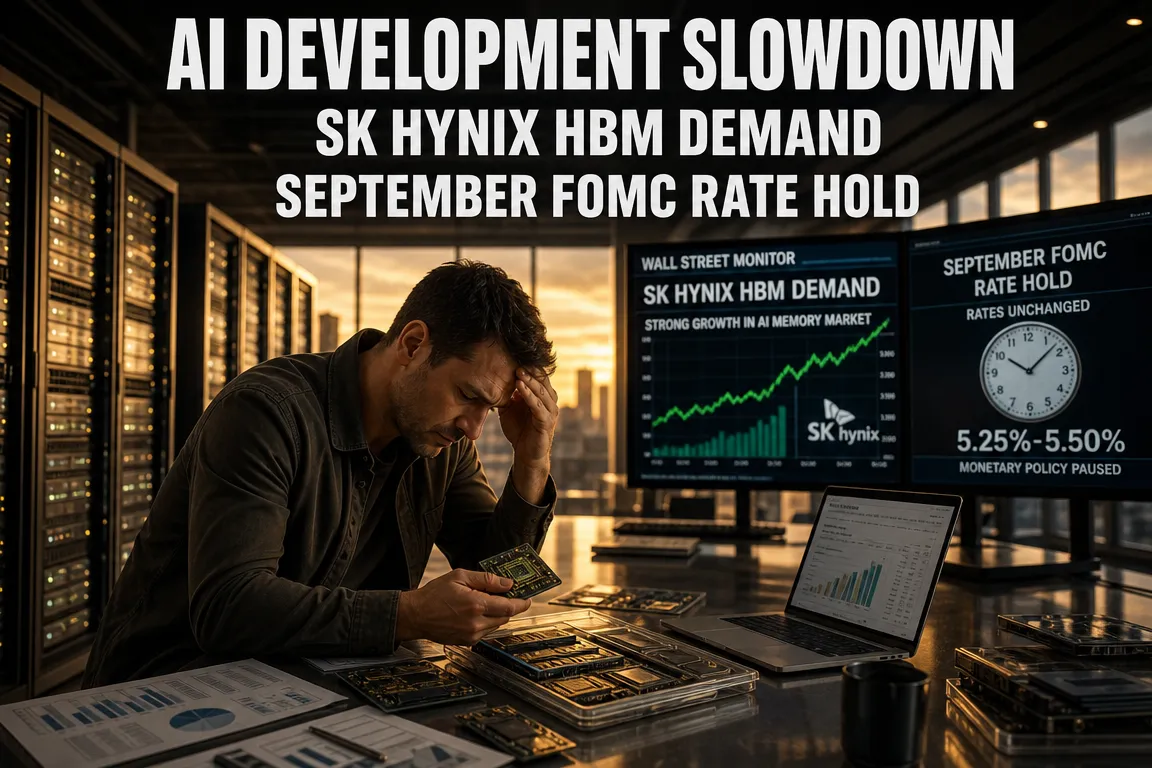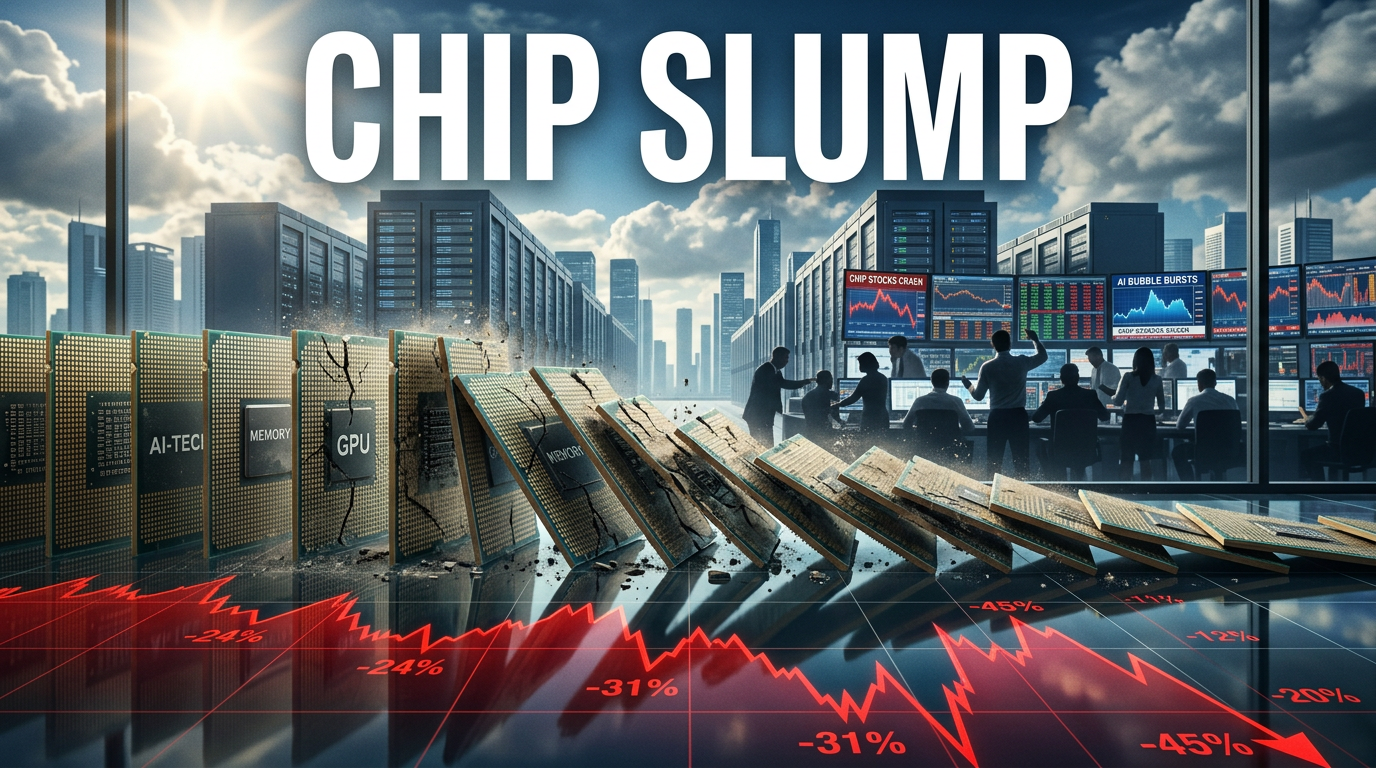
● AI Semiconductor Bubble Panic
Interpreting the Semiconductor Selloff Through Five Wall Street Reports: Why Position Crowding Matters More Than an AI Bubble
What really matters in this semiconductor selloff is not the stock decline itself, but how the market is interpreting the same news in completely opposite ways.
ASML delivered strong results, memory equipment orders increased, and Big Tech CAPEX outlooks are still being raised.
Yet the market is reading this not as “strong demand” but as “oversupply” and an “AI bubble.”
In this article, we will organize the five biggest worries semiconductor investors have into a Wall Street report perspective, one by one.
The core point is simple.
This semiconductor correction is closer to the result of overheated global semiconductor positioning, anxiety over memory semiconductors, and doubts about the sustainability of AI investment all hitting at once, rather than a deterioration in earnings.
1. The surface reason for the semiconductor plunge: fear that “AI demand is cooling”
Recently in the U.S. market, semiconductor stocks swung sharply even though the Nasdaq rose.
Big Tech stocks such as Apple, Alphabet, Meta, Amazon, and Microsoft showed strength, while memory-related names such as Micron, SanDisk, SK Hynix, and Samsung Electronics fell sharply.
In other words, this looks less like the collapse of the entire AI theme and more like a rotation of funds out of semiconductors into Big Tech.
The market is currently casting three doubts on semiconductors.
- There is a suspicion that data center construction is actually being canceled.
- There is concern that memory equipment orders have become too large, leading to oversupply.
- There is an interpretation that moves by Chinese DRAM makers and neo-cloud companies signal price declines.
But when you combine the Wall Street reports, these negatives are largely exaggerated or missing context.
2. Negative factor ① Why semiconductors fell despite ASML’s strong results
ASML is one of the most important companies in the semiconductor equipment market.
Based on the original report, ASML significantly beat market consensus on revenue, profit, and EPS.
In particular, EUV tools were described as being essentially sold out.
The report also said production expansion was expected to reach around 65 units this year, 85 next year, and about 110 units after that.
Viewed only from that trend, it is the opposite of a semiconductor demand slowdown.
Even so, the Philadelphia Semiconductor Index corrected sharply from its highs.
The original text explains that it fell from around 14,500 at the peak to around the 12,300 level.
This range is an important price zone where support and resistance have appeared many times in the past.
Technically, it is approaching a strong support line, but if this range breaks, further downside would remain possible.
Still, the important point is that it is more natural to see this as profit-taking and position unwinding all at once because semiconductor stocks had already risen too much versus the Nasdaq, rather than as a drop caused by worsening earnings.
3. Negative factor ② Why a surge in memory equipment orders was interpreted as bearish
This is the strangest interpretation of all.
Based on the original text, ASML’s memory-related revenue outlook was said to increase by 75% this year.
Compared with the 25% growth rate for foundry equipment, that is about three times higher.
In general, rising memory equipment orders mean companies like SK Hynix, Samsung Electronics, and Micron are seeing strong future demand.
In particular, if demand for HBM, DDR5, server DRAM, and high-performance memory for AI servers keeps rising, equipment investment increasing is a natural trend.
But the market is currently interpreting this in the opposite direction.
- Equipment orders are large.
- That means DRAM and HBM supply will increase.
- If supply increases, prices may fall.
- Ultimately, the memory cycle could peak out.
That is the logic.
The problem is that when market sentiment is poor, even good news gets read as bad news.
If equipment orders had been low, the market would likely have interpreted that as “AI demand is weakening.”
Instead, because equipment orders were high, this time it was interpreted as “oversupply.”
In the end, the global semiconductor market is currently in a phase where sentiment is moving prices more than fundamentals.
4. Negative factor ③ CXMT IPO and worries about Chinese DRAM supply
News of a possible IPO by Chinese DRAM maker ChangXin Memory Technologies, or CXMT, was also pointed to as a reason for the decline in memory stocks.
CXMT is China’s largest DRAM producer and is also described as a fourth-tier global player.
Its market share is said to be under 10%.
What the market is worried about is simple.
If CXMT raises large-scale funds through an IPO, it could expand DRAM production, which could pressure global memory prices.
But the original text explains that the IPO’s reception was actually weaker than expected.
The expected valuation was around 1 trillion yuan, but the actual figure was said to be around 579.2 billion yuan.
In that case, contrary to market worries, one could also interpret it as reducing the likelihood of large-scale expansion in the short term.
Another important point is U.S. export controls on advanced semiconductor equipment.
For a Chinese company to rapidly increase DRAM production capacity, it needs access to high-end equipment, but the U.S.-China technology conflict has limited access to advanced tools.
The original text also stresses that CXMT’s ramp-up in 2026–2027 will not be easy.
And China itself is not in a situation of excess memory supply.
When you factor in demand from Huawei, PCs, and consumer devices, DRAM demand in China is also substantial.
Of course, the long-term risk from Chinese memory makers should be acknowledged.
But for this selloff, it is closer to exaggerated fear than a variable that can immediately destroy the global memory semiconductor market.
5. Negative factor ④ CoreWeave’s memory hedge, is it a signal of falling prices?
According to a Reuters report, neo-cloud company CoreWeave was said to be considering derivative hedges against memory and storage price fluctuations.
The market interpreted this as “CoreWeave must be expecting memory prices to fall.”
But from a CFO perspective, it can be viewed differently.
Many of CoreWeave’s executives are known to have backgrounds in infrastructure investment, hedge funds, trading, commodities, and derivatives risk management.
With that kind of background, it is natural to consider hedging to reduce cost volatility whether memory prices rise or fall.
The more important interpretation may actually be that long-term supply agreements, or LTAs, have become more binding.
In the past memory market, even after signing long-term contracts, if prices fell sharply, some buyers would pay penalties, cancel the contract, and buy cheaper elsewhere.
But recently, HBM and high-performance DRAM for AI servers have been tight on supply, and the binding power of long-term contracts has strengthened.
In that case, CoreWeave would have difficulty easily breaking the contract, so it is trying to manage price volatility through hedging.
Reading this simply as a “signal of a memory price crash” is too one-sided.
6. Negative factor ⑤ How serious is the data center cancellation story really?
The most important issue in this semiconductor selloff is the data center cancellation story.
That is because if AI investment and data center construction slow down, the entire value chain, from GPUs and HBM to networking equipment, power infrastructure, and cooling systems, could be shaken.
The original text explains that Morgan Stanley estimated the 2025 scale of data center cancellations and delays at around 156 billion dollars.
That is more than 200 trillion won.
News that a bill passed in New York State delaying new construction of data centers over 50MW also added to the anxiety.
But there is context here too.
New York State is not a major data center hub in the U.S. to begin with.
The key East Coast data center regions are in the PJM power grid area, such as New Jersey, Pennsylvania, and Virginia.
Virginia, in particular, is one of the world’s largest data center clusters.
In other words, extending New York’s regulation into a narrative of a broad slowdown in U.S. data center demand is excessive.
SemiAnalysis released a strong rebuttal report with the message, “Stop claiming that half of 2026 data centers will be canceled.”
Based on satellite image analysis, it was also mentioned that the top two hyperscalers alone are each carrying out data center construction projects exceeding 5GW.
In Meta’s case, a campus plan previously known at around 2.5GW was said to potentially expand to two 7GW-scale sites, or 14GW in total.
This is not a picture of shrinking data center demand, but rather one of Big Tech CAPEX competition getting even stronger.
7. The trap in the 50% data center cancellation number
Many investors hear “50% of data center projects are canceled” and think of the collapse of the AI bubble.
But the most important rebuttal in the original text is this.
A large portion of canceled projects are projects only on paper before actual groundbreaking, meaning early applications that have not even secured power grid access.
Because power grid connections operate on a first-come, first-served basis, hyperscalers often submit applications in multiple regions, almost like placing orders.
When they later clean up low-probability projects, the cancellation ratio can look high statistically.
But evidence that major data centers under construction actually stopped is limited.
The original text explains that “real data center cancellations are at the 1% level, and construction sites never actually stopped.”
The Wyoming 1.6GW project is another example.
When an Oracle-related project fell through, the market interpreted it as weakening demand, but Google reportedly stepped in immediately.
If demand were truly dead, Google would not have filled that spot.
In the end, the data center bottleneck is less about lack of demand and more about power grids, land, permitting, cooling, and securing transmission capacity.
8. Big Tech CAPEX outlooks are actually being raised
A claim often made in bearish semiconductor arguments is that “if Big Tech cuts AI investment, it is over.”
That is true.
If companies like Google, Amazon, Microsoft, and Meta reduce CAPEX, the AI infrastructure value chain could take a major hit.
But based on the original text, major Wall Street firms are actually raising their 2027 and 2028 Big Tech CAPEX outlooks by about 10%.
The 2028 capital expenditure figure is mentioned at around 1.4 trillion dollars.
That is more than double the current level.
Computing capacity projections were also raised.
- 2026: around 51.5GW.
- 2027: around 80GW.
- 2028: around 116GW.
From these numbers alone, it is hard to say the data center and AI investment cycle has already turned down.
Of course, some projects may be delayed.
But the overall direction is still expansion.
Therefore, it is premature to conclude right now that memory prices have peaked, data centers are collapsing, or the AI bubble has burst.
9. The real cause of this correction: 82% long positioning in semiconductors
The most realistic reason for the decline in the original text is supply and demand positioning.
According to Bank of America’s global fund manager survey, “long semiconductors” was cited as the most crowded trade at up to 82%.
Simply put, everyone was on the same boat.
In such a situation, even if good news comes out, there are not enough buyers left to keep pushing prices higher.
If cash levels are low and many investors already have heavy semiconductor exposure, profit-taking will come out strongly even on small negatives.
In the Korean market especially, volatility was amplified by single-name leverage products for SK Hynix and Samsung Electronics, ADR premiums, and foreign investor flows.
This looks closer to position liquidation and leverage unwinding than to a collapse in fundamentals.
Ultimately, the core problem in the semiconductor market right now is not “earnings collapsed” but “too many investors already bought in.”
10. Is memory now a structural AI industry, or still a cyclical industry?
The essence of this debate is the identity of memory semiconductors.
In the past, memory was a classic cyclical industry.
When prices rose, companies expanded output, when expansion increased, oversupply came, and when prices fell, production was cut again.
But with the arrival of the AI server era, the argument has grown that HBM and high-performance DRAM may deserve a different valuation from traditional commodity memory.
In particular, as long-term supply agreements increase and the relationship between customers and suppliers becomes tighter, earnings volatility can decrease compared with the past.
As analyst Kim Seon-woo at Meritz Securities analyzed, LTAs may slightly limit the upper end of operating profit in the short term, but they also help protect the downside.
If earnings volatility decreases, the market may assign a higher valuation to memory companies.
On the other hand, there is also a conservative view.
Memory is still a cyclical industry, and as we move into 2027–2029, expansion effects could appear and prices could decline.
Even now on Wall Street, opinion is almost evenly split.
The bulls see memory as a core bottleneck asset in AI infrastructure, while the bears believe memory can never escape the supply cycle in the end.
This debate will be the key point determining the valuations of SK Hynix, Samsung Electronics, and Micron going forward.
11. The one thing to watch in Big Tech earnings: CAPEX guidance
In the upcoming Big Tech earnings releases, the most important number may not be revenue or EPS.
The core point is CAPEX guidance.
The market is in a strange state right now.
It already knows that Big Tech is making a lot of money.
But the market is worried that they may be spending too much of it.
So in the short term, if a company says it will reduce CAPEX, its stock may rise.
Conversely, if it says it will increase CAPEX further, the stock may swing in the short term.
But in the long run, cutting CAPEX in the AI competition could be interpreted like a declaration of defeat.
That is because major AI companies like OpenAI, Anthropic, and xAI are trying to secure massive computing resources, and if hyperscalers cut investment, they could fall behind in the AI race.
In particular, Meta has a high level of voting power influence from Mark Zuckerberg, so it is likely to push ahead with expanded AI investment.
By contrast, companies that need to pay more attention to board and shareholder sentiment may mention moderating CAPEX pace.
Therefore, the next earnings season will be an important event that determines the direction of semiconductor, cloud, data center, and AI infrastructure-related stocks.
12. Macro variables: PPI slowdown and interest rate outlook
The original text also mentions June PPI, or the Producer Price Index, as an important variable.
Headline PPI came in at -0.3% month over month, well below the market expectation of 0.1%.
Lower gasoline prices were cited as the main reason.
Because producer prices tend to lead consumer prices, this can be seen as a sign of slowing inflation.
Fed officials also made comments suggesting that inflation may have already peaked.
There were also remarks drawing a line against concerns that expanded AI investment could spark inflation.
From the market’s perspective, this could sound dovish.
That said, if oil prices rise again, the story changes.
If WTI crude moves back toward the 80-dollar range, PPI and CPI could once again come under pressure.
If Middle East risks, shipping blockades, or energy supply instability continue, the interest rate outlook could swing again.
So rather than looking only at semiconductors and AI investment, we also need to keep an eye on inflation, oil prices, and Fed policy.
13. Key points that other YouTube channels or news outlets do not explain well
First, most data center cancellation news is likely not “actual construction stoppage” but “cleanup of early application volume.”
It is excessive to conclude that AI data center demand has collapsed just because projects without even secured grid access were canceled.
In fact, sites with secured power grids are often immediately taken by Big Tech companies like Google.
Second, CoreWeave’s memory hedge may be a result of stronger contract binding rather than a bet on falling prices.
Because long-term supply contracts are stronger than before, the need for CFOs to manage cost volatility has increased.
Third, rising memory equipment orders can signal both oversupply and strong demand.
When the market is in fear mode, even the same news is interpreted only as a negative.
Right now, market sentiment matters more than the news itself.
Fourth, the biggest cause of this drop is positioning rather than fundamentals.
If long semiconductor positioning reached 82%, selling pressure had to become stronger even on small negatives.
Fifth, whether memory companies get a valuation re-rating depends on LTAs and earnings stability.
For SK Hynix and Samsung Electronics to be valued not just as cyclical companies but as core AI infrastructure players, we need to see whether earnings volatility is actually decreasing.
14. Investment takeaway: this is a correction phase, leverage should be treated with caution
The current semiconductor correction looks more like a process of cooling overheated supply-demand positioning than a collapse in fundamentals.
The broad direction of AI investment, data centers, Big Tech CAPEX, and HBM demand does not yet appear to have turned down.
But that does not mean investors should automatically buy aggressively.
Semiconductors have already risen a lot, and because positioning was so crowded, the correction could continue for some time.
In particular, single-name leverage, concentrated bets, and adding leverage to recover losses are extremely dangerous.
Even if fundamentals are good, if supply-demand positioning gets tangled, stocks can stay volatile much longer than expected.
So right now, this is a phase to confirm three things.
- We need to see whether Big Tech maintains or raises CAPEX during earnings releases.
- We need to see whether HBM and high-performance DRAM prices actually turn downward.
- We need to see whether cases of data center project cancellations at the actual construction stage increase.
If these three do not break down, this correction is likely to be normal volatility within the AI infrastructure cycle.
< Summary >
The semiconductor plunge looks less like deteriorating earnings and more like a correction created by excessive position crowding and anxiety.
ASML earnings, memory equipment orders, data center construction, and Big Tech CAPEX outlooks still suggest the AI investment cycle has not turned down yet.
The CXMT IPO and CoreWeave hedge issues were interpreted by the market as negatives, but in reality they are likely exaggerated fears.
The most important variables are Big Tech CAPEX guidance and the actual trend in memory prices.
Whether memory semiconductors will be re-rated as a structural AI industry is still under debate.
That said, the most realistic strategy is to avoid leverage and all-in bets, and respond by checking the data and earnings.
[Related Articles…]
- AI Semiconductor Cycle and Memory Market Outlook
- Big Tech Data Center Investment and Global Economic Outlook
*Source: [ 월텍남 – 월스트리트 테크남 ]
– 월가 보고서 5개 종합 “5가지 악재” 반박합니다.