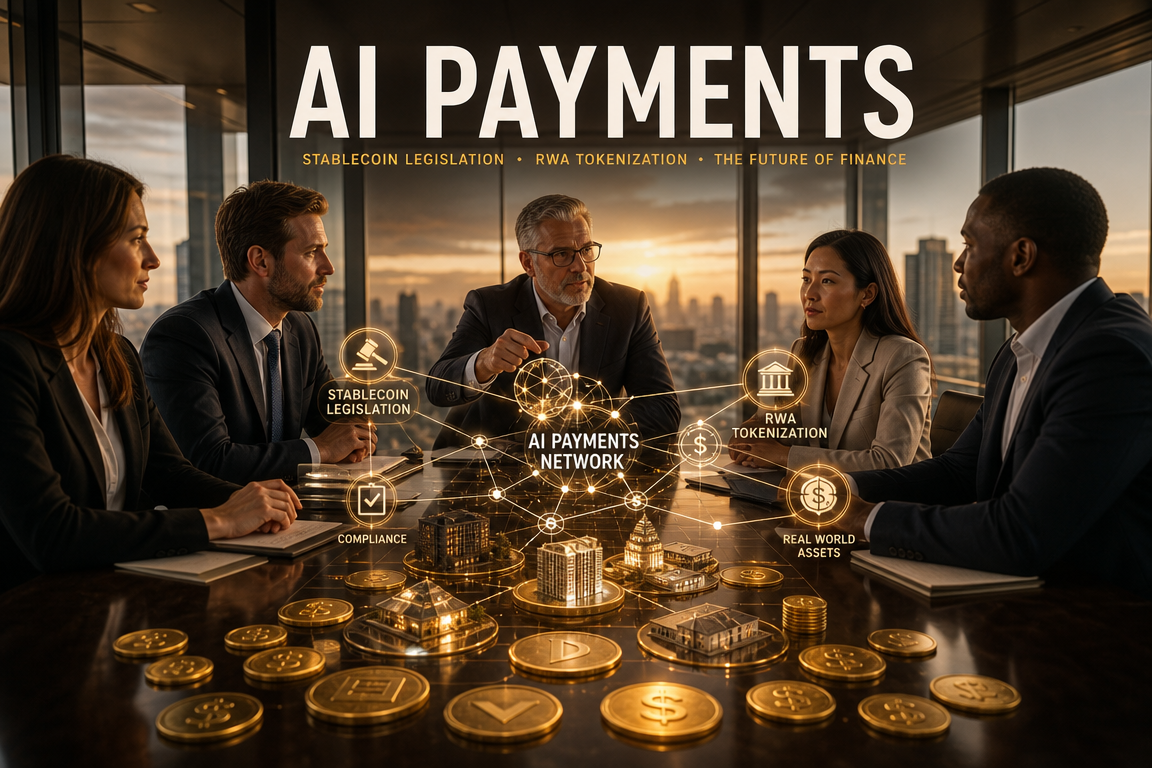
● Crypto-Reality-Shift
Is Cryptocurrency an Illusion? Why AI Payments, XRP, and Stablecoins Are Gaining Relevance
The core issue is no longer simply whether Bitcoin prices will rise.
The key question is which form of money will be used when AI agents make payments on behalf of people, refrigerators order eggs automatically, and electric vehicles settle charging fees on their own.
The central message is that cryptocurrency can no longer be explained only as a speculative asset. As it becomes connected to AI payments, stablecoins, CBDCs, digital currencies, and payment infrastructure such as XRP, it is evolving into the backend of the future financial system.
Many news reports and video analyses focus on coin price forecasts, but the more important issue is the payment standard for the AI era, integrated ledgers, tokenized national currencies, and why XRP is being discussed as a bridge asset.
In practical terms, cryptocurrency is increasingly likely to function not only as an investment asset, but as money used by machines.
1. Is Cryptocurrency Really an Illusion?
One of the most common questions about cryptocurrency is this:
If it cannot be seen or touched, does it really have value?
The comparison used in the source material is straightforward.
The physical value of a KRW 50,000 note is close to the cost of paper and ink.
It is treated as 50,000 won because society agrees to recognize it as such.
Gold works in a similar way.
Although it is a physical asset, its price is also determined by collective agreement in the market.
Samsung Electronics shares are no different.
They are backed by corporate earnings and assets, but the market price is still the result of what participants agree to trade at a given point in time.
Bitcoin and other cryptocurrencies should be viewed in the same framework.
The issue is not whether they have zero value, but what role they play through social consensus, network effects, utility, and institutional adoption.
In other words, the more relevant question is not whether cryptocurrency is real or fake, but how it will be used within future payment systems and financial infrastructure.
2. Why Will AI Era Payments Require Cryptocurrency?
Until now, most payments have been approved directly by people.
Consumers use cards, mobile payment buttons, or bank transfers.
In an AI agent era, however, the payer may be a machine rather than a person.
An AI kiosk can identify a customer through facial recognition or account data and infer a likely purchase based on spending patterns.
After the order is confirmed, payment can be completed automatically.
Cash is clearly not suitable in such a setting.
Card payments may still work, but in an environment where machines transact with each other around the clock, a faster and more automated payment method is required.
This is where stablecoins and cryptocurrency-based payment networks become relevant.
If AI is to order goods, use services, and complete settlement without human intervention, it needs programmable money.
3. How Physical AI Is Changing Everyday Payment Structures
One of the most notable examples is physical AI.
Physical AI refers to AI that does not only operate on a screen, but interacts with real-world devices and takes direct action.
A common example is an AI refrigerator.
People often forget how many eggs remain in the refrigerator.
An AI refrigerator, by contrast, knows the number of eggs available and the household’s consumption pattern.
If a family typically consumes five eggs per day but only four remain, the refrigerator can compare available options across retailers.
It may compare platforms such as Coupang, Kurly, and major supermarket online stores to select the lowest-cost and best-quality option.
It can then place the order and complete payment automatically.
The same applies to printers.
When ink runs low, a printer can automatically order supplies.
Electric vehicles can automatically pay for charging after the session ends.
Robots, drones, smart factory equipment, AI kiosks, and unmanned stores all follow the same logic.
Under this model, payment becomes machine-to-machine settlement rather than a human action.
Cryptocurrency, stablecoins, and digital currencies may emerge as the new payment infrastructure for this environment.
4. The Internet Originally Lacked Built-In Payment Functionality
An important technical point from the source material is that the internet was strong in transmitting information, but payment was not built into its native structure.
The HTTP protocol has long included the 402 Payment Required status code, but it never became a widely used payment standard.
In simple terms, the internet was highly effective at sending text, images, video, and data, but not money.
As a result, card networks, payment processors, banks, and mobile payment providers have handled settlement in the middle.
However, if AI agents are to make payments directly on the internet, the existing structure is no longer sufficient.
AI must be able to visit websites, buy data, pay API fees, and subscribe to services, which requires payment to be integrated more naturally into the internet itself.
The source material highlights X402-style payment standard discussions as important in this context.
The main issue is that a standard for AI to pay automatically on the internet is beginning to emerge.
Which blockchain layer, ledger, or stablecoin becomes integrated with that standard may become a major competitive factor in the AI payment market.
5. Why Are Stablecoins Becoming Central to AI Payments?
Stablecoins are cryptocurrencies designed to track the value of legal tender such as the US dollar, the Korean won, or the euro.
Highly volatile assets such as Bitcoin are not suitable for immediate use in everyday payments.
If a customer buys a 10,000-won item today and the coin price moves by 10% tomorrow, both buyers and sellers face operational friction.
Stablecoins are more suitable because they are designed to remain close to a reference currency, such as 1 dollar, 1 won, or 1 euro.
Most of the global stablecoin market is currently dollar-based.
USDT and USDC are the main examples.
Over time, however, won-based, euro-based, pound-based, and real-based stablecoins may expand as each national currency becomes tokenized.
This is not simply an expansion of the crypto market.
It represents a structural change in the future financial infrastructure connecting national currency systems, central banks, financial institutions, and payment firms.
6. Why CBDCs and Deposit Tokens Are Emerging
As stablecoins grow, central banks and governments face a strategic concern.
If privately issued stablecoins become too large, they may challenge monetary sovereignty.
This is why CBDCs are being introduced.
CBDC stands for Central Bank Digital Currency.
It refers to a digital form of legal tender issued directly by a central bank.
The concept of deposit tokens is also relevant.
This refers to bank deposits held at institutions such as KB Kookmin Bank, Shinhan Bank, or Hana Bank being represented as tokens on a blockchain.
As a result, money may take several different forms in the future.
Privately issued stablecoins.
CBDCs issued by central banks.
Deposit tokens representing commercial bank deposits.
And public blockchain assets such as Bitcoin, Ethereum, and XRP.
Once currencies and financial assets move onto blockchain-based systems, a new issue arises.
How will value move and settle quickly across different ledgers and networks?
7. Why XRP Is Being Watched for Its Bridge Function
The most important reason XRP is being mentioned is not simply price speculation.
XRP is being described as a bridge asset between different currencies and different blockchain networks.
For example, international transfers are currently complex.
Funds may move from won to dollars, then from dollars to yen or euros, with several intermediary banks involved and settlement taking days.
Fees are also high.
If all currencies and assets were tokenized, real-time settlement would be possible in theory.
The challenge is the large number of currency pairs.
If there are more than 150 currencies worldwide, the system would require numerous exchange paths such as won-to-dollar, dollar-to-yen, won-to-euro, and yen-to-peso.
A bridge asset that provides liquidity and routing between these currencies may therefore become useful.
The source material argues that XRP could serve that role.
XRP Ledger is designed for fast settlement, low fees, and cross-currency transfer.
Accordingly, the investment case for XRP is not simply whether it is cheap or expensive, but whether it can serve as part of the payment backend in a future integrated-ledger environment.
8. The Market Must Be Viewed Through Front-End and Back-End Layers
This is one of the most important but less frequently discussed points.
Most people evaluate stablecoins by asking which coin will be used for payments.
In practice, however, the market should be divided into front-end and back-end layers.
The front end is the layer users directly interact with.
For example, an AI system may pay with a dollar stablecoin or purchase goods using a won stablecoin.
The back end is the layer that connects different currencies, blockchains, and financial institution ledgers.
By analogy, the front end in the AI industry is a service like ChatGPT, while the back end consists of data centers, GPUs, and HBM semiconductors.
Similarly, the front end of the digital currency era may be a stablecoin payment application, while the back end may consist of integrated ledgers, bridge assets, and liquidity networks.
This is why XRP is attracting attention from a back-end infrastructure perspective.
9. Why the Genius Act and Clarity Act Matter
The source material also refers to U.S. legislative developments related to stablecoins and digital assets.
The key point is that the crypto market is moving away from its former position as a largely speculative, outside-the-system market and becoming more integrated into regulated finance.
For stablecoin legislation, reserve quality, anti-money laundering controls, auditability, and transparency reporting are critical.
A major issue is whether reserves are fully backed by cash or short-term Treasuries and other safe assets.
Not all stablecoins will survive under this framework.
Smaller issuers with weak reserves, limited transparency, or poor compliance may lose market share.
By contrast, stablecoins that meet institutional standards, are linked to major financial institutions, and maintain transparent reserves may command a premium.
This is highly relevant for cryptocurrency investors.
The market may increasingly reward infrastructure that can pass regulatory scrutiny and demonstrate real use cases rather than simply follow short-term trends.
10. The Market Is Becoming More Institutional
The character of the crypto market has changed significantly.
In the past, it was driven primarily by retail speculation.
Today, the expansion of Bitcoin ETFs, Ethereum ETFs, stablecoin legislation, custody services, and derivatives is increasing institutional participation.
Institutions evaluate markets far more strictly than retail investors.
They focus on regulatory risk, accounting standards, custody security, liquidity, counterparty risk, and legal status.
As a result, the crypto market is likely to become more selective.
Rather than broad-based rallies across all tokens, capital may concentrate in assets that serve real infrastructure functions or meet institutional standards.
From this perspective, XRP, stablecoins, CBDCs, tokenized assets, and payment networks are not just themes, but core components of a changing financial structure.
11. Weakening Dollar Confidence and the Rise of Neutral Payment Systems
One of the more notable points in the latter part of the source material is the diminishing sense of absolute confidence in the U.S. dollar.
U.S. Treasury yield volatility has increased, some countries are expanding gold reserves instead of Treasuries, and geopolitical risks in international payment networks are becoming more visible.
This is increasing interest in neutral payment systems.
Historically, during Bretton Woods discussions, Keynes proposed Bancor as a supranational settlement unit.
Bancor was not tied to a single country’s currency, but was intended as a neutral unit for international trade and payments.
The source material presents XRP as a digital version of this concept.
This interpretation should be treated as an investment thesis rather than a confirmed outcome.
Even so, the shift from dollar-centric to more multipolar global finance, along with experiments such as BRICS Pay and mBridge, is a meaningful trend to monitor.
Future international finance may be shaped by the coexistence of multiple digital currencies and neutral settlement infrastructures rather than a single dominant national currency.
12. The Symbolism of the X in XRP
The source material also discusses the X in XRP.
Gold is internationally denoted as XAU and silver as XAG, where X can signify an asset not tied to a specific country.
XRP is therefore interpreted as having potential symbolism as a neutral asset in global payment networks rather than a national currency.
The discussion also connects the letter X to Elon Musk’s X, X Payments, and SpaceX, suggesting that X has increasingly become associated with future infrastructure and payment systems.
This alone does not determine XRP’s value.
However, it is one reason investors see XRP differently from meme coins or purely speculative tokens.
It carries a narrative tied to international payments, liquidity, bridge currency functions, and integrated ledgers.
13. Market Price and Fundamentals Do Not Always Move Together
The source material also addresses a common frustration among investors.
Why do prices not rise even when there are so many positive developments?
This is common not only in cryptocurrency, but also in equities, gold, commodities, and real estate.
Improving fundamentals and immediate price action are not the same thing.
Even if institutional demand increases, legislation advances, partnerships are announced, and use cases expand, prices may remain unchanged for some time.
Conversely, assets can surge on expectations alone without clear fundamental support.
Markets reflect future expectations, liquidity, interest rates, sentiment, regulatory risk, and macro conditions all at once.
For that reason, cryptocurrency investing should not rely on the assumption that good technology will automatically lead to higher prices.
Investors should evaluate technological direction, regulatory progress, real demand, token economics, liquidity, and competing networks together.
14. The Core Point Missed by Many News Reports
Most crypto coverage focuses on price forecasts.
Typical headlines ask how high Bitcoin or XRP can rise, or whether stablecoins will dominate the market.
However, the more important issue in this source material is structure rather than price.
First, if AI agents become the payer, existing financial networks may be too slow and too complex.
Second, the internet originally lacked a payment standard, and AI payments are driving demand for a new protocol.
Third, stablecoins may serve as the visible front end, while bridge assets such as XRP may function as the invisible back end.
Fourth, CBDCs and deposit tokens may move bank and sovereign money onto blockchain-based systems.
Fifth, the future may be shaped less by a single dominant chain and more by a multi-chain, integrated-ledger structure linking many currencies and networks.
Sixth, the assets most likely to survive are not necessarily the most famous coins, but those that solve real settlement and payment problems.
That is the central conclusion.
15. Key Investment Considerations
When evaluating cryptocurrency and XRP, investors should look beyond price charts.
The following factors are relevant:
First, does real payment demand exist?
It is important to determine whether cryptocurrency-based payments are actually being used in AI agents, physical AI, EV charging, unmanned stores, and robotics.
Second, can the asset pass regulatory requirements?
Stablecoin issuers must meet reserve, audit, AML, and transparency standards.
Third, is the infrastructure suitable for institutional use?
Institutions focus on legal certainty, liquidity, security, custody, and accounting treatment.
Fourth, does it have connectivity in a multi-chain environment?
Future finance is unlikely to run on a single blockchain alone.
Connectivity between ledgers and currencies will matter.
Fifth, does the token itself have structurally driven demand?
Network growth does not always translate directly into token price performance.
Investors should assess whether the asset is actually needed for fees, liquidity, collateral, settlement, or bridge functions.
16. Conclusion: Cryptocurrency Will Be Defined by Payment Infrastructure, Not Speculation
It is increasingly difficult to dismiss cryptocurrency as an illusion.
As AI agents and physical AI expand, machines may begin to make payments directly.
That environment requires digital payment infrastructure that operates continuously, crosses borders, supports automation, and settles quickly.
Stablecoins are likely to play an important role at the front end of that system.
CBDCs and deposit tokens represent the way states and banks may respond to the digital currency era.
XRP is attracting attention as a bridge asset that can connect multiple currencies and ledgers.
No final winner has yet been determined.
Technology competition, regulation, institutional adoption, user experience, political variables, and macroeconomic conditions will all matter.
For investors, the relevant question is therefore not whether a coin will rise, but whether it will be necessary in AI-driven future financial systems.
< Summary >
Cryptocurrency is not merely an illusion; its value is shaped by social consensus, network effects, and real utility.
In the AI agent and physical AI era, machine-to-machine payments may become increasingly important.
Stablecoins, CBDCs, deposit tokens, and assets such as XRP may therefore gain strategic relevance as digital payment infrastructure.
XRP is being watched not simply as a payment coin, but as a bridge asset connecting currencies and blockchain ledgers.
Future crypto investing will likely depend less on price prediction and more on regulation, institutional adoption, real payment demand, and the asset’s role in an integrated-ledger environment.
[Related Articles…]
Stablecoins and the Next Stage of Global Financial Infrastructure
XRP and Digital Payment Infrastructure in Future Finance
*Source: [ 경제 읽어주는 남자(김광석TV) ]
– 암호화폐는 정말 허상일까? AI가 코인으로 결제하는 시대, XRP가 뜨는 이유 | 채널 50만 특별영상 | 취중전망 [3편]
● Digital-Banking Boom, Stablecoin Surge, RWA Shakeup
Why U.S. Digital Banks Are Positioned to Grow: Stablecoins, RWA Tokenization, and Silicon Valley Investment Culture
The key points in this discussion are threefold.
First, why U.S. digital banks remain small today but have significant growth potential.
Second, how stablecoins and RWA tokenization could reshape the revenue structure of the traditional banking industry.
Third, what Korean startups and fintech companies should learn from the U.S. competitive financial system.
The core message is not simply to invest in digital banks.
The more important point is that U.S. financial markets are beginning to bring digital assets into the banking system, and this trend is converging with the U.S. equity market, fintech investment, dollar-based stablecoins, and the Silicon Valley startup ecosystem.
1. Key Interview Figure: Who Is Douglas Park?
The central figure in this interview is Douglas Park.
He is a Silicon Valley-based corporate securities attorney.
He has advised startups, fintech companies, crypto businesses, and digital asset firms on legal and business strategy.
- Mathematics major at Harvard University
- Attended Stanford Graduate School of Business
- Former professor at HKUST Business School
- Graduate of the University of Michigan Law School
- More than 20 years of experience as a corporate attorney in Silicon Valley
- Nearly 30 years of Silicon Valley ecosystem experience including his Stanford years
He is notable not only as a legal expert.
His background in mathematics, business, academia, law, and startup practice allows him to assess digital banking and stablecoins from both regulatory and commercial perspectives.
His core view is that business and law are inseparable.
2. Silicon Valley Was Not Always What It Is Today
According to Douglas Park, Silicon Valley was very different in the past.
It is now known as the home of Apple, Google, Meta, and Nvidia, but it was once largely farmland and open land.
The early industries that shaped Silicon Valley were software and semiconductors.
With venture capital financing, these sectors formed the startup ecosystem that exists today.
The key point is that the region had long established a structure in which capital could be raised on the basis of a strong idea alone.
In Korea, founders are often required to show collateral, revenue, stability, or proven execution.
In Silicon Valley, investors will fund companies even when the probability of failure is high, as long as the upside is large.
This is one of the most important differences between U.S. startup culture and the Korean investment market.
3. Why U.S. Investors Fund High-Risk Startups
The U.S. investment market is characterized by a culture of risk tolerance.
Douglas Park noted that U.S. investors are much more accustomed to risk than Korean investors.
As a result, the U.S. has developed a strong venture capital ecosystem as well as a robust angel investor base.
Most startup investments in the U.S. are expected to fail.
However, if one or two out of ten companies succeed materially, the portfolio can still generate strong returns.
This is the basic structure of Silicon Valley startup investing.
In Korea, failed founders often face social stigma.
In the U.S., failure is often treated as a valuable learning experience for the next venture.
This difference also shapes founder behavior.
- U.S. founders: launch quickly, observe market response, and iterate
- Korean founders: often aim to launch only after the product is fully polished
- U.S. investors: view failure as part of portfolio construction
- Korean investors: tend to focus on minimizing failure risk
A common phrase in Silicon Valley is:
“Fail fast and fail often.”
This does not mean being careless.
It means launching early, testing customer response, and improving quickly.
4. The Core of U.S. Digital Banking: What Is Wyoming SPDI?
The most important financial term in this interview is Wyoming SPDI.
SPDI stands for Special Purpose Depository Institution.
It is a special-purpose depository license created by Wyoming for the digital asset era.
Traditional banks provide deposits, loans, credit cards, mortgages, and corporate lending.
A digital asset bank built on the SPDI model serves a different function.
- Digital asset trading
- Stablecoin processing
- Custody and settlement of tokenized assets
- Crypto custody
- Blockchain-based asset management
The main distinction is that such institutions do not rely on lending, or lend very little.
Traditional banks earn most of their income from net interest margin.
They take in deposits at lower rates and lend at higher rates.
By contrast, SPDI-style digital banks generate revenue mainly through transaction fees and custody fees.
5. Why a Digital Asset Bank Can Protect Customer Assets Even in Bankruptcy
One of the most important features of SPDI is bailment custody.
In simple terms, customer digital assets are held separately from the bank’s own assets.
Customer A’s assets, Customer B’s assets, and the bank’s own assets are not mixed.
Under this structure, customer assets do not appear on the bank’s balance sheet.
As a result, if the digital bank fails, customer digital assets can remain protected from the bank’s creditors.
This is a critical distinction between traditional banks and digital asset banks.
In traditional finance, banks use customer deposits to make loans, and loan losses can undermine the bank’s overall stability.
Digital asset banks, by contrast, are less exposed to lending risk.
They may be less vulnerable to risks such as recession, high interest rates, and credit losses.
6. Digital Bank Revenue Models: Fees Rather Than Net Interest Margin
Many people ask how a bank can make money without lending.
The answer for a digital asset bank is fees.
- Stablecoin transfer fees
- Digital asset trading fees
- Tokenized asset custody fees
- Institutional custody fees
- Blockchain payment infrastructure usage fees
This model is closer to a combination of a card network, securities firm, exchange, and custody business.
In other words, the future digital bank may resemble a digital asset infrastructure company with a banking license.
This matters from an investment perspective.
The U.S. digital banking market is still in an early stage.
However, if stablecoin payments and RWA tokenization expand materially, transaction volume could rise significantly.
Higher transaction volume would also support growth in fee-based revenue.
7. The U.S. Stablecoin Market: USDC and USDT at the Center
The two most widely used stablecoins in the U.S. are USDC and USDT.
These tokens are also among the most heavily used across the global crypto market.
Dollar-based stablecoins already play a major role in cross-border payments, exchange transfers, digital asset trading, and remittances.
Douglas Park argues that both banks and fintech firms should be allowed to issue stablecoins.
The reason is competition.
Allowing only traditional banks could slow innovation.
Allowing only fintech firms could create stability concerns.
The optimal model, in his view, is a regulated framework in which banks and fintech companies compete.
In the U.S., stablecoin legislation has advanced rapidly, and the interview referenced the Genius Act.
The key point is that the U.S. has already begun integrating stablecoins into the regulated financial system.
8. The Korean Stablecoin Market: Potential for KRW-Based Stablecoins
Korea is also discussing stablecoin legislation.
The interview noted that Hana Financial Group and other financial institutions have shown interest in KRW-based stablecoin initiatives.
This suggests that Korean financial institutions are beginning to view stablecoins not merely as crypto assets, but as a future payments infrastructure.
However, Korea still faces important policy questions.
One view is that existing banks should remain responsible for stability.
Another is that fintech firms should be given greater freedom to accelerate innovation.
This debate is likely to shape the future direction of the Korean financial industry.
The key question is whether Korea will remain bank-centered, move toward fintech-led competition, or establish a balanced structure in which banks and fintech firms compete.
9. The Signal for Digital Bank Growth: Widespread Stablecoin Usage
Digital bank growth is not determined by technology alone.
The adoption of stablecoins and digital assets by ordinary users is also critical.
At present, a person may want to use a stablecoin, but if the counterparty does not, usage remains limited.
However, once both users and businesses adopt them at scale, transaction volume could grow rapidly.
Douglas Park believes that point is approaching.
His rationale is that institutional investors and large financial firms are already entering the tokenized asset market.
- Franklin Templeton tokenized funds
- BlackRock’s digital asset and tokenization strategy
- Apollo Asset Management’s tokenized fund initiatives
- J.P. Morgan’s tokenized asset and institutional finance experiments
- Tokenized equity discussions at Nasdaq and the New York Stock Exchange
This trend matters because institutional investors are moving before retail participants.
Once institutions move, regulation, accounting, custody, and payment infrastructure tend to follow.
Retail investors and corporate users typically come next.
10. What Is RWA Tokenization: Even Buildings Can Become Digital Assets
RWA stands for Real World Asset.
It refers to representing real-world assets as blockchain-based tokens.
In simple terms, it converts ownership rights into digital certificates.
For example, consider a large office building.
Traditionally, ownership interests are managed through paper contracts and complex legal documentation.
With RWA tokenization, the building’s equity can be divided and represented as digital tokens.
Investors can hold these tokens as ownership interests in part of the asset.
The physical building does not disappear.
The real asset remains in place.
What changes is that ownership can also be expressed digitally.
- Commercial real estate
- Industrial real estate
- Factories and logistics centers
- Private equity interests
- Bond-like financial products
- High-value art
- Antiques and collectibles
That said, not every asset is suitable for tokenization.
Douglas Park noted that art, antiques, and collectibles may have limited tokenization demand unless their economic value is substantial.
In practice, the core RWA market is likely to center on large, illiquid assets.
11. How RWA Tokenization Could Affect Financial Markets
If RWA tokenization becomes mainstream, financial markets could change in three ways.
First, ownership management becomes easier.
Real estate, private equity, and alternative assets often have complex ownership structures.
Tokenization could make ownership records and transfers more transparent.
Second, liquidity may improve.
Real estate interests and private equity stakes are often difficult to trade.
Tokenized assets, within regulatory limits, may become easier to transfer.
Third, the unit size of financial products may shrink.
Assets once accessible only to institutional investors could potentially be divided into smaller units.
This will still require investor protection, securities law compliance, tax treatment, and accounting clarity.
Ultimately, RWA tokenization is not merely a blockchain trend.
It is an infrastructure shift in how financial assets are owned, stored, and traded.
12. U.S. Digital Banks Remain Very Limited
One notable point is that the number of U.S. digital banks remains small.
Douglas Park explained that digital asset-focused banks are still rare even in the U.S.
The main reason is regulation.
Banking is already a heavily regulated industry.
Adding digital assets increases regulatory uncertainty further.
There have also been few public listings among U.S. digital banks.
The interview noted that there have been no major U.S. digital bank IPOs, while Nubank of Brazil was cited as an IPO example in the U.S. market.
However, Nubank is better understood as a global digital bank rather than a U.S. customer-centric digital asset bank.
This scarcity is also an opportunity.
The market is not yet mature; the regulatory and infrastructure layers are still forming.
From an investment perspective, the question is not which large listed company already dominates the space, but which firms can overcome regulatory barriers and control the infrastructure.
13. Why U.S. Finance Is Strong: Competition and the Dollar
The influence of U.S. finance is not explained solely by the size of its banks.
Douglas Park argued that competition is the core of the U.S. financial system.
The U.S. has created an environment in which traditional banks and fintech companies can compete.
U.S. banks are also heavily regulated.
But in broad terms, the system favors market competition and private-sector flexibility.
Antitrust rules, anti-collusion enforcement, and free-market institutions support financial innovation.
The dollar is another essential factor.
The historical strength of the U.S. economy and the dollar’s reserve currency status have amplified the global influence of U.S. banks.
Although there is ongoing debate about dollar dominance, dollar-based stablecoins could extend U.S. influence in digital finance.
14. Why Korean Finance Has Been Slower to Innovate in Fintech
Korea already has a highly convenient financial system.
Transfers are fast, mobile banking is advanced, and card payment infrastructure is strong.
Paradoxically, this reduces the need for fintech companies to replace existing banks, compared with the U.S.
Another factor is government influence.
Korean banks are private institutions, but they are strongly affected by government policy and regulation.
Interest rates, lending, profitability, and social responsibility issues are all shaped significantly by policy direction.
Douglas Park also pointed to Korea’s historical background.
After the Korean War, the government led economic development through large conglomerates, and that structure influenced the financial system as well.
This model supported rapid industrialization, but it may also have constrained financial competition and fintech innovation.
15. Why Korea Can Still Catch Up: Technology and Global Orientation
Even so, Douglas Park believes Korea can compete effectively.
Korea adapts quickly to technology and has a strong global mindset.
The government is also promoting the startup ecosystem through various policy initiatives.
The interview referenced Startup For All.
It described a government effort to select 20 accelerators and incubators to support founders and startups.
If Korea combines technology and finance more effectively, it could create a new growth engine.
Artificial intelligence, fintech, stablecoins, digital payments, RWA tokenization, and crypto custody are all areas in which Korea could compete.
16. What Korean Founders Must Prepare Before Entering Silicon Valley
Douglas Park advised that Korean founders should prepare three things to succeed in Silicon Valley.
First, they must understand Silicon Valley culture.
Silicon Valley values speed over perfection.
It emphasizes fast experimentation, customer feedback, and iteration.
Second, they need to build networks.
Connections with investors, founders, attorneys, accelerators, engineers, and mentors are important.
In Silicon Valley, who you know is itself a competitive advantage.
Third, they must establish a clear legal structure.
Founders need to decide whether to operate through a U.S. subsidiary of a Korean parent company or to form a separate U.S. entity.
This decision affects fundraising, taxes, equity structure, mergers and acquisitions, and listing strategy.
Many Korean founders are strong in technology and product development but underprepared on legal and investment structure.
To raise capital in the U.S., it is important to establish a corporate structure that global investors can understand from the outset.
17. A Common Mistake by Korean Founders: Waiting for Perfection
The biggest mistake Douglas Park identified is perfectionism.
Korean founders often delay launch until the product is perfect.
In Silicon Valley, however, market-validated products matter more than perfect ones.
Building a perfect product from the start is nearly impossible.
Customers do not behave exactly as founders expect.
That is why rapid launch, failure, iteration, and relaunch are essential.
The Korean education system also plays a role.
Korea has a strong test-score and answer-centered education culture.
High scores, top universities, and error-free outcomes are often emphasized.
This can create pressure in startups to wait until everything is perfect.
By contrast, U.S. admissions and entrepreneurial culture consider factors beyond academic scores.
This difference influences founder behavior.
18. The Real Core Message That Is Often Missing in Media Coverage
The key takeaway from this interview is not simply that U.S. digital banks will grow.
The real point is that digital asset banks could change the traditional bank’s lending-based revenue model.
Conventional banks rely on net interest margin.
Digital asset banks, however, earn from transaction volume, custody, payments infrastructure, and movement of tokenized assets.
The center of finance may shift from banks that lend money to infrastructure banks that facilitate digital asset movement.
This is important because it changes exposure to interest-rate cycles.
Traditional banks are sensitive to interest rates, recessions, loan losses, and real estate prices.
Digital asset banks may be more sensitive to transaction volume and network effects.
Regulation is another critical factor.
Even the best technology cannot drive growth if the legal framework does not allow it.
Conversely, once regulation becomes clear, capital can enter quickly.
Investors should therefore pay more attention to legislation, licensing structure, custody rules, and stablecoin issuance standards than to technology headlines alone.
Finally, dollar-based stablecoins are not simply crypto products.
They may serve as a mechanism for extending dollar dominance in the digital economy.
This is one reason the U.S. is moving quickly to formalize stablecoin regulation.
19. Investment Checklist
When evaluating U.S. digital banks and stablecoin-related companies, do not focus only on share-price momentum.
Instead, consider the following points.
- Does the company hold a banking license or custody license?
- Are customer assets segregated from the company’s balance sheet?
- Is there actual transaction volume in stablecoin payments and digital asset custody?
- Does the company serve institutional clients?
- Does it have infrastructure connected to the RWA tokenization market?
- Is its relationship with U.S. regulators stable?
- Can its revenue model scale through fees rather than lending?
In an early-stage market, regulatory compliance may matter more than technical capability.
Because digital banking is part of financial services, entry barriers are higher than in a typical technology startup.
Over time, however, these barriers can become a durable moat for winners.
20. Likely Financial Market Changes Over the Next 5 Years
Over the next five years, several changes may occur simultaneously in the financial markets.
- Expansion of dollar-based stablecoin usage
- Acceleration of KRW stablecoin legislation
- Growth in institutional RWA tokenization
- Rising demand for digital asset custody banks
- Intensifying competition between traditional banks and fintech firms
- Increase in tokenized funds and tokenized securities products
- Greater entry of Silicon Valley startups into financial infrastructure
This trend is also linked to the U.S. economic outlook.
In a high-rate environment, traditional banks that depend on lending may face pressure.
Transaction-based digital financial infrastructure may grow through a different mechanism.
In U.S. equities, after AI, semiconductors, and cloud computing, fintech and digital asset infrastructure may emerge as a new growth theme.
21. What Korean Finance and Startups Should Learn
Korea does not need to copy the U.S. model exactly.
The country already has fast payments and high mobile banking adoption.
However, to strengthen entrepreneurship and financial innovation, Korea needs a culture that tolerates failure and a system that encourages competition.
In particular, Korean fintech will need a balanced regulatory framework that allows both banks and fintech firms to participate.
Banks bring stability.
Fintech brings speed and innovation.
The goal is not to choose one over the other, but to create a market in which both can compete and expand the ecosystem.
Korean startups should also target global markets from the beginning.
U.S. investors may show greater interest in companies with international scaling potential than in companies focused only on the domestic market.
Corporate structure, financing agreements, equity design, and product launch strategy should all be built to global standards from the start.
< Summary >
U.S. digital banks remain early-stage, but their growth potential is rising as stablecoins, RWA tokenization, and digital asset custody expand.
Wyoming SPDI-style digital asset banks generate revenue through transaction and custody fees rather than lending.
This model carries less credit risk than traditional banking and can protect customer assets through segregation.
The U.S. promotes financial innovation through competition between banks and fintech firms.
Korea needs to accelerate stablecoin legislation and establish a more competitive fintech framework.
The central shift in financial markets may move from lending-centric banks to infrastructure banks focused on digital asset movement.
Investors should prioritize regulation, licensing, custody structure, and actual transaction volume over technology narratives alone.
[Related Articles…]
- Stablecoins and the Future of Digital Financial Infrastructure
- How RWA Tokenization Could Reshape Real Estate and Financial Markets
*Source: [ Jun’s economy lab ]
– 미국 디지털은행 투자하세요 곧 크게 성장합니다(ft.Douglas Park)