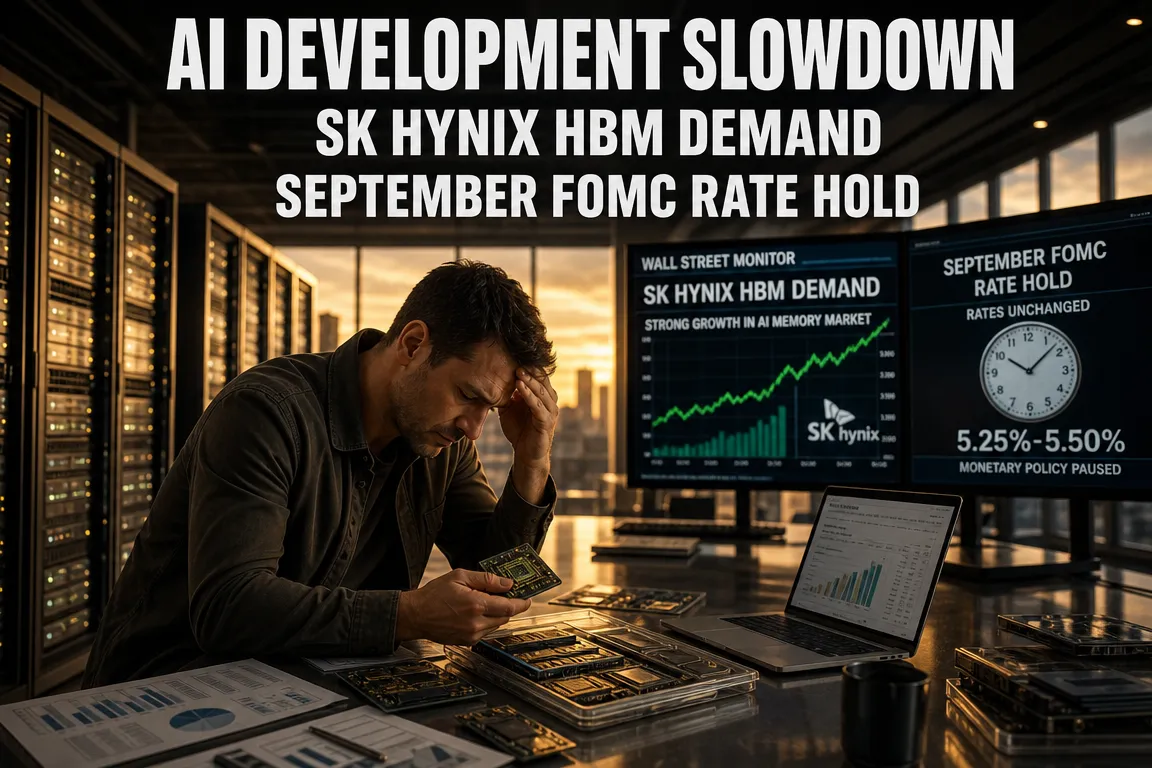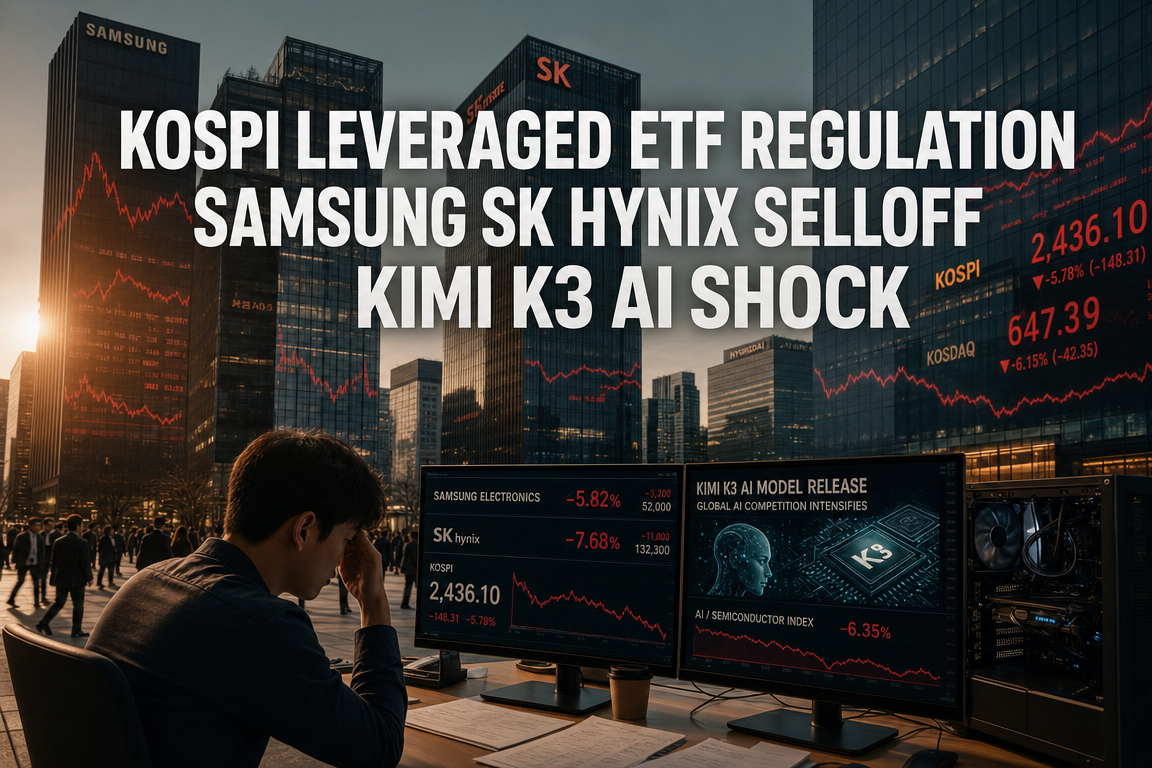
● AI, ETF, Semiconductors, Shock
Leverage ETF Regulation, Semiconductor Selloff, and China’s Kimi K3: Key Market Developments in One View
This market correction should not be viewed simply as a pause after a strong run in semiconductors.
The key issue is the simultaneous impact of tighter leverage ETF regulation, a sharp selloff in Samsung Electronics and SK Hynix, and the possibility of a reordering in the AI landscape driven by China’s Kimi K3.
This report reviews the structural factors behind KOSPI volatility, why AI monetization indicators have affected the semiconductor value chain, and the underreported issue of hyperscalers’ free cash flow pressure.
The central market variable is shifting from semiconductor earnings to whether AI large-cap technology companies are actually generating profits.
1. Stricter Leverage ETF Rules: Why Now
South Korean regulators have decided to tighten rules on single-stock leverage ETFs.
The main concern is that 2x leveraged products tied to specific large-cap names such as Samsung Electronics and SK Hynix have amplified volatility in the KOSPI.
Single-stock leverage ETFs increase gains when prices rise, but losses expand more sharply when prices fall.
Because Samsung Electronics and SK Hynix represent a large share of the domestic market, volatility in these products can affect the broader index, not just the underlying names.
1-1. How Large Has Trading Become
- Following launch on May 27, trading volume in single-stock leverage ETFs rose sharply in a short period.
- Trading value reached approximately KRW 13 trillion, or about 38% of total ETF trading value.
- Market capitalization increased by roughly KRW 7.5 trillion, indicating rapid growth in market influence.
At this scale, the product is no longer just a trading vehicle; it has become a factor affecting market direction and flows.
In periods when National Pension rebalancing, semiconductor profit taking, and interest-rate concerns overlap, leverage ETFs can accelerate declines.
1-2. The Main Risk: Negative Compounding
The key risk in leverage ETFs is not simply that they move twice as much as the underlying stock.
The real issue is negative compounding in volatile markets.
For example, a 20% decline followed by a 25% rebound in a regular stock restores the original price level.
However, a 2x leveraged ETF would fall 40% in the same decline and still fail to recover fully after a 50% rebound.
Repeated swings reduce returns over time and can lead to losses larger than expected.
In the source material, Samsung Electronics fell about 9% while the related leverage ETF declined more than 30%, and SK Hynix fell about 7% while the corresponding leverage ETF dropped roughly 34%.
This is a case where a smaller component amplifies the movement of the larger market structure.
The leverage ETF, as a derivative product, increases volatility in Samsung Electronics and SK Hynix, which in turn weighs on the broader KOSPI.
1-3. Key Elements of the Regulatory Tightening
The measures include limiting new products, banning advertising, strengthening investor education, raising minimum deposit requirements, increasing trading unit sizes, and tightening premium-discount controls.
- Temporary suspension of new listings
New listings of single-stock leverage ETFs and ETNs would be restricted. - Complete ban on advertising
Marketing that drives speculative inflows would be restricted. - Stronger pre-trade education
Required education would expand from 2 hours to 3 hours, with more stringent testing. - Higher base deposit requirement
The minimum deposit may rise from around KRW 10 million to KRW 30 million. - Limits on collateral recognition
Stock holdings would be less likely to count toward deposit requirements, with a shift toward cash-based margin rules. - Larger trading units
Trading could move from 1-share units to 20-share units, raising the entry threshold. - Stricter premium-discount management
The allowable gap between ETF market price and NAV would be tightened from around 3% to 2%.
These measures do not eliminate leverage ETFs.
They are intended to reduce uninformed participation in higher-risk products and moderate market overheating.
From the source perspective, however, the measures may still be insufficient in scope and were introduced too late.
2. The Semiconductor Selloff Is Not Only About Leverage ETFs
The sharp decline in semiconductor stocks led by Samsung Electronics and SK Hynix cannot be explained by leverage ETFs alone.
Leverage ETFs do not create the direction of the move; they magnify an existing trend.
The underlying cause of the semiconductor decline lies elsewhere, with leverage products accelerating the move.
2-1. Why Stocks Fell Despite Strong Earnings
Samsung Electronics, TSMC, and Micron all reported strong results.
Samsung Electronics posted record-level sales and operating profit, TSMC delivered an earnings beat, and Micron also showed strong sales and EPS performance.
Yet semiconductor stocks still corrected.
The market is increasingly focusing not on current earnings, but on future demand and AI monetization potential.
Equity markets typically discount 6 to 12 months ahead.
As a result, even strong current earnings may not prevent share prices from weakening if investors begin to anticipate a slowdown in the AI investment cycle in late 2026 or 2027.
2-2. The Market Question Has Changed: Can AI Actually Generate Profit?
The central market question is now:
Who pays for AI?
In other words, who ultimately bears the cost of the massive spending on AI services?
AI large-cap companies have been investing heavily in data centers, GPUs, HBM, servers, and power infrastructure.
That capital spending supports revenues for companies such as Nvidia, Micron, Samsung Electronics, SK Hynix, and Broadcom.
However, if AI hyperscalers cannot generate sufficient returns, the investment cycle may slow.
For this reason, semiconductor investors now need to monitor not only chipmakers’ earnings, but also the results and cash flow of hyperscalers such as Google, Microsoft, Meta, and Amazon.
2-3. Why the LLM Token Expenditure Index Matters
The source material highlights Silicon Data’s LLM Token Expenditure Index as an important leading indicator.
This index reflects large language model usage and token pricing, providing a proxy for AI service demand and spending.
In practical terms, it shows how much AI is being used and how strongly that usage translates into revenue and costs.
If AI services are being used more heavily, token expenditure rises.
If token spending slows or declines, concerns rise that AI monetization may be weaker than expected.
The source notes that this indicator has moved closely with hyperscaler share prices and is also linked to the recent correction in semiconductor stocks.
2-4. The Underreported Point: Hyperscaler Free Cash Flow
The most important issue is hyperscaler free cash flow.
Many reports focus only on semiconductor earnings.
However, the key variable is the cash flow of large technology companies funding AI data centers.
When hyperscalers invest in data centers, that spending becomes revenue for semiconductor firms.
But if hyperscaler free cash flow weakens or turns negative, the market will begin pricing in a slowdown in future chip demand.
The source material cites concern, based on Bank of America analysis, that some hyperscalers may face greater free cash flow pressure in the second half of 2026 through 2027.
This is the most important hidden factor behind the semiconductor selloff.
The issue is not weak earnings at Samsung Electronics, but whether AI large-cap customers can keep buying semiconductors at the current pace.
3. Power Constraints and Data Center Regulation Are Emerging as Semiconductor Risks
AI data centers consume massive amounts of electricity.
Building a 1-gigawatt data center may require power capacity comparable to that of one nuclear reactor.
The challenge is that power grids, water supply, land availability, environmental regulation, and local opposition are all increasing.
The source mentions cases in New York State where data center construction has been delayed or restricted.
If this trend spreads, the pace of AI data center expansion could slow.
Slower expansion would affect demand for GPUs, HBM, and server memory.
As a result, power infrastructure is not just an energy issue; it is becoming a material variable for semiconductor stocks and the broader AI value chain.
4. China’s Kimi K3: Why the Market Reacted
Kimi K3, released by China’s Moonshot AI, emerged as an important AI development in this market move.
Kimi K3 is Moonshot AI’s large language model, not a vehicle model.
Moonshot AI was founded in March 2023 and is one of China’s leading AI startups.
It is part of the group often described as China’s six AI leaders and is reported to have received substantial investment from Alibaba, Tencent, Meituan, and other major Chinese technology companies.
The company is said to have around 300 employees, which has drawn attention to its efficiency in building high-performance models with relatively few people.
4-1. Core Features of Kimi K3
- Very large parameter scale
The model is described in the source as having around 2.8 trillion parameters. - Open-weight strategy
Unlike closed U.S. models, it releases model weights to encourage broader adoption. - High performance
It is reported to be comparable to GPT, Claude, and Gemini in mathematics, coding, logic, and visual agent tasks. - Strong cost efficiency
Its cost for similar tasks is presented as lower than that of leading U.S. models. - Long-horizon reasoning
It is described as strong in complex mathematics, logic, research, and coding tasks that require extended reasoning. - Multimodal and agentic coding capabilities
It combines visual input with code execution and may support more autonomous development workflows.
The key issue is that if performance is comparable but pricing is lower, enterprises have an incentive to adopt Chinese models.
This is similar to the impact seen after DeepSeek.
4-2. The Possibility of an AI Value Chain Shift to China
The source notes that usage is moving rapidly from U.S.-centered models toward Chinese open-weight models.
If companies such as DeepSeek, Tencent, Xiaomi, and Moonshot AI continue to release lower-cost, high-performance models, the center of gravity in the AI value chain could shift.
The U.S. is building its AI ecosystem around OpenAI, Google, Anthropic, Meta, and Microsoft.
China is developing its own AI and semiconductor ecosystem around DeepSeek, Moonshot AI, Tencent, Alibaba, Xiaomi, and CXMT.
China’s advantage is not limited to software models; it also has strength in physical AI.
Its position in automobiles, robotics, consumer electronics, and manufacturing may allow faster integration of AI into real products.
The U.S. remains strong in software, cloud, and GPU ecosystems, but is relatively less advantaged in manufacturing.
4-3. Why Kimi K3 Pressured U.S. Equities
The market impact of Kimi K3 is not simply that Chinese AI improved.
The larger issue is that U.S. large-cap technology companies have invested enormous amounts of capital to build AI capabilities.
If Chinese firms can reach similar performance at much lower cost, investors may begin to question the efficiency of U.S. spending.
This leads to several questions:
Was such a high level of spending necessary?
Is AI infrastructure investment becoming excessive?
Are semiconductor demand expectations being revised down too quickly?
These concerns can feed into corrections in the Nasdaq, semiconductors, and AI-related equities.
5. What to Watch in KOSPI and Global Markets
Market direction may increasingly depend on the earnings of AI large-cap technology companies rather than semiconductor firms alone.
Even if Samsung Electronics and SK Hynix continue to report strong results, semiconductor stocks may remain under pressure if Google, Microsoft, Meta, or Amazon show weaker AI monetization signals.
Conversely, if AI large-cap companies deliver strong revenue growth, cloud expansion, AI service monetization, and stable free cash flow, the semiconductor correction may ease.
5-1. Key Indicators to Monitor
- AI large-cap earnings
Revenue growth and cloud growth at Google, Microsoft, Meta, and Amazon are important. - Hyperscaler capital expenditure
Investors should monitor whether data center spending continues to expand or begins to slow. - Free cash flow
This shows whether AI investment is weakening cash generation. - LLM token usage
This is a leading indicator of whether AI services are actually being used more. - Power infrastructure and data center regulation
These may become bottlenecks for AI expansion. - Chinese AI model performance and pricing
Models such as DeepSeek and Kimi K3 may pressure the profitability of the U.S. AI ecosystem. - Interest-rate concerns and liquidity conditions
Global rates and liquidity remain key macro variables.
5-2. Investment Interpretation
This is not a period in which investors can simply buy semiconductors on strong earnings alone.
Semiconductors sit in the middle of the AI value chain.
End demand must remain strong at the AI large-cap level for chip orders to continue.
Accordingly, the direction of semiconductor stocks will likely be driven more by the monetization competition among U.S. and Chinese AI firms than by short-term earnings at Samsung Electronics and SK Hynix.
Long-term optimism about KOSPI reaching much higher levels still depends on continued growth in semiconductors and the AI value chain.
However, leverage ETFs, rate concerns, AI bubble fears, China’s AI progress, and data center power bottlenecks will continue to create volatility.
6. Key Points Rarely Emphasized in Other Coverage
- First, the core issue behind the semiconductor decline is not chipmaker weakness but hyperscaler cash flow pressure.
If AI large-cap companies fail to generate profits, semiconductor demand expectations will weaken. - Second, LLM token spending is becoming a new leading indicator for the AI era.
It helps measure actual usage and monetization potential. - Third, leverage ETFs do not create direction; they magnify volatility once a direction is in place.
That is why losses can become disproportionately large during corrections. - Fourth, China’s real AI advantage is cost efficiency rather than just performance.
If similar performance can be delivered at lower cost, global AI demand may shift toward Chinese models. - Fifth, the AI race is both a technology contest and a capital-market contest.
As the market influence of U.S. mega-cap tech, China’s leading AI firms, and Korea’s semiconductor leaders grows, shifts in AI leadership can move the broader equity market.
< Summary >
This market correction reflects the combined impact of leverage ETF regulation, semiconductor profit taking, doubts about AI monetization, and the shock from China’s Kimi K3.
Single-stock leverage ETFs increased investor losses through negative compounding and amplified KOSPI volatility.
The core reason for the semiconductor selloff is not weak earnings at Samsung Electronics and SK Hynix, but concern over whether AI large-cap firms can continue funding data center investment.
LLM token spending and hyperscaler free cash flow are likely to become key indicators for semiconductor stocks.
Kimi K3 has emerged as a factor pressuring the U.S. AI ecosystem and Nasdaq by combining high performance with lower cost.
Going forward, investors will need to monitor not only semiconductor earnings, but also AI monetization and capital expenditure trends at Google, Microsoft, Meta, and Amazon.
[Related Articles…]
- Leverage ETF Regulation and KOSPI Volatility Review
- Semiconductor Selloff and AI Monetization Risk Analysis
*Source: [ 경제 읽어주는 남자(김광석TV) ]
– [LIVE] (1)레버리지ETF 대수술 (2)반도체 주가급락의 비밀 (3)중국 AI Kimi K3 역습 [즉시분석]
● AI-Meltdown, Rate-Jolt, Chip-Flip, Tesla-Block, Market-Storm
Key Market Themes Investors Should Monitor Across SK hynix, Samsung Electronics, Tesla, Micron, and SpaceX
The key issue in this market is not simply that semiconductors rose, Tesla is preparing a robotaxi launch, or Micron declined.
The more important point is that semiconductor price increases, data center siting constraints, Nasdaq futures trends, U.S. rates and inflation interpretation, and the AI investment cycle are interconnected.
When evaluating SK hynix, Samsung Electronics, Micron, and Tesla, headline-driven analysis is insufficient. Investors should also assess price ranges and the trading zones in which sentiment changes around key supply and demand levels.
This report summarizes the market drivers more objectively, rather than relying on post hoc explanations such as “the real reason for the surge” often seen in media coverage.
1. The core semiconductor signal: a 20% DRAM price increase is positive, but it also signals risk
Samsung Electronics has reportedly entered negotiations to raise third-quarter DRAM prices by as much as 20%.
Prices for standard DRAM and LPDDR are also reportedly being raised by more than 20%.
On the surface, this is a clear sign of strong semiconductor demand.
When suppliers can raise prices, it indicates that customers still need volume.
This is constructive for memory semiconductor companies such as SK hynix, Samsung Electronics, and Micron, given continued demand from AI servers, data centers, and high-performance memory.
However, investors should also note another factor.
The market has already priced in much of the semiconductor supercycle expectation.
With HBM, DRAM, and AI semiconductor premiums elevated, the key question is whether current margins and revenue growth can be sustained.
In other words, the price increase is favorable, but investors are now asking whether the premium can be maintained in the next quarter.
This is a major reason for recent volatility in semiconductor equities.
Demand remains solid, but expectations have become elevated.
2. Micron’s decline should not be attributed only to Chinese DRAM competition
Whenever Micron shares weaken, Chinese DRAM producers such as CXMT are often cited.
Chinese memory competition is a long-term risk and should be monitored.
However, the more immediate issue is delays in data center construction and local community resistance.
In parts of the United States, data center projects are facing pushback due to electricity use, water consumption, noise, and residential concerns.
This is especially sensitive in New York and other politically progressive regions, where low-income housing policy, electricity costs, and infrastructure constraints matter.
Data centers are essential to the AI industry, but they also require substantial power and cooling resources.
This is not a simple “AI demand remains strong” story.
For the AI investment cycle to continue, the market needs not only GPUs but also power infrastructure, water infrastructure, land, and local approval.
This is one of the most overlooked factors when evaluating semiconductor and data center-related stocks.
Ultimately, demand for companies such as Micron, SK hynix, and Samsung Electronics is tied to data center investment, and data center investment is influenced by local politics and infrastructure bottlenecks.
3. Data center expansion is likely to favor Texas
Where data centers can be built in the United States will be an important variable for AI sector growth.
In regions such as New York, where regulation is stricter and local opposition is stronger, large-scale data center construction is difficult.
By contrast, Texas offers business-friendly policies, abundant land, and a relatively lighter regulatory environment, making it more receptive to data center and AI infrastructure investment.
Elon Musk and other technology companies moving to Texas is consistent with this trend.
When evaluating AI semiconductor demand, investors should not focus only on Nvidia GPU sales. They should also assess where and how quickly data centers can actually be built.
Power, water, land, lobbying, and state policy are all interconnected.
4. SK hynix and Samsung Electronics: the box range matters more than the “real reason for the rally”
Whenever SK hynix ADR or Korean semiconductor shares move sharply, headlines often focus on the “real reason for the rally” or the “real reason for the decline.”
However, stocks rarely move on a single news item alone.
For large-cap semiconductor names, sector trends, Nasdaq performance, AI sentiment, rates, the U.S. dollar, and options positioning all interact.
Therefore, investors should first determine whether only one stock declined or whether the broader semiconductor sector sold off together.
If Micron falls and SK hynix, AMD, ARM, and Nvidia also weaken, the move is more likely a sector correction than a company-specific issue.
In that case, the key question is the price range in which the stock is trading.
Stocks often move within a range, break above the upper end to enter a new advance, or fall below the lower end to search for the next support level.
Accordingly, the more important question is not “why did it rise today?” but “what range is it holding above?”
5. Key price range for SK hynix ADR
The key level identified for SK hynix ADR in the original context is around $150.
$150 should be viewed not as a single line, but as the center of a support range.
Because stocks do not stop at an exact price, it is more realistic to view this as a range of roughly $10 above and below $150.
In other words, the support range is approximately $140 to $150, with a more conservative view extending to around $135.
If the $135 to $130 area breaks down, a conservative approach would allow for a move toward the $100 level.
Conversely, if the stock rebounds from this support zone and Nasdaq futures improve, it could recover with the broader semiconductor sector even without a company-specific catalyst.
The objective is not to call the exact bottom, but to define where to scale in and where to respond if support fails.
6. SK hynix and Samsung Electronics in Korea should also be viewed through supply and demand zones
For SK hynix in Korea, chasing the stock near its highs is less attractive than identifying lower accumulation zones and support areas.
In the original context, the high-260,000 won area was presented as a level where aggressive chasing should be avoided.
Samsung Electronics should also be evaluated not only by gap-ups or short-term surges, but by the psychological burden created by the gap itself.
A gap may initially appear to signal strength, but over time it can create concern that the stock will revisit the gap area.
As a result, gap structures can weaken investor sentiment.
The key is not to assume that gaps will always be filled or never be filled.
What matters is whether there is a supply and demand zone near the gap and whether the stock is consolidating above or below that area.
7. Tesla robotaxi: regulation and labor dynamics matter more than technology alone
Tesla’s robotaxi business is a meaningful long-term growth theme.
It connects autonomous driving, AI, robotics, and mobility platform economics, making it one of Tesla’s core future businesses.
However, it would be risky to assume that robotaxis will scale quickly across the United States.
In places such as New York, taxi unions have significant influence.
When Uber and Lyft expanded, they faced strong resistance from the existing yellow cab industry, and operational adjustments were required around app usage and business structure.
A driverless robotaxi would raise even more complex issues involving the taxi industry, labor unions, city governments, insurance, and liability.
Therefore, investors should evaluate not only Tesla’s technology, but also which states may approve deployment first and what regulatory barriers remain.
Texas and Arizona, where regulation is more flexible, may offer better early-stage prospects than New York, where labor and political interests are stronger.
8. PayPal and Michael Burry: a decline does not automatically make a stock attractive
PayPal was once a leading fintech growth name, but its share price has remained weak for an extended period.
It attracted renewed attention after reports that Michael Burry had purchased the stock.
The relevant point is not that Burry bought it, therefore it must be correct.
Burry is not infallible.
One element of his approach is to look for mean reversion potential in heavily depressed stocks.
PayPal may rebound on acquisition speculation or valuation support, but its current growth profile must still be assessed independently.
In equity markets, a famous investor’s position is only a reference point, not an investment thesis.
For U.S. equity investing, the more important issue is the stock’s cycle, whether it is in a small-cap rotation or a broader technology recovery phase.
9. Inflation interpretation: “inflation is lower” does not mean prices are actually falling
The market has been highly sensitive to inflation and rate commentary.
However, a key distinction is often overlooked.
When inflation is said to have declined, that does not mean prices themselves have fallen.
It means the pace of price increases has slowed.
This is why consumers do not feel that everyday prices are materially lower.
Price levels remain high; only the rate of increase has moderated.
Accordingly, Federal Reserve policy should not be viewed through a simplistic “rate cuts are bullish, rate hikes are bearish” framework.
Rate cuts can support equities if they reflect an economy that remains resilient and benefits from added liquidity.
By contrast, rate cuts driven by a severe recession can coincide with weaker equity markets.
Similarly, rate hikes aimed at curbing overheating inflation do not necessarily prevent equities from rising if corporate earnings remain strong.
Ultimately, the economic backdrop behind the rate move matters more than the direction itself.
10. Nasdaq futures trend matters before individual stock action
When evaluating semiconductors, Tesla, and AI-related names, focusing only on individual charts can narrow the analysis.
The first step is to assess Nasdaq futures and S&P 500 futures.
In the U.S., traders often watch /ES and /NQ futures, and platforms such as TradingView, MarketWatch, and Yahoo Finance are commonly used to track S&P 500 mini futures.
In the original context, a specific support zone and pattern in Nasdaq futures were emphasized.
A diamond pattern or consolidation structure was discussed, with the key issue being whether the lower boundary holds into the next week.
For technical analysis, the objective is not to memorize pattern names.
The more important issue is identifying the levels below which sentiment weakens and above which buying interest returns.
Even if an individual stock appears favorable, a weakening Nasdaq trend can pull it lower.
Conversely, even with limited company-specific catalysts, large-cap technology stocks can rebound if the Nasdaq and semiconductor indices recover.
11. Leverage risk for Korean investors: rapid gains can turn into rapid losses
Korean investors make extensive use of leveraged products.
In U.S. equities, there is strong interest in leveraged ETFs such as TQQQ, SOXL, and TMF.
Leverage can generate fast gains when direction is correct, but losses also accelerate quickly when the market moves against the position.
In volatile markets, margin calls and forced liquidations can occur.
The original context noted that more than 1 million Korean investors were exposed to margin-call risk.
This does not mean leverage should never be used.
It does mean that leverage requires stronger risk management and discipline than most investors expect.
Even quality large-cap technology stocks can be sufficient for long-term wealth accumulation, yet many investors allocate excessively to leverage in pursuit of quick profits.
Over the long term, survival matters more than short-term returns.
12. The most important points often omitted in media coverage
First, data centers are a hidden bottleneck in AI.
Even if AI semiconductor demand remains strong, growth can slow without land, power, water, and local approval for data center construction.
Second, Tesla robotaxi is likely to face regulation before it faces technology constraints.
Technological progress and large-scale commercial deployment are different issues.
Third, stocks move in ranges, not lines.
Investors should focus on supply and demand zones rather than a single support level.
Fourth, inflation has not fallen in absolute terms; the pace of increase has slowed.
Misreading this distinction can lead to incorrect conclusions about rates and consumer data.
Fifth, “the real reason for the rally” is usually a retrospective explanation.
It is more important to track the price range a stock is defending.
Sixth, market cycle matters more than a famous investor’s purchase.
Burry, Cathie Wood, and Wall Street analysts can be useful references, but they should not replace a portfolio framework.
13. Practical points investors should monitor now
- Semiconductor demand is strong, but elevated expectations must also be considered.
- For SK hynix and Samsung Electronics, focus first on supply and demand zones and trading ranges.
- Micron should be assessed not only for Chinese DRAM competition, but also for U.S. data center construction delays.
- Tesla robotaxi depends as much on state regulation, taxi unions, and insurance as on technology.
- If Nasdaq futures weaken, company-specific catalysts may have limited effect.
- Rate cuts should be evaluated in the context of why they are occurring.
- Leverage should be assessed based on survival capacity, not only expected return.
- The AI investment cycle should be viewed across semiconductors, data centers, power infrastructure, and raw materials.
14. Investment framework: portfolio management matters more than calling the bottom
Many investors try to identify the exact bottom.
In practice, it is more important to buy in favorable zones and define in advance how to respond if support fails.
A decline of 1% to 2% should not automatically be interpreted as a loss of trend in a long-term position.
The key issue is not the entry price itself, but whether the stock remains within a valid trading range.
Holding within a support zone and breaking below it are materially different situations.
For U.S. equity investing, investors need to combine stock analysis, macro data, rates, Nasdaq trends, and sentiment.
Those who focus on the broader trend rather than short-term headlines are more likely to remain invested over time.
< Summary >
Semiconductors have support from DRAM price increases, but elevated expectations and margin premiums remain a constraint.
Micron, SK hynix, and Samsung Electronics should be viewed in the context of sector trends and data center investment, not isolated headlines.
Tesla robotaxi is likely to be influenced more by U.S. state regulation and taxi unions than by technology alone.
Inflation is not falling in absolute terms; the pace of increase is slowing, and the economic backdrop behind rate changes is critical.
In the current market, investors should monitor Nasdaq futures, supply and demand zones, data center infrastructure bottlenecks, and leverage risk.
Investing is less about calling the bottom than about defining the range and managing exposure.
Investment Risk Disclosure
This report is not a recommendation to buy or sell any security.
All investment decisions should be made based on your own financial situation, investment horizon, and risk tolerance.
Any price levels and chart ranges mentioned are for reference only and reflect the source context. Before investing, investors should review the latest prices, filings, earnings, and macroeconomic data.
[Related Articles…]
- Semiconductor Cycle: Key Watchpoints for SK hynix and Samsung Electronics
- Tesla Robotaxi and U.S. Regulatory Risk Analysis
*Source: [ 미국주식은 훌륭하다-미국주식대장 ]
– 지금 안 보면 늦습니다. SK 하이닉스 삼성전자 테슬라 마이크론 스페이스X