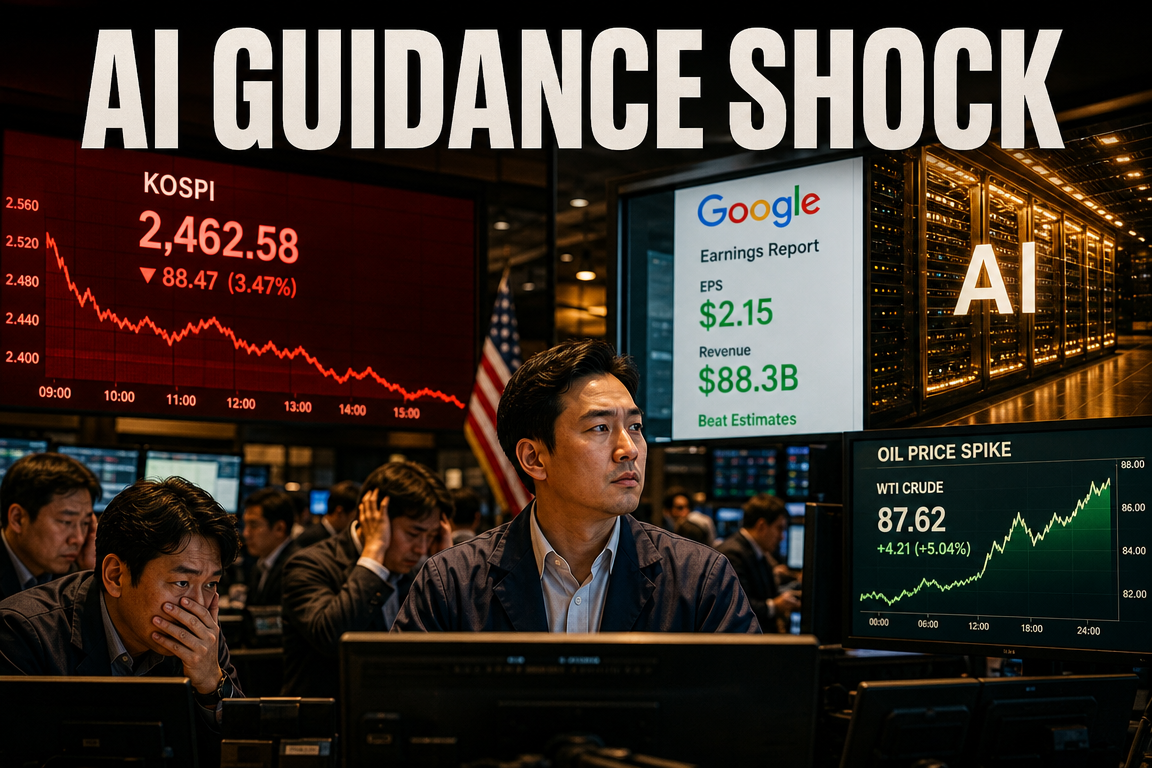
● KOSPI, Late-Selloff, Google-Fear, Oil-Shock
Reasons Behind the Late-Session KOSPI Decline: Why Samsung Electronics and SK Hynix Held Up, and Why the Market Suddenly Weakened
The KOSPI opened the day on a solid footing.
Supported by the U.S. AI semiconductor uptrend, strong Super Micro earnings, and expectations of stable flows into Samsung Electronics and SK Hynix, the index at one point appeared to be regaining upward momentum.
However, much of the intraday gain was given back late in the session.
The main reason was straightforward.
Expectations for AI server demand remained intact, but caution ahead of Google’s earnings release, combined with rising oil prices, prompted investors to lock in gains.
In particular, Google’s comments on AI investment, data center spending, and cloud growth are likely to determine the short-term direction of the KOSPI, as well as Samsung Electronics and SK Hynix shares.
1. KOSPI performance in one line
-
The KOSPI started strongly on AI semiconductor optimism.
-
Expectations for improved demand support centered on Samsung Electronics and SK Hynix.
-
In the late session, gains narrowed as concerns over Google’s earnings, higher oil prices, and geopolitical risk increased.
-
The market effectively closed on the view that AI optimism remains, but investors should wait for confirmation from major tech earnings before adding risk.
2. Why the KOSPI was strong early: three positive factors
① Kimi K3, China’s AI model, initially seen as a negative factor but later reinterpreted
China’s AI model Kimi K3 has recently drawn market attention.
At first, the concern was that a cheaper and more efficient Chinese AI model could reduce the pressure on U.S. big tech to keep expanding AI spending.
This interpretation weighed on AI semiconductor and memory-related stocks.
However, the market view has shifted somewhat.
As AI models become larger and more advanced, they require more computing power and more memory.
Accordingly, the emergence of large-scale AI models such as Kimi K3 may increase demand for HBM, DRAM, SSDs, and AI servers.
This interpretation is favorable for Samsung Electronics and SK Hynix.
SK Hynix holds a strong position in the HBM market, while Samsung Electronics tends to influence overall investor sentiment whenever the memory cycle shows signs of recovery.
② Strong Super Micro earnings signaled that AI server demand remains firm
Super Micro, a U.S. AI server company, released earnings overnight.
The results exceeded market expectations, and the stock rose about 20% in after-hours trading.
This should not be viewed simply as a single-company earnings beat.
Super Micro is one of the key names used to gauge AI server demand.
Strong earnings from Super Micro suggest that spending on data centers and AI servers remains solid.
Higher AI server demand benefits the entire value chain, including GPUs, HBM, high-performance memory, power equipment, and cooling solutions.
As a result, U.S. semiconductor stocks strengthened, and that positive sentiment carried over to the Korean market.
③ Expectations for lower leverage in Samsung Electronics and SK Hynix ETFs
One of the major domestic market issues recently has been leverage ETFs linked to Samsung Electronics and SK Hynix.
There have been discussions about reducing the existing 2x leverage structure to around 1.5x.
This helped stabilize sentiment in the short term.
Leverage ETFs amplify buying pressure in rising markets, but also intensify selling pressure in declining markets.
As a result, they can increase volatility and destabilize the broader market.
A lower leverage ratio could reduce excessive concentration and abrupt flow swings in Samsung Electronics and SK Hynix.
Expectations around this adjustment likely contributed to the market’s stability early in the session.
3. Why the market weakened late: three negative factors
① Geopolitical risk related to Iran and rising oil prices
The first variable to monitor was the rise in oil prices.
Ongoing geopolitical risk involving Iran has pushed global oil prices higher again.
Higher oil prices are generally a negative for equity markets.
Rising crude prices increase corporate costs and may revive inflation pressure.
If inflation rises, expectations for rate cuts may weaken.
In a global environment that is still not fully stable, higher oil prices tend to pressure investor risk appetite.
In that sense, rising oil prices are sending a “pause and reassess” signal to risk assets such as the KOSPI.
② Caution ahead of Google’s earnings release
The most direct reason for the late-session selloff was caution ahead of Google’s earnings release.
Google is more than a search company.
In the current market, the more important issue is not just earnings but commentary on AI investment and data center spending.
If Google signals that it will continue aggressive AI investment, that would be positive for AI semiconductors, memory chips, and server-related companies.
By contrast, if it emphasizes investment efficiency or slower CAPEX growth, the market could react negatively.
The AI semiconductor rally ultimately depends on large-scale capital spending by big tech.
That is why investors chose to realize some gains before Google’s earnings announcement.
③ Profit-taking in stocks that had already risen
Samsung Electronics, SK Hynix, and other semiconductor names have already posted strong gains on AI optimism.
When an important event approaches after a rally, investors begin to weigh the risk-reward balance.
The view that “stocks may rise further after earnings, but could fall sharply if the result disappoints” tends to lead to caution.
That appears to have influenced today’s late-session move.
In other words, the decline was driven less by a sudden negative shock and more by risk reduction ahead of a key event.
4. Implications for Samsung Electronics and SK Hynix
① Samsung Electronics: recovery expectations remain, but confirmation is still needed
Samsung Electronics has the largest influence on the direction of the KOSPI.
Strong AI server demand can support not only HBM but also general DRAM and high-performance memory pricing.
However, the market still wants to see how quickly Samsung Electronics can demonstrate improved HBM competitiveness.
As a result, Samsung’s share price is unlikely to rise on AI optimism alone; it will need confirmation through orders, customer qualification, and memory price recovery.
② SK Hynix: HBM leadership premium remains, but volatility may increase
SK Hynix is widely seen as the leading beneficiary of the HBM market.
It is one of the first stocks to react when news indicates stronger AI server demand.
At the same time, it is highly sensitive to earnings and CAPEX outlooks from major tech firms such as Google, Microsoft, Amazon, and Meta.
If Google signals stronger AI infrastructure spending, that would be clearly positive for SK Hynix.
If it suggests slower spending, short-term profit-taking could intensify.
③ KOSPI: reaffirmation of a market structure heavily concentrated in semiconductors
Today’s trading confirmed that the KOSPI remains heavily dependent on semiconductor flows.
When Samsung Electronics and SK Hynix hold up, the index tends to remain stable; when they come under pressure, the entire market weakens.
In this structure, big tech earnings, U.S. Treasury yields, KRW/USD moves, and global oil prices all directly affect the KOSPI outlook.
5. The key point that is easy to miss in other market commentary
The real issue today is not simply that Kimi K3 was positive or that Super Micro reported strong earnings.
The more important point is that market attention is shifting from AI model competition to the sustainability of AI infrastructure spending.
Investors are now focused less on which AI model is more advanced and more on whether big tech will continue buying enough servers and semiconductors to support the buildout.
In other words, the core question for the AI sector has changed.
It has shifted from “Is AI innovative?” to “Can AI investment remain strong enough to justify continued spending?”
This shift is important.
If Google strongly supports further AI investment, Samsung Electronics, SK Hynix, Nvidia, and Super Micro could all benefit again.
However, if Google emphasizes spending discipline, cost control, or CAPEX moderation, the entire AI semiconductor value chain could weaken.
Another important point is the planned reduction in leverage ETF exposure.
Many investors view this only as a factor that stabilizes the market.
However, it may also reduce upward momentum in a strong market.
In other words, volatility may decline, but short-term upside energy could also weaken.
This is an area that many investors may overlook.
6. Key points to watch tomorrow
-
Check whether Google’s cloud revenue growth exceeds expectations.
-
Monitor whether Google continues to emphasize AI data center investment and CAPEX expansion.
-
Assess how Google management describes the cost burden of AI investment.
-
Confirm whether Super Micro’s after-hours gains are sustained in regular trading.
-
Watch Nvidia and the Philadelphia Semiconductor Index, as both can directly affect Korean semiconductor stocks.
-
Track whether international oil prices continue to rise or begin to stabilize, as this will affect the near-term KOSPI direction.
-
Monitor KRW/USD and U.S. 10-year Treasury yields, both of which influence foreign investor flows.
7. Scenario outlook for the KOSPI
Positive scenario
If Google reports solid earnings and reiterates stronger AI investment, semiconductor stocks could strengthen again.
In that case, Samsung Electronics and SK Hynix would likely lead the KOSPI’s rebound.
If Super Micro’s gains hold and Nvidia also remains firm, sentiment toward Korean AI semiconductors could improve further.
Neutral scenario
If Google delivers solid earnings but provides mixed commentary on AI spending, the market may move toward stock-by-stock differentiation.
In that case, clearly advantaged HBM beneficiaries such as SK Hynix may hold up better than others.
The KOSPI would likely remain range-bound.
Negative scenario
If Google disappoints on earnings or suggests slower AI CAPEX growth, semiconductor stocks could undergo a short-term correction.
If this is combined with rising oil prices, the KOSPI may face additional foreign selling pressure.
In that case, recently strong AI semiconductor names could see heavier profit-taking.
< Summary >
The KOSPI opened strongly on AI semiconductor optimism but gave back much of its gains late in the session.
Positive factors included the re-interpretation of Kimi K3, strong Super Micro earnings, and expectations of lower leverage in Samsung Electronics and SK Hynix ETFs.
Negative factors included geopolitical risk related to Iran, rising oil prices, and caution ahead of Google’s earnings release.
The key issue is Google’s message on AI investment and data center CAPEX.
If Google signals strong commitment to AI spending, Samsung Electronics and SK Hynix could benefit.
If it emphasizes slower spending, AI semiconductor stocks may face short-term pressure.
Today’s market action appears to reflect pre-earnings profit-taking rather than a disorderly selloff driven by a fresh negative shock.
[Related Articles…]
*Source: [ 내일은 투자왕 – 김단테 ]
– 코스피 막판 급락 이유 #코스피 #삼성전자 #하이닉스
● AI Education Shock, Job War, Question Power
The First Cohort to Compete with AI Has Arrived: What Children Need Now in AI Education and Future Job Strategy
The core message of this article is not simply that “AI must be learned.”
The next generation of elementary school students will be the first to enter the labor market and compete directly with AI from day one.
Accordingly, what parents and education systems need to prepare now is not another coding academy, but the ability to ask questions, disciplined thinking, identifying meaningful interests, and hands-on experience building with AI.
In particular, agentic AI, vibe coding, and teenage startup experience may become stronger indicators of future talent than university prestige or certifications.
The central message of this discussion is clear.
The winners in the AI era will not be those who use AI the most, but those who ask the best questions of AI and create clear differentiation in their own fields.
Viewed through economic outlook, future employment, youth unemployment, AI education, and the broader Fourth Industrial Revolution, current education systems will likely need to change rapidly.
The challenge is that public education may not be able to keep pace.
1. News Summary: In the AI Era, the Most Exposed Generation Is Today’s Elementary School Students
The strongest concern raised in the discussion is that the impact of AI will differ by generation.
The generation two or three decades from now may adapt more naturally to a society in which AI is fully embedded.
They may work only two to three hours a day or hold new forms of freelance and creative work that are not yet easy to imagine today.
The real issue is the next generation.
Today’s elementary school students will enter the labor market in roughly 10 to 15 years.
By then, many existing jobs may have disappeared, while new jobs may not yet be sufficiently established.
Historically, transitional generations during industrial revolutions have faced the greatest disruption.
- Existing jobs will be rapidly reduced by AI and automation.
- New jobs will emerge, but take time to mature.
- The generation caught in between will face the greatest uncertainty in employment, income, and career choice.
- This is the generation currently in elementary school and early adolescence.
These children will be the first generation to secure their first job while competing with AI.
They may face pressure to perform better than AI or to work at a much lower cost than AI.
The latter is not a desirable option for humans.
The answer, therefore, is clear.
They must build unique capabilities and differentiation in ways that AI cannot easily replace.
2. The Structure of the AI Economy: The Superstar Economy Will Intensify
A key concept highlighted in the discussion is the superstar economy.
In the AI era, what matters far more than the occupation itself is how exceptional a person is within that field.
In the past, a good university, stable employment, and above-average diligence were often sufficient to build a middle-class career path.
In the AI era, however, the value of average capability may decline rapidly.
AI can now handle average-level writing, analysis, coding, design, customer support, and translation at very low cost.
The key question is no longer whether one should become an AI expert.
The real question is how one can differentiate at a top-tier level in a specific domain.
- If someone is only a lower-half AI user, survival will be difficult.
- By contrast, even a trivial activity can become viable if executed at a world-class level.
- Even routine work can create opportunity if paired with a distinctive method and content creation capability.
- In the AI era, small but highly differentiated talent is more valuable than average general-purpose talent.
This trend also affects the broader global economy.
Productivity may rise, but income distribution is likely to become more uneven.
In other words, AI can lift economic growth while widening the gap in both asset and labor markets.
This is a critical point for future economic outlook analysis.
3. The Real Reason Youth Unemployment Is Rising: Not Because Young People Cannot Use AI, But Because They Cannot Ask the Right Questions
Recent global employment data show an interesting pattern.
Overall unemployment remains relatively stable, while youth unemployment is rising in multiple countries.
This cannot simply be explained by saying that young people are unable to use AI.
In fact, younger users often adopt AI tools more quickly.
The issue is not tool proficiency, but the ability to know what to ask AI.
For example, consider a new economist and a senior economist with 20 years of experience using the same AI tool.
The younger user may be faster in tool operation.
However, the experienced economist is more likely to be stronger in question depth, error detection, contextual interpretation of data, and understanding policy implications.
The gap in the AI era is therefore likely to come not from access to tools, but from the quality of questions.
- Those who merely ask AI for answers will be easier to replace.
- Those who verify and challenge AI’s answers will remain relevant.
- Those who define better problems for AI will create more value.
- Those who use AI as an execution tool to produce real outputs will be validated by the market.
For future talent, the key capability is therefore not memorization but questioning ability.
The ability to define a problem in an uncertain environment will matter more than the ability to recall a correct answer quickly.
4. The Era of Memorization-Based Talent Is Ending; the Era of Question-Based Talent Is Emerging
Korean education has long been strong in memorization and finding the correct answer.
This approach was effective during rapid development from a developing economy to a developed one.
It worked because the strategy was to quickly learn and replicate solutions already built by advanced economies.
The AI era is different.
There is no predefined answer.
The United States, Europe, and China do not know with certainty how AI will fully reshape industry, employment, and education.
In such an environment, those who keep asking questions, forming hypotheses, and revising them are at an advantage.
The discussion emphasized the concept of thinking muscle.
Muscle declines when it is not used.
Thinking works the same way.
As AI becomes more convenient, humans may lose the habit of thinking independently.
- The ability to ask why a result occurred
- The ability to identify errors in an answer
- The ability to question whether other perspectives exist
- The ability to anticipate future problems
- The ability to define what kind of life one wants
This is the core of AI-era education.
Being able to solve math problems faster is less important than asking why the problem should be solved in the first place.
Writing a report more neatly is less important than understanding how that report affects decision-making.
5. The First Task for Parents: Assess a Child’s Talent with Realism
One of the most uncomfortable but important issues in AI-era parenting is a realistic assessment of talent.
The discussion suggested that the common view of human ability as “50% innate, 50% education” may in practice be closer to 70% innate factors and 30% educational effect.
This does not mean education is irrelevant.
It means educational resources must be allocated more strategically.
Projecting parental aspirations onto children becomes riskier in the AI era.
If children are pushed into average competition, they will compete not only with people but also with AI.
Accordingly, it is critical to identify early what a child can actually do well.
- Observe what activities hold the child’s attention for long periods.
- Identify areas in which the child learns faster than peers.
- Find subjects the child can repeat without losing interest quickly.
- Separate what parents like from what the child likes.
- Consider talent, interest, and marketability together.
What matters most is realism.
Parents should not rely on hopeful assumptions, but on the child’s actual responses and outcomes.
In the AI era, the strategy of “if everyone else is doing it, our child should do it too” may be among the most dangerous.
6. Why Finding Meaningful Work Matters: In the AI Era, Happiness Is Also a Competitive Advantage
The discussion emphasized finding work one truly likes as an increasingly important direction in the AI era.
The message is consistent with Steve Jobs’ view that people must find work they love in order to be satisfied.
Although this may sound like emotional advice, it is also economically practical.
In the AI era, people who go deep in one field will have an advantage.
Work done under compulsion is difficult to sustain.
By contrast, work one likes can be pursued for longer periods, tested more often, and developed more deeply.
In other words, doing work one likes is not just a hobby; it is a source of long-term productivity.
Because the future labor market will reward continuous learning and adaptation, that ability will often begin with interest.
- Working on something one likes lowers learning costs.
- Longer persistence supports deeper expertise.
- People are more likely to try again after failure.
- AI can be used to scale personal interests faster.
- Ultimately, differentiation becomes more likely.
For adults who feel they have not found such work, the focus should shift to finding meaning within their current roles.
Even repetitive work can contribute to changing someone else’s life.
In the AI era, reinterpreting the meaning of one’s work is itself a survival strategy.
7. The Most Disruptive Proposal: Let Children Start a Startup with Agentic AI at Age 11 or 12
One of the most notable proposals was for elementary school children and parents to build an AI startup together.
The suggestion was to study agentic AI and vibe coding, then begin real startup experience around age 11 or 12.
The company will most likely fail.
The discussion explicitly described failure as highly probable.
However, success is not the point.
The experience of identifying a problem, using AI to create a product or service, and bringing it to market can itself become an exceptional credential in the AI era.
In the future, companies may value real AI-building experience more than a long list of certifications.
Experience gained at a young age may become a stronger differentiator than university prestige.
- Agentic AI helps children understand automation workflows.
- Vibe coding helps turn ideas into services quickly.
- Parent-child projects can begin with small, solvable problems.
- Even if the startup fails, children learn business, customers, pricing, products, and marketing.
- The process becomes a stronger portfolio than the outcome alone.
The point is not to turn children into child CEOs.
The point is that in the AI era, people who have executed will often be valued above those who have only studied.
8. Public Education Will Not Change Quickly: Therefore, Family Strategy Matters More
One of the most realistic statements in the discussion was this:
“Even if a Terminator appears next Wednesday, South Korea will still hold the university entrance exam until Tuesday afternoon.”
Although humorous, the line accurately describes the rigidity of the Korean education system.
Even if AI changes industry, employment, and hiring practices, public education may still change slowly.
An exam-centered structure, evaluation system, university hierarchy, and memorization-based testing are not easy to dismantle quickly.
Parents therefore need to hold two realities at once.
One is that the existing education system cannot be ignored entirely.
The other is that relying on that system alone may leave children behind in future labor competition.
- School education should be used as a basic foundation.
- Entrance exam preparation must still be managed in practical terms.
- However, a child’s real competitiveness should be built through projects outside school.
- AI experience, startup experience, content creation, and problem-solving experience will matter more.
- Portfolio-based growth records may become increasingly important.
AI-era parenting cannot be delegated entirely to schools.
The household must become a small experimental space.
Parents must act as co-explorers, not merely supervisors.
9. What Government and Education Policy Need to Change
At the policy level, education must move from memorization-based instruction to question-based learning.
However, this cannot be solved simply by adding AI content to textbooks.
The evaluation system itself must change.
Until now, the ability to choose the correct answer quickly has mattered most.
Going forward, education should place greater value on how problems are defined, what hypotheses are formed, and how those hypotheses are tested.
- Problem-definition ability should matter more than AI-tool usage alone.
- Project-based learning should expand.
- Team collaboration and role assignment should be strengthened.
- Students who ask better questions should be recognized.
- Failed projects should also count as learning outcomes.
- Integrated education linking economics, technology, and society is needed.
To address youth unemployment, support must go beyond simple job placement.
Young people need support to build their own small markets using AI.
Policies that enable AI startups, solo businesses, automation-based services, and entry into the global freelance market may become increasingly important.
10. Key Points Often Understated in Other News and Online Content
First, the AI gap is not about whether people use AI, but about the quality of their questions.
Many discussions say people must use AI, but the more important issue is what they are able to ask it.
Those without domain knowledge cannot verify AI outputs.
For this reason, subject depth may matter more than AI usage skills.
Second, the value of certifications is declining, while the value of execution records is increasing.
Companies are likely to care more about what people have built than what they have studied.
In particular, records of completing real projects using agentic AI will be strong signals.
Third, the slower public education changes, the larger the gap between households may become.
The gap between children who experiment with AI at home and those who only follow school curricula may widen.
This could become a new form of educational inequality.
From an economic trend perspective, AI is likely to create significant gaps not only in labor markets but also in education markets.
Fourth, the advice to “become an AI expert” is only partially correct.
AI itself will also become a superstar economy.
Those who only know AI superficially will become more common, while those who use AI to solve problems in their own fields will remain scarce.
The key is not an AI major, but the combination of AI and domain specialization.
Fifth, the problem facing today’s elementary school generation is not only a career issue but also a social stability issue.
In every industrial transition, the generation caught in the middle experiences significant anxiety and conflict.
If AI-driven labor transition proceeds quickly, income insecurity, housing insecurity, and political dissatisfaction among younger cohorts may increase.
This is a major variable in long-term economic outlook analysis.
11. AI-Era Education Checklist for Parents to Start Today
- Observe the child’s interests.
Record the activities they sustain for long periods and repeat without fatigue. - Use AI together as a tool.
Starting as a game reduces pressure.
Image generation, story creation, and simple app building are suitable entry points. - Create a question notebook.
A notebook of questions may matter more than a notebook of answers. - Complete small projects.
Blogs, short videos, simple websites, automation tools, and AI chatbots are useful output-oriented activities. - Keep a record of failure.
In the AI era, failed attempts are also part of a portfolio.
What was tried, why it failed, and what was learned all matter. - Manage entrance exam preparation and future capability separately.
Exams are a present reality, while AI capability is a future asset.
Choosing only one is risky. - Teach economics and technology together.
AI skills alone are not enough.
Students must understand how technology affects industry, companies, employment, income, and asset markets.
12. Message for Employees and Adults: It Is Not Too Late
Although this discussion appears to focus on children, it is equally relevant for current employees.
In the AI era, working adults must also continuously redefine their roles.
They need to separate the parts of their work that AI can replace from the parts where they can create higher value.
For employees in their 30s and 40s, this is a critical transition point.
Using AI only as a productivity tool may improve efficiency slightly, but it will not significantly change career direction.
By contrast, using AI to expand into new projects, automation systems, side businesses, content, and data-analysis capabilities can open entirely new opportunities.
- Automate repetitive parts of your work with AI.
- Review the direction of your industry every week.
- Define the problem before asking AI.
- Create and publish one small output.
- Build a case for AI-based improvement inside your organization.
In the AI era, employees must work more like small entrepreneurs.
People need a personal project within the company and a personal market outside it.
That is the most practical response to future labor uncertainty.
< Summary >
The generation most exposed to the AI era is today’s elementary school students.
They will be the first generation to compete with AI from their first job search.
In the future, the most important capabilities will be questioning ability, thinking discipline, problem-definition skill, and execution experience, not memorization.
The people who will remain relevant are not those who use AI the most, but those who ask better questions and produce differentiated results in their own fields.
Parents should observe a child’s talent and interests with realism and help them gain experience through small projects or startup attempts using agentic AI and vibe coding.
Because public education will change slowly, family-level experimentation becomes more important.
Records of what has been built, rather than certifications, and experience solving problems with AI, rather than university prestige, may become the key credentials of future talent.
[Related Articles…]
*Source: [ 경제 읽어주는 남자(김광석TV) ]
– AI와 경쟁할 첫 세대, 지금 아이들에게 필요한 진짜 교육 | 50만 특집 경읽남과 토론합시다 | 김대식x이광용 [4편]