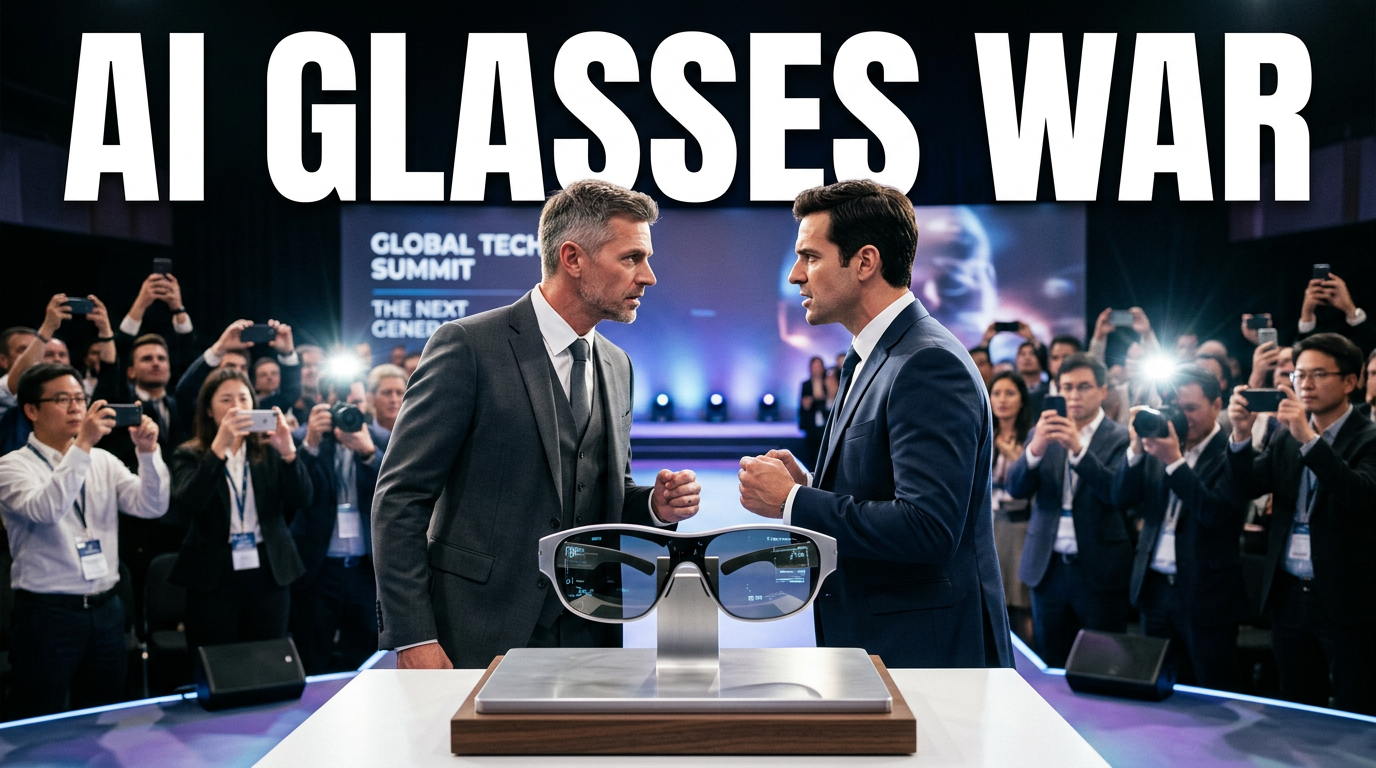
● AI Glass War
Core summary of the AI glasses war after Galaxy Unpacked 26: Samsung, Meta, Apple, and China are targeting not “glasses,” but the AI platform
The most important point from this Galaxy Unpacked 26 was not simply that Samsung Electronics unveiled AI glasses.
The real core point is that the Google·Samsung·Qualcomm alliance has entered the AI glasses market first pioneered by Meta, and with Apple and Chinese companies joining in, the competition for leadership in the post-smartphone era has begun.
In particular, this announcement further revealed an intelligent eyewear lineup developed in collaboration with Gentle Monster and Warby Parker, along with battery life, a charging case, Galaxy Watch 9-linked gestures, and AI-connected scenarios with smartphones.
On the surface, it looks like just glasses with a camera, but in reality it is a huge battlefield where AI agents, the smartphone market, the semiconductor market, big tech competition, and the wearable device ecosystem are all intertwined at once.
In this article, we will break down why Samsung AI glasses launched without a display, how they differ from Meta Ray-Ban, why Apple wants to enter this market, and which companies and industries could benefit from a global economic outlook perspective.
1. Key details of Samsung AI glasses unveiled at Galaxy Unpacked 26
Samsung unveiled an additional AI glasses lineup under the name “intelligent eyewear” at Galaxy Unpacked 26.
This product is an extension of the Google·Samsung·Qualcomm collaboration project first mentioned at Google I/O.
With fashion brands Gentle Monster and Warby Parker participating, Samsung made clear that this is not just an electronic device, but a “fashion-item-style AI device.”
The main points confirmed in this announcement are below.
- Two additional AI glasses models developed in collaboration with Gentle Monster and Warby Parker unveiled
- Including the model first revealed at Google I/O, the lineup expands to four models in total
- Battery life of around 8 to 9 hours mentioned depending on the product
- Structure capable of up to 7 charges through the charging case
- Usage scenarios linked with Galaxy smartphones and Galaxy Watch 9 introduced
- Demonstration of taking photos or controlling functions through finger-click gestures
- Emphasis on features connected to Galaxy AI, such as meeting capture, voice recording, translation, interpretation, and AI summaries
The important thing here is that Samsung AI glasses are closer to a “companion device” connecting Galaxy smartphones and Galaxy watches than a standalone device.
In other words, the glasses do not handle all computing themselves; instead, they serve as an entry point for seeing, hearing, and recording, while the smartphone handles AI processing and data organization.
2. Why did Samsung partner with Gentle Monster and Warby Parker?
Samsung’s collaboration with Gentle Monster and Warby Parker is a highly strategic choice.
AI glasses are not a product that sells simply because the specs are good, like a smartphone.
Because they are worn on the face every day, design, brand image, and comfort are as important as performance.
Samsung partnered with fashion brands from the outset to avoid putting technology front and center and instead create the impression of “beautiful glasses that also have AI functions.”
This strategy differs from Meta’s as well.
Meta partnered with Ray-Ban and chose a relatively mainstream price point and mass-distribution strategy.
Samsung, on the other hand, appears to be taking a premium-first approach by using brands like Gentle Monster and Warby Parker that already carry higher price positioning.
Simply put, Meta’s strategy is “spread widely and collect data,” while Samsung’s strategy is closer to “create a high-end wearable experience within the Galaxy ecosystem.”
3. The biggest difference between Meta Ray-Ban AI glasses and Samsung AI glasses
Right now, the company leading the AI glasses market is Meta.
Meta Ray-Ban smart glasses already have a real user base and offer features such as photo capture, video recording, music playback, calls, and voice AI invocation.
In particular, when the user says “Hey Meta,” the glasses can recognize objects in front of them, read documents, translate, and answer questions.
The difference between Samsung and Meta lies in their view of the product.
| Category | Samsung AI Glasses | Meta Ray-Ban AI Glasses |
|---|---|---|
| Core strategy | Ecosystem expansion linked with Galaxy smartphones and watches | Securing an independent AI platform and social data |
| Partners | Google, Qualcomm, Gentle Monster, Warby Parker | Meta, Ray-Ban, Oakley |
| AI engine | Potential connection with Google Gemini and Galaxy AI | Centered on Meta AI |
| Strengths | Combines with smartphones, watches, and the Android ecosystem | Connected to Instagram, Facebook, and content sharing |
| Goal | Next-generation wearable that extends the smartphone experience | Next-generation platform that reduces smartphone dependence |
Meta wants to escape the influence of Apple and Google’s mobile operating systems.
In fact, Meta experienced a major shakeup in ad revenue when Apple changed its privacy policy.
So for Meta, AI glasses are not just a device, but an exit path toward an independent platform.
By contrast, Samsung already has a powerful hardware ecosystem built around Galaxy smartphones and Galaxy watches.
For Samsung, AI glasses are less a product that directly replaces the smartphone and more a device that extends the smartphone’s life and increases the value of the Galaxy ecosystem.
4. Are display-free AI glasses really useful?
The first question many people ask is this.
“If there’s no screen, what do you even use it for?”
But when you look at real use cases, a lot can be done even without a display.
- Read and summarize documents in front of you
- Translate foreign-language sentences in real time
- Interpret what the other person is saying
- Take photos and videos hands-free
- Make phone calls
- Listen to music
- Receive voice navigation guidance
- Record meeting content and have AI summarize it on the smartphone
- Check heart rate, distance, and pace by voice during exercise
- Look at products in a store and search for price or product information
In particular, the real strength of AI glasses is that “AI sees what I’m seeing too.”
Right now, to use AI on a smartphone or PC, I have to explain the situation.
I have to take a photo, capture a screenshot, put it into a prompt window, and ask again.
This process is more tedious than people expect.
But with AI glasses, the scene the user is looking at becomes input for the AI directly.
For example, if you’re walking down the street, see a flower, and ask “What is this?” AI can answer immediately.
You could also look at a restaurant menu and ask, “Is this spicy?”
You could see a product at a supermarket and ask, “What’s the lowest online price?”
This is exactly why AI glasses matter in the era of AI agents.
5. Why glasses are the form factor that best fits AI
There is a point that Mark Zuckerberg and Demis Hassabis of Google DeepMind both commonly emphasize.
In the AI era, the most natural interface is glasses.
The reason is simple.
Glasses can see what the user sees, hear what the user hears, and directly receive the user’s voice.
The most important thing for AI is context.
It needs to know where I am, what I’m looking at, who I’m talking to, and what situation I’m in to provide a proper answer.
With smartphones, the user has to enter this context one by one.
But AI glasses can automatically collect context.
This difference is enormous.
That is why AI glasses are not just wearable devices, but may become the first gateway through which AI agents enter the real world.
6. The reason there is no display is closer to a market-entry strategy than a lack of technology
Some people are disappointed that Samsung AI glasses launched without a display.
That’s because many were expecting AI glasses with a screen, like some Chinese products or Meta Ray-Ban display models.
But whether a display is included is not simply a matter of adding one more part.
Display-free AI glasses are electronics-centered products that pack the camera, microphone, speaker, battery, and chipset into the temples.
Once a display is added, optical technology becomes necessary.
To project information onto the lenses, light must be emitted precisely and focused correctly for the user’s eyes.
That creates problems with weight, heat, power consumption, battery life, lens thickness, and cost all at once.
In other words, AI glasses with a display are not as simple as attaching a screen to a smartphone.
Just as the early desktop PC market differed from the laptop market, display-free AI glasses and display-equipped AR glasses may look similar, but the technical difficulty is completely different.
So Samsung appears to have chosen to open the market first with a display-free product, then move to a display-type AI glass once optical technology matures.
7. Samsung’s real winning move is the “glasses·watch·smartphone” triad
One thing worth noting in this announcement is the connection with Galaxy Watch 9.
Rather than pushing AI glasses as a standalone device, Samsung showed a structure in which Galaxy smartphones, Galaxy watches, and AI glasses all move together.
For example, if a user records or captures meeting content with AI glasses, AI can organize the content in a notes app on the Galaxy smartphone.
It can also control camera shots or feature selection through the Galaxy Watch.
Using finger-click gestures, functions can be executed without touching the glasses directly.
This is a very important direction.
If all the functions are packed into the AI glasses, they become heavy, hot, and expensive.
But if the smartphone and watch share computation, communication, and control functions, the glasses can stay much lighter and last longer.
At the current level of technology, this approach is far more realistic.
And at this point, Samsung has an advantage over Meta.
That’s because Samsung already has a hardware ecosystem connected across smartphones, watches, earbuds, tablets, laptops, and TVs.
8. Why is Apple preparing AI glasses for next year?
Apple is also reported to be preparing to enter the AI glasses market.
Apple tried to open the spatial computing market through Vision Pro, but it faced practical limitations in weight, price, and lack of content.
MR headsets like Vision Pro offer great immersion, but they are hard to wear all day in everyday life.
By contrast, AI glasses are light, can be worn while commuting, while traveling, and even while exercising.
For Apple, it cannot afford to miss the next-generation interface after the iPhone.
In particular, Apple has an ecosystem that can connect the iPhone, Apple Watch, AirPods, Vision Pro, and Apple Intelligence.
Like Samsung, Apple is also likely to approach AI glasses not as an independent device, but as a premium wearable that extends the iPhone experience.
Ultimately, Samsung and Apple are pursuing a strategy of attaching AI glasses around the smartphone ecosystem, while Meta is pursuing a strategy of moving away from the smartphone ecosystem through AI glasses.
9. Why Chinese companies are frightening in the AI glasses market
Chinese companies are also moving quickly in the AI glasses market.
China has strengths in smartphones, batteries, camera modules, displays, optical components, and manufacturing supply chains.
In particular, price competitiveness and speed of product launch are a burden for global big tech.
Chinese companies are likely to bring display-equipped products or low-cost AI glasses to market quickly and test consumer reactions.
However, their weakness is access to global AI services and trust in privacy protection.
AI glasses handle the scene in front of your eyes, conversations, location, and voice data, so security and privacy are extremely important.
Ultimately, Chinese companies will likely be strong in hardware speed and price, but in global markets, AI model quality and data trustworthiness may become the key issues.
10. Industries that benefit from AI glasses from a global economic outlook perspective
When the AI glasses market grows, it’s not just glasses manufacturers that benefit.
Even bigger changes will happen in supply chains and platforms.
10-1. Semiconductor market
AI glasses need low-power chipsets, image processing processors, communication chips, and semiconductors for sensors.
This is why Qualcomm is working with Samsung and Google.
As smartphone growth slows, wearable AI devices could become a new growth axis for the semiconductor market.
10-2. Batteries and power management components
Because glasses are small, it is difficult to greatly increase battery capacity.
Ultimately, battery efficiency, charging cases, power management chips, and heat control technology become core competitive advantages.
Highlighting up to 7 charges with the charging case this time was also a strategy to reduce concerns about usage time.
10-3. Camera modules and sensors
AI glasses operate based on the user’s field of view.
Therefore, the importance of ultra-small cameras, microphones, location sensors, motion sensors, and gaze-recognition technology is increasing.
As the market eventually moves toward display-type AR glasses, the value of optical modules and lens technology is likely to grow even more.
10-4. AI agent services
No matter how good the hardware is, if the AI is dumb, users will leave quickly.
The usability of AI glasses ultimately depends on AI agent performance.
Real-time interpretation, document summaries, context awareness, shopping search, navigation, and schedule management all need to connect naturally.
At this point, competition among Google Gemini, Meta AI, and Apple Intelligence is likely to intensify.
10-5. Fashion and luxury brands
AI glasses are products worn on the face.
If the design is bad, they are hard to popularize no matter how good the functions are.
That is why the role of brands like Gentle Monster, Warby Parker, Ray-Ban, and Oakley is important.
Collaboration between technology companies and fashion companies is likely to increase further in the future.
11. The most important point other news often fails to mention
The most important thing in this AI glasses competition is not hardware specs.
The real core point is “who controls the gateway to real-world data?”
In the smartphone era, users typed into search boxes, opened apps, and took photos to upload them.
But in the AI glasses era, what users see and hear becomes data immediately.
This could transform advertising, shopping, search, maps, content, and workplace automation markets all at once.
For example, when a user walks past a café and asks, “How is the rating here?” the search advertising market changes.
When someone sees a product in a store and asks, “Is this more expensive than online?” the e-commerce market changes.
When someone says in a meeting, “Summarize what was just said,” the workplace productivity software market changes.
When someone traveling asks, “Tell me the history of this building,” tourism and educational content markets change.
Ultimately, AI glasses are not a new screen but a new search box.
And this search box is not held in the hand; it is attached to the eyes and ears.
That is the real reason big tech is obsessed with AI glasses.
12. Will AI glasses replace smartphones right away?
It is difficult to completely replace smartphones immediately.
The reasons are clear.
- Battery capacity is limited.
- Heat generation is a major issue.
- An LTE or 5G module is needed for standalone connectivity.
- High-performance AI computation is difficult to process inside glasses.
- Optical technology for display-based AR is highly challenging.
- Privacy and recording-consent issues remain.
So in the short term, they are likely to serve as a complement to smartphones.
But in the long term, they can reduce smartphone usage time and replace some functions.
In particular, photo capture, video recording, real-time translation, voice search, navigation, and exercise assistance may feel more convenient with AI glasses than with smartphones.
Ultimately, the most likely structure to emerge first is smartphones as the brain in your pocket, and AI glasses as the eyes and ears.
13. The difference between MR headsets and AI glasses
MR headsets like Vision Pro or Galaxy XR and AI glasses may look similar, but the market characteristics are different.
MR headsets are products that remove the constraints of space.
Their strength is in bringing a virtual space in front of your eyes wherever you are.
But they are heavy, expensive, and hard to wear continuously in daily life.
AI glasses, on the other hand, are products that remove the constraints of intelligence and connectivity.
Wherever the user goes, AI follows and assistance is available while looking at the real world.
To put it simply, MR headsets are products that “create a new space in front of me,” while AI glasses are products that “attach AI to the reality I’m seeing.”
If you look only at the everyday market size, AI glasses may have a much larger potential.
14. What investors and workers should watch in the AI glasses market
When looking at the AI glasses market, you should not just ask which product looks prettier.
Going forward, the following points should be considered together.
- Whether Samsung AI glasses stimulate Galaxy smartphone sales and replacement demand
- How strong Google Gemini is in real-time translation and visual recognition
- How far Qualcomm’s wearable-specific chipsets advance in low power and high performance
- How naturally Meta connects Instagram and AI glasses
- How Apple bundles AI glasses with the iPhone, Apple Watch, and AirPods
- How much Chinese companies lower market prices with low-cost AI glasses
- How privacy regulations affect the spread of camera-equipped wearables
- When display-type AR glasses will arrive in a lighter and more natural form
In particular, from a global economic outlook perspective, the key issue is whether AI glasses can become the next-generation device after smartphones.
As the smartphone market enters maturity, big tech companies and component suppliers need a new growth engine.
AI glasses are emerging as the most realistic candidate among those options.
15. In the Samsung·Meta·Apple AI glasses war, who will ultimately win?
In the short term, Meta has the advantage.
That’s because it has already opened the market with Ray-Ban and is quickly accumulating real usage data.
In the medium term, Samsung has an opportunity.
Combining Galaxy smartphones, Galaxy Watch, Google Gemini, and Qualcomm chipsets can quickly improve usability.
In the long term, Apple is a variable that cannot be ignored.
Because Apple is strong in product refinement and ecosystem integration, it can change the premium standard of the market even if it enters late.
Chinese companies are likely to shake up the lower end of the market through price and speed.
In the end, the AI glasses market is likely not to have one winner taking all, but rather to become a platform-by-platform ecosystem competition much like smartphones.
The Android camp will move around Samsung, Google, and Qualcomm; Meta will strengthen its independent AI and social platform; and Apple will prepare premium AI glasses centered on the iPhone ecosystem.
16. Conclusion: AI glasses are not the “device after smartphones,” but the “input device for the AI era”
AI glasses are not yet a finished product.
Displays are still lacking, battery life is limited, and privacy issues remain.
But the direction is quite clear.
For AI to become truly useful, it needs to understand the user’s real-world context.
The device that most naturally receives that real-world context is glasses.
That is why Samsung, Meta, Apple, and Chinese companies are all jumping into this market.
In the future, the AI glasses market is likely to become not just a wearable device competition, but the key battlefield in a big-tech race that shakes the AI platform, semiconductor market, smartphone market, advertising market, search market, and content market.
Right now it looks like glasses without a screen, but a few years from now it could become the most powerful AI interface that drastically reduces how often we take out our smartphones.
< Summary >
At Galaxy Unpacked 26, Samsung unveiled an additional intelligent eyewear AI glasses lineup developed in collaboration with Gentle Monster and Warby Parker.
This product strongly signals that the Google·Samsung·Qualcomm alliance has now fully entered the AI glasses market centered on Meta.
Samsung AI glasses are closer to a companion-device strategy linked with Galaxy smartphones and Galaxy watches than a standalone device.
The reason there is no display is due to optical technology, battery, heat, and weight issues, and this is actually a practical choice for early market entry.
The core value of AI glasses lies in enabling AI to understand what the user sees and hears together, providing real-time translation, search, recording, summaries, and navigation.
Meta is aiming for an independent platform and data acquisition, Samsung for expansion of the Galaxy ecosystem, and Apple for a premium wearable strategy centered on the iPhone.
AI glasses will not immediately replace smartphones, but they are highly likely to become the most important input device in the AI agent era.
[Related Articles…]
- AI glasses market outlook and big tech competition structure
- Outlook for semiconductor gains from the spread of AI wearables
*Source: [ 티타임즈TV ]
– ‘갤럭시 언팩 26’ 삼성과 애플, 메타, 중국의 글래스 대전 어떻게 될까? (신동형 알서포트 전략기획팀장)